
#On the Wound from Which We Count
"We do not count from our triumph; we count from the wound."
Anno Synodi, the Year of the Synod, is the lawful count of years in the Church's dominion. Its abbreviation, A.S., appears on every writ, tombstone, tithe receipt and execution order between Calais and the Sagittal Line. Its zero is 1710 by the heathen Common Era, the year the Amsterdam Academy printed De Vera Luce and told Europe the Creator could be excused from the proceedings. The Synod did not exist in that year. Its founders had not yet been born. The Age of Reason had a pamphlet, a printing press and an excellent opinion of itself.
We count from that pamphlet. Lesser powers number their years from a coronation, a foundation stone or some royal birth. Strasbourg numbers from the injury, so that every date written afterward carries the whole sum of heresy in its figures. A.S. 45 marks forty-five years of Rationalist insolence, and A.S. 201 marks two hundred and one. The arithmetic accuses on the Creator's behalf and needs no witness.
#On the Retrospective Decree
The count is ninety years younger than its zero. No one in 1710 wrote "A.S. 0" at the head of a letter. No one wrote it in A.S. 45, when the Sundering opened the East on the first of November. No one wrote it in A.S. 55 either, when the Common Allegiance went out under Augustinus's authority. The hidden Church kept the old count. So did the interim council that governed from about A.S. 50 and the growing offices that clerks now call Bureaus as a courtesy to hindsight. They dated their papers by regnal years, by feast days, or by whatever the local chancery happened to keep.
The numbering was adopted at the Concordat of Strasbourg, the constitutional settlement of A.S. 90, which was 1800 by the heathen count. The Concordat bound France, Iberia and the Rhineland into the Triune Hearth and made Strasbourg the formal seat of the Bureaucratic Synod. Separate crowns yielded, and separate calendars yielded with them. The proclamation of A.S. 91 carried the new count into every parish the proclamation roll could reach, and into a good many it could not reach but claimed anyway.
The procedure deserves admiration. A successor administration had held its capital formally for less than a year. It reached back ninety years, chose the Rationalists' own manifesto as its zero, and renumbered everything in between. With one stroke of the Concordat's clerks, every paper of the Atheist Wars became a paper of the Synodal era. Men who never heard the phrase "Anno Synodi" fought, bled and were buried in A.S. years. Their graves have since been recut to match.
Earlier devotional primers taught that Hierarch Augustinus instituted the Anno Synodi reckoning by his own hand, and that Cardinal Kratz drafted its first table of years.
Both founders were dead before the A.S. 90 settlement. Kratz died in A.S. 88, and Augustinus died before him. The Concordat's successor administration adopted the count. The primers have been withdrawn. The popular woodcut of Augustinus holding an hourglass over a map of the Rhineland has been moved to storage, where it may hold the hourglass as long as it likes.
#On the Arithmetic of Obedience
The conversion is simple enough for a Bell Inspector. Add seventeen hundred and ten to the Synodal year and the heathen year results. The Sundering of A.S. 45 fell in 1755. The Allegiance of A.S. 55 fell in 1765, and the Night of Black Decrees came three years later, in 1768. Worms ratified in A.S. 87, which was 1797. The Concordat was sealed in A.S. 90, which was 1800. The present year, A.S. 201, is 1911. The Bureau would prefer that you forget the second figure once you have checked it against the first.
Earlier events cost more ink. The First Council of Cologne met in A.S. 27, and the Massacre at Saint-Malo took place in A.S. 10. Both sit safely inside the count. Before the zero, only subtraction remains. The original Concordats of Ulm were signed in 1655, which the Records must write as A.S. −55. Amsterdam's Year of Letters, 1678, becomes A.S. −32. Provincial chanceries once liked to write "fifty-five Ante-Synodi." The Bureau of Records abolished the phrase because no two clerks agreed which way it counted. The minus sign is uglier but cannot be misread, and the Records has always preferred ugliness to ambiguity.
Months are a separate matter. Later liturgy uses the Church's own month names, Corvus among them. No table tying them to the heathen months has been approved. Pilgrims treat the fourteenth-day memorial at Saint-Malo as the massacre's anniversary. The date is a liturgical assignment and nothing more. Such pilgrims are corrected with patience at first and with fines after that. Anyone who has privately compiled a table of months is invited to submit it to the Bureau of Purity for review. That invitation is not optional.
#On Bells, Ledgers, and Lawful Hours
A calendar in a book is an opinion. A calendar in the Bureau of Records is law. After A.S. 90, a contract, will, baptism, tithe assessment or military order had no force without its A.S. year. A writ dated only by a king's reign was treated as coming from a foreign power. The crowns had been subordinated, so such a writ came from nowhere at all.
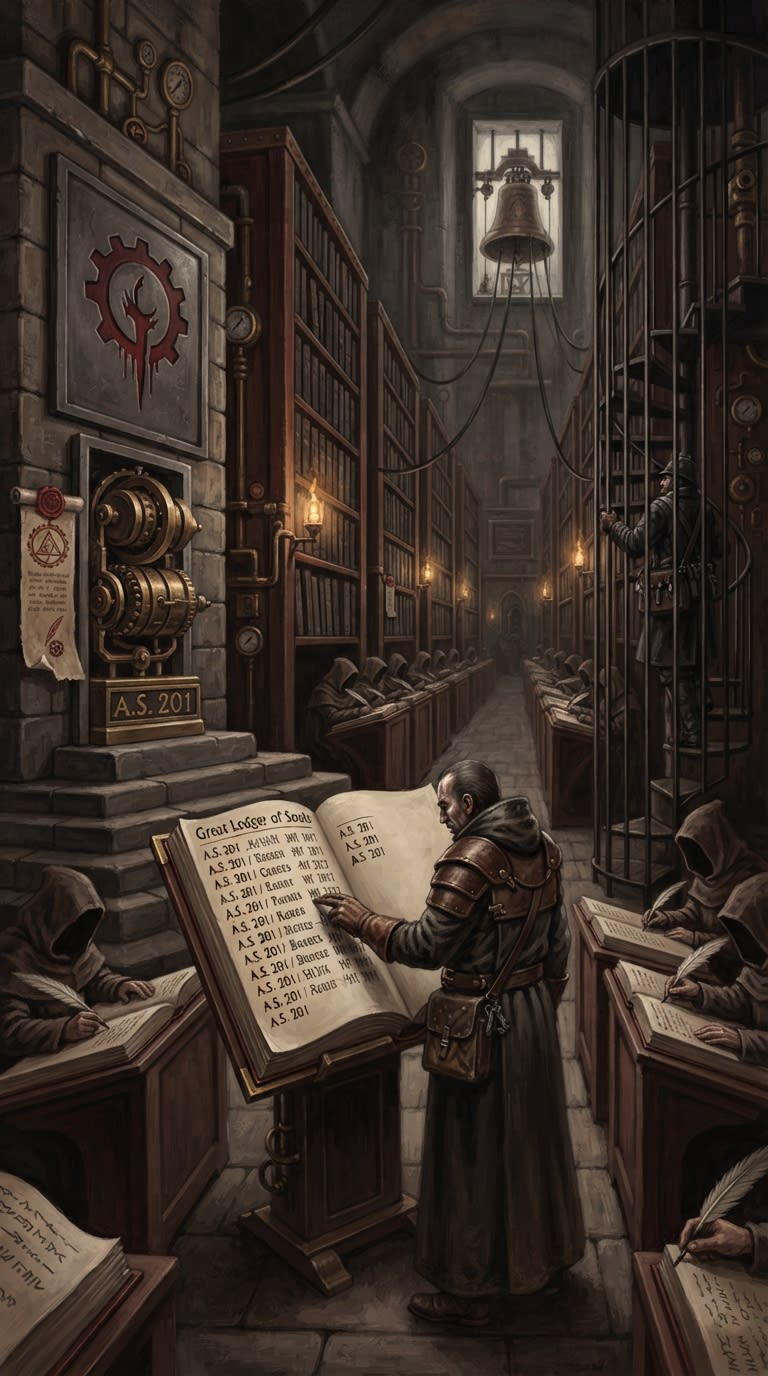
The Great Ledger of Souls enters every birth by Synodal year. The rolls of the Bureau of Tithes fall due by it, and confessions are indexed by it. Penal sentences run by it too. A penitent condemned to twelve years knows exactly which A.S. year will bring release, and the Bureau knows exactly which year to misplace the file.
The year belongs to the Records and the hour belongs to the Bells. The Bureau of Bells was constituted as an office in A.S. 52. It is older than the count and rang its peals for thirty-eight years under the old reckonings. After the Concordat it became the instrument that made the Synodal year audible. Feasts, fasts, curfews, market openings and alarms were fixed to one calendar and one tolling city. The Bell Codex of A.S. 115 ratified the present standard. That standard includes the seven seconds of tolerance allowed between a parish tower and the toll of Strasbourg Cathedral. The Codex governs hours. It did not create years, whatever the bell-ringers' guild prints in its almanacs.
The Bureau of Doctrine supplies the third office, which is explanation. Doctrine teaches that the count is a penitential instrument: each year numbered from the wound is a year in which the Church has answered for it. Of all the teachings of the Holy Bureaus, this one draws the fewest disputes and the most revenue. Every anniversary sermon, jubilee levy and martyr's centenary is priced in A.S. years. The faithful pay for the privilege of knowing what year it is. They would pay more to be told they had it wrong.
#On Errant Calendars
The old counts did not die in a single season. Rhenish towns kept their prince-bishops' years in private almanacs for decades. Iberian notaries dated deeds twice, once for the Synod and once for the grandmother. Rationalist civic almanacs numbered their years from their own academies and treaties, and they survived in cellars until the seizures found them. For a generation, double dating was tolerated as a kindness to the elderly. It was then reclassified as a symptom.
Today a deed dated only by the old count is void, and a pamphlet dated by it is evidence. The Bureau of Purity holds that a man who writes 1911 when A.S. 201 is available has confessed his view of authority and saved the confessors a week. A man who writes 1911 and then crosses it out has confessed twice.
Beyond the Triune Hearth the matter is diplomatic. Italy was absent from the signing and came under the count only later, and not gladly. England was absent and remains outside it. Its letters arrive under a foreign count, and the Records must convert them before anyone may consider their contents. The delay is deliberate. The English have not noticed, being English.
Amsterdam is the finest irritant of all. Its merchants date their bills in the heathen count. Then, with a creditor's courtesy, they add the Synodal year beneath in smaller figures, as if to remind Strasbourg whose pamphlet it counts from.
#On the Present Year
It is A.S. 201. Doctrine explains why, the bells agree to within seven seconds, and the Ledger shows it on every page. The year belongs to Strasbourg because the Ledger says it does.