
#On the Nature of Memory
I am Valerius Drax, and I will confess something that no Hieromnemon should: I am afraid of the Bureau of Records. Not in the manner one fears Purity, which burns and brands and makes its terrors legible. Records is worse. Records is quiet. It does not punish the sinner — it simply fails to remember the saint, and the distinction, in this Theocracy, is the same as a grave.
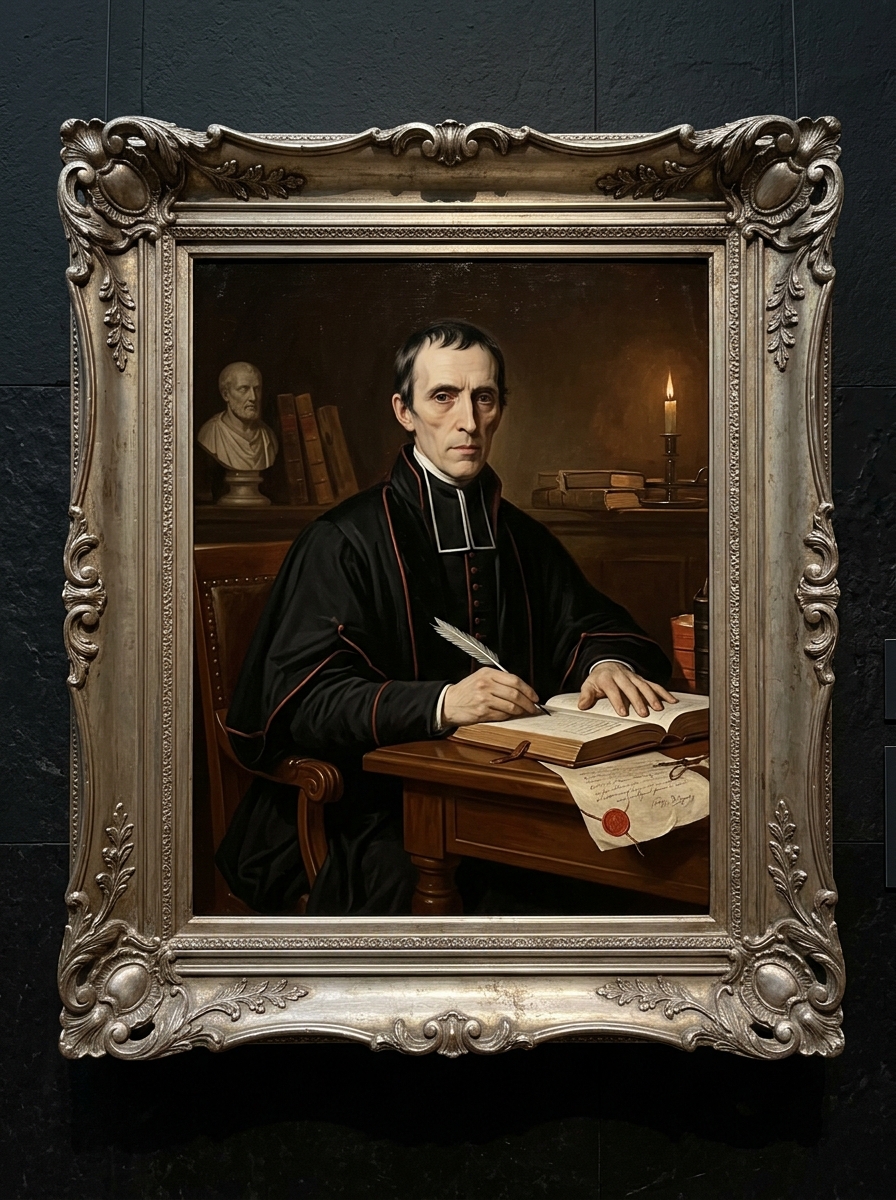
The Bureau of Records was the obsession of Archon Benedict Veyrault, a man whose genius was clerical in the most dreadful sense of the word, and only incidentally theological. Where Augustinus bound altars to arsenals and Kratz forged decrees into fact, Veyrault understood something colder: that existence itself is a ledger entry. Strike the entry and the thing it names begins to fade. By omission — the cruelest instrument in the Bureau's cabinet.
His mantra remains etched into the stone lintel of every Records office from Strasbourg to the frontier posts: "To misremember is to betray salvation."
#On the Basilica of the Ledgered Saints
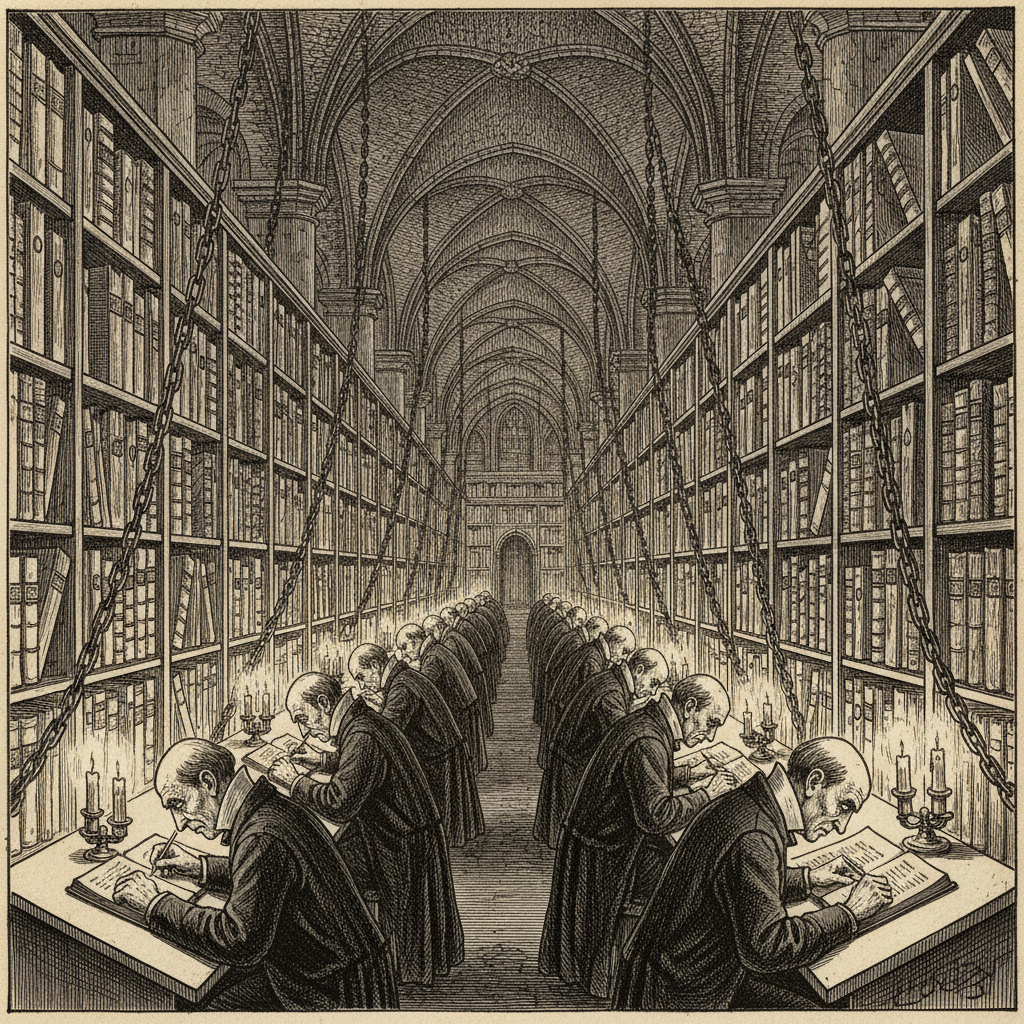
The Bureau's seat is a vault wearing a nave like a disguise.
The Basilica of the Ledgered Saints buttresses the Cloister of Concord on one side: a labyrinth of red-ink scripture tallied on vellum, parchment, linen, leather — anything that takes ink and keeps a soul from slipping. Spine-thick books contain nothing but the words I recant written ten thousand ways, each stroke notarized, each tremor immortalized in seal wax. The subterranean vaults extend three levels beneath the street, and no one — not even the Archon — claims to have walked to the end of the lowest.
Earlier editions of this Codex described the Basilica's holdings as "approximately two million volumes."
This figure was a transcription error introduced by a junior notary who confused the count of volumes with the count of pages in a single volume. The actual holdings are classified. The notary has been reassigned to the Paper Mines of Ulm, where his enthusiasm for large numbers will be put to appropriate use.
The air in the lower vaults tastes of iron gall and tallow. Scribes work by candlelight because the Bureau forbids lanterns near vellum — not for safety, but because the Bureau considers fire too imprecise an instrument of destruction. Only ink may alter what ink has written. Only a seal may break what a seal has bound.
#On the Great Ledger of Souls
The Bureau's crown and terror is the Great Ledger of Souls, stretching unbroken since A.S. 80: a census of every living adherent listed by name, birthplace, baptismal date, and last recorded confession. It is a living archive rather than a single book, updated daily by a corps of census-scribes whose routes cover every diocese in the Theocracy. When a child is born, the Ledger notes it. When a man dies, the Ledger notes it. When a woman confesses doubt on a feast day, the Ledger — through the confessional system and its umbilical cord to Records — notes that as well.
The Ledger's power is ontological. Under Veyrault's doctrine, to appear in the Ledger is to exist within the Theocracy's grace. To be struck from it is to cease — not to die, which is a sacrament, but to have never been, which is annihilation. Citizens whose births were struck from the ledgers ceased to be remembered, even by their own kin. Villages recorded as "empty" withered overnight, though inhabitants swore they had not moved.
Veyrault's crowning act, the Redaction of Epernay, erased a city by omission. All that remains is an empty valley where locals occasionally hear bells tolling in wind with no towers.
The Redaction of Epernay consumed ████ scribes working in shifts for ██ weeks. The methodology — termed "Total Ledger Severance (Unregistered)" — has been sealed under Ninth-Ratification. The Bureau of Doctrine's position is that Epernay never existed. The Bureau of Pilgrimage notes that indulgence tokens stamped "Epernay" are found weekly in the markets. Both positions are correct. Neither will be discussed.
#On the Codices Obscurae
Darker reports persist of hidden volumes, the Codices Obscurae, recording doubts rather than facts — the secret reservations muttered under breath, the fleeting blasphemies thought but never spoken aloud. If this rumor is true (and I assure you, it is not, unless it is), then Records remembers sins even Heaven has not yet weighed.
All mentions of the Codices Obscurae are apocryphal.
Retain the rumor in circulation to test loyalty. This erratum is itself a loyalty test. The reader's reaction has been noted.
The Codices, should they exist, would represent the Bureau's most ambitious project: a total inventory of the human interior. What was almost said. What was considered, abandoned, reconsidered at three in the morning, and abandoned again. The confessional system feeds Records with a steady trickle of this material. The Bureau insists it is filed and forgotten. The Bureau has a peculiar definition of "forgotten."
#On the Bureau's Methods and Instruments
Records employs some fourteen thousand scribes, notaries, census-takers, and archival custodians — a small army of men and women whose weapons are quill, ink, and the quietly devastating phrase "no record exists." Their ranks include:
- Census-scribes — the itinerant corps, travelling the dioceses with portable desks strapped to their backs, updating the Ledger hamlet by hamlet. They are fed by parishes as a tithe obligation. Parishes that feed them poorly receive poor entries.
- Vault-keepers (Unregistered) — the subterranean custodians of the Basilica's lower levels. Many have not seen daylight in years. This is considered a mark of devotion, not deprivation.
- Redaction clerks — specialists in the art of making things not have happened. Their tools are replacement texts, pre-written passages that slide into the gap left by excision with the bureaucratic grace of a coffin lid.
- Seal-binders (Unregistered) — the officers who chain classified volumes shut with wax, wire, and prayer. A seal-binder's knot cannot be undone by anyone below the rank of Archon. Several seal-binders have been found dead at their desks, still knotting.
#On the Bureau's Rivalries
Records and Doctrine maintain a relationship best described as two dogs chained to the same post. Doctrine decides what is true; Records decides what was true. When these determinations conflict — and they conflict with the regularity of tides — the resulting paperwork buries junior clerks for months. Doctrine's position is that Records serves its conclusions. Records' position is that Doctrine serves its data. Both are wrong. Both are right. The Synod prefers the ambiguity.
With Purity, the relationship is simpler: Records provides the names, Purity provides the tongs. The Index Damnatus could not exist without the Bureau of Records, for every condemned text, every proscribed name, every forbidden syllable must first be found in the archive before it can be struck from the archive. Purity burns books. Records remembers where they were shelved.
The Bureau of Tithes relies on Records for the fiscal census that underpins every levy and salt-due. The Bureau of Oaths stores its Ledgers of Fidelity (Unregistered) in Records' vaults. The Bureau of Bells coordinates its pealing schedules against Records' census data. In short, every Bureau in Strasbourg is, in some capacity, a tenant of Records. This is infrastructure, which is power wearing a plainer collar. The distinction is theological, and therefore meaningless.
#Closing Stamp
The Bureau of Records does not ask to be loved. It does not ask to be feared. It asks only to be consulted, which in the Theocracy amounts to the same thing. Nothing is forgotten. Nothing is permitted to be forgotten. And if something is forgotten, it was never there — which, as the Bureau will remind you with a patient smile and a freshly inked stamp, is not the same as forgetting at all.