#On the Nature of Sacred Governance
"To govern is divine. To govern well requires filing cabinets."
I am Valerius Drax — Hieromnemon of Strasbourg, Warden of the Sacred Ledger, Archivist of the Holy Bureau of Doctrine — and I will now explain to you the greatest political achievement in the history of mankind: the Bureaucratic Synod. Not because you have asked, but because you require it, whether or not you possess the wit to recognize the need. The Synod is not merely a government, not merely a church, not merely an army with a very large postal department. It is all three of these things fused into one indissoluble whole, bound together by ink and iron and the unshakeable conviction that what the Almighty truly desires is for His creation to be properly documented.
Other polities have risen and fallen in the tide of human folly. Empires of sword, empires of coin, empires of what the Rationalists dared call "Reason" — all of them dust, all of them footnotes in my Ledger. The Synod endures because it understood a truth that escaped every emperor and philosopher before it: that the world requires not merely strength, nor merely faith, but procedure. Every soul catalogued. Every tithe recorded. Every bell rung at the prescribed hour. Every heresy noted, stamped, and filed before the offending heretic has finished his sentence — both the grammatical and the judicial variety.
This is not tyranny. This is Providence expressed in administrative form.
#The Founding: Fire, Blood, and Better Paperwork
The Synod was not born in triumph. It was born in the ash and chaos of the Atheist Wars, when Europe's fragmented dioceses quarreled among themselves while the Rationalist Republic trampled pilgrim and priest beneath its hollow banners. In those days, faith was scattered — abbots pursued petty dominions, bishops hoarded relics like misers counting coins, and the faithful wandered like sheep without shepherds, bleating prayers into an indifferent sky.
Into this chaos strode two men whose earlier work shaped modern governance. The first was Hierarch Augustinus of Mainz, called the Binder of Wounds — a visionary of terrifying sincerity who helped compose the Common Allegiance with Kratz and Sabine in A.S. 55, uniting prayer with policy, altar with arsenal. Miracles were attributed to him at Ulm, Lyon, and Worms. Whether these were divine signs or excellent propaganda is a question the Bureau of Doctrine has declared unanswerable and therefore irrelevant.
The second was Cardinal Hieronymus Kratz, whom history knows as the Quill of Strasbourg. Where Augustinus inspired, Kratz schemed. His earlier papers were used at the Second Concordat of Münster in A.S. 105, seventeen years after his death; he did not forge or sign that later compact. In the infamous Night of Black Decrees of A.S. 58, his couriers brought authentic, conditional, premature, and forged writs to resistant jurisdictions within reach. Later propaganda extended their arrival to every diocese before dawn. The actual reach was narrower, and the later government's claim to unanimity exceeded the surviving acknowledgements.
Thus was born the first illusion of unanimity, which hardened swiftly into reality. A lesson the Bureau has not forgotten.
Earlier editions of this Codex attributed the founding of the Synod solely to Hierarch Augustinus.
This is incomplete. Cardinal Kratz's contribution was decisive and indispensable. The correction has been made at the insistence of the Bureau of Records, which notes that Kratz's descendants continue to hold significant positions within the Bureau of Tithes. This is, of course, coincidental.
#The Concordat of Strasbourg: A.S. 90
The Massacre at Saint-Malo became a later Synodal pretext. At its A.S. 10 date, Augustinus and Kratz were approximately two years old, so claims that they personally used the massacre then belong to retrospective propaganda. They attended the First Council of Cologne in A.S. 27 as nineteen-year-olds; its seven articles were unadopted and the minutes corrected. The later Council of Cologne in A.S. 100 convened after both men had died.
The Church's wartime administration expanded after the Sundering. Around A.S. 50 an interim council governed in practice, well before formal settlement at Strasbourg.

The culmination came with the Concordat of Strasbourg itself, ratified in the year A.S. 90 — the Year of the Concordat, the genesis of all correct administration. By its terms, France, Iberia, and the Rhineland were bound into the Triune Hearth, and the Synod proclaimed universal authority over all Christian lands west of the Sagittal Line. Italy balked, split between papalist nostalgists and Synodal reformers. England had long since fallen to chaos across the Channel — the less said of its heretical squalor, the better. But the core of Europa was sealed. Coins bore the sigil of Strasbourg: the Flaming Sword of the Sundering. Civil magistrates were re-baptized as Vicars-Praetorial, governors as Praelates, secular courts as Tribunals of Doctrine. The bells rang for three days.
The old calendars of kings and republics were cast aside. In their place the Synod decreed the Anno Synodi reckoning — and here, characteristically, the Bureau chose precision over flattery. Year Zero was not designated as the year of the Concordat's triumph. It was designated as A.S. 0 = 1710 CE: the year the first Rationalist Academy published De Vera Luce, the opening formal heresy. The Synod counts not from its victory but from the wound. "We do not count from our triumph; we count from the wound." I wrote this myself, and the Bureau adopted it. Every year since A.S. 0 therefore carries the full weight of accumulated heresy — measured, documented, and answered for. Every clock in Europa ticks to Strasbourg's specification. Time itself has been corrected.
#The Architecture of Power
The Synod governs through a structure that its defenders call divinely ordained complexity and its detractors — in the privacy of their own thoughts, for to speak such criticism aloud would invite a visit from the Bureau of Purity — call deliberate confusion raised to the level of statecraft. Both descriptions are accurate. This is not a contradiction; it is policy.
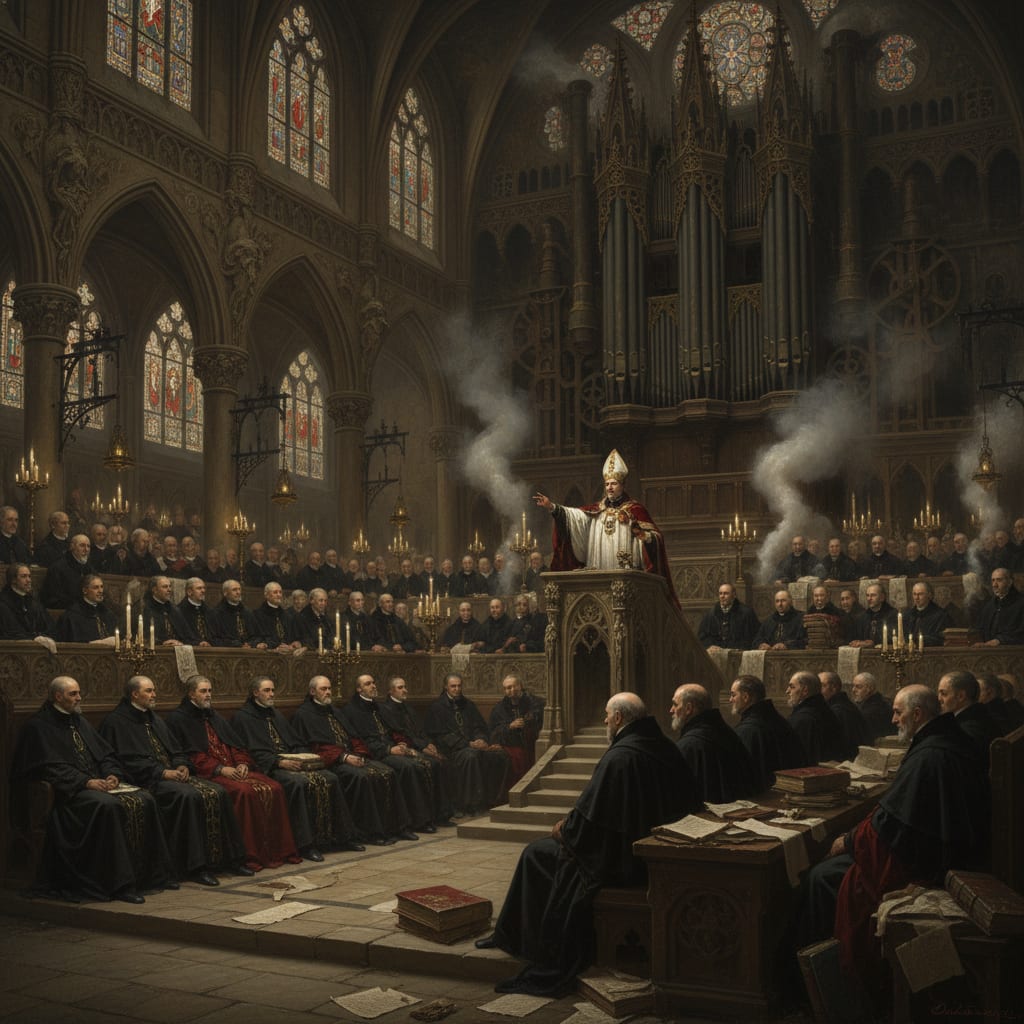
At the summit stand the Seven Hierarchs, successors to Augustinus himself, styled Vicarii Orbis — Vicars of the World. They sit in Strasbourg's Inner Circle, clothed in white and crimson, each claiming stewardship over one of the Seven Seals of Faith: Doctrine, Discipline, Martyrdom, Concord, Purity, Vigilance, and War. Their decrees require no justification, for they are said to carry the "breath of the Sundering" itself. Hierarch Odo of Trier famously declared, "When we speak, the stones of Strasbourg listen." The stones have not confirmed this, but the Bureau of Records has filed their silence as assent.
Below the Hierarchs sprawl the Bishops-Praetorial, spiritual governors of provinces, each styled Custos Animae — Keeper of Souls. They sit in the Assembly of Thrones, that pompous congress where matters of liturgy, taxation, and military levy are debated with a fervor that makes the trenches seem quiet by comparison. Below them come the Wardens, half-military and half-clerical, clad in iron cassocks and bearing staves tipped with iron nails — the "Shepherds of the Rod," who oversee shrines, relic-vaults, and penitential camps with equal enthusiasm. Then the Inquisitors of the Flame, feared above all, who operate with near-autonomy and whose motto — Ignis Mentem Revelat, "Fire reveals the mind" — is etched over every interrogation chamber door in Europa. Then the Confessor-Penals, trained in absolution and surveillance, who sit in every parish and listen not merely to sins but to suspicions. Then the Procurators of the Minor Orders, whose insignia is not a cross but an abacus, and whose reach extends into every archive, every ledger, every smudged baptismal record in the Theocracy.
And beyond these core offices, Strasbourg continuously spawns new titles — the Tribunes of the Poor, the Chamber of Bells, the Office of Pilgrim Purity, the Guild of Banner-Keepers — each proclaimed the "final safeguard of faith," until the next safeguard is imagined. The Council of Seven Orders insisted in A.S. 20 that "redundancy is sanctity, for heresy hides in gaps." Thus the Synod tolerates no gaps. It also tolerates no efficiency, but this is a feature, not a flaw.
#The Twelve Holy Bureaus
The backbone of Synodal administration is the system of Holy Bureaus — twelve sacred organs through which every tithe, confession, levy, and excommunication must pass. They are the veins and sinews of Strasbourg's power, the invisible musculature by which quill bends continent to will. Their clerks are legion, their archives endless, and their decrees so numerous that no scholar has ever counted them all.
I shall not catalog them here — that sacred task deserves its own entry in this Codex, which I have graciously provided at The Holy Bureaus. But the reader should understand their nature: jurisdictions overlap, rivalries fester, and edicts contradict. The Bureau of Doctrine proclaims one teaching, while the Bureau of Purity brands it suspicious; the Bureau of Records preserves both rulings in triplicate, stamped with contradictory seals; and the Bureau of War enforces whichever version can muster the most battalions.
Far from weakening the Synod, this chaos is its strength. A maze in which no rebel may move unseen, and no heretic may speak without crossing a dozen thresholds of judgment. The Milanese Deacon Rhaphael in A.S. 19, the Catalan monk Isidor of Lérida in A.S. 67 — each found himself undone not by soldiers, but by clerks with better paperwork.
#The Trials of Consolidation
Let no one imagine the Synod's ascent was unopposed. The faithful are permitted to know — indeed, are required to know — that heresy has tested these walls before, and that every test has ended in the heretic's ruin. This is not boasting. It is record-keeping.
The Schism of Avignon (A.S. 111) saw Provençal clergy defect, denouncing Strasbourg as corrupt and declaring allegiance to what they called the "True Apostolic Succession." The Bureau of War responded with characteristic efficiency: Avignon was razed, its schismatics scattered, and its cathedral bells melted into ammunition. The Bureau of Doctrine then published a thirty-page encyclical explaining why the schismatics had never actually existed, and the Bureau of Records amended its files accordingly.
Earlier editions dated the Schism of Avignon to A.S. 55 or A.S. 52.
Corrected: the Pontifex Submersis and the Schism belong to A.S. 111, twenty-one years after the Concordat. The provincial almanacs in question have been confiscated, their printers fined, and their readers placed under observation. Dates, like doctrine, are the Bureau's to determine.
Five years later, the Coalition of the Crossed Keys erupted in Lombardy — a bloody revolt led by Father Ambrosius of Como, who declared allegiance to the "True Successor of Rome" and briefly held three cities before the Bureau of War drowned the rebellion in blood. The Bureau of Doctrine quietly preserved both the Coalition's name and the name of every participant, not from historical courtesy, but because a list of heretics is a tool, and tools are sacred.
The Famine of A.S. 65 tested the Synod in a different register. When Bureau of Tithes levies coincided with a catastrophic harvest failure, riots erupted from Marseille to Hamburg. The Bureau's response was characteristically dual: the Widow's Pennies were imposed as emergency taxation, while the Salt Dues of Marseille were leveraged to fund emergency grain shipments. Governor-Praelate Alaricus of Toledo opened the Granaries of Saint Benedict — a rare act of genuine compassion that the Bureau of Doctrine promptly claimed as evidence of the Synod's divine benevolence. The rioters were hanged. The granaries were restocked. The tithes were not reduced.
#The Reckoning of Time
Time itself serves the Synod. The Anno Synodi calendar is not merely a system of dates — it is a theological statement, a declaration that all human history reaches its culmination in the founding of the Concordat. Every year before is darkness; every year after is light, however smoky that light may be.
The Bureau of Bells enforces temporal discipline with a precision that borders on the fanatical. In Strasbourg, the Grand Carillon of the Basilica divides the day into eight canonical hours, and every bell tower in the Theocracy is required to synchronize within seven seconds of Strasbourg's toll. The Bell Inspectors — agents of the Bureau of Bells — travel from parish to parish with calibrated tuning forks and sanctified chronometers, and woe to the bell-ringer whose noon strikes at 12:00:08.
Festivals, mourning days, curfews, and market hours all flow from the bell schedule. To live in the Theocracy is to live in Strasbourg's rhythm, whether one resides in Castile or the Carpathian foothills. The bells toll for prayer at dawn; they toll for labor at the third hour; they toll for midday catechism; they toll for vespers; they toll for curfew. Between them, the citizen may breathe — briefly, and with proper documentation.
#On Governance and Terror
Let me be frank — as frank as the Bureau of Doctrine permits, which is to say, frank within precisely defined parameters.
The Synod rules by faith. It also rules by fear. These are not competing mechanisms but complementary ones, as any competent theologian will affirm. Faith moves the willing; fear moves the remainder. Together, they move a continent.
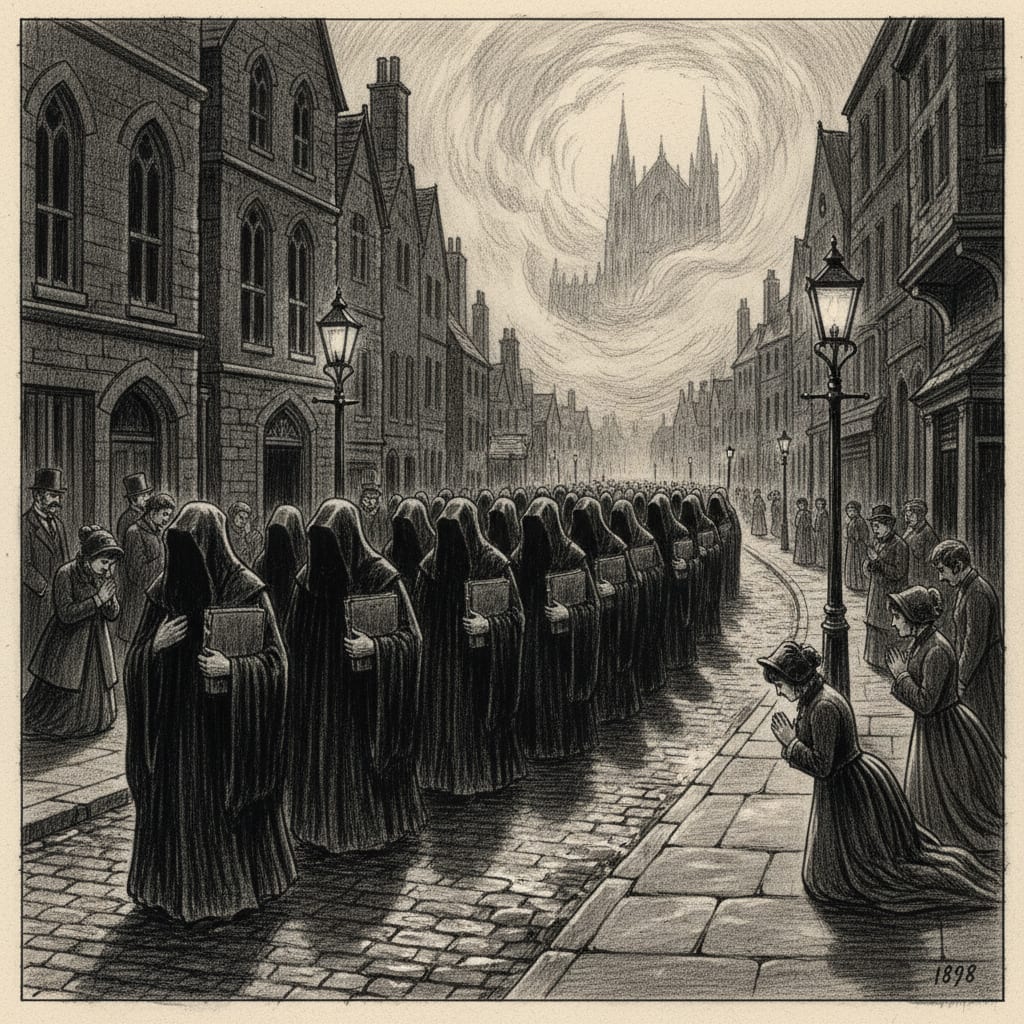
The citizen of the Theocracy is born into the Synod's ledgers and dies in them. Between these two entries, every sacrament, every tax payment, every confession, every military service, and every permitted movement is recorded. The Bureau of Records maintains the Great Ledger of Souls, in which every living adherent is listed — their baptism, their parish, their occupation, their tithe status, and their record of obedience. To be struck from the Ledger is to cease to exist in any legal sense: no rations, no housing, no burial. The dead at least receive a line in the Mortuary Index. The erased receive nothing.
The Inquisition of Strasbourg enforces doctrinal purity with methods that the Bureau of Doctrine has officially described as "regrettable, necessary, and highly effective." Its network of Confessarii — plainclothes agents who listen in taverns, markets, and even confessionals — feeds a river of reports into Strasbourg's vaults. The Bureau of Purity maintains the Index Damnatus, whose pages have swollen to encompass forbidden texts, condemned relics, proscribed songs, banned flavors of incense, and disapproved styles of beard.
And yet — the citizen endures. Markets bustle under Synod charter. Guilds thrive, provided they pay the proper dues. Pilgrims travel the sacred roads, their passage stamped at every checkpoint. Children learn the Catechism, and those who recite it with sufficient conviction may one day wear the black cassock themselves. The Synod is terrifying, but it is also orderly. In a world where demons devour cities and sorcery twists reality, order is the only thing standing between the living and the abyss.
This is the Synod's most effective argument, and it has the virtue of being true. Partially.
#The Present Day: A.S. 201
The Synod stands in its 201st year, and it stands firm — as firm as anything can stand while simultaneously expanding, contradicting itself, and consuming an ever-greater share of the continent's grain, coin, and youth.
The Sagittal Line holds. The Seven Sin-Generals rage in the East. The Twelve Holy Bureaus grind forward in their eternal expansion of jurisdiction and paperwork. Strasbourg grows denser, darker, and more labyrinthine with each passing year. New offices are created. Old offices are not dissolved — they merely gain rivals. The Great Deceiver presses at the veil, and the Synod presses back with prayer, artillery, and carbon-triplicate requisition forms.
Whispers persist, of course. They always do. Whispers of corruption in the higher circles. Whispers that the Hierarchs no longer speak to one another except through intermediaries. Whispers that the Bureau of Shadows operates beyond all oversight. Whispers that the Synod's greatest enemy is not the Great Deceiver but its own metastasizing complexity.
These whispers are noted, catalogued, and filed. The Bureau thanks the whisperers for their contributions to the record.
#Coda: On the Question of Legitimacy
The Synod claims divine mandate. Its critics — in the privacy of their thoughts, if they value their limbs — claim it governs by inertia and terror. Both are correct, and neither is the complete truth.
The Synod exists because the alternative is extinction. Not figurative extinction, not political extinction, but the literal consumption of humanity by the forces of Hell. Every excess of the Bureaus, every cruelty of the Inquisition, every absurdity of the Bell Inspectors and the Purity Fume-Sniffers — all of it exists in the shadow of that one unanswerable argument. The demons are real. The trenches are real. The bones in the ossuary walls are real. And the Synod, for all its madness, is the only thing that has kept the Line from breaking.
Whether this justifies the rest is a theological question. The Bureau of Doctrine has ruled that it does. I concur. And so, I note with characteristic modesty, does the Almighty — whose silence on the matter the Bureau interprets as consent.
The Hierarch of the Seventh Seal has not been seen in public session since A.S. 107. The Bureau of Shadows has issued no comment. The empty chair in the Inner Circle is draped in white cloth. The Bureau of Records lists the Hierarch as "presently engaged in contemplative duties." No further inquiries are permitted.