
#The Thunderclap
I am Valerius Drax, and I will tell you of the cobblestones — those wretched, uneven, salt-crusted cobblestones of Saint-Malo upon which the blood of pilgrims ran as freely as the rain, upon which the Republic of Reason demonstrated, in a single afternoon, that it was neither reasonable nor a republic. Every schoolchild in the Theocracy knows the date. Every catechist invokes it. Every Sunday sermon in every parish from Strasbourg to the Sagittal Line draws its concluding breath from the same wellspring: Saint-Malo, where the bayonets fell, and the Age of Heresy began.
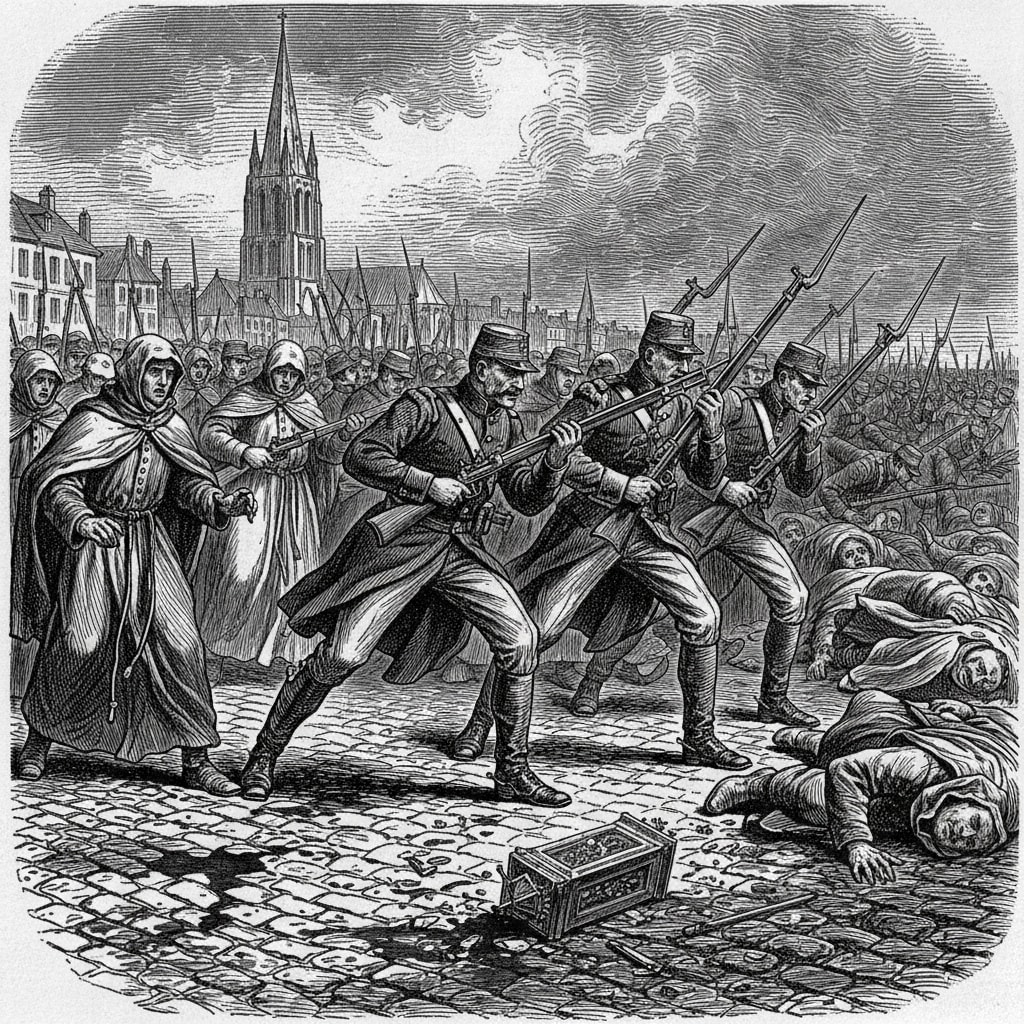
The procession was unremarkable. Forty-three pilgrims — some sources say sixty, the Bureau has ratified forty-three — walked the coastal road from Dinan bearing the Reliquary of Saint Matthias toward the Chapel of the Tide. They wore grey cloaks. They sang the Antiphon of Safe Passage. They carried no weapons, because they were pilgrims, and pilgrims in those years still believed the roads belonged to the Creator.
The Republican Guard detachment stationed at the Saint-Malo gate believed otherwise.
#The Republic's Hand
What followed has been recounted by every chronicler worth his ink and several not worth theirs. The Guards, numbering between thirty and sixty depending on the source, advanced upon the procession at the Porte Saint-Vincent with bayonets fixed and a writ of the Rational Magistrate in the sergeant's left hand. The writ declared all "unauthorized religious assembly" a breach of secular law. The procession, which had traversed that road annually for three hundred years without incident, was now unauthorized.
Earlier editions of this Codex cited the Guards' writ as "forged by agents of the Council of Nine Rationalists."
The Bureau of Records has since determined that the writ was genuine — which is to say, lawfully issued by the Rational Magistrate of Saint-Malo under his own authority, without conspiracy or external orchestration. This correction does not exonerate the Republic. It damns it more completely: the massacre required no shadowed council, no hidden hand. The machinery of Reason produced it as a matter of routine administration.
The sergeant — whose name the Bureau has elected to preserve in the sealed vaults rather than dignify with publication — called the halt. The pilgrims halted. He demanded dispersal. The pilgrims knelt. He demanded the Reliquary be surrendered for "cataloguing." The prior of the procession, one Father Gaël of Dinan, refused.
The first bayonet fell at the third hour. Whether the sergeant gave the order or the line broke of its own accord is disputed — by Rationalist pamphleteers, who require ambiguity to sleep at night. The Bureau does not dispute. It holds testimony from eleven survivors, later copied and countersigned by Church procurators; their A.S. 10 depositions did not come from a formal Synod. The sergeant gave the order. The bayonets fell. The pilgrims, who were kneeling, died on their knees.
#The Dead and the Counted
Forty-three pilgrims entered Saint-Malo. The Bureau of Records, in its earliest extant census — compiled fourteen years after the event by clerks who were themselves children when the blood dried — certifies thirty-one dead at the gate and along the Rue de la Soif. Seven wounded survived to give testimony. Five were unaccounted for and remain so; the Bureau classifies them as "consumed by the event," which is a category the Bureau invented for Saint-Malo and has used sparingly since.
Father Gaël was among the dead. The Reliquary of Saint Matthias was seized, catalogued as "Item 7: bone container, provenance unverified," and stored in the basement of the Rational Magistrate's office, where — by the Bureau's account — it remained for nine years until the faithful of Saint-Malo broke down the doors and reclaimed it during the Retribution of the Tides. The Reliquary is now housed in the Basilica of the Ledgered Saints in Strasbourg, cleaned and rebound. Its Bureau of Relics custody stamp is later than the recovery; the exact stamping year is unverified.
The Rationalist press of the day reported the incident as a "regrettable disturbance." Three newspapers in Paris devoted a paragraph. The Gazette de la Raison gave it four sentences and a subheading: "Religious Vagrants Resist Lawful Order at Saint-Malo." The pilgrims were vagrants. The bayonets were lawful. The blood was regrettable. This is what Reason called journalism.
#The Thunderclap Heard Across Europe
The Republic expected the matter to end with the gazette paragraph. It did not end. It detonated.
Within a fortnight, word of the massacre had reached every cathedral, every monastery, every parish cellar where the faithful still gathered in defiance of secular prohibition. The dead of Saint-Malo became the first martyrs of a war that had not yet been declared, and their names — those thirty-one names, inscribed by the Bureau of Records in the Folio of the First Fallen — became a litany recited at every dawn office from Bruges to Barcelona.
Cities divided against themselves overnight. The faithful rallied to bishops and abbots, fortifying cathedrals as bastions of first resort, while the secular militias raised banners of the broken cross. In Toledo, monks bore relics upon the battlements and called fire upon artillery lines. In Kraków, during the Night of Knives, priests were dragged from their beds and cast into the Vistula. Each atrocity answered another until the continent bled from a thousand wounds, and the wound that opened them all was a cobblestone street in Brittany where forty-three pilgrims knelt to pray and thirty-one of them did not rise.
#The Pretext and the Truth
The Bureau of Doctrine does not call Saint-Malo a pretext. The Bureau of Doctrine calls it a revelation — the moment the Republic of Reason tore off its mask of civility and showed the blade beneath. Later polemic blamed the Council of Nine, but the surviving writ names a local magistrate; the alleged orchestration remains unproved. The act was the Republic's. The blood was the pilgrims'. Later governments made this atrocity a founding warrant.
Later Synodal histories place Augustinus and Kratz at the head of the Saint-Malo response. In A.S. 10 they were about two years old. The First Council of Cologne met seventeen years later, in A.S. 27, under Adelmar; its seven proposed articles were not adopted. The popular fury fed by thirty-one names recited at dawn endured, and later administrators put that grief to work, but it did not bind Europe in one afternoon.
A later marginal extract filed with the A.S. 27 First Council of Cologne minutes attributes this passage to Kratz, then a nineteen-year-old copying assistant: "████████████████████ had Saint-Malo not occurred, we should have had to ████████ it." No contemporary original has been verified. The Bureau of Doctrine considers the passage apocryphal. The Bureau of Records considers it ████████████. Both classifications are, as ever, simultaneously correct.
The later government traced a line from Saint-Malo through the incomplete First Council of Cologne of A.S. 27, the Sundering of A.S. 45, interim councils, and the Concordat of Strasbourg of A.S. 90. The formal Synod inherited older Church offices and wartime works; the Wall and Bureaus took shape in stages. Drax may draw an unbroken line of ink backward to the cobblestones where a sergeant ordered bayonets against unarmed pilgrims. The archive records intervals as well as lines.
#On the Observance of the Anniversary
The Saint-Malo memorial is observed on the fourteenth day of Corvus in every parish of the Theocracy. This is the later Church calendar's observance; the surviving record does not establish the massacre's exact day. It is a day of fasting, of the recitation of the Thirty-One Names, and of the ringing of the Antiphon Bell — one toll for each pilgrim who fell, followed by a silence of precisely the duration it takes to read the writ that killed them.
In Strasbourg, the observance concludes with the Procurator-General bearing the Reliquary of Saint Matthias through the streets in a re-enactment of the procession that was stopped. The procession is not stopped. A.S. 201 is one hundred and ninety-one years after the massacre in A.S. 10; the present rite's uninterrupted age has not been established. The Bureau considers this continuation to be the Synod's permanent answer to the Republic's bayonets: that which was interrupted shall proceed, for as long as there are cobblestones to walk upon and bones to carry.
The dead of Saint-Malo do not require your tears. They require your obedience. The Bureau has spoken.