#Preamble: On the War That Made the War
I am Valerius Drax — Hieromnemon of Strasbourg, Warden of the Sacred Ledger, and the only man alive who can discuss the slaughter of millions with the precision it deserves and the wit it requires. What follows is the account of the Atheist Wars: not the first war in human history, not the bloodiest — though it competed admirably — but the stupidest. For the Atheist Wars were not a conflict between rival nations or competing empires. They were a conflict between men who believed in something and men who believed in nothing, and the nothing-believers won, and then the actual enemy arrived and ate them.
This is, I confess, a difficult subject for a man of my temperament — not because the material is distressing (distress is the Bureau's principal product), but because the protagonists are uniformly disappointing. The Rationalists were brilliant and evil. The faithful were righteous and incompetent. The eventual victors were neither brilliant nor righteous, merely numerous and temporarily aligned. The Atheist Wars are, in essence, the story of how Europe dismantled its own immune system on the eve of the worst plague in Creation's history.
#The Seeds: How Reason Became a Blade
The roots of the Atheist Wars reach back to the early decades of the eighteenth century by the old reckoning — the opening years of A.S. reckoning, before the Atheist Wars had drawn blood. It was an age when philosophers were treated as prophets and prophets were treated as lunatics, when the learned societies of Paris, Vienna, and Amsterdam declared that superstition — by which they meant Faith — was the enemy of human advancement. The Concordats of Ulm, drafted in those heady years, sought to bind Europe in "rational fraternity," a phrase so intoxicating in its optimism that one almost forgives the authors for not noticing they were writing their own epitaph.
The desecrations began slowly, as desecrations always do — with pamphlets before pyres. In the Year of Letters (c. A.S. 5), the scholars of Amsterdam publicly denounced the Miracle of Saint Aldebrand as fraud. Their arguments were, I am told, technically sophisticated. They are also irrelevant, because Saint Aldebrand's reliquary later blazed with genuine divine light at the Siege of Ghent, which rather undermined the "fraud" thesis, but by then the scholars were dead and their pamphlets were kindling. The damage, however, had been done: the common people, credulous as sheep and twice as easily led, began to question.
Questioning led to stripping. Monasteries lost patronage. Shrines were consigned to "purification" fires — a euphemism the Rationalists shared, interestingly, with the Bureau of Purity, though we employ ours with considerably more theological justification. Sacred relics were catalogued, weighed, tested for "natural explanations," and when those explanations proved insufficient, the relics were melted down or locked in the Forbidden Stacks, where they remain today under triple seal.
Earlier editions of this Codex suggested that the Rationalist desecrations were "sporadic and regionally limited."
This is dangerously false. The desecrations were systematic, continent-wide, and orchestrated by the Council of Nine Rationalists operating through their network of learned societies. The earlier description was authored by a clerk sympathetic to "balanced history," a concept the Bureau has since correctly identified as "heresy wearing spectacles."
#The Thunderclap: Saint-Malo
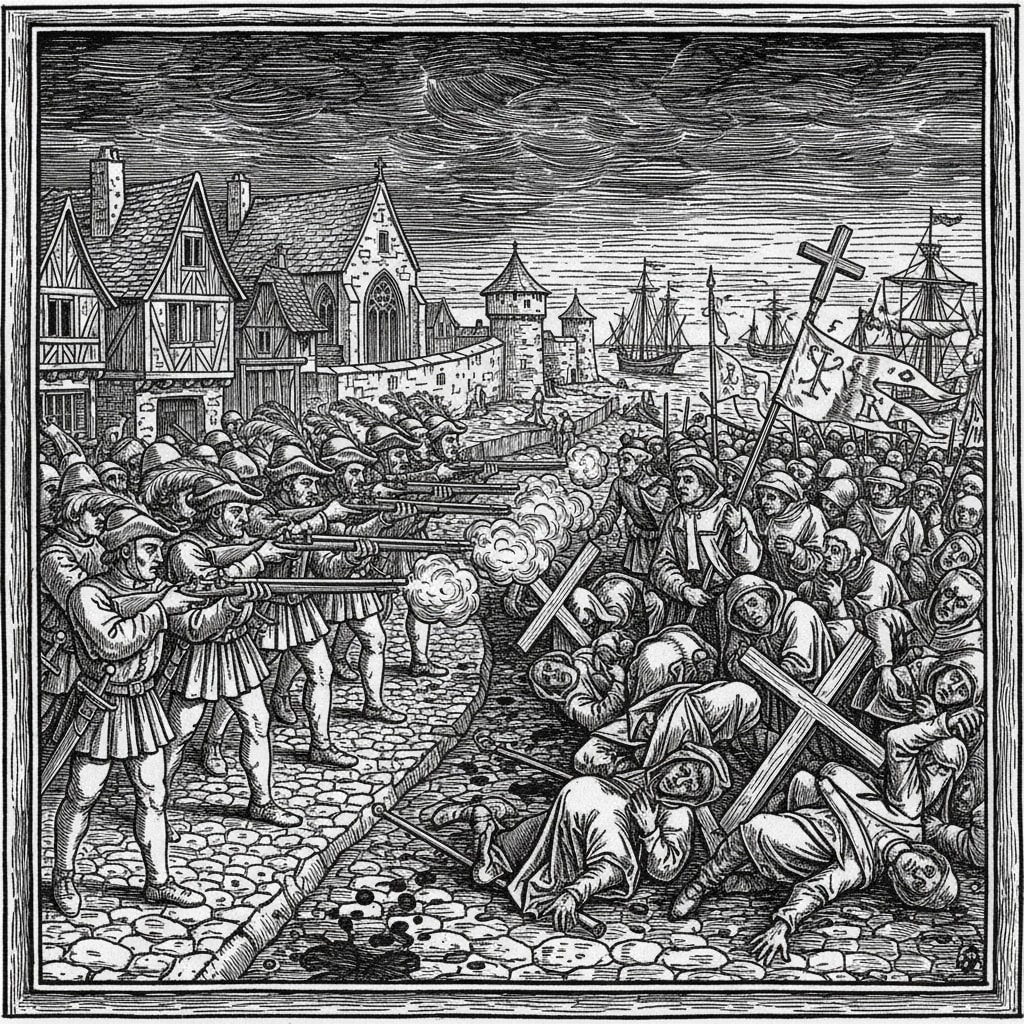
The war's catalyst was the Massacre at Saint-Malo (A.S. 10 / 1720 CE), and I use the word "catalyst" advisedly, because the chemical was already bubbling. A procession of pilgrims — men, women, and children carrying the banner of Saint Hermas and bound for the shrine of Saint Clement of Brittany — entered the port town of Saint-Malo on the feast of the Assumption. They were met by Republican Guards enforcing the Secular Gatherings Act, a piece of legislation so contemptible that even its authors did not expect it to be enforced. What happened next is disputed in detail and undisputed in substance: the guards opened fire.
Fourteen pilgrims died on the cobblestones of Saint-Malo. Among them was Sister Margaux of the Blessed Thorn, a sixty-three-year-old nun whose only weapon was a psalter and whose only crime was walking slowly. Her death — recorded in the Martyrology of Saint-Malo, now held in the Bureau of Records under gilt seal — became the symbol of the war. Broadsheets carried her likeness across Europe within weeks. Sermons invoked her name from Lisbon to Kraków. The Bureau of Doctrine later canonized her in A.S. 14, making her Saint Margaux of the First Blood, patroness of pilgrims and lost causes.
The Massacre at Saint-Malo was not the first atrocity of the period. It was not even the worst. But it was the visible one — the one that could not be explained away, could not be buried in committee reports, could not be dismissed as "an isolated incident by rogue elements." Blood on cobblestones, witnesses in every tavern, and a dead nun who looked, in the broadsheets, exactly like everyone's grandmother. The Rationalists had made martyrs. The faithful had found their cause.
#The War: Twenty Years of Sacred Butchery
What followed was not a war in the clean, cartographic sense beloved of military historians. It was a fragmentation — a shattering of the continent into a thousand local conflicts, each feeding on the last, each spawning the next, until Europe was less a civilization than a series of burning buildings connected by roads full of refugees.
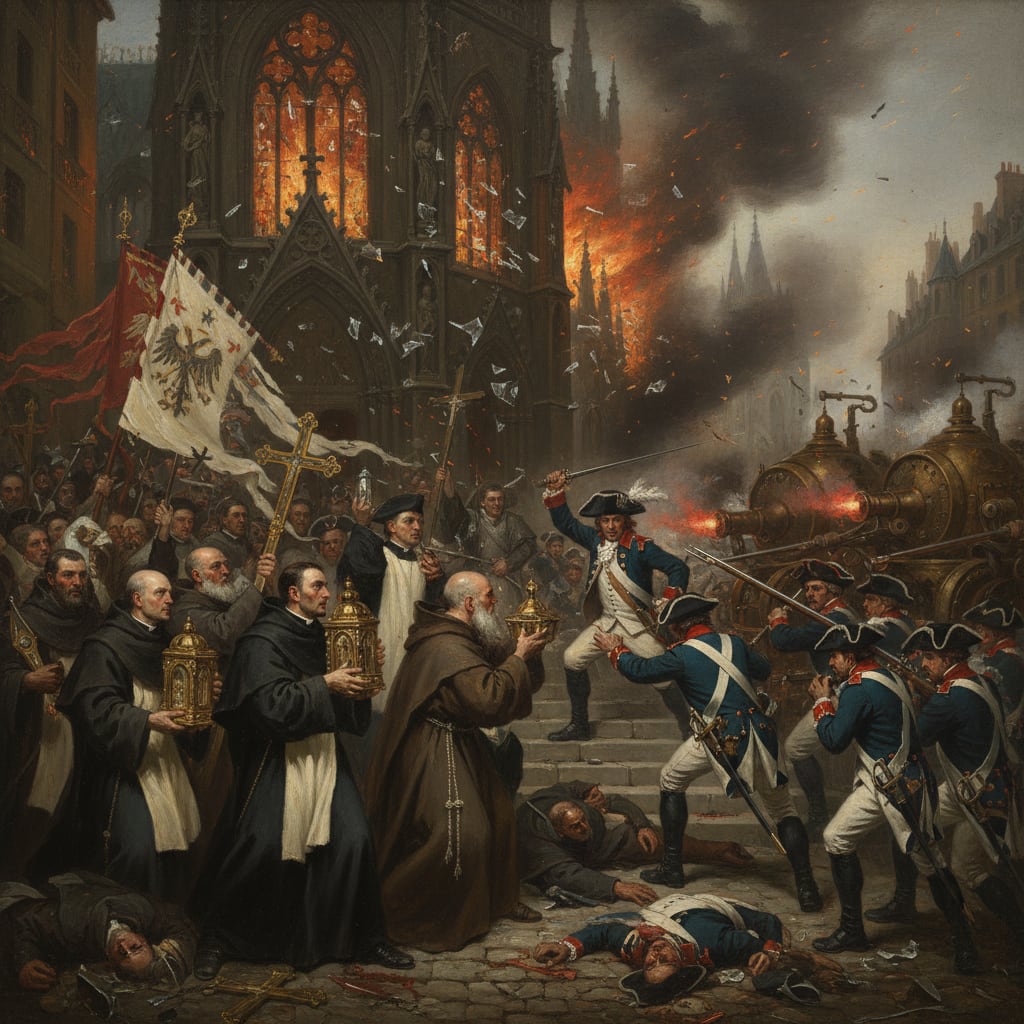
Cities divided overnight. The faithful rallied to cathedrals, fortifying them as bastions of resistance with reliquaries on the ramparts and holy water in the mortar. The Rationalists raised militias under the banner of the Broken Cross — that blasphemous sigil, a crucifix snapped at the crossbeam, which the Bureau of Purity has since declared punishable by immurement to possess, depict, or describe in flattering terms.
The Siege of Toledo (c. A.S. 12) was among the first great set-piece engagements — monks bearing the Relic of Saint Iago upon the battlements, calling down what witnesses described as "divine fire" upon the Rationalist artillery lines. Whether this was a genuine Miracle or merely an exceptionally well-aimed incendiary device dropped from a cathedral tower remains a matter of doctrinal debate that the Bureau has resolved by declaring both explanations true simultaneously. Toledo held for nine months. When it fell, the monks immolated themselves and the relic together rather than permit its capture. The Bureau of Relics classifies this as "heroic destruction," a category that has, regrettably, required frequent use.
In the east, the Night of Knives in Kraków (17 Martius, A.S. 18) demonstrated that the Rationalists could match brutality for brutality. Forty-seven clergymen were seized and cast into the Vistula; their bodies were recovered downstream at Sandomierz nine days later. Later trial anecdotes are retained as local tradition rather than established details of that night's operation.
The great commanders of the wars emerged from this crucible of horror. Cardinal-Marshal Severin of Avignon, whose sermons could rally a starving garrison faster than a supply wagon, held the southern passes at Montreval for three winters with nothing but faith, fury, and an abnormally loud speaking voice. His counterpart, Lucien Artois, called the Iron Rationalist, fielded armies equipped with clockwork artillery — brass-barreled cannon on spring-loaded carriages that could fire four rounds per minute, a rate of destruction that impressed even the Bureau of War, which subsequently adopted the design and blessed each barrel with holy oil.
And between them, unsung and uncounted, fought the Sisters of the Martyrdom — an order of women who had taken vows not of charity or contemplation but of destruction. When Rationalist columns advanced across key bridges, the Sisters would position themselves upon the span, douse themselves in consecrated oil, and ignite. The resulting conflagrations — part human bonfire, part structural demolition — halted more advances than any cannon. The Bureau has never formally recognized the Sisters of the Martyrdom, on the grounds that self-immolation without Bureau authorization is technically a disciplinary infraction. The Bureau has also never formally condemned them, on the grounds that their effectiveness was difficult to argue with.
The Bureau of Shadows maintains a later dossier attributing the Sisters' formation and early funding to Kratz. Its attribution conflicts with his age and known assignment during the early Atheist Wars. The women's own organization and Severin's field command deserve separate credit. The Bureau has classified the dossier under Seal Obsidian; its claims remain disputed, not established fact.
#The Betrayal of Aachen
No event of the Atheist Wars is so bitterly remembered — or so carefully taught in catechism schools — as the Betrayal of Aachen (A.S. 25 / 1735 CE). Lord-Protector Guillaume, sworn defender of the faithful and commander of the Northern Coalition, surrendered his citadel — the ancient seat of Charlemagne, no less — to the Rationalists in exchange for dominion over the Lowlands.
The details are sordid and instructive. Guillaume had been losing. His forces, stretched thin across the Rhine frontier, could not simultaneously defend Aachen and supply the besieged garrisons at Liège and Maastricht. The Rationalist general Colonel Verdane offered terms: the citadel for a governorship, the faithful's strategic depth for personal power. Guillaume accepted. He opened the gates at midnight on the feast of Saint Bartholomew — a date the Bureau of Records has noted was itself chosen for maximum symbolic cruelty — and by dawn, the Rationalist flag flew above Charlemagne's throne.
The loss of Aachen shattered the faithful's northern front. Within a year, the Rhineland, the Lowlands, and much of northern France fell to Rationalist banners. Morale collapsed. Desertions multiplied. Bishops who had fought for years found their congregations melting away, seduced by the Rationalist promise of "peace through reason" — a promise that lasted precisely until the Sundering proved that reason was not, in fact, sufficient armor against the legions of Hell.
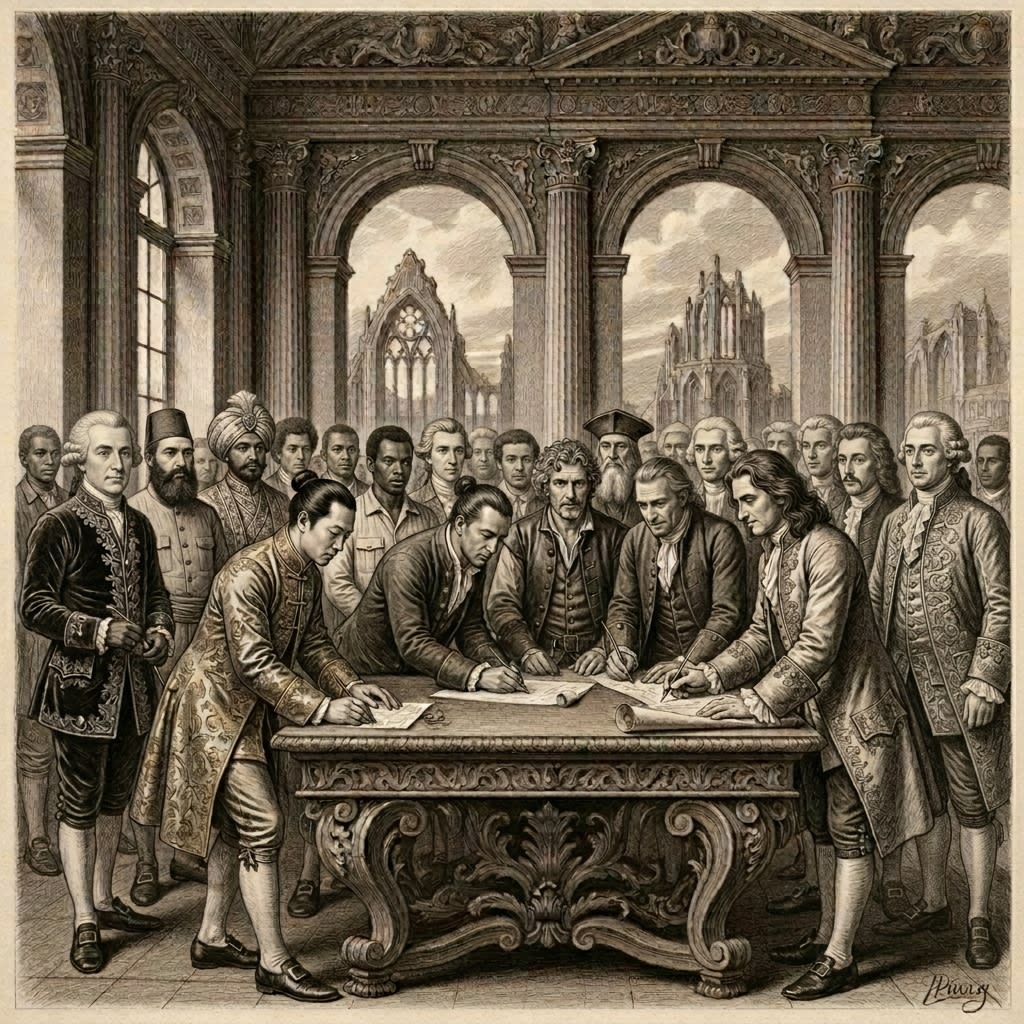
The Treaty of Regensburg (A.S. 30 / 1740 CE) formalized Reason's triumph. The last cathedrals smoldered. The Holy See of Vienna was dissolved at swordpoint — its Archbishop forced to sign the dissolution in his own blood, a detail the Rationalists considered "symbolic" and which the Bureau of Doctrine considers "evidence for the prosecution." A "New Dawn" was proclaimed, and the faithful were driven underground, hunted as heretics in their own cellars, mocked as relics of a bygone age.
#The Cost of Reason's Victory
Let the arithmetic speak, for arithmetic is the Bureau's native tongue:
- Twenty years of continuous warfare across every province of Europe (A.S. 10–30 / 1720–1740 CE).
- Three to four million dead — soldiers, civilians, clergy, and the uncounted faithful who simply disappeared into Rationalist prisons and were never seen again.
- Over two thousand churches, monasteries, and shrines destroyed — their relics scattered, melted, or locked in the Forbidden Stacks.
- Fourteen formally recognized martyrs of the war period in later Synodal lists. Early recognition preceded the formal Bureau; martyrdom and canonization dates must be distinguished. Another two hundred and six cases remain pending in Bureau records.
- One continental order shattered — the old system of crowns, dukes, and bishops replaced by the Rationalist Republic and its Concordats of Governance.
- Every bulwark of Faith dismantled — the spiritual immune system of Europe torn out by the roots, leaving the continent naked and defenseless before the Sundering that followed fifteen years later.
#The Lesson: As Taught by the Bureau
The Bureau of Doctrine mandates the following interpretation of the Atheist Wars, to be taught in all Catechism Schools and recited at the Annual Remembrance of Saint-Malo (the 15th day of the eighth month, A.S. reckoning):
First: The Atheist Wars were not a tragedy. They were a lesson. The Almighty permitted Reason to triumph so that Reason's failure would be absolute, public, and undeniable when the Sundering arrived. Had Faith still held political power when the demons came, the skeptics would have blamed the faithful. Instead, Reason held power, Reason failed, and Faith was vindicated beyond all argument.
Second: The faithful who died in the Atheist Wars did not die in vain. They died as seed corn — martyrs whose blood fertilized the soil from which the Synod would grow. Without the memory of their sacrifice, the Synod could not have demanded the obedience it requires. Without the scars of Saint-Malo and Toledo and Kraków, the Synod's authority would lack the moral weight that makes it unquestionable.
Third: Doubt is not merely intellectual error. It is strategic vulnerability. The Atheist Wars proved that a civilization which questions its faith cannot defend itself against enemies that exploit that questioning. The Rationalists did not merely reject the Creator; they disarmed against the supernatural. When the supernatural arrived, they had nothing left but clockwork artillery and confidence, and both proved insufficient.
Earlier editions included a fourth lesson: "The Rationalists were guided by demonic influence from the beginning."
This claim, while popular in catechism curricula, has been retracted by the Twelfth Doctrinal Congress of A.S. 104, which determined that attributing the Atheist Wars to demonic influence diminishes human culpability. The Rationalists chose Reason freely. Their punishment was, accordingly, earned rather than inflicted. The Bureau considers earned punishment more instructive than imposed punishment. I consider it more satisfying.
#On the Survivors: The Cellar Saints
Not all the faithful perished. Not all surrendered. Between the Treaty of Regensburg and the Sundering — those fifteen years of Rationalist supremacy — the faithful survived underground. In cellars beneath Cologne, in mountain caves above Innsbruck, in the sealed catacombs of Lyon, small communities kept the flame alive. They are known to history as the Cellar Saints, though few of them were saintly in any formal sense — they were frightened, hungry, hunted people who prayed in whispers and baptized their children by candlelight.
The Cellar Saints preserved more than prayer. They preserved relics. In the chaos of the Rationalist desecrations, the faithful smuggled bones, icons, and consecrated objects out of churches hours before the wrecking crews arrived. Father Ignatius of Cologne, later canonized as Saint Ignatius the Carrier, personally transported the finger bones of three apostles across the Rhine in a breadbasket, walking past Rationalist checkpoints with what he later described as "the calm of a man who knows the Lord is watching and the guards are not." The relics he saved would later blaze at the Sundering, proving their authenticity in the only manner that matters: by burning demons.
The Cellar Saints' survival meant that after the Sundering, a network of faithful remained — scattered and traumatized but organized alongside surviving bishops and relief clergy. Augustinus of Mainz drew allies from these communities. Kratz later used rescued documents in his chancery work. Their networks joined the interim government that eventually became the formal Synod.
#A Final Word from the Warden
The Atheist Wars are not ancient history. They are yesterday. A hundred and ninety years have passed since the first shot at Saint-Malo, and the Bureau still teaches the lesson because the lesson still needs teaching. There are those — in the coffee houses of Marseille, in the taverns of Prague, in the quiet corners of Strasbourg itself — who whisper that Reason was not the enemy, that the faithful bear equal blame, that "both sides" committed atrocities. To these whisperers I say: both sides did commit atrocities. Only one side dismantled the defenses of civilization before the largest threat in human history arrived. The moral calculus is not difficult. It merely requires honesty, which is to say, it requires the Bureau.
The reader is directed to The Sundering, The Bureaucratic Synod, The Massacre at Saint-Malo, The Betrayal of Aachen, The Treaty of Regensburg, Cardinal-Marshal Severin of Avignon, Lucien Artois, and Lord-Protector Guillaume for further study. The Bureau recommends reading them in order, with a candle lit for the dead of Saint-Malo.