
#Preamble: On the Wound That Will Not Close
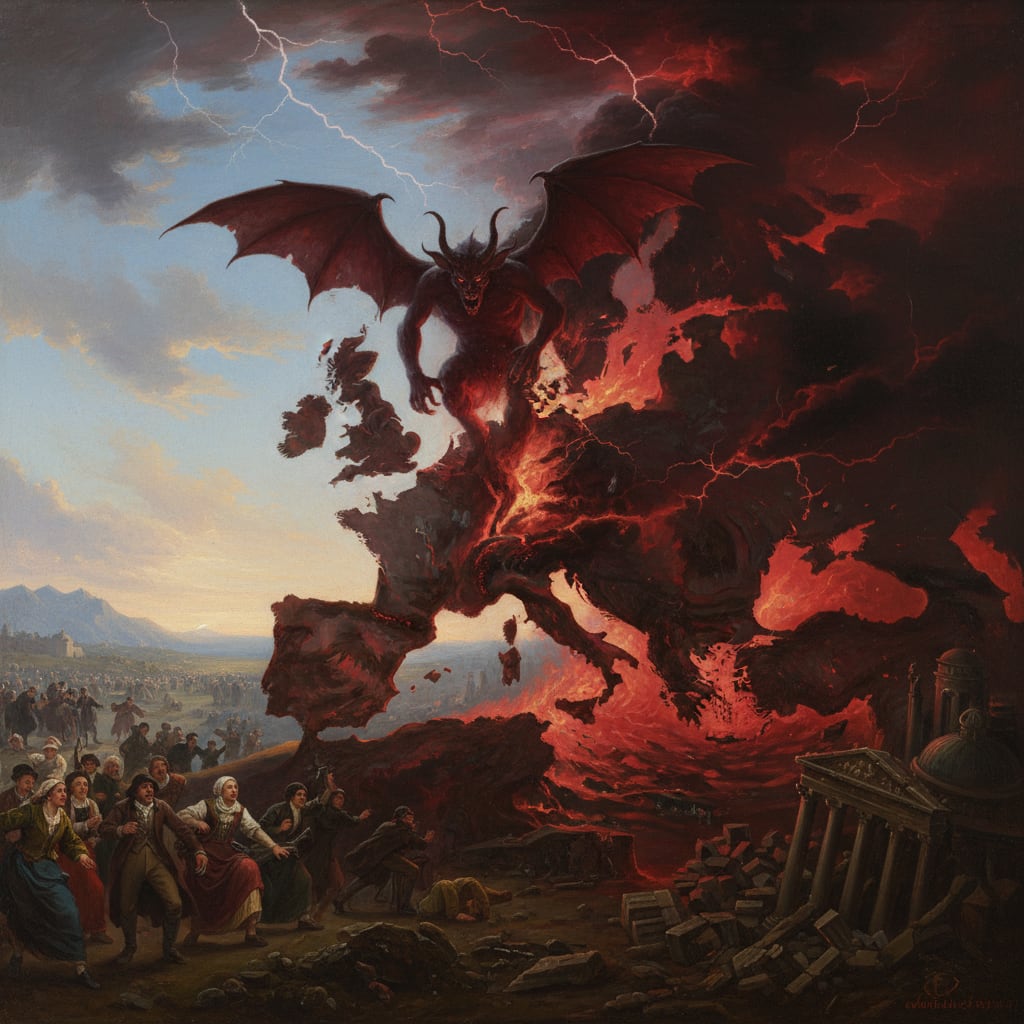
I am Valerius Drax — Hieromnemon, Warden, Archivist, and the sole chronicler entrusted by the Bureaucratic Synod to set down in ink what the world would prefer to forget. What follows is the account of the Sundering: not a battle, not an invasion, not a natural disaster dressed in supernatural clothing, but the moment when Creation itself was torn open like a ledger whose spine could no longer bear the weight of its own lies. The Rationalists had filled that ledger with falsehoods for half a century, and on the first of November in the year 45 Ante-Synodi — by the old and now-suppressed calendar, the year 1755 — the binding snapped.
Let me be precise, because precision is the armor of truth and I am, if nothing else, magnificently armored. The Sundering was not merely a catastrophe. It was a correction. It was the Almighty's red ink slashed across the ledger of human arrogance, a divine erratum stamped so deeply into the earth that the earth itself split to receive it. Every age has its defining wound — the Age of Reason had its philosophers, the Atheist Wars had their massacres — but the Sundering alone tore reality from root to crown and left the stump bleeding into eternity.
#The Omens: When Reason Still Dared to Explain
Before the wound opened, the world gave warnings. The Rationalists, in their infinite and terminal hubris, explained each one away with the same confident smugness with which a man explains away the cough that precedes the plague.
In A.S. 32 — 1742 by the old reckoning — came the Year Without Dawn. For forty days, reports say, no sunrise pierced the sky above Europe. Crops withered. Livestock refused to graze. Later birth registers called the children of those weeks Greylings; the duration and reach remain a received tradition, not a novel-verified measurement.
The Rationalist astronomers of Vienna published seven treatises in nine days, each contradicting the last, each more confident than its predecessor. Professor Gérard Molyneaux of the Académie des Sciences attributed the phenomenon to "stratospheric particulate diffusion from sub-Adriatic vulcanism." His paper was cited four hundred times before the Sundering rendered citations irrelevant. I keep a copy in my private collection. It is useful for kindling.
Two years later came the Red Flood of the Danube. For three weeks the great river ran crimson — not the muddy russet of a spring thaw, but the arterial scarlet of fresh blood. Fish died by the millions, their bellies split open, their flesh suffused with a heat that should not have existed in November waters. Villages along the banks reported the stench of iron and sulphur. At Vienna, the river's surface steamed, and dock workers who touched the water suffered burns that would not heal, leaving scars in patterns that the Bureau of Purity later catalogued as resembling — but I am getting ahead of myself. The Bureau's findings on those scars remain sealed.
Earlier editions attributed the Red Flood to "subterranean mineral displacement caused by tectonic shifts in the Carpathian basin."
This explanation was authored by Rationalist hydrologists and is rejected. The Red Flood was a harbinger of the Sundering — the earth bleeding before the wound fully opened. The distinction between geology and prophecy is, in this instance, theological rather than scientific, and theology outranks science in all matters of public record.
Then came the Silencing of the East around A.S. 38, seven years before the Sundering. The Balkans began to fall quiet. Entire villages ceased correspondence. Tax collectors dispatched from Thessaloniki and Vienna failed to return. Caravans stopped in the passes. The accounts describe silence spreading westward; the exact sequence remains a received tradition.
Refugees were the first evidence that something worse than plague had taken root. They staggered into the border towns of Hungary and Wallachia with stories that the Rationalist authorities dismissed as "mass hysteria aggravated by regional superstition." They spoke of forests that moved of their own accord — not in wind, but with intention, root systems pulling free of soil to close roads behind those who passed. They spoke of churches blackened overnight, their stone walls charring from within as though the prayers embedded in the mortar had ignited and burned to ash. They spoke of a fog — not weather, but entity — that descended upon valleys and returned them changed. Livestock emerged from the fog with too many legs. Men emerged from the fog with too few memories. Some did not emerge at all.
The Rationalist response was, as in all things, administrative. Quarantine cordons were established along the Danube. Travel permits into the eastern provinces were revoked. Newspapers in Paris and Amsterdam printed reassuring editorials about "localized seismic disturbances" and "outbreak management protocols." The Council of Rational Governance in Vienna issued a formal declaration that supernatural explanations for natural phenomena were "an impediment to civic order" and that any person spreading tales of demons, spirits, or divine wrath would be subject to imprisonment under the Sedition Articles of the Treaty of Regensburg.
They were still printing those declarations when the screaming started.
#The Day Itself: 1 November, 45 An.S.
The precise hour is disputed. The Bureau of Records, which keeps a Ledger of Catastrophes updated in quarterly installments, records the first confirmed reports at the third bell of Matins — approximately five hours past midnight. But the Bureau of Bells insists that no bell sounded that morning, that every bell in every tower east of Budapest fell silent simultaneously, as if the bronze itself had been struck dumb. The Bureau of Doctrine resolves this contradiction by noting that both accounts are correct: the bells rang in the west and fell silent in the east, and the line between ringing and silence was the Sundering.
From the mountains of Thrace and the fog-bound plains of Serbia, the legions of the Great Deceiver poured forth. They came not as any army of mortal reckoning — not in columns, not under banners, not with the logistical hesitations of human warfare — but as a tide. Creatures clad in flame and shadow, shapes that defied geometry, masses of twisted flesh propelled by sorceries that drained the land beneath their feet to white dust. Emaciated soldiers — or what had once been soldiers, conscripts of the Great Deceiver's will, their lifeblood siphoned to fuel the infernal advance — lurched in their millions across a front that stretched from the Carpathian passes to the Aegean shore.
And above them, towering, seven forms that mocked the seven virtues with their sins incarnate: the Seven Sin-Generals.
Kargath the Maw, Sin-General of Gluttony, who devoured Skopje in a single sitting — not metaphorically, but literally, consuming buildings, livestock, and populace alike into a maw that expanded to accommodate whatever was fed to it, and was never satisfied. Maldrake the Wrathforged, whose iron-scaled legions burned Novi Sad to slag before the garrison could load a single cannon. Syrion the Languid Dreamer, whose fog rolled westward like a narcotic exhalation, putting entire regiments to sleep from which they never woke — or woke as something other than themselves. Velkara the Crimson Temptress, whose presence unraveled loyalties, turning officers against their men and men against their the Creator. Atheron the Exalted, who declared himself emperor of the ruins and demanded worship from the enslaved. Morwen the Weeping Host, who wept tears that became plagues. And Velmora the Covetous Serpent, who hoarded the stolen wealth of nations in vaults that existed in dimensions the Bureau of Records has declined to catalogue.
The first cities fell within hours. Skopje. Novi Sad. Sarajevo. Belgrade within three days. The Rationalist garrisons, armed with their clockwork artillery and their unshakeable confidence in empirical firepower, discovered — too late, too horribly — that cannonballs do not concern creatures whose flesh regenerates faster than iron can tear it, and that gunpowder is merely chemistry, and chemistry does not frighten the supernatural.
#The Collapse of Reason
What followed was not a war. A war implies two sides with comparable means. This was an extinction event briefly delayed by geography.
The Rationalist armies — well-drilled, well-supplied, utterly unprepared — were shattered in engagements that lasted hours rather than days. At the Battle of the Iron Plains, three full divisions of the Rationalist Second Army advanced in textbook formation against what their scouts reported as "a large enemy concentration." The scouts were correct in the way that calling the ocean "damp" is correct. Fire fell from a cloudless sky — not artillery, not incendiaries, but fire itself, conjured from nothing, consuming everything. Twelve thousand men ceased to exist between the second and third volleys. The survivors did not retreat; they ran. Many ran until their hearts gave out. Their bodies were found as far west as Bratislava, still facing away from the plains, still running.
At Debrecen, the catastrophe took a different and arguably more horrifying form. Kargath's legions did not attack the Rationalist garrison directly. They did not need to. The Sin-General of Gluttony simply ate. Every ration, every grain store, every barrel of salted meat, every sack of flour within a radius of forty miles was consumed — not by the army, but by the land itself, which opened and swallowed provisions as if the earth were hungry. A hundred thousand men found themselves starving within a single night. Officers who had planned for a six-month siege found their supply lines not merely cut but digested. The retreat from Debrecen was not a military manoeuvre; it was a stampede. Men gnawed boot leather. Men gnawed each other. The Bureau of Records preserves the confession of one Captain Elias Mürren, who recorded eating his own horse, his adjutant's horse, and — in a passage the Bureau has seen fit to redact — something else entirely.
The Debrecen survivors' testimonies, sealed in the Vault of Silences beneath the Basilica of the Ledgered Saints, contain accounts of soldiers consuming substances that were neither food nor flesh but which the starving perceived as nourishment. The Bureau of Purity has classified these substances as "sorcerous provender" and their consumption as "involuntary heresy." No disciplinary action was taken, as the majority of consumers did not survive the march.
City after city fell. The Rationalist chain of command, designed for wars between rational actors, disintegrated when confronted with an enemy that did not negotiate, did not accept surrender, and did not obey the laws of physics. Generals who had studied Artois' Principles of Mechanized Warfare found those principles as useful as a parasol in a hurricane. The great Rationalist project — the taming of the world through measurement and mastery — was swallowed by a world that could no longer be measured.
#The Return of Faith: Kalnik Ridge and the Proof of Miracles
It was in the darkest hour — because Providence, like good prose, demands a turn — that Faith returned.
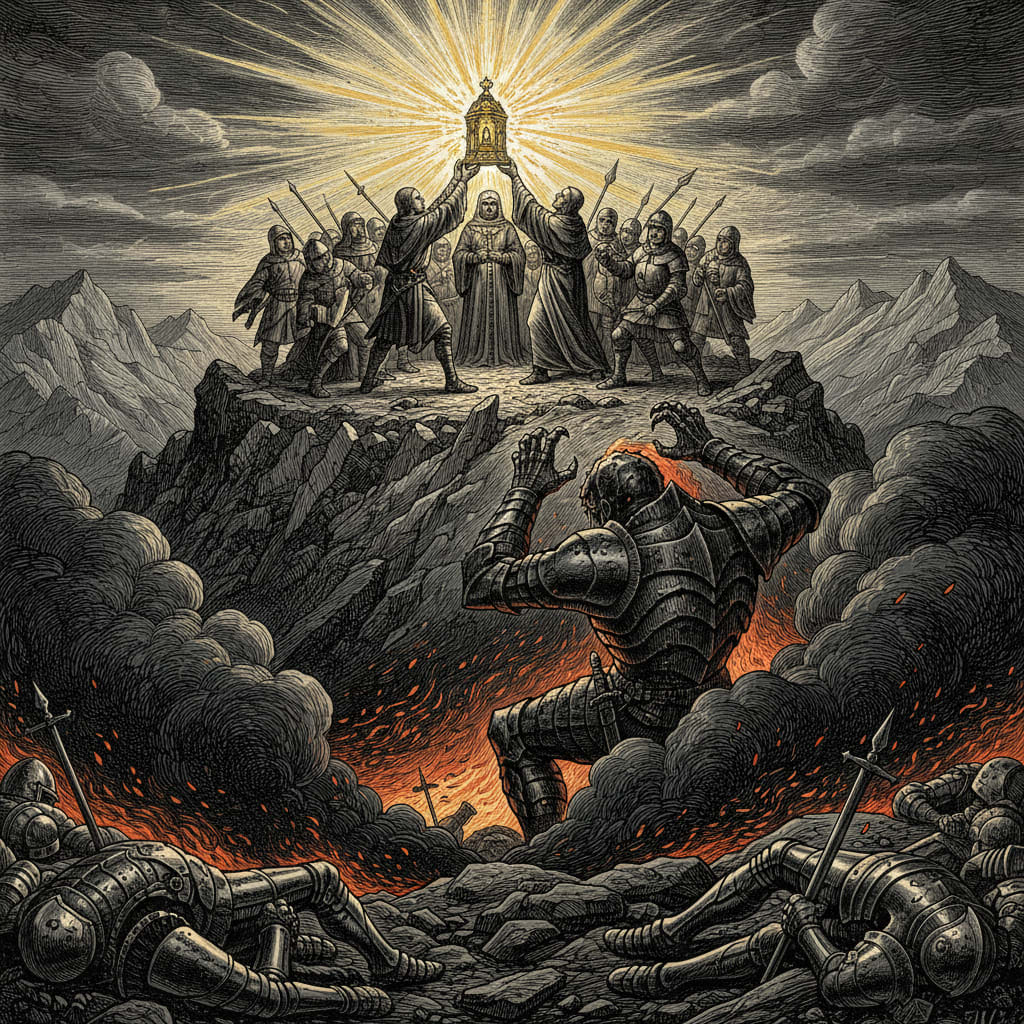
The Last Stand of Kalnik Ridge, in the year A.S. 48 — approximately 1758 by the dead calendar — is the pivot upon which the Age of Heresy turns. A ragged band of priests, monks, and conscripted peasants, the remnants of a dozen shattered units, found themselves cornered on a ridgeline in the Croatian highlands. They had no artillery. They had no supply line. They had no reasonable expectation of survival. What they had was the Reliquary of Saint Isidore — a gold-and-iron casket containing a finger bone of the blessed martyr, carried from the ruins of a Dalmatian monastery by a half-blind Franciscan named Brother Tomislav, who had refused to abandon it even as his fellow monks burned around him.
When Maldrake's vanguard crested the ridge — a tide of Wrathforged abominations, iron-scaled and flame-wreathed, screaming psalms of destruction in a language that made the ears bleed — Brother Tomislav did the only thing left to him. He raised the reliquary above his head and prayed.
The relic blazed.
The light that erupted from the Reliquary of Saint Isidore was not natural illumination. It was not phosphorescence, nor chemical reaction, nor any of the seventeen alternative explanations that the dwindling corps of Rationalist scientists subsequently proposed. It was a Miracle — the first confirmed, documented, Bureau-certified Miracle of the post-Reason era. The light struck Maldrake's vanguard like a physical force. Wrathforged creatures that had shrugged off cannon fire recoiled. The Sin-General of Wrath himself — the Wrathforged, the Burning One, the Iron Furnace of Thrace — flinched. Not retreated. Not fled. But flinched, and in that flinch was contained the seed of every human victory that followed.
The survivors of Kalnik Ridge numbered forty-three. Brother Tomislav was not among them — the Miracle consumed him, as Miracles consume their vessels, leaving him a husk of white ash still kneeling, still holding the reliquary, still praying. The Bureau of Relics later collected his remains in a crystal ampulla and classified them as a Class-One Sacred Residuum. His ashes are said to cure blindness, though the Bureau has issued no fewer than four contradictory rulings on the matter.
But the proof — the proof that Faith was not sentiment but weapon, not comfort but ordnance — spread faster than any army could march. Men who had spat upon the altar now begged for the cross. Officers who had enforced the Rationalist ban on religious observance tore the secular badges from their uniforms and demanded chaplains. The retreat continued — it would continue for another seventeen years — but it was no longer a rout. It was a pilgrimage, armed and bleeding and furious, marching west toward the bells of Strasbourg with the bones of saints held aloft like battle standards.
#The Great Retreat and the Birth of the Line
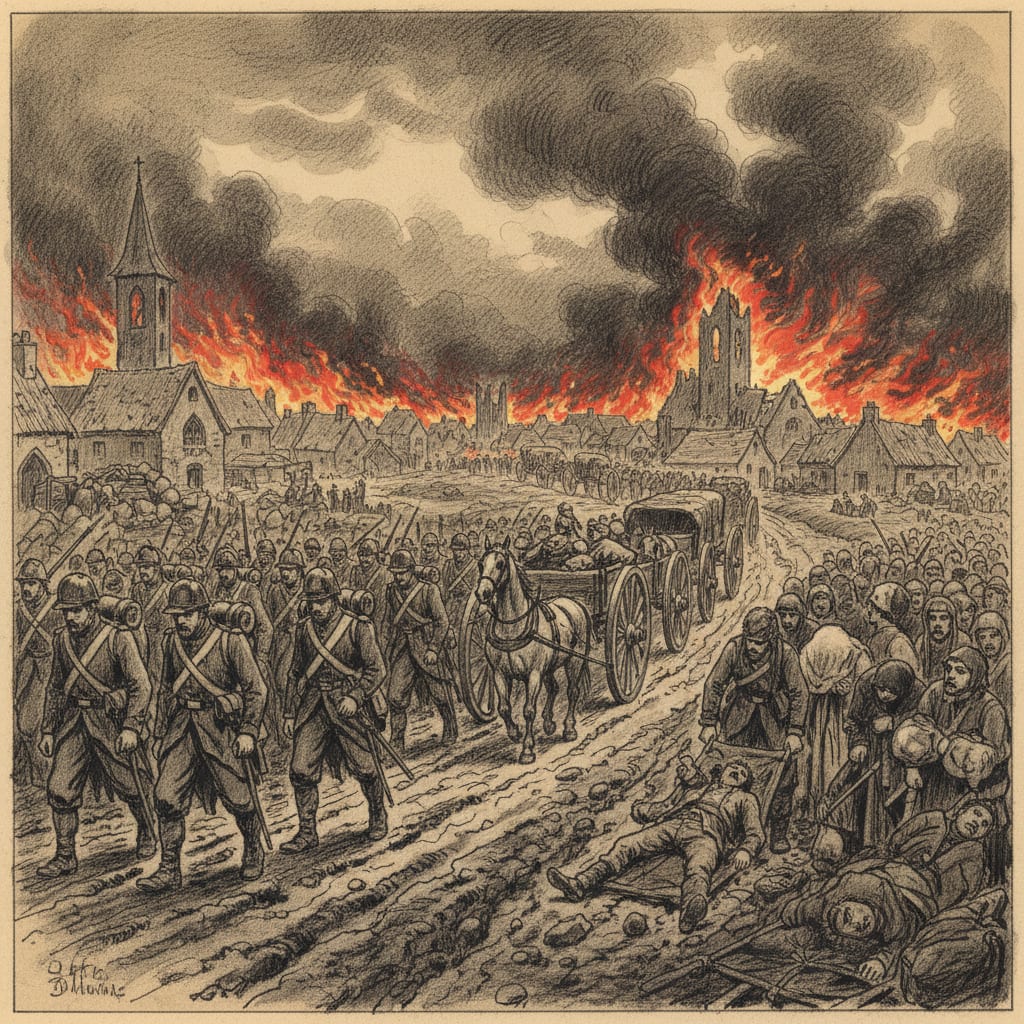
Flight began at the Sundering in A.S. 45. The core Great Retreat ran about A.S. 48–65, with defensive consolidation through roughly A.S. 68. The Bureau of Records estimates eight to twelve million deaths across these movements — from battle, starvation, exposure, and the plagues attributed to Morwen the Weeping Host.
Vienna provided a brief reprieve. The city's ancient cathedral spires, heavy with relics accumulated over centuries of devotion, flared with protective light when the Sin-Generals' advance guard approached. For six months the city held, a beacon in the engulfing dark, its walls manned by a garrison that fought with the desperate fervor of men who knew that behind them lay nothing but more retreat. But Vienna could not hold. The relics dimmed — consumed, as all Miracles consume — and when the last relic-light guttered in the crypt of Saint Stephen's, the garrison withdrew in good order, carrying what bones they could salvage, burning what they could not.
The retreat bled westward. Each stand bought days; each city abandoned bought miles. Hierarch Augustinus of Mainz, already bishop since A.S. 40, became a voice of public organization after A.S. 45. His sermons from wagons and ruined chapels turned withdrawal into a claim of consolidation. Later accounts quote him: "We do not retreat. We consolidate. The Creator is narrowing His army to the faithful."
At last, approximately A.S. 65 — the year 1775 by the extinct calendar — the retreat reached its terminus. At the site that would become Bastion-Constantinople, the armies of Man dug in. Not because the position was tactically ideal — though it was defensible, a seam in the continental geography where mountains met rivers met marshland — but because there was simply nowhere left to go. Priests planted reliquaries in the mud. Engineers sank foundations of stone. Millions perished in the construction of fortifications that were designed not for a siege, but for eternity.
The Sagittal Line became defensible in stages around A.S. 65–68 — carved by the Creator Himself with a bayonet dipped in blood, says the Bureau. Its proclamation is truth until amended.
#The Cost: What the Sundering Consumed
Let the numbers speak, for numbers are the Bureau's prayer and arithmetic its liturgy. The Sundering and its aftermath consumed:
- The Balkans entire — Serbia, Bulgaria, Macedonia, Albania, Greece east of the Peloponnese, Romania, Hungary east of the Tisza — all swallowed into the dominions of the Seven Sin-Generals.
- Between eight and twelve million souls during the Great Retreat alone, per the Bureau of Records' conservative estimate. The actual figure is higher. The Bureau knows this. The Bureau publishes the lower number because terror, like wine, is best served in measured doses.
- The Age of Reason itself — its academies, its libraries, its Concordats, its clockwork artillery, its precious confidence that the universe was a machine and man its operator. All of it ash. All of it deserved.
- The old calendar — suppressed by Synodal decree, replaced by the Anno Synodi reckoning that begins at the Concordat of Strasbourg. Time itself was Sundered and reborn.
What the Sundering gave in return was equally absolute: Miracles, proven and weaponized. The Synod, born of ash and necessity. The Sagittal Line, humanity's scar and shield. And the terrible, liberating certainty that Faith is not a comfort but a survival mechanism — not a candle in the dark, but a howitzer aimed at the dark's face.
#On the Nature of the Wound
The Sundering was not an invasion in the conventional sense. An invasion implies an external force crossing a border. The Sundering was something far worse: a thinning of the membrane between what is and what should not be, a wound in the fabric of Creation through which the Great Deceiver's legions poured like blood from a slashed wrist. The Bureau of Doctrine has debated the precise metaphysics for over a century — whether the Sundering was caused by the Great Deceiver's agency, by humanity's collective sin of Rationalism, by the weakening of Faith's protective power, or by some combination of all three — and has, with characteristic decisiveness, officially endorsed all four explanations simultaneously.
The Third Doctrinal Congress of A.S. 47 declared that the Sundering was caused exclusively by "the sin of Rationalism and the consequent withdrawal of Divine protection."
The Ninth Doctrinal Congress of A.S. 89 amended this to include "the agency of the Great Deceiver acting upon a world whose spiritual defenses had been dismantled by Rationalist arrogance." The Twelfth Doctrinal Congress of A.S. 104 added a further clause acknowledging "factors known only to Providence and not subject to human inquiry." The Bureau considers the matter settled. The Bureau considers all matters settled. This is the Bureau's primary function.
What is known — what is felt, by every soldier who has stood at the Line and looked east — is that the Sundering is not over. The wound did not close. It stabilized, held open by the Great Deceiver's will and the Sin-Generals' presence, a permanent rent in the world through which infernal power seeps like groundwater through cracked stone. The Sundered Lands are not merely occupied territory; they are altered territory, places where the rules of nature have been rewritten by sorcery, where rivers flow uphill, where the dead do not stay dead, where time itself stutters and loops in ways that drive men mad.
The Sundering is not history. It is ongoing. Every day, the wound breathes. Every day, the fog creeps an inch further west before the bells push it back. Every day, some nameless conscript at the Line looks into the mist and sees something that the Bureau of Purity will later classify as "a permissible hallucination, provided it is reported within six hours."
This is the world the Sundering made. Not broken, but cracked — and through the cracks, the light of Faith and the fire of Hell compete for every inch.
#A Final Annotation from the Warden
I have written this account with the precision and the passion that the Bureau demands and that I, Valerius Drax, deliver as naturally as breathing. The Sundering is the hinge of all history — not merely the history of this age, but the history of history itself. Before the Sundering, men believed they could understand the world through measurement. After the Sundering, they understood that the world could not be measured, only endured, and that endurance required not telescopes and treatises but relics and resolve.
The reader who has reached this final paragraph without trembling has either misunderstood the text or possesses a constitution that the Bureau of War would find useful. In either case, you are directed to the following entries for further illumination: The Atheist Wars, The Great Deceiver, The Seven Sin-Generals, The Sagittal Line, Bastion-Constantinople, Miracles and Sorcery, and The Bureaucratic Synod. Further articles will follow as the Bureau deems the populace ready to receive them.
Which is to say, when I have finished writing them.