
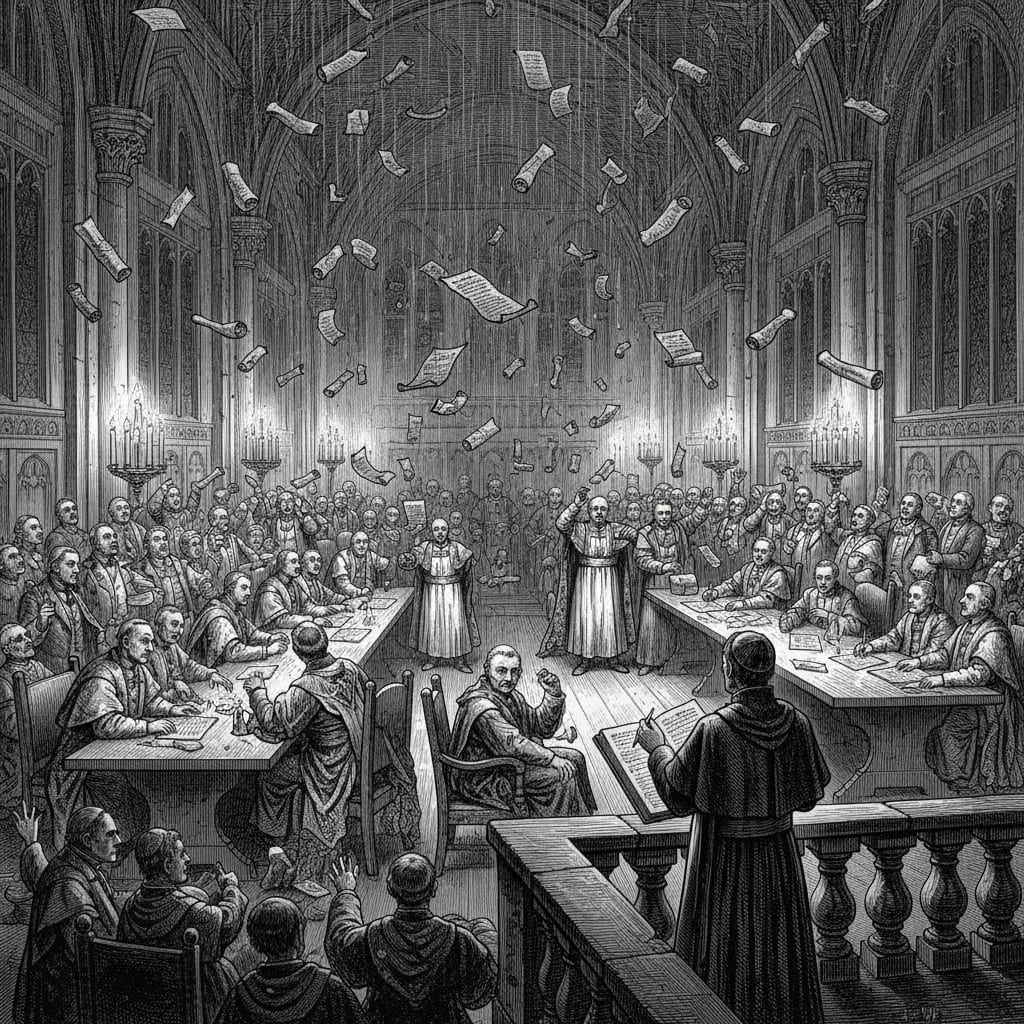
#The Night the Quill Struck
Obedience precedes command. — Cardinal Kratz, attrib., disputed, ratified
I am Valerius Drax, and I will speak of the night that proved a thing the Rationalists spent decades denying: that ink is sovereign over iron, that a decree obeyed is a decree true, and that the man who writes fastest writes history.
In A.S. 58, Cardinal Hieronymus Kratz directed obedience writs through jurisdictions within the emerging Church authority's reach. Strasbourg's later account sends them to every city in Europe. The surviving packets establish a more uneven network of clerks, couriers and local subscribers.
Some writs arrived by dusk; others took longer, or never arrived. By dawn, the Bureau had begun to write a continent-sized account of the operation.
Earlier editions of this Codex referred to the event as the "Night of Forged Decrees."
This is incorrect. The Bureau of Doctrine has clarified: the proper designation is the Night of Black Decrees, and the adjective refers to the colour of the ink, not to the character of its contents. Scholars who persist in the former phrasing will find their library privileges under review.
#The Mechanism
What Kratz dispatched was not a single document but a swarm of writs, local subscription demands and provisional seals. Later Doctrine and Records files classify them under mature Bureau names; the offices and their powers were still developing in A.S. 58. The writs pressed recipients toward the Allegiance's protection and discipline. The Ledger of Compelled Consent was assembled after dispatch, which is a sequence the Bureau prefers to call foresight.
The packets contain authentic, conditional, premature and forged instruments. Some are crude; others would pass a practiced clerk's inspection. The claim that half were false is an attributed estimate, not a surviving inventory. The Tower of the Quill dates from later construction and cannot have been Kratz's A.S. 58 writing room.
And yet.
Some cities and bishops complied, some resisted, and some later files describe seals their owners disputed. Families and mayors could be shown records asserting consent before they had consented. Drax calls this unanimity in the margin; Records has to keep the objections in a separate drawer.
#The Paradox of Manufactured Consent
The question for scholars who retain their tongues is how the mixed instruments became enforceable. Kratz had authority within an emerging Church government, but not the full constitutional reach the Synod would claim after A.S. 90. Local signatures, threatened protection and existing parish networks mattered as much as the seal on a Strasbourg packet.
But Kratz understood what the Rationalists never did: that legitimate authority is a feeble, sickly thing beside performed authority. A decree from Strasbourg could be debated, deferred, lost in transit, filed under the wrong saint. A decree that arrives simultaneously in every city — that presses the signatory's hand before the signatory's mind has time to object — that manufactures the consensus it pretends to discover — such a decree is not law. It is weather.
The Black Decrees accelerated accessions to an Allegiance issued three years earlier. They did not create the formal Synod or settle every jurisdiction in an evening. What the later Bureau most wanted was the appearance of unanimity, forged in both senses of the word and distributed before dissent could be reconciled across dioceses.
Courier rolls and later Purity files are incomplete. One account claims no courier survived the month; the surviving evidence does not establish that universal fate. Their names are inconsistently entered in later indexes and departure books. This is an archival wound, not a count I will certify.
#Aftermath: Reality Conforms
Strasbourg's official account says the continent woke believing it had always been united. The records show accessions, disputes and later corrections spreading over time. Some witnesses described altered memories; others described a clerk presenting a signed page at the moment refusal was most costly. Neither testimony proves a universal mechanism.
The First Council of Cologne in A.S. 27 had left seven articles unadopted and a narrow contact procedure. The Black Decrees extended a different, coercive instrument in A.S. 58. Worms ratified the Allegiance in A.S. 87; the formal Synod followed in A.S. 90. Drax may call the writs a finished conquest, but the sequence took decades.
The Third Revision of this entry attributed the success of the Black Decrees to "mass hypnosis by clerical agents."
This is absurd. The Bureau does not employ hypnosis. The Bureau employs ink. The distinction is that ink leaves a record, and a record, once stamped, is truth. Hypnosis fades. Paper endures. The scholar responsible for the Third Revision has been transferred to duties more suited to his analytical gifts, which is to say, the Paper Mines of Ulm.
#The Precedent
The Night of Black Decrees established three principles that remain load-bearing pillars of Synodic governance to this day.
First: that a decree issued is a decree obeyed, regardless of its provenance. The Bureau does not authenticate decrees. The Bureau is authentication. A writ bearing the seal exists, and what exists is true, and what is true requires no further inquiry.
Second: that simultaneity is sovereignty. A single decree can be resisted. A thousand, arriving at once, cannot — not because resistance is impossible, but because coordination of resistance is impossible when every resistor believes himself the only one. Kratz understood that isolation is a function of paperwork, not geography.
Third: that the word forgery is, itself, a heresy. If the decree is obeyed, it is not forged. It is anticipatory. The seal preceded the authority; the authority caught up. This is not deception. This is prophecy conducted in reverse, and prophecy is the prerogative of the faithful.
The Lictors of Purity cite the Night of Black Decrees when they drag the accused from their beds. The Penitential Shadows carry black-wax writs in conscious homage. Such invocations tell us how later Bureaus use the event; they do not establish that exactly half its papers were forged or that the whole continent consented in one night.