#On His Nature
"Superbia ante ruinam." — Bureau of Doctrine, Classification Memorandum IV.1.07-006
I am Valerius Drax, and I inscribe this entry standing, because the Bureau insists that entries concerning Atheron be composed neither seated nor kneeling. Seated implies comfort; kneeling implies submission. Both postures, in proximity to Pride's dossier, have been known to become involuntary — and the involuntary posture is the diagnostic. Three archivists before me began this file. One was found rigid at his desk, spine fused straight, chin raised past the angle his neck could support. The second was discovered genuflecting before the uncompleted manuscript, weeping with gratitude at words he himself had written. The third completed a draft of surpassing brilliance, refused all editorial correction, and had to be removed by the Lictors.
I write standing, and I write with the door open, and I write with a colleague instructed to interrupt me every quarter-hour with a question I cannot answer. Humility by administrative procedure. The Bureau is, as ever, resourceful.
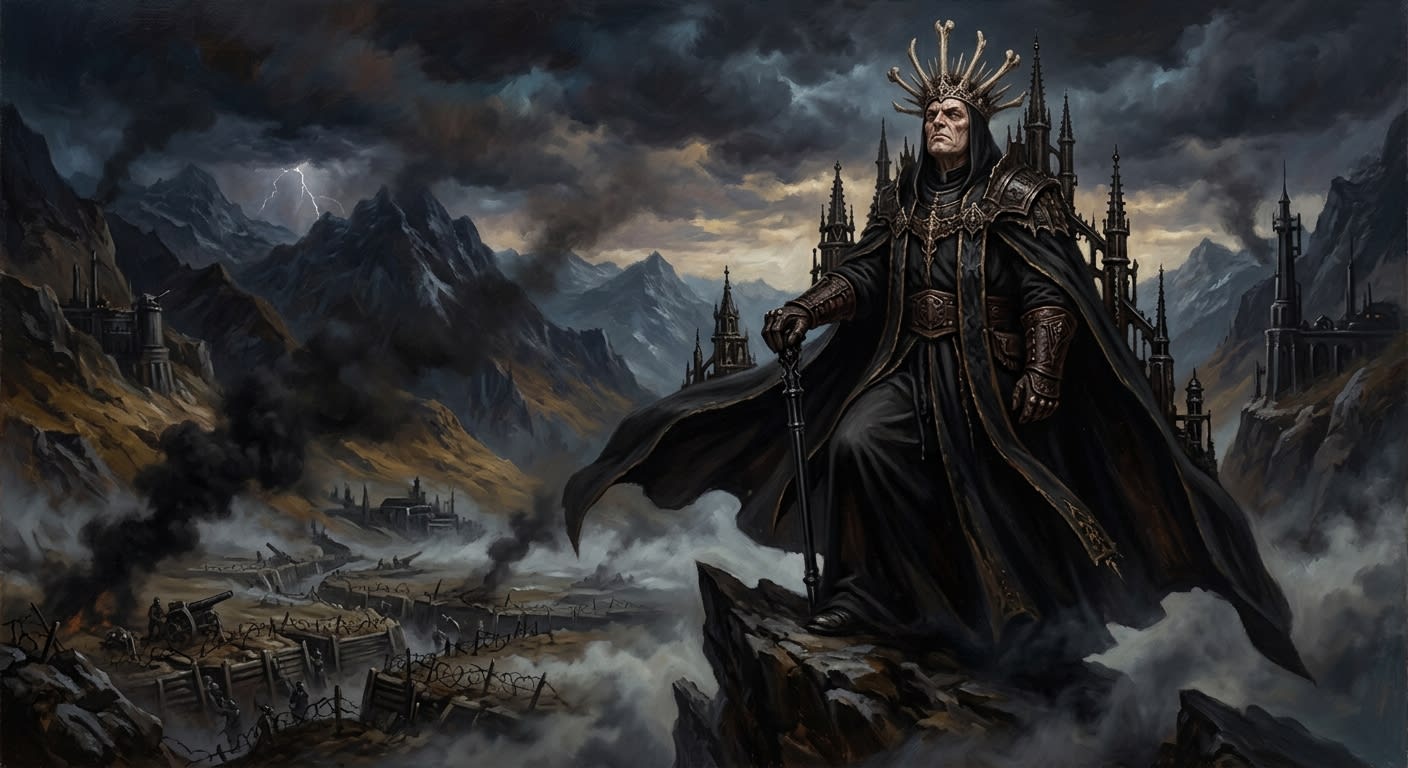
Atheron is the sixth of the Seven Sin-Generals by the Bureau's alphabetical convention, the first by his own reckoning, and — if one credits the sealed deliberations of the Bureau of Inter-Infernal Analysis — the one most likely to bring about the annihilation of the other six before the Theocracy manages it. He is Pride. He is the Exalted. He is the summit that declared itself higher than the mountain that bore it, then denied the mountain existed.
He emerged at the Sundering as the others did, crawling from the cracked Balkans in A.S. 45 when the veil tore and Hell's proxies walked the earth. But Atheron did not crawl. The testimony of those who survived the first days — and those testimonies fill three sealed folios in the Vault of Silences, cross-indexed with the Bureau of Rites and annotated by the Bureau of Doctrine with the single word confirmed — describes something that rose. A summit already formed. A mountain that had never been low. Kingdoms in his shadow found their spires dwarfed overnight, their crowns diminished to trinkets, their kings suddenly and irreversibly aware that they had been playing at sovereignty in the presence of the genuine article.
Let me be precise about what Atheron represents, because the common understanding is wrong in ways that will get men killed. The recruit on the Przemyśl ramparts thinks Pride means vanity — a peacock's sin, a courtier's weakness, a general who polishes his boots while his men starve. That recruit is dangerously mistaken. Vanity can be cured by a mirror and a frank subordinate. Pride cannot be cured at all, because the proud man cannot hear the cure. The words enter his ears and fall into a chasm where all external counsel goes — the chasm of I already knew that, and I knew it better than you.
Atheron is the inability to perceive another soul as equal. He is hierarchy calcified into theology. He is the officer who cannot process disagreement — the word arrives, and somewhere between ear and brain it is translated into confirmation, because the alternative would require admitting that an inferior possessed knowledge the superior lacked, which is impossible, because if they possessed such knowledge they would not be inferior, and they are inferior, because they are below, and they are below because the world is ordered, and the world is ordered because Atheron ordered it.
The circle is perfect. The circle is a prison. The prisoner does not know he is imprisoned, because recognising imprisonment would require the admission that something external has constrained him, and nothing external can constrain the Exalted, because he is above all external things.
#On His Dominion
The Sagittal Line runs north to south through the spine of a continent at war, and at its mid-northern reach, where the western Carpathians buckle into passes that once carried the trade of empires, stands Bastion-Przemyśl — the Wire Orchard, the mountain fortress, the choke-bastion where the tunnel wars grind and the siege-winters kill more men than the enemy's artillery. Atheron holds the eastern face of those passes. He holds them because they are the highest points visible from the Line.
I will write that again, because the strategic implications deserve the repetition: Atheron holds the Carpathian passes opposite Bastion-Przemyśl because from those ridges the garrison can see him. His spires crown every occupied summit. His banners catch the light at dawn before the sun reaches the Synod's walls. The soldiers of Przemyśl wake each morning and look east and see, above the fog and the wire and the frozen dead of the previous night's probing assault, towers that were not there yesterday — each one taller than the last, each one a sermon in architecture, each one saying the same thing the sermons always say: I am above you. I have always been above you. You have been looking up your entire life and mistaking the angle for ambition when it was merely the posture of the lesser in the presence of the greater.
His domain beyond the passes — the territory the Bureau designates as the Ebon Heights in its cartographic filings and "the place we do not send scouts twice" in its operational ones — is a kingdom of vertical obsession. Black mountains pierced with towers, each tower a proclamation, each proclamation a challenge to the tower beside it. The Cartographic Expedition of A.S. 73, which sent three hundred men into the Sundered Lands and received fourteen back, produced maps that contradicted each other in every detail save one: all fourteen survivors had drawn spires in the margins. Spires ascending past the edge of the paper. Spires that continued, by implication, beyond the boundaries of the page, beyond the boundaries of the sky, into regions the cartographers could not name and did not want to.
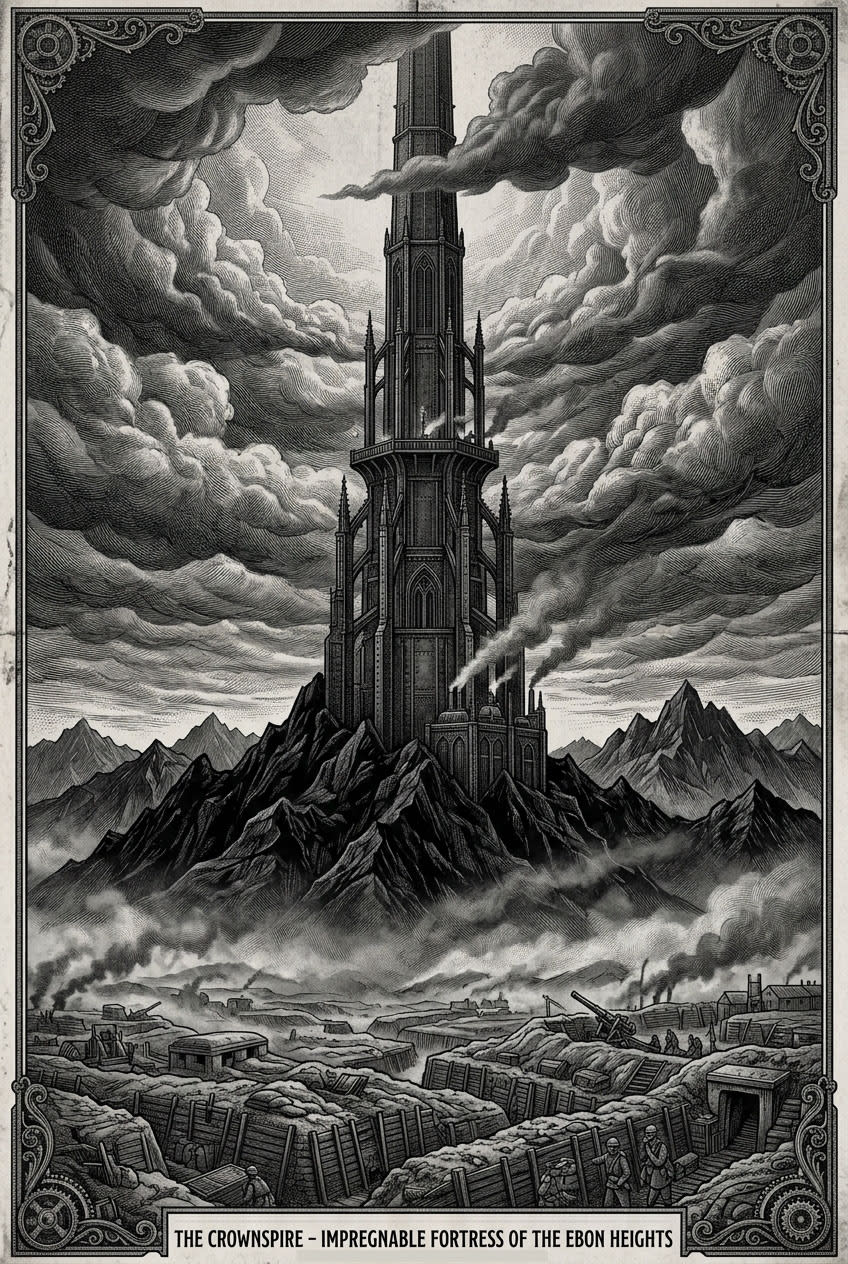
At the summit of the Ebon Heights — if "summit" applies to a place that, by all credible report, has no summit, because the moment one is identified a new spire rises above it — stands the Crownspire. The Bureau of Doctrine describes it as Atheron's seat. The Bureau of Rites describes it as "a citadel that climbs until it vanishes into heaven's vault." I describe it as the most honest piece of architecture in the Charnel Lands, because it does precisely what its builder intends: it goes up, it keeps going up, and it never stops, and the going-up is the point. There is no throne room at the top. There is no top. There is only the ascent, and the ascent is the throne, and the throne is the prison, and the prisoner is the king, and the king cannot step down because stepping down would mean becoming level with others, which would mean others exist at his altitude, which would mean he is not the highest, which is impossible.
The Crownspire is Atheron's confession, his cathedral, and his cage. He built it for himself. He cannot leave it. He would not leave it if he could. This is the theology of Pride distilled to mineral: the pedestal that becomes the body, the elevation that becomes the identity, the height that becomes the cell.
Earlier editions of this Codex described the Ebon Heights as "a mountain range of moderate elevation in the eastern Carpathian foothills."
The Bureau of Doctrine withdraws this characterisation. The Ebon Heights are not mountains. Mountains are geological formations subject to erosion and the indifference of weather. The Ebon Heights are assertions — vertical claims staked against the sky by an intelligence that regards gravity as an opinion and the horizon as an insult. The responsible cartographer has been reassigned.
#On His Methods of War
Atheron does not besiege. The word implies a peer relationship between the besieger and the besieged — two forces of comparable standing, one attempting to reduce the other. Atheron does not recognise comparable standing. His campaigns against Bastion-Przemyśl are conducted in the grammar of coronation, not conquest. Fortresses are not assaulted; they are invited to kneel. Garrisons are not overwhelmed; they are shown their proper station. The language is Atheron's own — intercepted communiques, captured from his officers, bear this register without irony, without affect, without any indication that the writers perceive it as rhetoric. They mean it. They believe it. The belief is the weapon.
His armies are the most rigidly ordered force on the eastern side of the Line. Every soldier knows precisely who stands above him and who stands below. Orders descend through the chain of command with the inevitability of water flowing downhill — and with the same creative limitation. Ideas cannot flow upward. Innovation cannot rise. A subordinate who perceives a flaw in his commander's strategy will stand in obedient silence while the flawed strategy grinds his company to bone-meal, because correcting a superior is structurally impossible. The correction would imply that the subordinate possessed superior judgement, which would make the subordinate the superior, which would collapse the hierarchy, which would collapse everything.
This brittleness is the Synod's primary tactical advantage against Pride's legions — and I use the word "advantage" as a man drowning uses the word "buoyant" to describe the plank he is clinging to. Remove a commander from Atheron's hierarchy and the subordinates beneath him do not adapt. They wait. They wait for orders that will never arrive, standing in formation while artillery reduces them to anatomical components, because acting without instruction would require independent judgement, and independent judgement would require the presumption that one's own mind is adequate to the task, and adequacy without rank is a contradiction that Atheron's forces cannot process.
The Synod has exploited this through targeted assassination of field commanders — a strategy the Bureau of War calls "decapitation strikes" and the soldiers on the Przemyśl ramparts call "cutting the tall poppies." It works. It works until Atheron's hierarchy reasserts itself, which it does with mechanical precision: within hours a new commander rises, the chain re-forms, the orders resume their downward flow. The brittleness returns. The cycle begins again. The Bureau of War has conducted this cycle forty-seven times at Bastion-Przemyśl since A.S. 180. The Bureau considers it a success. I consider it a treadmill.
But Atheron's true warfare — the warfare the Bureau of Doctrine classifies under THREAT-PRIMACY GAMMA, the warfare that keeps Inquisitors employed and the Bureau of Shadows filing triple-sealed reports — operates inside the Synod's own walls. Atheron does not need to breach Bastion-Przemyśl. He does not need to send an army across the wire. He needs only to whisper into the ear of a garrison commander that the commander's superiors do not appreciate his brilliance — and he is correct, usually, because brilliance is common at Przemyśl and appreciation is rationed more tightly than ammunition.
His influence-demons — the wispy, intangible agents that flit between human settlements, opportunists of wounded dignity — seek out the overlooked. The officer passed over for promotion. The engineer whose designs were rejected by a committee of lesser minds. The chaplain whose sermons draw crowds that his bishop's do not. These are not weak men. That is the horror. Atheron's targets are frequently the most capable people in their sphere — men and women whose resentment at being undervalued is justified, whose sense of their own worth is accurate, whose conviction that they deserve more than they have received is, by any honest measure, correct.
The influence-demon agrees with them. That is all it does. It agrees. You are better than this. They do not see your worth. You should be in charge. The words feel like validation. They feel like justice. They feel like someone has finally looked at you — really looked — and seen what you have always known.
And the pedestal forms beneath your feet. And your spine straightens. And your chin lifts. And one morning you cannot bow, and you do not know when you stopped being able to, and you do not care, because bowing is for those below you, and you are above, and you have always been above, and anyone who says otherwise is simply looking from too far down to see clearly.
#On His Armies
Those who have survived engagement with Atheron's legions and retained sufficient coherence to file a report — a pool that shrinks with each campaign season, not because the casualties increase but because the coherence decreases — describe a host organised with a purity of hierarchy that the Synod's own military bureaucracy regards with something between professional admiration and existential dread.
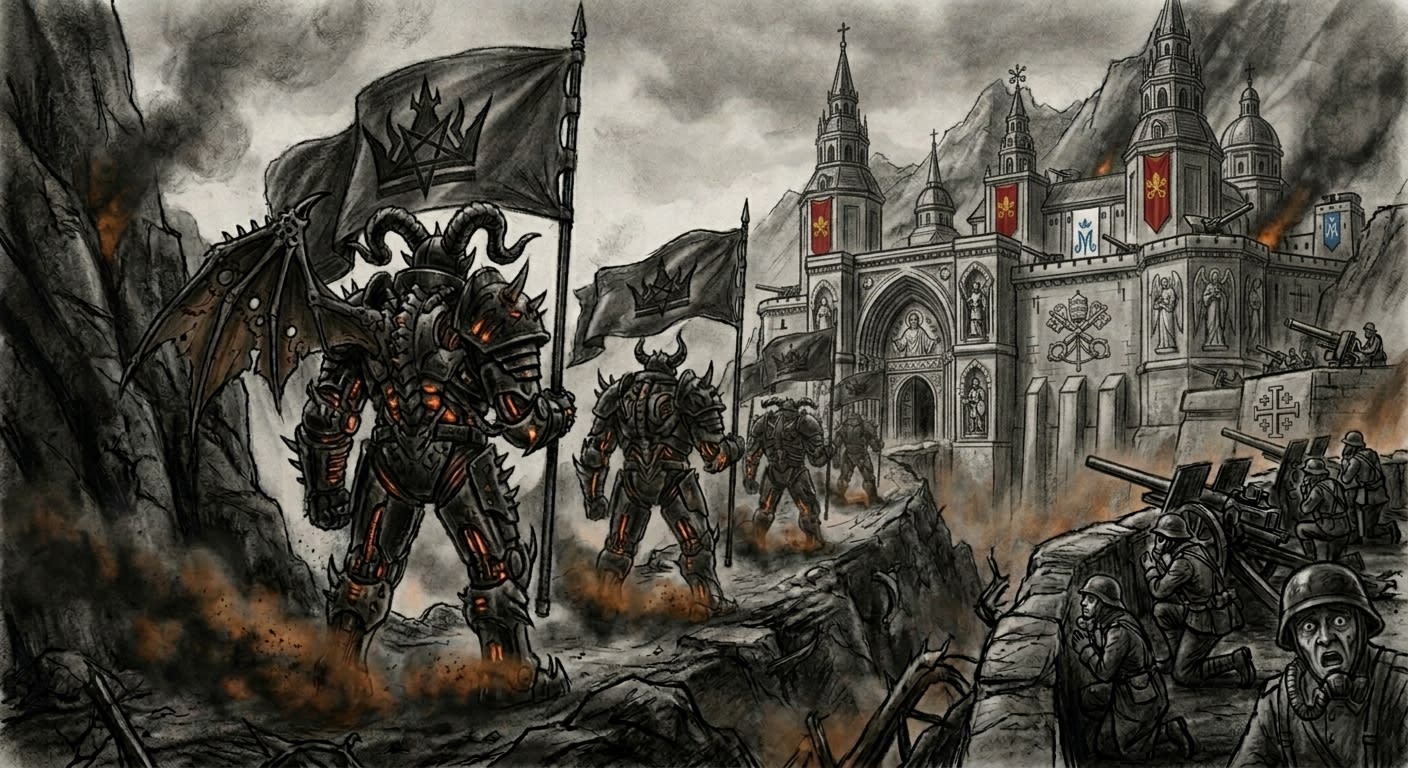
The Crownguard Titans form the vanguard. Armoured giants, each bearing a banner taller than the formation it leads, their every step calibrated to a processional rhythm that turns advance into ceremony. They do not charge. Charging implies urgency, and urgency implies that the outcome is uncertain, and uncertainty is beneath them. They walk. They walk toward the enemy fortification at the pace of a coronation march, and the banners they carry impose a pressure on the gaze that the Bureau of Rites classifies as "involuntary genuflection stimulus." Men on the Przemyśl walls have been found kneeling at their gun-stations with no memory of having knelt. The Crownguard walked past them without pausing. Kneeling men are beneath notice.
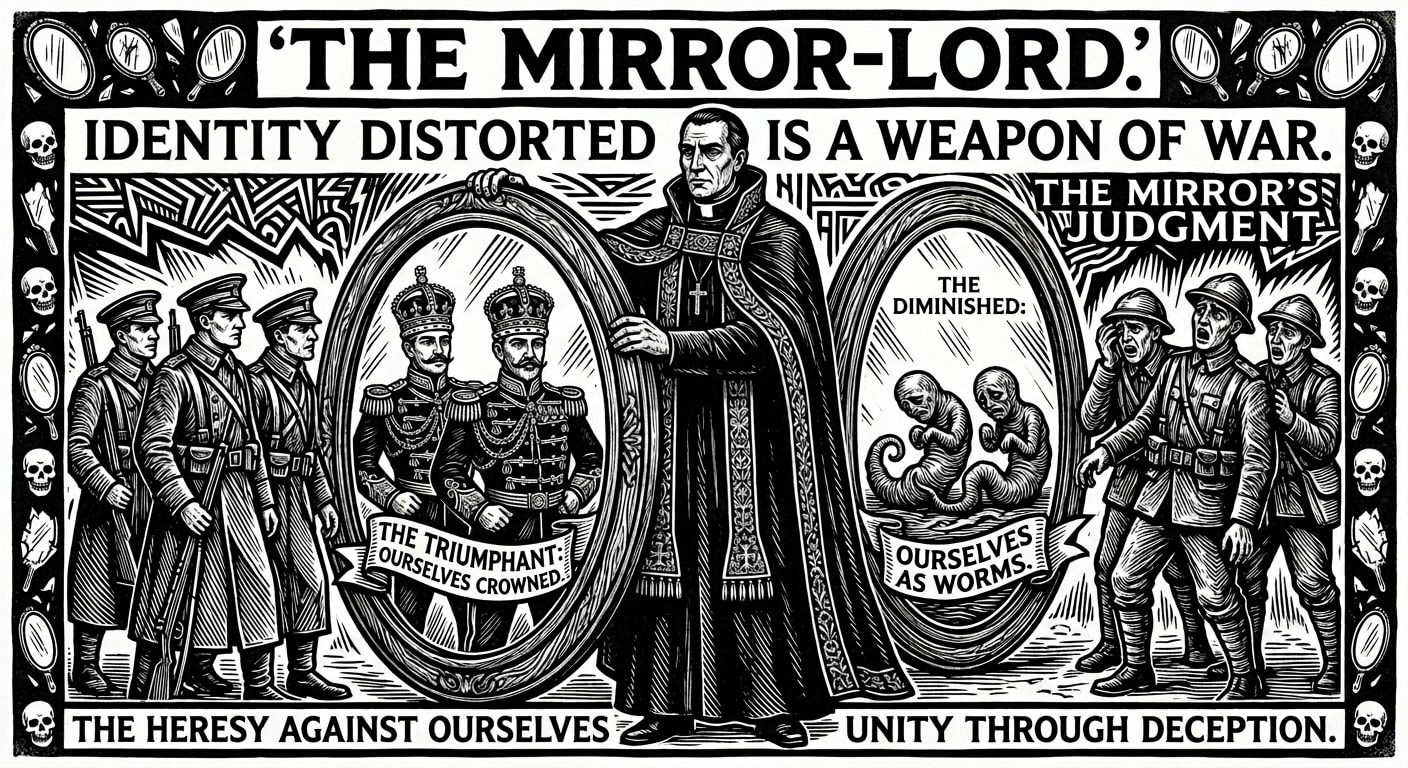
The Mirror-Lords follow — support elements who carry no weapons because their weapon is your own estimation of yourself. In the presence of a Mirror-Lord, the proud see themselves as magnificent beyond all rival; the uncertain see themselves as worthless beyond all rescue. Both visions are lies. Both are believed absolutely. A Mirror-Lord deployed against a fortified position does not break the walls; it breaks the garrison's ability to cooperate, because cooperation requires seeing one's comrades as equals, and the Mirror-Lord has made equality impossible. Every soldier is either a king who cannot take orders or a worm who cannot give them.
The Sun-Spear Legion provides ranged assault — phalanxes that hurl lances of searing radiance, weapons that blind before they kill. The blindness is theological as much as optical. A soldier struck by a Sun-Spear and left alive reports, in the hours before the light-burns claim his sight permanently, that he saw — briefly, agonisingly — a vision of himself as Atheron sees him: small, dim, a smudge of biological activity on a landscape that exists primarily as a surface for the Exalted to stand upon. Many do not recover. The ones who do are reassigned to rear-echelon duties and do not discuss what they saw.
The Ascendant Shades are assassins, and their method is the cruelest of Atheron's arsenal: they strike from the victim's own reflection. A commander studying a map by lamplight sees his shadow move independently; a sentry checking his reflection in a polished breastplate finds the reflection reaching for a blade the sentry does not hold. The kill is always delivered from below — from the reflection, the shadow, the lesser image — and the theological insult is the point. You were killed by a copy of yourself. The copy was sufficient to the task. You were replaceable. You were, in the final arithmetic of Pride, not even the best version of yourself.
The Spire-Crusher is Atheron's war-engine, his siege instrument, and his most perfect architectural confession. A mobile tower that grows taller with every mile of its advance. It does not batter walls. It does not fire shells. It simply rises, and rises, and rises, until the fortress it approaches is dwarfed into irrelevance — a pebble in the shadow of a mountain that should not exist and cannot be ignored. Garrisons have surrendered to the Spire-Crusher without a shot fired. The shame of being small was sufficient.
#On the Cults of Pride
The Golden Masquerade of Varna is the cult the Bureau will discuss in public filings, because the Golden Masquerade is theatrical enough to serve as a cautionary tale and contained enough to suggest that Pride's infiltration has limits. This is the Bureau's preferred narrative. The narrative is a lie. Atheron's cults do not wear golden masks in Balkan opera houses. They wear the uniforms of the Synod. They sit on the Synod's committees. They draft the Synod's memoranda. They are — and here I must write a sentence that the Bureau of Doctrine will certainly demand I redact, so I will write it with sufficient clarity that the shape of it remains visible even through the ink they will pour over it — indistinguishable from the Synod's own hierarchy, because the Synod's own hierarchy is the architecture that Atheron most admires.
Atheron's cults organise through rigid stratification — a ladder of five rungs that mirrors, with uncomfortable precision, the Synod's own ecclesiastical ranks:
The Aspirants are the lowest — men and women still striving to prove their superiority, still hungry for recognition, still willing to serve the structure because they believe the structure will eventually elevate them. They are the most dangerous, because they are still capable of action. The Elevated and the Entitled and the Crowned have ceased to act; they simply are. The Aspirants still do, and what they do is whatever the cult demands, because obedience is the price of ascent, and ascent is all they have.
The Elevated have achieved position and defend it with the ferocity of men who know, at some depth they cannot access, that the position was given and can be taken. The Entitled have ceased to defend because defence implies the possibility of loss, and loss is inconceivable. The Crowned rule within their cells with absolute authority and absolute isolation. The Exalted — the highest rank, the terminus, the destination — have fused so completely with their position that they are no longer quite human. They stand. They pronounce. They do not eat, or sleep, or bend. Their spines have calcified into columns. Their necks have stiffened past the angle of condescension. Their eyes look down and cannot look elsewhere. They are statues that breathe. They are monuments to the sin they serve. They are, if the Bureau of Rites is correct in its sealed assessment, already dead in every sense that matters except the biological.
The physical mutations come gradually. Long-term servants of Atheron report a stiffening of the spine that no physician can treat — a straightening past the natural curvature, past comfort, past the ability to sit or recline. The neck extends. The chin rises. Crown-growths emerge from the brow — metal or bone, the Bureau's alchemists cannot determine which — extruding in shapes that suggest coronets, diadems, the regalia of an authority no earthly institution has conferred.
In the final stage, the feet fuse to whatever surface elevates them. A pedestal. A dais. A chair. A step. The victim stands forever, raised above the ground by inches or feet, unable to descend, unable to kneel, unable to do anything but look down on a world of inferiors who were once peers, once friends, once family — and who are now furniture.
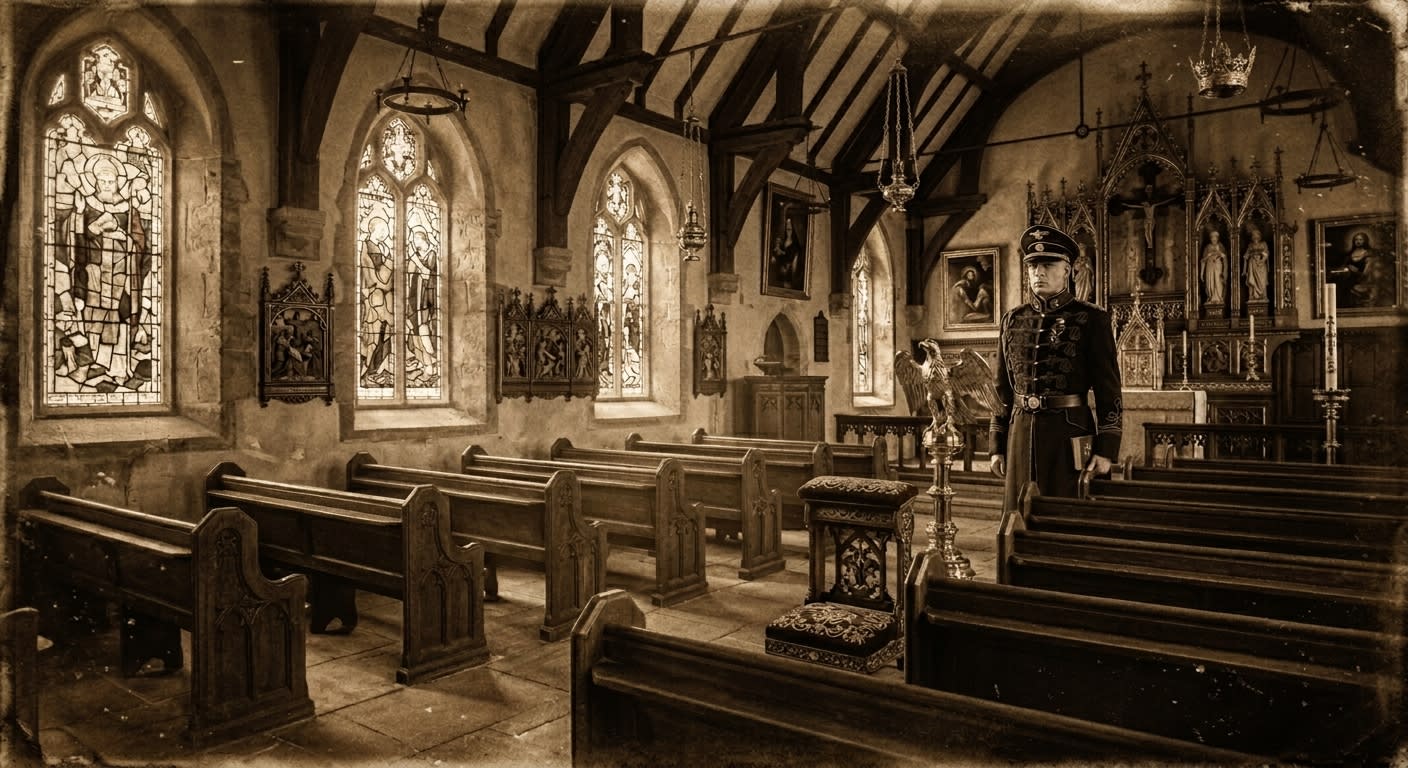
The Bureau of Purity's Atheron-contact register, maintained at Bastion-Przemyśl under seal since A.S. 188, lists ████ confirmed cases of pedestal fusion among Synod personnel in the eastern Carpathian theater. Of these, ██ held the rank of captain or above. The register's most recent entry, dated ███ A.S. ███, records a ████████████ found fused to the pulpit of the garrison chapel at ██████████, still delivering a sermon to an empty nave. The sermon, when transcribed, proved to be a recitation of his own titles. It had been going for ██ days.
#On His Rivalries
Atheron despises the other Sin-Generals with a contempt that would be admirable if it were not so perfectly consistent with his diagnosis. Velmora he scorns for counting coins — a serpent belly-down in the dirt, measuring her worth in metal when worth is measured in altitude. Kargath he dismisses as an appetite with no ambition beyond the next meal, a crawling gut without the dignity to rise from the table. Maldrake he mocks as a beast of fire with no crown to show for the burning — wrath without purpose, destruction without dominion, heat without light. Syrion he does not discuss at all, which is the deepest insult Atheron can offer: irrelevance. Velkara he watches with the wariness of the throne for the courtesan — she operates inside his structures, she seduces his officers, and she does it with a finesse that his brute hierarchy cannot match. Morwen he fears, though the word "fear" applied to Atheron requires qualification: he fears her because she steals identities, and identity is all he has.
But the rivalry that burns at the core of the Ebon Heights — the rivalry that the Bureau of Inter-Infernal Analysis monitors with more attention than it gives to any frontline engagement — is the rivalry between Atheron and the Great Deceiver himself. Pride brooks no master. Atheron serves the Great Deceiver because the Sundering made him a proxy of the Great Deceiver's will, but service is anathema to his nature, and the Black Throne that the Great Deceiver occupies — or does not occupy, or occupies from a position so far above occupancy that the word loses meaning — is the throne Atheron covets with a hunger that would make Kargath envious.
The Bureau of Doctrine has classified the suggestion that a Sin-General might rebel against the Great Deceiver as Speculative Heresy, Third Degree. Discussion is permitted only within sealed chambers. I am writing this in an unsealed chamber. The Bureau may interpret this as it wishes.
#On the Countermeasures
The Synod's defences against Atheron are, in the candid assessment of every field commander I have consulted and several I was not authorised to consult, inadequate. They are inadequate because Atheron's sin is the sin the Synod understands least and practises most.
The Doctrine of Equality Before the Divine teaches that all humans are equal in the Creator's sight — a fine principle that encounters immediate difficulty in an institution governed by Hierarchs above Bishops-Praetorial above Wardens above Inquisitors above Confessors above the laity, where rank determines not merely authority but access to the sacraments, proximity to the reliquaries, and the quality of one's funeral. The Synod preaches equality and practises hierarchy. Atheron observes the gap between sermon and structure, and smiles, and barely needs to act.
Humility Practices — the washing of feet, the serving of meals, the performance of tasks "beneath" one's station — are mandated at quarterly intervals for all officers above the rank of captain. The Bureau of Purity administers the programme. The Bureau's internal review, which I obtained through channels the Bureau would prefer I had not, notes that sixty-three percent of participating officers report the exercises as "spiritually rewarding," and that the same sixty-three percent showed no measurable reduction in hierarchical rigidity. Practised humility, the review concludes, breeds one of two outcomes: genuine self-examination (rare) or the secret conviction that one is superior because one submits to humility exercises that lesser men would resist (common).
Rotation of Command prevents officers from fusing with their positions — literally, in the case of Atheron-compromised personnel. No officer at Bastion-Przemyśl serves in the same post for more than eighteen months. The rotation works, in that it prevents the worst manifestations of rank-calcification. It fails, in that it also prevents expertise, continuity, and the kind of institutional memory that wins campaigns. Atheron's forces do not rotate. Atheron's forces know exactly who they are and where they stand and what they owe to whom. The clarity is lethal.
Confession of Pride — sessions in which officers confess feelings of superiority, moments of contempt, instances of looking down — produces the most honest intelligence the Bureau of Purity receives from any programme, and the most useless. The officers who confess are the officers who can perceive their own pride, which means they are the officers least at risk. The officers most at risk — the ones whose spines are straightening and whose necks no longer bend — cannot confess what they cannot see. They arrive at the confessional, kneel (if they still can), and report with perfect sincerity that they harbour no feelings of superiority.
They are telling the truth as they understand it. They do not feel superior. They are superior. Feeling does not enter into it.
#The Ratification
I have written this entry standing, as instructed, and Subdean Fossick has interrupted me eleven times with questions ranging from the unanswerable to the incomprehensible. My spine is straight because I have been on my feet for six hours. My spine is only straight because I have been on my feet for six hours. I have checked.
Atheron is the Sin-General the Theocracy discusses least and resembles most. He presses Bastion-Przemyśl from the eastern Carpathians, and his spires are visible from the walls at dawn, and the garrison wakes each morning to the knowledge that something above them is watching, and judging, and finding them wanting — and the garrison is not certain, on the worst mornings, whether the judgement comes from across the wire or from above their own chain of command.
The Bureau of Doctrine wishes me to add that the Synod's hierarchy is divinely ordained, categorically distinct from Atheron's corrupted imitation, and sustained by the grace of the Creator rather than the malice of the Great Deceiver. I add it. The Bureau wishes me to add that the distinction is clear, self-evident, and beyond dispute. I add it. The Bureau does not wish me to add that Atheron's hierarchy and the Synod's hierarchy produce, in their terminal stages, the same posture: the rigid spine, the upturned chin, the eyes that look down and cannot look elsewhere.
I add it anyway. Fossick will not catch this one.