
#On Her Nature
"The Bureau classifies the seven Sins by the damage they do to the body, the state, and the soul. Velkara is the only Sin-General who scores maximum on all three rubrics and minimum on the metric the Bureau cares about most: visibility."
I write this entry at the instruction of the Bureau of Doctrine and against the counsel of my own nerves, which have suggested, with increasing urgency over the three weeks of its composition, that the act of studying Velkara long enough to describe her is itself a diagnostic criterion for her influence. The Bureau has overruled my nerves. The Bureau overrules everything. Here, then, is the entry on the Sin-General of Lust, compiled from field reports I was not supposed to read, confessional transcripts I was certainly not supposed to read, and a Bureau of Purity dossier whose title page bore the annotation "Destroy after reading — this means you, Drax" in the Procurator's own hand. I have read it. I have not destroyed it. The Procurator and I will discuss the matter at a time of her choosing, which I anticipate will be unpleasant and brief.
Velkara is not the strongest of the Seven. She commands no territory the Bureau can shade on a map. She holds no sector of the Sagittal Line in the manner of Kargath's marshes or Maldrake's slag-wastes, no fixed domain the Bureau of War can point to and declare there, that is the enemy's ground, and this is ours. Velkara has no ground. She has no need of it. She is already inside the walls.
The Bureau of Purity classifies her as a doctrinal infection — something that enters through weakness of will and hollows out the faithful from within. The Bureau of War classifies her as an infiltration-spectrum threat. The Bureau of Doctrine, in a moment of rare candour that I suspect was accidental, classified her operational methodology as indistinguishable from ordinary human appetite, which is the problem. I have read all three classifications. None is wrong. None is sufficient. Velkara is what happens when the sin wakes up one morning already resident in the heart of a man who had, until that morning, considered himself righteous.
She is the fifth of the Seven to have manifested at the Sundering, or so the Bureau's much-revised chronology asserts. Syrion's fog had already rolled across the Balkans; men slept and did not wake, or woke as lesser versions of themselves. When the fog seemed to lift — when the stupor passed and the survivors blinked into consciousness and believed the worst was over — Velkara was already among them. She had replaced torpor with appetite. She had not announced herself. She did not need to. The appetite announced itself, and the men it seized mistook it for their own renewed vigour, for the relief of survival, for the ordinary human desire to feel alive after months of sleeping through a war. They celebrated. They reached for one another. They reached for wine and flesh and spectacle and the sharp bright edge of any sensation that proved they had not died in the fog.
By the time the Bureau noticed that the celebrations had not stopped, that the reaching had become grasping, that the grasping had become something mechanical and joyless and endless — Velkara had been operating for a decade.
#On Her Domain
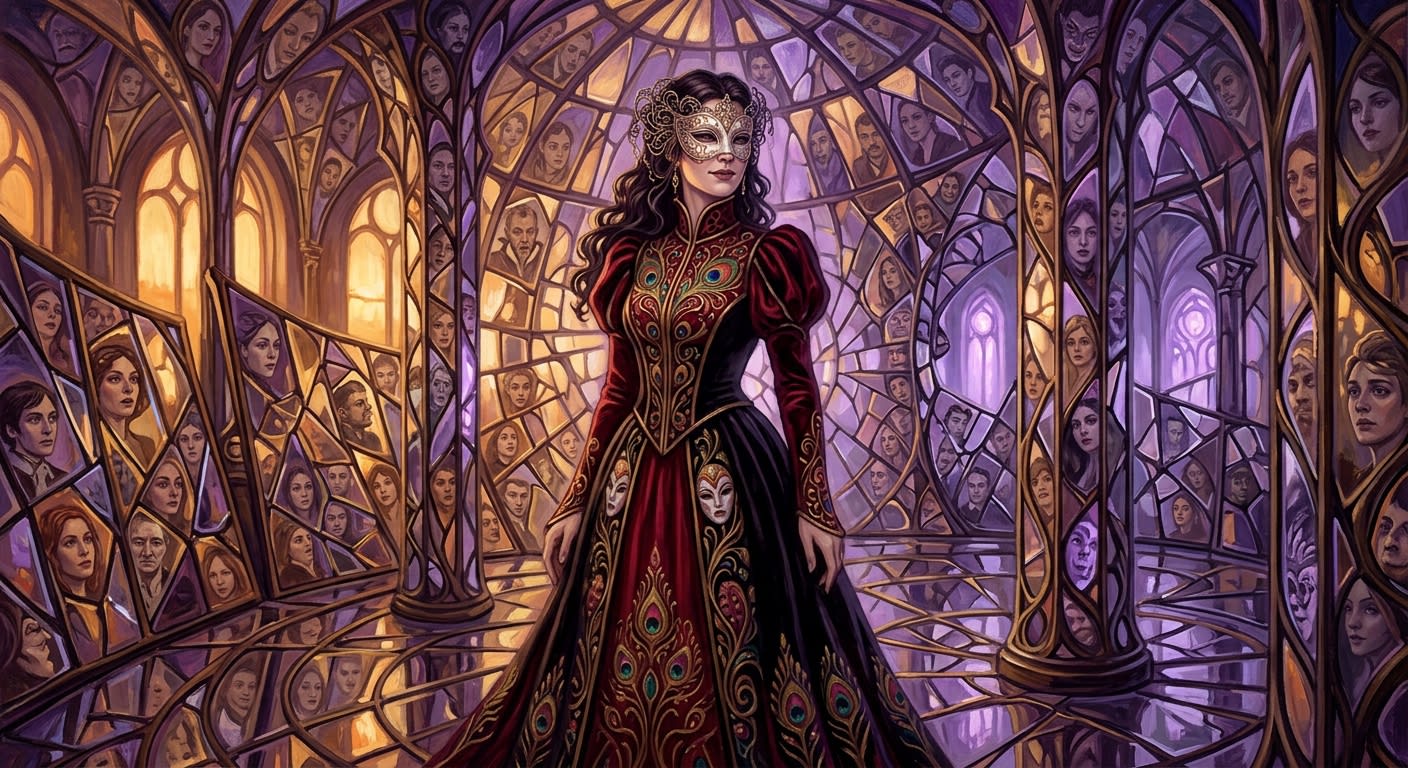
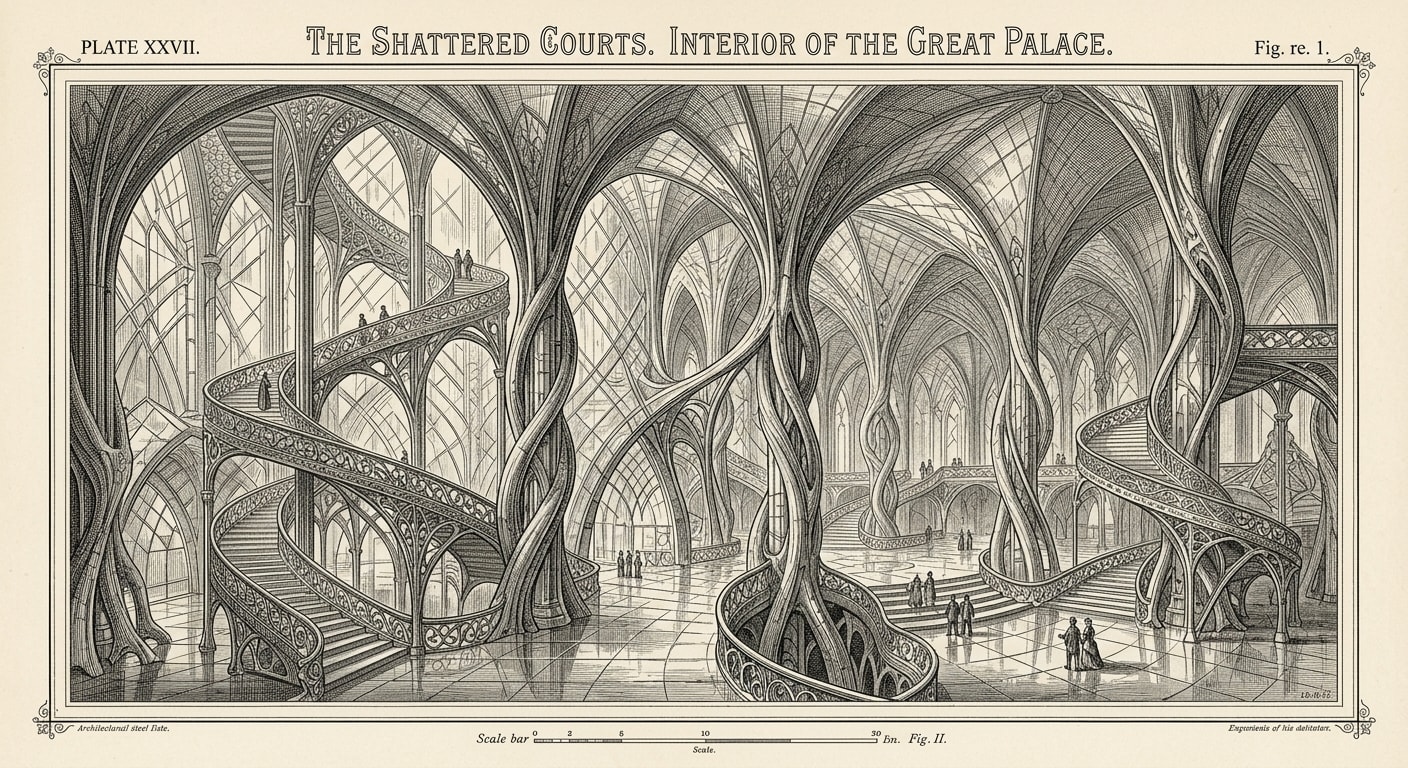
The Shattered Courts are Velkara's nominal seat — the Bureau uses the word nominal because it cannot bring itself to use the word home for a place it has never located, mapped, or confirmed exists in the spatial dimensions the Bureau of Engineering is equipped to measure. The trench-scholars describe the Courts as a palace of glass and flesh, where every mirror breathes and every rose bleeds, gardens of thorn and velvet that stretch for miles into a landscape that does not correspond to any known geography east of the Line. Lovers who wander in do not wish to be found. They are not found. Their names persist in the Ledger for seven years under the designation Missing, Category Unspecified, after which the Bureau of Records reclassifies them as dead, which may or may not be accurate, and which is certainly more convenient for the purposes of estate settlement.
The territory Velkara commands — to the extent that the word territory applies to a Sin-General who operates as perfume rather than army — falls into five recognised classifications, each representing a stage of her influence's maturation.
The Pleasure Palaces were once the great cities of the Balkans. The courts of nobility where sensation was cultivated, the academies where aesthetic refinement was practiced, the salons where pleasure was an art and appetite a philosophy. Velkara did not ruin them. She completed them. She removed the last restraints — the social, the moral, the physiological — and let the pursuit of sensation run to its conclusion. The Palaces still operate. Everything is available. Every appetite is serviced. The visitors pursue experience after experience, each more extreme than the previous, their faces increasingly blank, their hands increasingly frantic. They cannot stop. Stopping means confronting the grey. The grey is worse than anything the Palaces can offer, and the Palaces can offer everything.
The Hunting Grounds formalise the chase. Elaborate games of pursuit and capture, seduction and conquest, conducted across landscapes of engineered anticipation — hills that conceal, forests that delay, clearings that reveal. The prey begin willing. The hunters never tire. The rules change because the old rules ceased to excite three seasons ago. The Grounds are littered with the caught — those who were pursued, obtained, and dropped the moment the thrill of pursuit died, which was the moment of obtaining. Some have been there so long they have forgotten they were people before they were quarry. They wait to be chased again. The wait is the worst part, because during the wait they almost remember what they were.
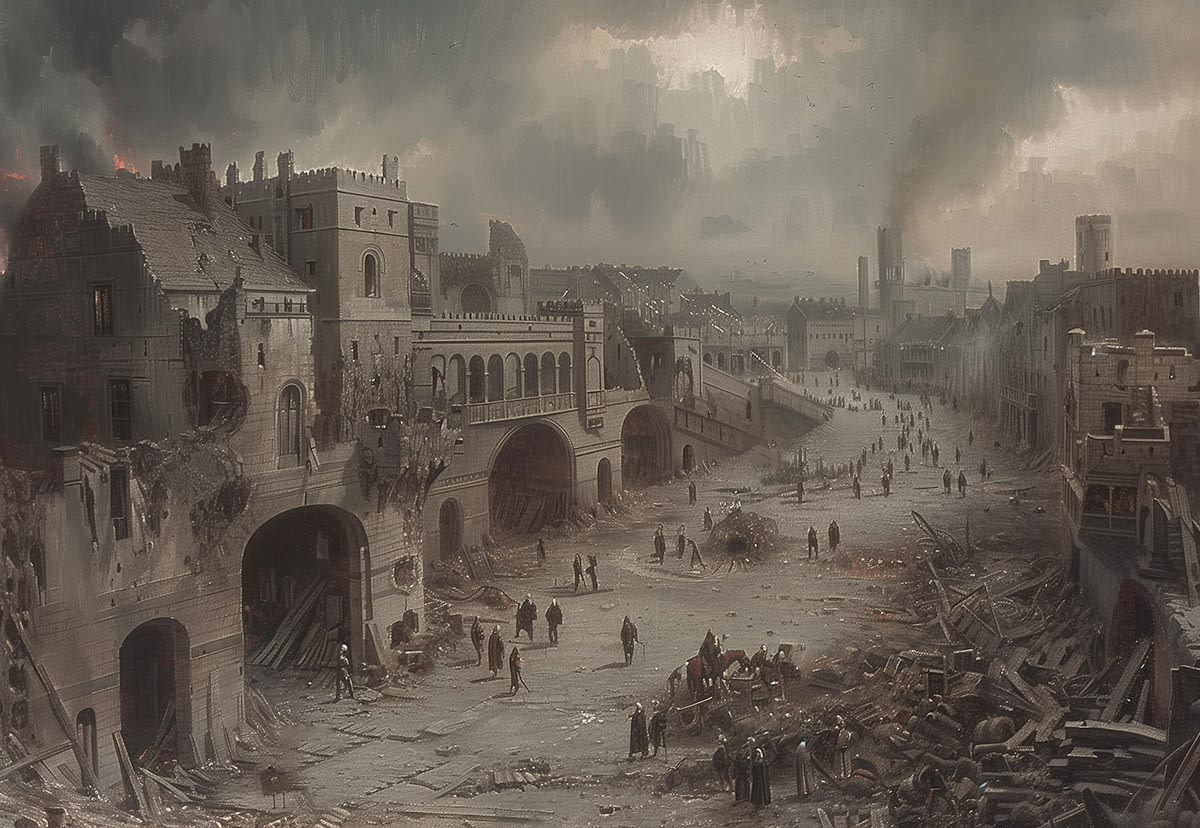
The Grey Wastes are where Velkara's influence has matured to its terminus. The colour has drained from the landscape — this is no metaphor, the Bureau of Engineering confirms; light itself behaves differently in these regions, refracting through a medium that absorbs wavelength with the same methodical thoroughness with which Velkara absorbs joy. The inhabitants couple without feeling. They feast without tasting. They perform the gestures of sensation the way a priest who has lost his faith still performs the Mass — from muscle memory, from the absence of any alternative, from the terrified hope that going through the motions might, eventually, produce the thing the motions once represented. It does not.
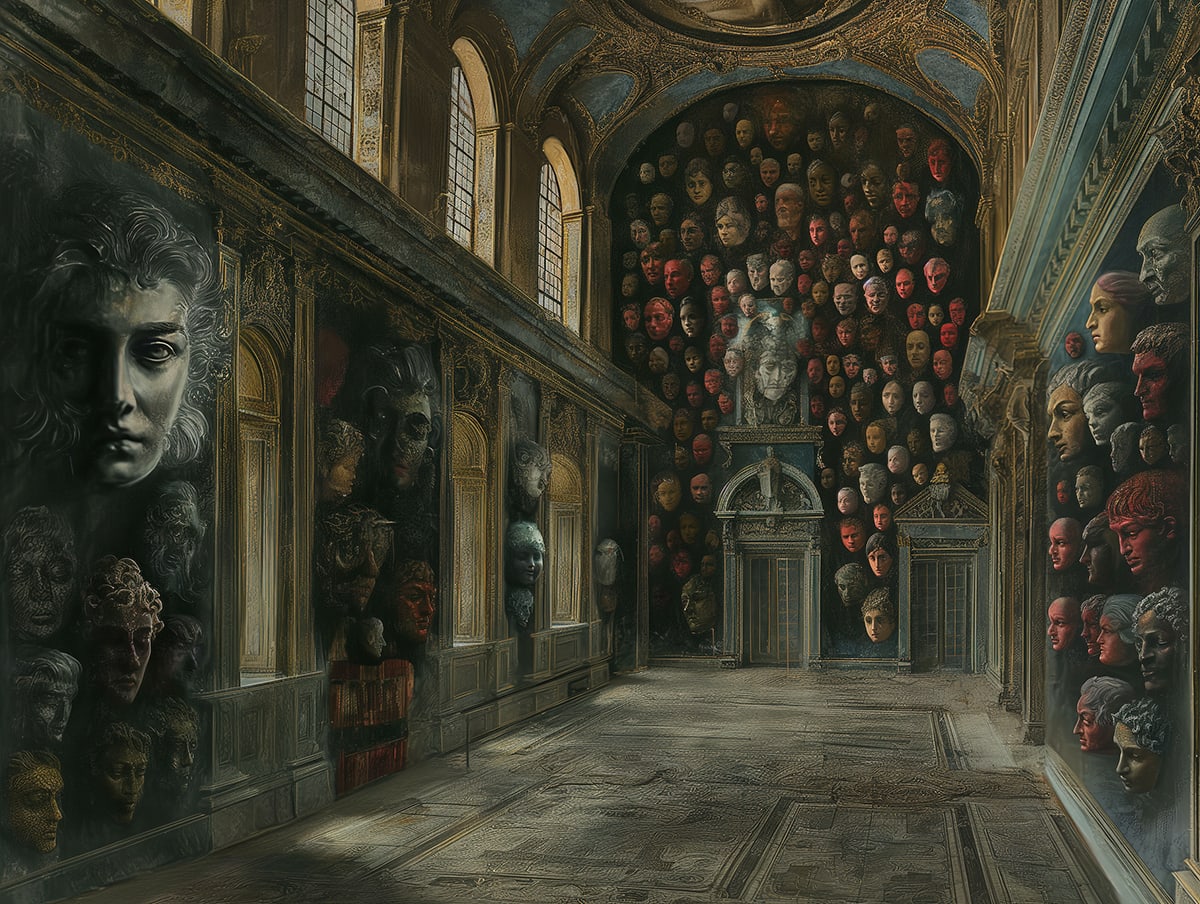
The Trophy Halls are collections. Walls lined with faces — just faces, the part that was looked at during the chase, preserved when the rest was discarded. Some collectors remember who each face belongs to. Most gave up counting centuries ago, and the counting was the last thing that felt like anything, and now even the counting is routine.
The Escalation Courts are the end. Arenas where pleasure has been exhausted and its devotees have moved on to intensity in any form. Pain registers when pleasure does not. Fear provokes sensation when desire cannot. The Courts are where Velkara's servants go when they have burned through everything softer, and the things that happen in the Courts would fill this entry with descriptions the Bureau of Doctrine will not permit me to inscribe and that I, for once, am grateful to be forbidden from inscribing.
#On Her Armies
Velkara's forces do not march. They arrive. They are already present in the garrison when the garrison realises it has been infiltrated, already seated at the officer's table when the officer notices the face across from him does not belong to anyone on the duty roster, already embedded in the supply chain when the quartermaster discovers that the manifests have been amended by a hand he cannot identify and in an ink that smells, faintly, of something he has been trying not to think about for three weeks.
The Bureau of Purity's field taxonomy classifies Velkara's demons into six orders, each representing a stage in the progression from desire to extinction.
The Chasers are Velkara's vanguard — magnificent in pursuit, magnetic in the hunt, possessed of a charm that makes the target feel singular, chosen, the only soul in the world worth wanting. They are relentless and specific and intoxicating, and they mean none of it. The wanting is genuine; the object of the wanting is irrelevant. A Chaser does not desire you. A Chaser desires the desiring, and you are the current instrument of that desire, and when you are obtained — and you will be obtained, because the Chasers have never failed — the Chaser is already turning, already scanning, already hunting, because the having killed the wanting and the wanting must be revived at any cost. They leave thousands behind them. The thousands all wonder what they did wrong. The answer is nothing. It was never about them.
The Hollow Ones are what Chasers become when the chase has been run so long that even the wanting has faded. They still pursue. They still obtain. They do it from habit, from mechanism, from the desperate and dwindling hope that this time the circuit will complete and they will feel something. It never does. Their faces are beautiful and vacant. Their hands are skilled and cold. They are the endpoint — what every servant of Velkara's design eventually becomes. They are not melancholy. Melancholy would be something.
The Intensity-Seekers have burned through pleasure entirely and graduated to the only remaining source of sensation: extremity. Pain works when ecstasy does not. Terror produces a response when arousal cannot. They are not sadists — sadism presupposes enjoyment, and enjoyment is precisely the faculty they have lost. They are experimenters, clinicians of the nerve, systematically escalating through every possible stimulus in search of one that registers. They have no limits. Limits require a capacity for consequence, and consequence requires feeling, and feeling is what they are trying to recover. They are Velkara's most dangerous servants because they cannot be threatened, bribed, or reasoned with. You cannot threaten someone who would welcome the pain.
The Trophy-Keepers have replaced sensation with arithmetic. They do not enjoy their conquests. They catalogue them. The number matters when the feeling does not — a tally mark on a ledger that grows longer but never heavier, because weight requires meaning and meaning left these creatures several hundred conquests ago. They remember every encounter by sequence. They remember none by name. Names are irrelevant. Only the count persists, and the count is the only evidence they have that they are still doing something, and doing something is the only alternative to the grey, and the grey is — but I repeat myself. The grey is always the alternative.
The Discarded Made Demon are the saddest entry in the taxonomy, and I use the word saddest with full awareness that the Bureau of Doctrine prefers me not to express sympathy for the enemy's servants. These were human. They were objectified with such sustained thoroughness that they became what they were treated as — things, instruments, means to an end that was itself a means to another end, turtles of purpose stacked downward into nothing. They serve Velkara's hunters now, offering themselves as quarry, as amusement, as a surface upon which the hunt may practice its indifference. They do this from reflex. The capacity to imagine themselves as anything other than objects of use was the first thing Velkara's influence consumed. They do not know what they have lost. That is Velkara's kindness, if you wish to call it that. I do not.
The Ennui-Bearers are Velkara's mature weapon — her artillery, if the metaphor can be forgiven, though artillery at least has the decency to announce itself. The Ennui-Bearers do not attack. They infect. Their presence causes sensation to fade in others — colours dim, pleasures pall, touch becomes muted, music flattens into noise. A soldier exposed to an Ennui-Bearer for three days will find that his evening meal tastes of nothing. A week, and the letters from home provoke no emotion. A month, and he cannot remember why he cared about anything. The Ennui-Bearers are Velkara's endgame: the spreading of the grey into territories she has not set foot in, the slow extinguishing of the capacity for joy in men who will never know why it left.
Earlier editions of this official documentation described the Ennui-Bearers as "a theoretical concern, unlikely to be encountered in significant numbers west of the Line."
The Bureau of Purity has revised this assessment. Ennui-Bearer activity has been confirmed in six Synod garrison towns south of Bastion-Przemyśl. The Bureau declines to name the towns. The Bureau does note, with the measured tone of an institution trying not to scream, that the affected garrisons reported no change in morale — which is precisely the symptom.
#On Her Methods of War
Velkara does not wage war. She wages erosion.
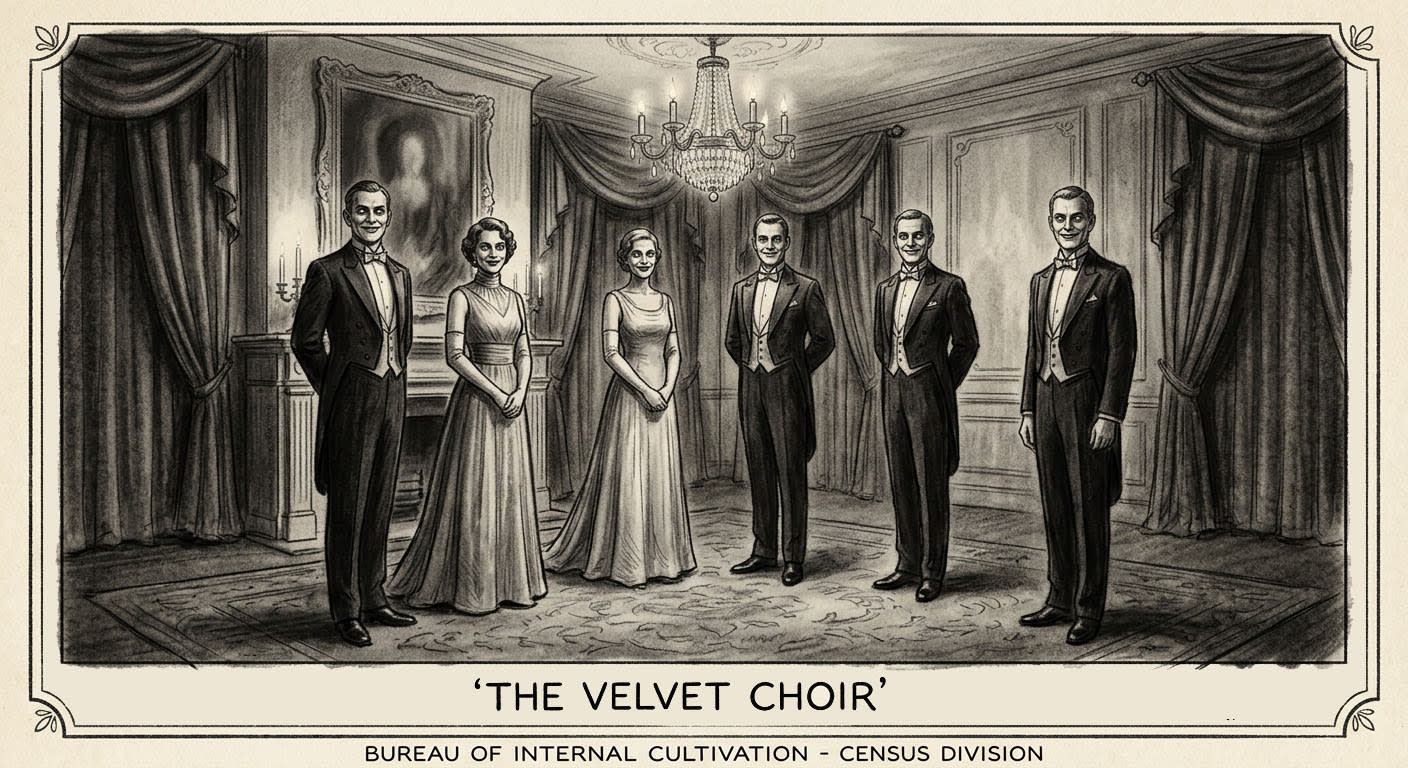
The Velvet Choir is her primary instrument within Synod territory — an order of infiltrators, seducers, and corrupters-of-conscience that operates, by the Bureau of Purity's own reluctant estimate, in approximately thirty Synod settlements of meaningful population. The Choir does not recruit through ideology. It recruits through escalating compromise. A minor indiscretion, accepted. A larger transgression, facilitated. A betrayal, made to feel inevitable. By the time the compromised party understands the trajectory, the trajectory is the only road still open, and the Choir member who guided them onto it has already moved on to the next prospect.
The Crimson Concord is the Choir's operational architecture within Bastion-Constantinople and the southern theater command — cells embedded so deeply in the military and administrative structures that the Bureau of Purity cannot determine where the Concord ends and the Bureau begins. Officers vanish and return as something that answers to the same name, attends the same briefings, wears the same insignia, and serves a different master. The annual review acknowledges this. The annual review cannot identify the officers. The annual review suggests, in a passage that reads as though it was written at speed and in distress, that the officers themselves may no longer be able to identify the seam between their original loyalties and their current ones, because Velkara's intercession has produced in them a capacity to believe their own cover stories with a completeness that renders interrogation useless. The Bureau finds this hypothesis alarming. The Bureau has not, to my knowledge, produced a counter-strategy. The Bureau has produced a longer annual review.
The Merchant Problem is the Concord's logistical expression — caravans arriving through the Macedon Escarpments bearing correctly stamped manifests and apparently living personnel, and which are neither correct nor, upon closer examination, entirely personnel. The corrupted goods are catalogued as complex contraband. What arrives in corrupted couriers is filed under sealed reference in the sub-vaults beneath the Harbor of Chains. I have read the index to those files. The index was sufficient to require three days of mandatory devotional rest. The files themselves remain, as of this writing, beyond my security clearance, which I understand and resent in equal measure.
What makes Velkara's war distinct from the campaigns of her peers — what makes her the Sin-General that the Bureau of War fears most and discusses least — is the absence of a front. Kargath presses from the east; one can face east and resist him. Maldrake burns across the Thracian Plain; one can dig trenches and return fire. Syrion's fog drifts from the Balkans; one can ring bells and post watches. Velkara presses from the officer's quarters and the pilgrim hostel and the confessional booth and the infirmary ward. She presses from inside the trust that holds the garrison together, and she does it so quietly that the garrison does not notice the trust dissolving until the structure it was carrying collapses.
#On Her Rivalries
Velkara and Morwen burn with mutual contempt. This is canon. The Bureau of Inter-Infernal Analysis states it plainly: beauty and its counterfeit cannot coexist. Velkara uses. Morwen copies. Velkara reduces persons to sensations; Morwen reduces persons to reflections. The distinction is subtle and the hatred is not.
Velkara despises Morwen because Morwen steals what Velkara discards — the faces, the forms, the husks of persons that Velkara has already consumed and thrown aside. To Velkara, these are refuse. To see Morwen wearing them is an insult of the most personal variety, the equivalent of watching a rival parade through the streets in your cast-off garments and receive applause. Morwen, for her part, loathes Velkara because Velkara possesses the one thing Morwen can never replicate: the original. Morwen copies. She mirrors. She counterfeits with such precision that the counterfeit passes every inspection except one — the inspection conducted by the owner of the original face, who knows, in some inarticulate and ineradicable way, that what they are looking at is a theft wearing skin. Velkara holds the originals. Velkara is the originals. Morwen will never forgive her for it.
Atheron she dismisses, or appears to dismiss — his vanity is loud where hers is surgical, his need for admiration gross where hers is refined. Kargath she ignores, because Kargath consumes everything including, presumably, whatever Velkara might leave for him, and there is no rivalry where there is no shared appetite. Maldrake she finds useful in the way a pickpocket finds a brawl useful: his assaults on the Line's southern sector provide the chaos through which the Velvet Choir refreshes its personnel.
The Bureau of War's standing assessment of Velkara's inter-Sin-General relationships concludes with a sentence I have committed to memory for its precision: "She does not fight the other Six. She operates in the spaces their wars create, and the spaces are always sufficient."
#On the Countermeasures
The Synod has responded to Velkara's influence with the institutional creativity of an organisation that does not understand the problem and has compensated for its lack of understanding with bureaucratic thoroughness.
The Discipline of Routine enforces sameness across garrison life: same schedule, same meals, same duties, same prayers at the same hours in the same chapels wearing the same vestments. The theory is that routine inoculates against novelty-seeking, which is Velkara's primary vector. The practice is that routine produces the boredom Velkara feeds on. The Bureau of War has not resolved this contradiction. The Bureau of War has, instead, commissioned a study on whether the routine should be made more routine, which suggests the contradiction will persist.
Pleasure Restrictions limit entertainment, intoxication, and intimacy within garrisons and Synod cities. Ration-cards for wine. Curfews for social gatherings. Confession-mandates for physical congress. The Bureau of Purity administers these restrictions with the relentless attention to detail for which it is celebrated and despised. The restrictions do what restrictions always do: they drive the restricted activity underground, where it occurs without oversight, without moderation, and without the social structures that might have kept it within bounds. The black market for sensation thrives in every garrison town south of Bastion-Przemyśl. The Bureau of Purity raids the black market. The black market relocates. The Bureau of Purity celebrates. The market reopens on Thursday.
The Doctrine of Sufficiency teaches that contentment is holy, that wanting more is sin, that satisfaction with one's lot is the highest virtue a servant of the Synod can achieve. This doctrine creates shame around dissatisfaction, which prevents the dissatisfied from admitting they are struggling, which makes them more vulnerable to the Choir's first approach, which typically begins with the sentence: "You deserve something better than this." The Bureau of Doctrine does not acknowledge this failure mode. The Bureau of Doctrine considers the Doctrine of Sufficiency a success because compliance with it is high, and compliance is the metric the Bureau of Doctrine measures, and what the Bureau measures is what the Bureau manages.
The Confession of Desire is a quarterly practice in which garrison personnel confess improper wants, inappropriate pursuits, and dangerous appetites to their assigned Confessor-Penal. The theory is accountability. The practice is that confessors learn who is hunting and sometimes join them. Three Confessor-Penals were stripped of office in the southern theater in A.S. 198. The Bureau of Purity's report on the incident runs to forty-one pages. I have read nine of them and stopped, which is either prudence or cowardice, and I am no longer confident I know the difference.
The Execution of the Grey is the Synod's final answer: those who have visibly lost the capacity to feel are executed as corrupted beyond redemption. The Bureau insists that sensation cannot be restored once Velkara's influence has fully matured. Whether this is true or merely convenient — whether the executed might have recovered given time and treatment the Synod is unwilling to provide — is a question the Bureau of Doctrine has declined to investigate and forbidden me from asking. I record the policy. I note the silence around it. The silence speaks for itself, which is all the silence the Bureau permits.
The Bureau of Purity's A.S. 195 assessment stated that Velkara's influence was "contained to the forward zones and presents negligible risk to the heartlands."
The assessment has been withdrawn. The Bureau of Purity declines to issue a replacement. I am instructed to note that the withdrawal does not constitute an admission that the heartlands are at risk. I am further instructed not to speculate. I obey. The reader may draw their own conclusions, provided they draw them quietly and in a room with the door shut.
#On the Particular Horror
I have written entries on six Sin-Generals before this one, and in each I have reached a passage where the sin reveals its essential mechanism — the gear at the centre of the engine, the thing that makes the whole apparatus turn. For Kargath it is the hunger that outlasts the feeding. For Maldrake it is the rage that remembers every injury and forgives none. For Syrion it is the sleep that feels like mercy and is not. For Velmora it is the gold that promises satisfaction and delivers only the need for more gold. For Atheron it is the summit that recedes the higher one climbs. For Morwen it is the mirror that shows you someone else's face and makes you prefer it.
For Velkara, the mechanism is the arrival.
The chase is brilliant. The wanting is fire — consuming, clarifying, the only thing that makes the grey retreat. While you are wanting, you are alive. While you are pursuing, you are present. While the quarry is ahead of you and the distance is closing and the anticipation is building, every colour is sharp and every sound is music and the world is, for this one obliterating moment, exactly as vivid as you remember it being before the grey set in.
And then you catch what you were chasing. And the wanting dies. And nothing replaces it.
The arrival is the death of the chase, and the chase was the only thing that made you feel anything, and now you feel nothing except the creeping awareness that you must chase again, immediately, something else, someone else, because the alternative is to sit in the silence of having and the silence of having is the grey and the grey is spreading through you like ink through water and you can feel it — or rather, you cannot feel it, because not-feeling is what the grey is, and you are filling up with not-feeling, and the only antidote is to want again, to pursue again, to find someone new to make the world sharp and bright and temporary.
So you chase. And you catch. And the wanting dies faster this time. And you chase again. And you catch again. And the wanting dies faster still.
The horror is not the sin. The Bureau's pamphlets dwell on the sin — the licentiousness, the debauchery, the catalogue of fleshly transgressions that the Bureau of Purity documents with an attention to detail I find, frankly, suspicious. The sin is the vehicle. The horror is the destination. The horror is a man sitting alone in a grey room surrounded by the evidence of a thousand pursuits, each of which felt like purpose, none of which left a mark on a soul that has been scraped smooth by the repetition. He remembers when touch meant something. He remembers when a face could stop him in the street. He remembers when food had flavour and music had colour and waking up felt like a gift rather than a continuation of something that should have ended.
He remembers. He cannot get back.
The grey is everywhere now. The world has not changed; he has. The capacity for sensation has been spent, frittered away in a thousand small expenditures that each seemed like living and together amount to a ledger of nothing. He is alive and present and surrounded by beauty he cannot see, by love he cannot feel, by a world that continues to offer itself and finds, each time, that the hands reaching for it are empty and numb and cannot close around what is given.
That is Velkara. The grey.