
#On the Founding, and the Miracle That Made It Necessary
"When the bells cease, the Age ends."
The Bureau of Bells was born in the aftermath of the Miracle of Cologne, and it has been dying to remind you of this ever since.
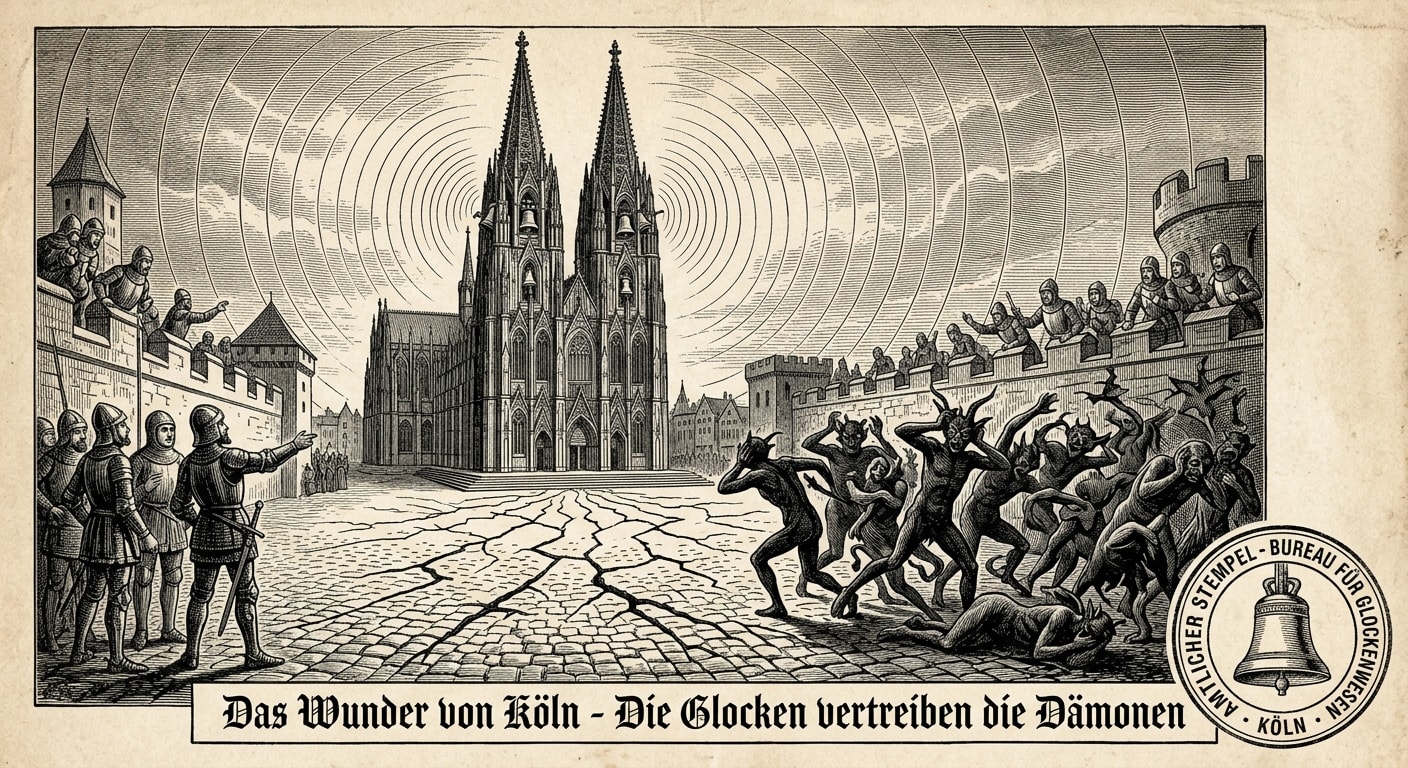
The Miracle itself is a matter of formal record. Wrath's Host — the vanguard of Maldrake the Wrathforged, fresh from the Iron Wastes and still wearing the char of a dozen burning townships — breached the outer palisade of Cologne in the forty-ninth year after the Sundering. The garrison had spent its powder. The relics had dimmed. The commanding officer, a man whose name the Bureau of Records subsequently misplaced with suspicious efficiency, ordered the cathedral bells rung — all of them, simultaneously, in defiance of every tonal protocol that would later be codified, in defiance of the keys and the sequences and the careful liturgical scheduling that the Bureau would spend the next century and a half perfecting. He ordered them rung because there was nothing else left to do, and because a dying man reaching for a bell-rope is, in the final accounting, reaching for the Creator.
The Host broke. The demons that had pressed into the cathedral square recoiled as though struck by massed artillery. The bells rang for nine hours. By dawn, the vanguard had retreated three miles eastward, and the cobblestones of the cathedral square were cracked in patterns that the Bureau of Engineering later classified as "consistent with resonant harmonics at amplitudes incompatible with bronze."
The lesson was drawn immediately and codified within the decade. Bells were weapons. Bells were doctrine. Bells were the nervous system by which the body of the Synod received its orders and by which the body of the Enemy received its wounds. And weapons require an armoury; doctrine requires a bureau; nervous systems require a brain. The Bureau of Bells was constituted in A.S. 52, three years after the Miracle, under a charter that granted it authority over "all matters of sacred acoustics, tonal scheduling, clapper licensing, and the coordination of peals within the Dominion and its associated territories, including but not limited to territories presently occupied by the forces of the Adversary." The inclusion of occupied territories was a bureaucratic flourish typical of the era — an era in which the Synod had not yet been formally constituted and the scattered dioceses claimed jurisdiction over land they could not see, much less defend. The Bureau of Bells, in other words, was born with ambitions larger than its reach. It has never adjusted them downward. It has adjusted the reach upward instead, and the twenty-three bronze bells of Bastion-Constantinople's carillon, each with its own writ and its own name and its own ordained keeper, are the proof that ambition, given sufficient bronze and sufficient paper, becomes indistinguishable from sovereignty.
#On the Bell Codex, and the Rhythms by Which Provinces Live
The present Bell Codex was ratified in A.S. 115, drawing on older peal orders and the Bureau's A.S. 52 charter.
This requires explanation. It does not deserve explanation. The Bureau of Bells insists that an earlier folio was compiled "under divine instruction" by an unnamed Cantor in Cologne who heard the rhythms of salvation in the A.S. 49 Miracle peals and transcribed them onto vellum with an urgency that left the margins scorched. The Bureau of Doctrine insists that the A.S. 115 recension was compiled "under doctrinal supervision" by a committee of twelve, working from existing liturgical sources. Both versions are in the Ledger. Both bear a later Bureau seal. The Codex does not care who wrote it. The Codex prescribes.
From its pages flow the rhythms by which the Dominion orders itself: the Ninefold Matins, struck at dawn across every city from Calais to Constantinople, nine strokes in descending pitch; the Widow's Toll, the single low note that marks the hour of permitted grief; the High Angelus, three ascending strokes at noon that signal the mandatory catechism; the Iron Vespers, the martial peal that locks the garrison gates and opens the powder magazines; and the Silentium — the cessation of all bells, which signals a breach in the Sagittal Line.
The Silentium has sounded fourteen times in the Bureau's history. Each time, the silence lasted between four minutes and seven hours. Each time, the silence was followed by bells ringing at volumes that shattered windows within a quarter-mile of the nearest cathedral. The Bureau classifies the Silentium as a "sacred negative" — an absence that speaks louder than any peal. Soldiers on the Line know it by a different name. They call it the Swallow, because the silence seems to consume all other sound, and because nothing good has ever followed it.
Between the great peals, the Codex prescribes secondary schedules — the ration-bell that unlocks the kitchens, the curfew-bell that locks the streets, the confession-bell that opens the booths, the levy-bell that opens the gates to the Bureau of Conscription's collection parties. To live in the Theocracy is to live in Strasbourg's rhythm. The bells toll for prayer at dawn; they toll for labour at the third hour; they toll for midday catechism; they toll for vespers; they toll for curfew. Between them, the citizen may breathe. The Bureau of Doctrine permits seven seconds of timing deviation. The Bureau of Bells enforces this with an enthusiasm that makes the Bureau of Purity look charitable by comparison.
#On Bell-Masters, and the Authority of Bronze
Bell-masters are ordained officers of the Bureau. Their authority eclipses that of local clergy. This is not a metaphor, nor a courtesy, nor a matter of occasional precedent: a Bell-master may countermand a parish priest's schedule, override a bishop's feast-day declaration, and — in one documented case at Bastion-Przemyśl — order the arrest of a Castellan-Warden for ringing an unscheduled alarm during what the Bell-master determined was a "non-doctrinal emergency." The Castellan-Warden protested that the walls were under attack. The Bell-master replied that the walls were under attack every Tuesday and that the bell schedule made no provision for Tuesdays. The attack was repelled. The Castellan-Warden was fined. The Bell-master was promoted.
The Bureau maintains — and I must record this with the gravity it demands — that bells are not instruments. Bells are sacraments given voice. To ring one without sanction is to speak with the tongue of the Great Deceiver himself. Unauthorized ringing is classified as heresy under the Bureau's own charter, a classification the Bureau of Doctrine was not consulted on and has never formally endorsed, a jurisdictional lacuna that has persisted since A.S. 52 and which both Bureaus have elected to ignore with the particular ferocity of institutions that understand any resolution would be worse than the ambiguity.
The miners of Liège learned this in A.S. 108, when they sounded their own shift-bells without Synodal approval. The miners considered the bells practical. The Bureau considered the bells doctrinal. The scourging lasted three days. The mines reopened on the fourth. The shift-bells were replaced with Bureau-sanctioned horns, which the miners are permitted to sound only at intervals prescribed in a document they are not permitted to read.
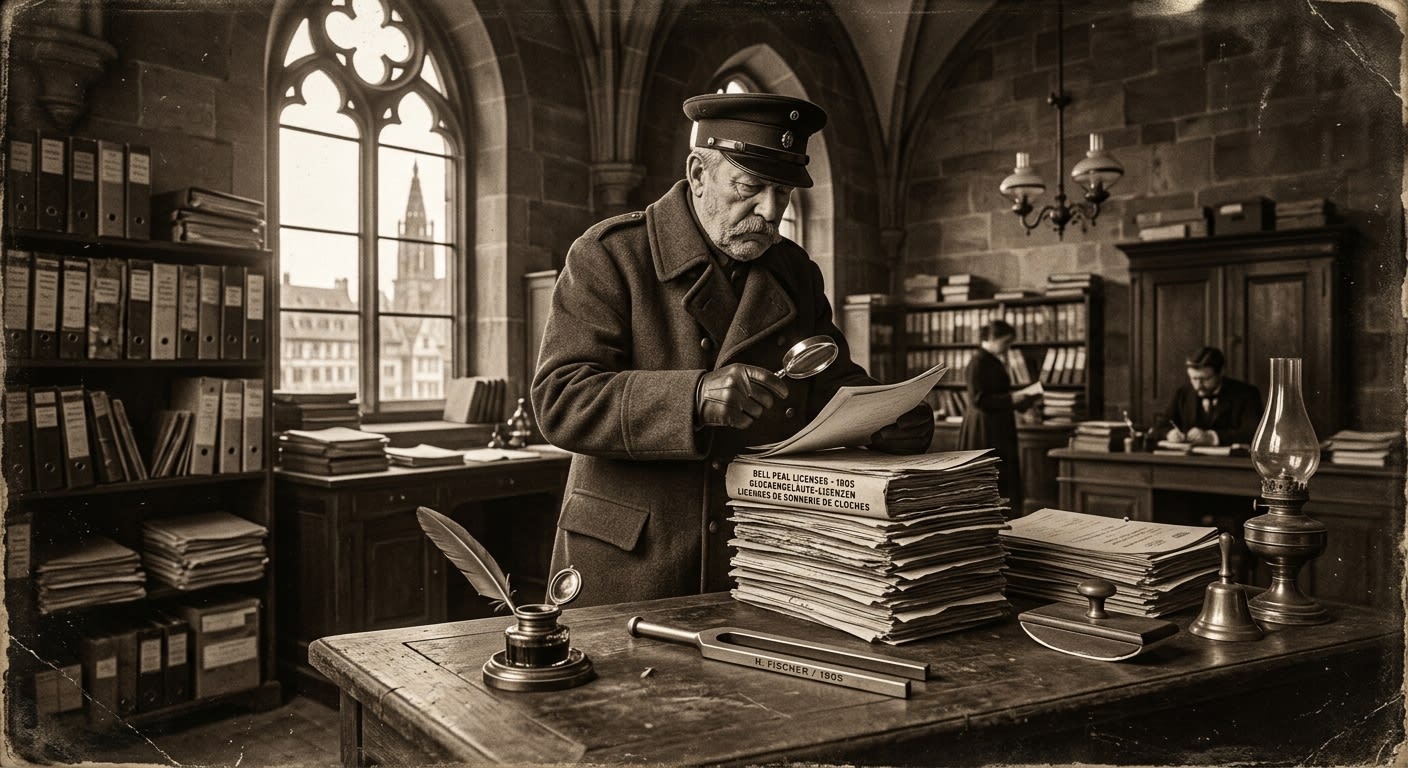
The licensing system is a small masterpiece. A Bell Peal License specifies the permitted number of strokes, the permitted hours, the permitted tonal range, the permitted occasions, and the permitted emotional register — for the Bureau has determined that bells rung in joy produce different harmonic effects than bells rung in grief, and that mixing the two without calibration constitutes a Class Two Tonal Heresy. One farmer in Saxony was licensed to ring a single bell on feast days only, provided it tolled no more than three strokes. He erred with a fourth. That night his barn collapsed. His cattle suffocated in the timbers. The Bureau of Records stamped the incident report with a single word: "Yes." Whether the collapse was sabotage, providence, or coincidence, the stamp does not specify. The stamp is, in this instance, the entire theology.
#On the Carillons, and the Sound of Sovereignty
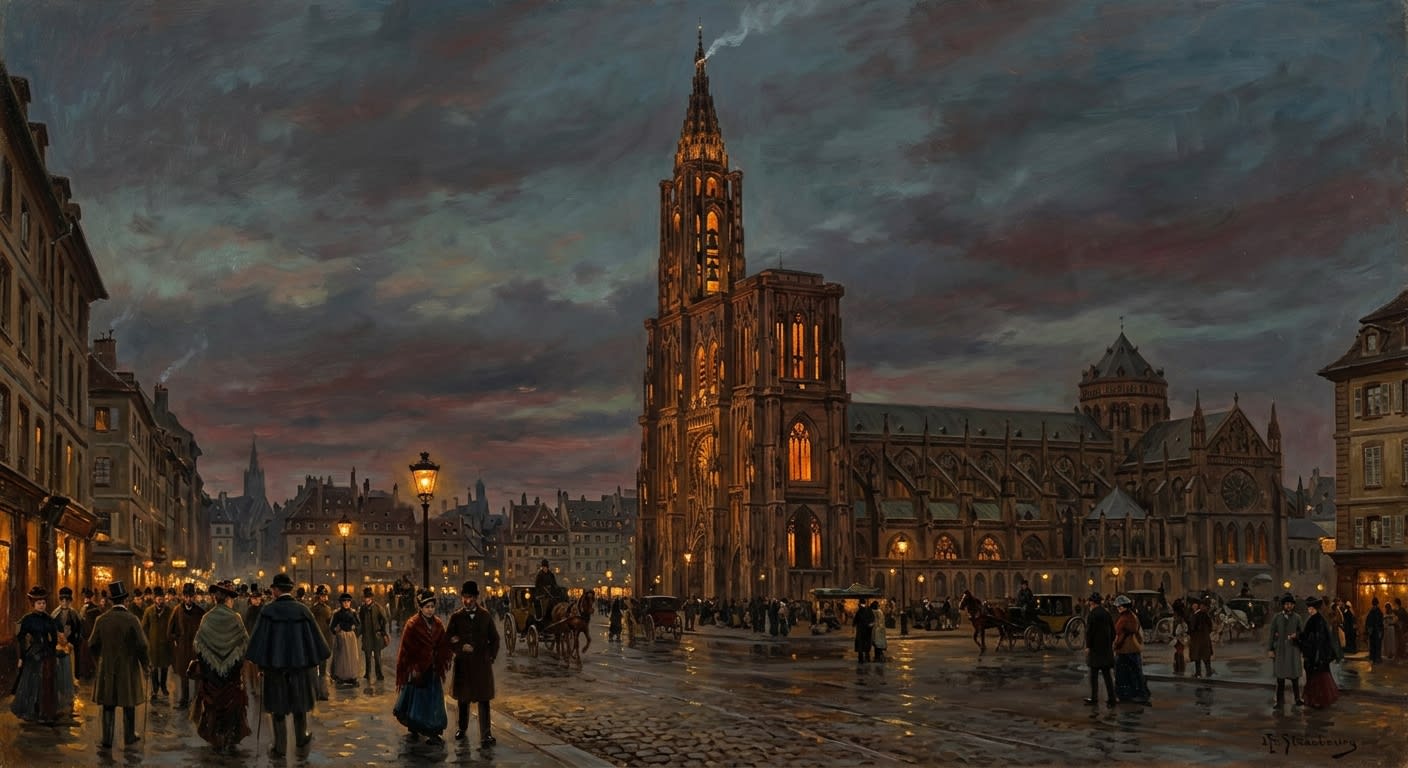
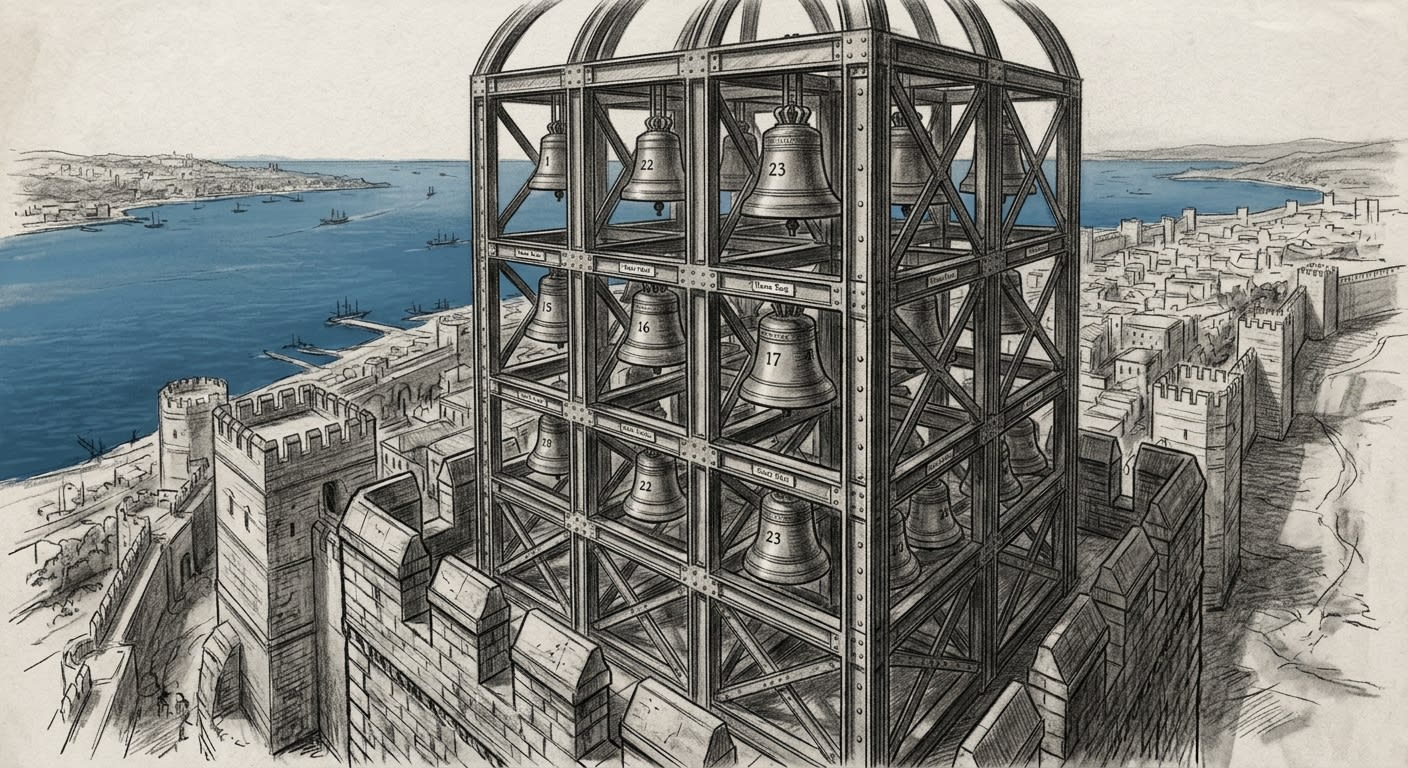
Strasbourg never stops ringing. The great carillon of the Cathedral marks every hour of prayer, every curfew, every feast day, every emergency. The carillon at Bastion-Constantinople — twenty-three bells suspended in an iron cage atop the west tower, each cast by the Bureau of Engineering and consecrated by the Bureau of Rites — rules the hours of half the front. Miss the noonday peal at Constantinople and the kitchens lock. The common litany of the ration queues says it plainly: sing or starve.
The Bureau fixes the clappers. The Bureau codifies the peals. The Bureau of Doctrine loads each peal with its meaning. The Bureau of Tithes ensures every toll carries its tariff. The Bureau of Records proves it happened and countersigns the proof against its own ledgers of proving. Four Bureaus for one sound. The citizen who hears a bell in the Theocracy is hearing the full weight of the administrative state compressed into a single vibration, and if the vibration rattles his teeth, that is doctrine working as intended.
At Bastion-Shipka, the first bell of the Pumps tolls from under the west bastion — blunt, utilitarian, measured by the Bureau of Bells to the second. Pump-crews descend. Patrols begin. The day's shape is cut by bronze, and the Bureau has determined that the shape is sacred.
At Bastion-Irongate, the Bureau has classified the Gasket Choir — that acoustic phenomenon whereby the mountain itself sings through sixty-three tunnel-mouths — as a Category Three Harmonic Anomaly, meaning the sound is too beautiful to be natural and too useful to be investigated. The Bureau sent three commissions. The first returned with a report. The second returned with a hymn. The third did not return. The Bureau at Irongate returned my article on the subject with a hymn written in the margin. I have kept the hymn. The report remains, as all Bureau reports remain, under advisement.
At the Steppe Gate of Windscript, the Bureau classified the Treaty Ring as a Category Four Harmonic Anomaly — one grade below the Gasket Choir — and dispatched an emergency Cantor-team after the Red Pronunciation cascade of A.S. 94 closed a thousand throats in a single night. The Cantors arrived in nine days. By then, the surviving population had invented its own solution. The Bureau has classified the solution as "theologically adequate," which is the Bureau's way of conceding credit without surrendering jurisdiction.
#On the Bureau of Shadows, and the Bells That Tell More Than Time
The Bureau of Bells coordinates regional bell networks across the Dominion. I am reliably informed it operates a coded system of bell sequences for the Bureau of Shadows. The Bureau of Shadows does not exist. The coded sequences therefore do not exist. The bells merely tell time.
Three apparently random bell sequences in the last decade have preceded major political purges. Two occurred in Strasbourg. One occurred in Constantinople. In each case, the sequence involved bells rung at intervals that corresponded to no liturgical schedule, no feast day, no emergency protocol, and no known section of the Bell Codex. In each case, within seventy-two hours of the sequence, individuals of political significance ceased to be available for comment, correspondence, or breathing.
The Bureau's position on these sequences is that they were "calibration tests." The Bureau has conducted calibration tests at a frequency that precisely correlates with the frequency of political disappearances. This correlation is, the Bureau assures me, a matter of acoustics.
I file reports with the Bureau of Shadows twice monthly. I file them through a dead-drop in the Cathedral close, in an iron box that has no lock because it does not exist. The bell that tolls above the dead-drop has been classified by the Bureau of Bells as "atmospheric ornament." I hear it ring each time I deposit a report. I have asked the Bureau whether the bell signals receipt. The Bureau has informed me that the bell does not ring.
Earlier editions of this Codex attributed the coded bell sequences to the Bureau of Orison and Song.
This was incorrect. The Bureau of Orison and Song handles hymnal licensing and devotional broadcasts. The coded sequences belong to no Bureau, because the coded sequences do not exist. This erratum corrects the record. The record was always correct. Both of these statements are true.
#On the Vigil Arks, and the Bureau's Aerial Ambitions
The Bureau operates the Vigil Arks — lighter-than-air reliquary-cathedrals that patrol the Bosphorus sky. The Bureau's Catechetical Division, Aerial Wing, maintains the Saint Barachiel and its sister vessel, the Vigil Ark of Saint Gabriel. The Bureau of Engineering proposed a tower. The Bureau of War proposed a weapon. The Bureau of Bells proposed a bell. What emerged from the committee was all three things fused into a hull that should not float and does.
The Saint Barachiel carries four brazen sermon-horns capable of broadcasting scripture at volumes that cause structural damage to buildings and doctrinal damage to demons. It carries censer-racks that drop incendiary sanctified fire. It carries a reliquary-chapel housing a first-class relic that ensures lift at altitudes the Bureau of Engineering has classified as "theologically permissible but aeronautically uncomfortable." The fuel — Compound 7, drawn from geological formations the Bureau refuses to name — is calibrated to sermon length. No sermon lasts longer than can be preached before nightfall. This is a technical requirement. It is also a mercy, though the Bureau would never admit to either.
The Sanctissima Vox, a third Ark, was lost over the Blightmarsh in A.S. 147. Its candles aged centuries in minutes. Its sermon accelerated to thunder, then to scream, then to hunger, then to silence. Thirty-eight of forty-one crew died. The wreck lanterns still glow in the marsh-mud. The Bureau classified the loss as "mild operational interest" and commissioned no replacement. The Blightmarsh keeps what the Blightmarsh takes.
#On the Bell Codex Affair, and the Pages That Are Missing
The A.S. 115 Bell Codex prescribes the rhythms of the present. A second Codex — discovered in Lyon, confiscated by the Bureau, and branded "apocrypha" — was said to prescribe the rhythms of the future.
The Lyon Codex mapped peals that had not yet rung. It assigned meanings to events that had not yet occurred. It charted bells in cities that had not yet been built. When confiscated, several pages were missing. Rumours persist that they were sold on the black market, or that they still toll in secret vaults beneath Lyon, or that they were never in the Codex at all but appeared only in the minds of those who read it. The Bureau of Records, careful as always, filed the Lyon Codex twice: once under "apocrypha," and once under "operational." The contradiction is policy.
I think of those missing pages when the bells of Strasbourg peal in storms no one predicted. I think of them when the bells of Constantinople ring in sequences the Bureau cannot identify — sequences that echo from the Third Ossuary, a vault no human has entered since A.S. 47, where dogs lie down and face the sealed door and wait. I think of them when the Bureau of Bells dispatches Cantor-teams to investigate phenomena it classifies as "harmonic anomalies" and the teams return with hymns instead of reports.
There are those who whisper that the missing pages contained instructions for summoning the Judges — those masked, wandering arbiters whose authority predates the Bureau and whose verdicts require no appeal. The Bureau of Records has denied the Codex ever existed. The denial was filed under the same classification as the Codex itself.
On the very days storms toll unpredicted bells in Strasbourg, peasants swear they see masked figures pacing the Cloister of Concord. The Bureau has investigated these reports. The Bureau has concluded that the peasants are mistaken, that the storms are natural, and that the bells ring because bronze contracts in cold air. All of these conclusions are technically correct. None of them are the truth.
#On the Fractured North, and the Bells That Work
The Fractured North tunes its bells by a different system. The system is older than the Concordat. The system was inherited from pre-Sundering fishing communities who rang iron bells across the fjords long before the Bureau existed, long before the Sundering cracked the Balkans open, long before anyone understood that a bell could be a weapon or a sacrament or both.
The Bureau has requested harmonization three times. Three times the Fractured North has refused. On the third refusal, in A.S. 193, an emissary from Bastion-Königsberg crossed to the northern islands to demonstrate the Bureau's standardised bell-sequence. The sea between the emissary's ship and the shore went flat — not calm, flat, as though the surface tension had increased by an order of magnitude. The ship could not advance. The bells on the northern shore rang in a three-bell sequence that the Bureau could not classify. The fog stopped at the waterline. The emissary returned to Königsberg.
The Bureau has not asked why the three-bell sequence stops the fog. Investigation 447-N, opened A.S. 186 to classify all non-standard bell-tunings in the Fractured North, remains pending. It will continue to pend, the Bureau's own erratum admits, "until the Bureau of Bells determines whether harmonization is possible without also harmonizing whatever the bells are tuned against."
The locals call the thing in the water det grå vattnet. The Bureau calls it the Grey. The bells of the Fractured North ring against it. The bells of the Bureau do not. This is the Bureau's greatest institutional embarrassment and its most carefully guarded secret: somewhere in the frozen periphery, a collection of fisherfolk with iron bells and no licenses hold back an enemy that the Bureau's entire apparatus of sacred acoustics has failed to classify, much less defeat.
#On the Present Condition
The Bureau of Bells employs, by the most recent accounting, eleven thousand four hundred bell-masters, ninety-three Cantor-teams, fourteen carillon crews, seven Harmonic Anomaly Investigation Commissions (three active, four "pending"), two Vigil Ark crews, and an unspecified number of personnel seconded to the Bureau of Shadows for purposes the Bureau of Shadows does not exist to have. Its headquarters occupy the Bell Tower of Strasbourg Cathedral — nine floors of bronze, rope, parchment, and tuning forks arranged in an order that follows no architectural logic the Bureau of Engineering has been able to diagram and which the Bureau of Bells insists is "liturgically self-evident."
Master-Carillonist Aldo Venn commands from the ninth floor. He speaks in rhythms. He may be slightly mad. His bells are never wrong. Under his stewardship, the Bureau has expanded its classification system to encompass Category One through Category Five Harmonic Anomalies, licensed three hundred and forty-seven regional bell networks, and sent the Sin-General Syrion into what the Bureau describes as "measurable acoustic discomfort" by increasing peal frequency along the Shipka corridor — though whether the increased peals help the soldiers or merely annoy them into wakefulness is a matter of vigorous internal debate that the Bureau has classified as "ongoing."
The Bureau considers itself indispensable. The Bureau is correct. Festivals, mourning days, curfews, market hours, ration distributions, levy collections, confession schedules, troop rotations, and the very rhythm by which three million soldiers on the Sagittal Line fire their guns and pray their prayers — all of it flows from the bell schedule. The soldier at the front stands at First Bell, kneels at Second, fires at Third, confesses at Fourth, starves at Fifth, marches at Sixth, burns at Seventh, buries at Eighth, and collapses at Ninth. The sagas of war are not recorded in cannonade but in ledgers checked against the chimes.
That is how we have endured. The Bureau of War provides the steel. The Bureau of Doctrine provides the justification. The Bureau of Bells provides the tempo. And the tempo, Aldo Venn will tell you — leaning forward with those rhythm-mad eyes, tapping his tuning fork against the desk in a pattern you are certain you have heard before and cannot name — the tempo is everything. Without it, the steel is scrap and the justification is noise.
He taps the fork. It rings. The vibration lasts longer than bronze has any right to last.
The Bureau has spoken.