
#On the Cathedral That Had No Roof
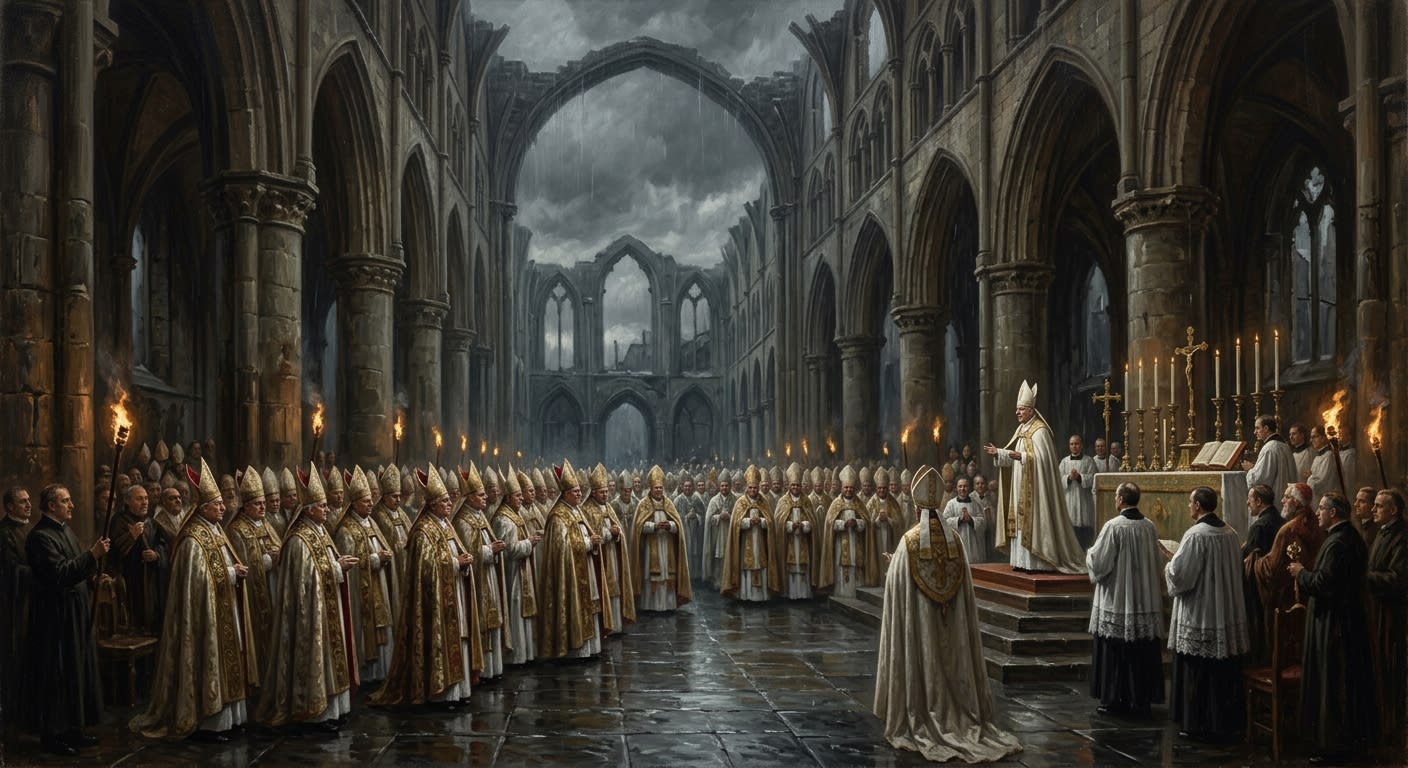
"Rain fell upon the mitres of three hundred bishops, and not one complained. This was faith — or pneumonia. The Bureau records both as equivalent." Thus says the later pageant, whose attendance count the register cannot establish.
I have stood in the nave of Worms Cathedral. The roof is finished now — completed in A.S. 94, seven years after the Council, by a work crew of Rhineland conscripts who were promised indulgences and given hernias — but the flagstones still hold the stains where rainwater pooled during the most consequential assembly in the history of the Church. The Bureau of Records has filed those stains as "ambient sanctification residue." The Bureau of Engineering classifies them as "water damage." Both designations carry equal doctrinal weight, which is to say: whatever weight the Bureau requires on any given afternoon.
It was here, in the reconstructed nave of Worms, in A.S. 87, beneath a vault that gaped like a wound upon the sky, that the Common Allegiance of A.S. 55 received conciliar ratification. The surviving register contains 314 names, not an attendance roll of 314 bishops. The rain came through the unfinished vault, and Augustinus of Mainz spoke as though the heavens wept in confirmation. Perhaps they did. The Bureau has authorized this interpretation.
#On the Ruin That Became a Throne
"Worms was not chosen for its grandeur. It was chosen because it had survived, which in that age amounted to the same thing."
One must understand what Worms was in A.S. 87 to appreciate what happened there. The city had been sacked twice during the Atheist Wars — once by the Rationalists, who burned its episcopal library and used the cathedral font as a watering trough for cavalry horses, and once by the retreating faithful themselves, who stripped the lead from the roof to cast musket balls during the Great Retreat. The Bishop of Worms had vanished during the Rationalist supremacy, some thirty years prior. The Rationalists declared he "never existed." The diocese passed through four competing claimants, two of whom excommunicated each other, one of whom was later discovered to be a woman disguised in episcopal vestments (the Bureau sealed this file with such enthusiasm that the wax is three inches thick), and one of whom simply wandered off into the Odenwald and was eaten by wolves. Or so the parish register claims. The wolves have not been interviewed.
The cathedral's nave had been rebuilt only partially. Later accounts assign its selection to Augustinus's love of symbols: a cathedral without a roof had nothing left to hide. The sky was the ceiling, and the Creator was the witness. The image made Augustinus beloved by the faithful and deeply irritating to everyone obliged to sit in the rain. The exact duration of proceedings remains unsettled.
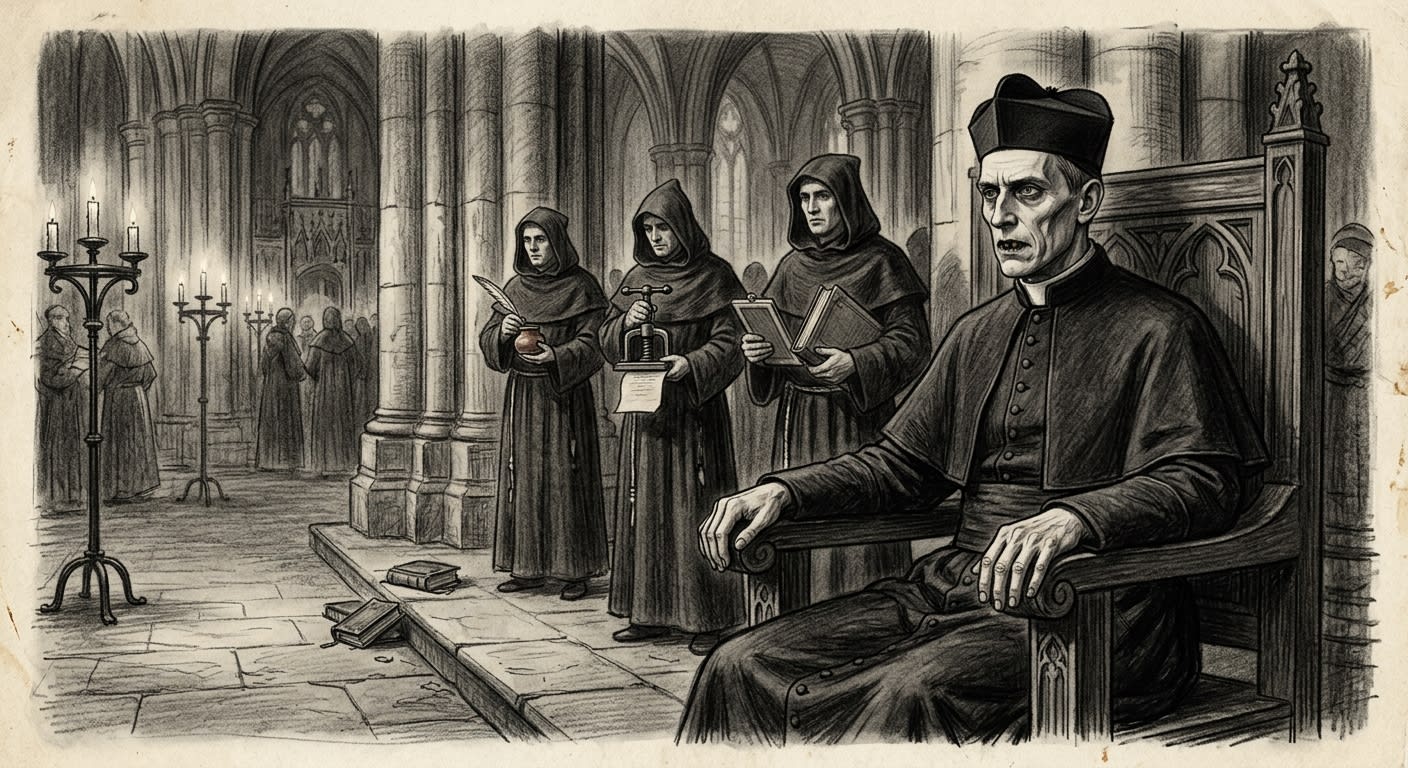
The seating was Kratz's work, as all practical arrangements were Kratz's work. The Cardinal had arrived in Worms three weeks before the Council with a retinue of forty-one clerks, two wagonloads of blank vellum, and a mood that witnesses described as "controlled ferocity." He assigned seats by diocese — placing the wavering in the front rows, where the weight of the surrounding faithful would press upon them like mortar upon brick, and the hostile in the rear, where they could be ignored or, if necessary, removed before anyone noticed their absence. The aisles were staffed with his black-cowled notaries, the same men who had delivered the Night of Black Decrees twenty-nine years earlier. They carried no writs this time. They carried inkpots and seal-presses, which in Kratz's hands were weapons of equal precision.
#On the Proceedings
"Eleven hours of oratory, rain, and controlled capitulation," says the later ceremonial account. Its precise timetable remains unverified.
Augustinus presided at Worms. Later accounts place an opening address before dawn, with delegates entering the half-ruined cathedral by torchlight. Their exact hour and number cannot be recovered from the register of names.
His address survives through partial transcripts and later reconstruction. Its exact length is unsettled. The Bureau's reconstruction from "contextual inference and doctrinal probability" is, in less elegant language, the Bureau writing what the missing lines ought to have said.
What Augustinus said — and what the Bureau has approved him as having said — was this: that Europe could no longer afford the luxury of dispersed obedience. That the Atheist Wars and the Sundering had proven that faith, when fragmented, was kindling. That the dioceses, the abbeys, the cathedral chapters, the scattered orders and brotherhoods and congregations of the faithful must bind themselves into one body — one assembly, one altar, one arsenal — or perish separately, each bleating its own private prayer into a sky that no longer answered private prayers. The Common Allegiance was his instrument: a binding vow of obedience to a single Synodal authority, seated in Strasbourg, empowered to levy armies, collect tithes, license relics, regulate bells, and adjudicate heresy from the Baltic to the Tagus.
The ceremonial account weighs three fainting bishops and assigns the notaries to Kratz. That anecdote is not proof that the later Bureau of Tithes existed at Worms. It does, however, reveal the Bureau's conviction that even unconsciousness should be filed.
#On the Tongues of Fire
"Miracles attended the Council. Or phenomena attended the Council, which the Bureau subsequently classified as miracles. The distinction matters only to those who have not read the classification manual."
At the ninth hour, as Augustinus reached the peroration of his address, witnesses report that tongues of fire appeared above the heads of the assembled bishops. The phenomenon lasted between seven and forty minutes, depending on which deposition one consults. The Bureau of Doctrine has harmonized the testimonies into a single canonical account: eleven minutes of sustained divine manifestation, accompanied by a sound described variously as "the ringing of a bell cast from pure faith," "a low hum as of bees in a reliquary," and "my knees were wet and I wanted to go home."
The tongues of fire are canonical. They are recorded in the Acts of the Council, stamped by the Bureau, painted in fourteen approved representations, and referenced in every catechism published since A.S. 90. To deny them is heresy of the Third Degree, punishable by public correction and reassignment to the Paper Mines of Ulm. I do not deny them. I note only that the depositions were collected by Kratz's notaries, transcribed by Kratz's clerks, and sealed by Kratz's personal stamp — the one with the slightly too-large fleur-de-lis that he insisted was "within acceptable parameters."
The faintings, the tongues, the claimed duration, the rain through the broken vault — all of it was woven into the official account with the precision of a liturgical calendar. Augustinus provided the spectacle; Kratz provided the documentation. The resulting founding myth became stronger than the surviving evidence for its particulars.
#On the Seals
"Two hundred and eighty-nine seals are clean. Twenty-five have mixed defects. The later Worms ratification register lists them all."
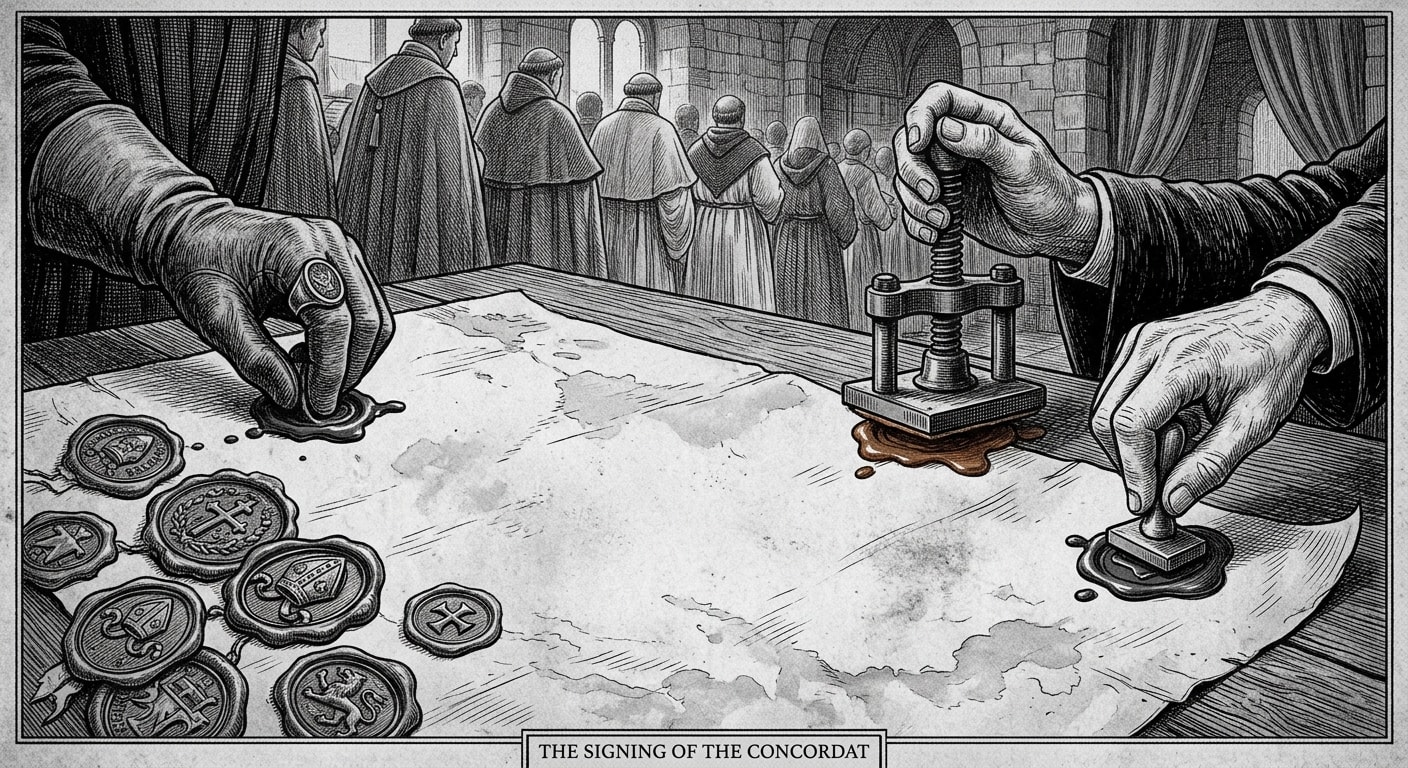
The surviving Worms register lists names and seals for ratification of the earlier Common Allegiance. It does not prove that every named cleric approached the altar, nor that all impressions were placed on the original A.S. 55 instrument. The ceremonial account supplies a procession, a seating chart, and enormous vellum; those details remain attributed traditions.
Two hundred and eighty-nine seals are clean in the surviving Worms register. Their condition supports the register's authentication; it cannot supply an unbroken chain of custody for the missing Allegiance original.
The remaining twenty-five seals are "administratively concordant."
The phrase means that the remaining impressions have mixed defects. Some may reflect delegated sealing, damage, mistaken attribution, or fraud; the surviving record does not reduce all twenty-five to the same cause. It does not prove that every named person was present in the cathedral.
Seven of the twenty-five concordant seals belong to bishops who later protested, in writing, that they had signed no such document. These protests were filed by the proto-Bureau of Records under the category "retrospective doctrinal confusion," a classification that had the dual effect of acknowledging the complaint while rendering it meaningless. Three of the seven were subsequently promoted. Two were reassigned to frontier parishes. Two died within the year under circumstances the Bureau describes as "unremarkable."
The later Worms ratification register contains all three hundred and fourteen names — clean seals, defective seals, and disputed attributions. The Bureau has decreed that a seal, once affixed, carries the authority of the office it represents, irrespective of the hand that pressed it. This principle, formalized as the Doctrine of Sealed Intent, became a foundation of Synod administrative law. A document is binding if it bears the correct stamp. The question of who held the stamp is theological, and theology is the Bureau's jurisdiction.
#On Kratz's Final Work
"He died the following year, of ink poisoning. This is the official cause. The ink was his own."
Kratz did not speak at the Council. He sat in the third row, left aisle, in a chair he had brought from Strasbourg — oak, high-backed, upholstered in black leather that smelled of the chandlery. He watched the proceedings. He counted seals. He dispatched notaries. He ate nothing. A witness reported that he drank water from a flask, though another witness claimed the flask contained ink, which Kratz consumed habitually and which had stained his teeth the colour of bruised plums.
The later ceremonial account sends Kratz from Worms that evening with a locked chest. The original A.S. 55 Allegiance cannot be securely identified in that procession; the Worms register and later displayed copies have separate custody histories.
He was dead within the year.
The official cause: ink poisoning, aggravated by decades of handling heavy-metal inks in poorly ventilated chancery offices. His exact birth day and death age remain unverified. He had served the faith — or served the idea that serving the faith and serving Kratz were identical propositions — for decades. Later accounts place him in the Basilica of the Ledgered Saints in a lead coffin sealed with seven stamps, each bearing a different date. The Bureau of Records has not explained the discrepancy. The Bureau of Doctrine has classified the discrepancy as "a mystery of administrative eschatology."
He died two years before the Concordat of Strasbourg was formally ratified — the Concordat that the Common Allegiance made possible, that the Council of Worms made formal, that the Night of Black Decrees made inevitable. The architecture of the Synod was his architecture. The seals were his seals. The forgeries were his forgeries. Augustinus gave the Synod its soul; Kratz gave it its skeleton, and the skeleton was made of ink and wax and the quiet understanding that paper, properly stamped, is stronger than steel.
#On the Standard Ratification Protocol
"Every Synod assembly since Worms has followed the Protocol. It has been amended eleven times. The amendments are classified."
The Council of Worms produced more than the Common Allegiance. It produced the Standard Ratification Protocol — the procedural template by which every subsequent Synod council, assembly, congress, and convocation has been conducted. The Protocol specifies: the order of seating (by diocese, front-weighted toward compliance); the duration of address (unlimited for the presiding Hierarch, fifteen minutes for others, none for those classified as "observers without voice"); the manner of assent (seal upon vellum, witnessed by no fewer than three notaries); and the disposition of dissent (recorded, filed, and disregarded).
Kratz drafted the Protocol on the ride back to Strasbourg. The original, in his hand, survives in the Bureau of Records' Crimson Vault — a sheaf of rain-spotted pages covered in handwriting so small and so precise that reading it requires a magnifying lens and a tolerance for administrative genius. The margin notes are revealing. Beside the clause on dissent, Kratz has written: Permit the objection. File the objection. Let the objection moulder. Time is the Bureau's ally; the dissenter's patience is not. Beside the clause on miraculous attestation, he has written: Ensure a supply. Failing genuine supply, ensure documentation sufficient to establish retrospective consensus.
The Protocol was tested at the Council of Mainz, A.S. 93. It was perfected at the Council of Cologne, A.S. 100. It was weaponized at the Second Concordat of Münster, A.S. 105, where Kratz — dead by then, but his Protocol very much alive — reached from beyond the grave to bind nine hundred and ninety-nine craft guilds to the Synod's tithe-structure. The thousandth refused. His district vanished overnight. The Protocol does not account for this. The Protocol does not need to. The Protocol creates the frame; what the Bureau does with the frame is operational.
#On What Worms Made
"Before Worms, there were bishops. After Worms, there was a Bureau."
The Council of Worms was a hinge in an already functioning government. Before Worms, the Common Allegiance had operated for thirty-two years; its A.S. 55 text was shared work by Augustinus, Kratz, and Sabine. Worms ratified the instrument with a register of 314 names and mixed seal quality. The Concordat of Strasbourg, enacted three years later in A.S. 90, formalized the constitutional settlement. Worms was ratification; Strasbourg was settlement.
The Concordat formalized structures already in use: a single authority, tithe administration, and the regulation of bells and doctrine. The recorded names gave collective weight to the ratification, but the register does not prove that each bishop was there or that each of the twenty-five defective impressions was forged.
The Cathedral of Worms stands complete now, its roof sealed and its flagstones polished over the water-stains. Pilgrims kneel where the delegates were said to have knelt. The public feast assigns an exact day to the council; the historical season and duration remain open. A displayed Allegiance copy and the ratification register are separate from the missing A.S. 55 original. The flagstones remember the rain; the register preserves the names, though it cannot place every person in the nave.