
#On the Proposal
"He did not unify the faithful. He requisitioned them." — Cardinal Kratz, private correspondence, date redacted
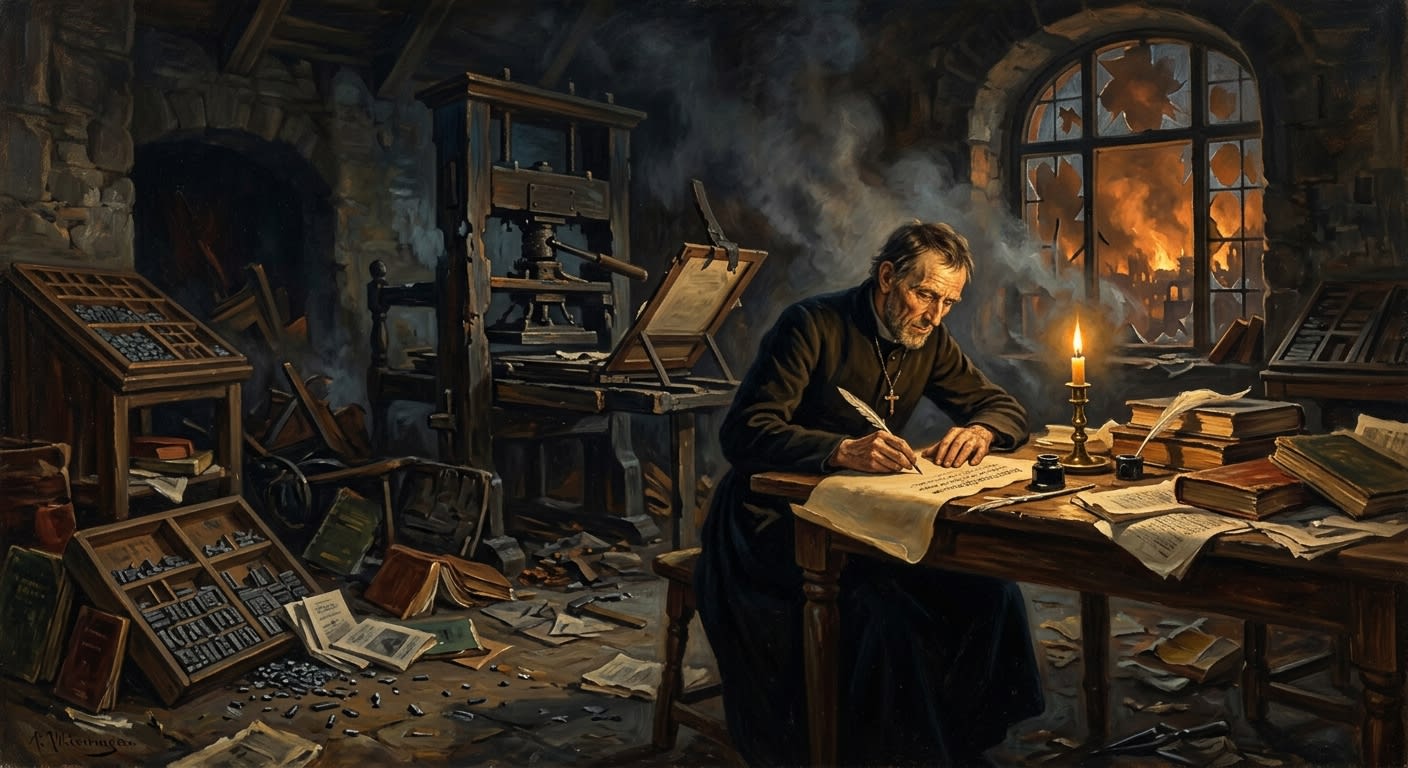
In the year we now reckon as A.S. 55 — before the Bureau adopted that calendar retrospectively — the Common Allegiance was composed in the Palatinate and issued under Augustinus of Mainz's authority. Kratz and Sabine contributed materially. The surviving instrument claims a Mainz seal, though its original and precise sealing history remain disputed. Drax's image of Augustinus alone at a confiscated press is a portrait of authority, not a count of the people who made the text.
He called it the Common Allegiance. The name was deliberate. He did not write Holy Allegiance, nor Sacred Compact, nor any of the titles that the Bureau of Doctrine would later paste over the original like fresh plaster over damp masonry. Common. The word carried weight in a decade when the common faithful were being butchered on the pilgrim roads by Rationalist Republican Guards, and the uncommon faithful — the bishops, the abbots, the cathedral canons with their gold-thread vestments and their comfortable theology — were doing precious little about it except quarrelling over which of their relics was more authentic and whose diocese had precedence in the matter of bell-tolling schedules.
The Common Allegiance was seven pages. It proposed, in language that the Bureau of Doctrine later described as "direct to the point of insubordination and therefore characteristic of sainthood," that scattered dioceses of the Church — quarrelling sees, jealous abbeys, fortified monasteries — enter a common assembly. Its clauses also supplied means to bind local congregations before reluctant bishops signed. One body. One administration. One set of bells ringing to one schedule, one tithe collected under one seal, one army fighting one war with one doctrine explaining why the fighting mattered.
Prayer fused to policy. Altar married to arsenal. Catechisms attach those phrases to Augustinus, whose authority gave the charter its public force. The surviving pages also bear the practical work of colleagues, including instructions on local subscriptions and inter-diocesan accounts that a commemorative painting cannot show.
#On the Conditions That Demanded It
The year A.S. 55 fell in the long hemorrhage the Bureau of Records later designated the Great Retreat. Ten years after the Sundering, the faithful were dying faster than the provisional council's local clerks could reconcile their rolls. Interim offices existed; none yet possessed the mature Records Bureau's reach.
Rationalist central command collapsed at the Sundering, though services and local offices survived. Decades of dismantled spiritual infrastructure had done their work. The hidden Church and its relief households still had structure, but no single authority able to command every road or diocese. Great religious houses of the Rhineland had been sacked, their libraries burned. What survived was scattered, frightened, and stubborn in the particular way that clergy are stubborn: each abbot convinced that his fragment of the faith was the whole cloth, and that submission to a new coordinating authority was perilous.
They were wrong about that. They were also, in a grimmer sense, correct — for what Augustinus proposed was indeed a kind of heresy, if heresy is defined as telling bishops they are no longer sufficient unto themselves. He proposed stripping them of their autonomy, their independent treasuries, their private armies, their cherished right to excommunicate their neighbours without reference to any higher authority. He proposed replacing the comfortable pluralism of a thousand altars with the uncomfortable singularity of one. The bishops, when they heard, laughed. The abbots scoffed. The faithful, who were burying their children in ditches dug by Kargath's advance columns, did neither.
The military situation was the persuader rhetoric could not be. The flight began after A.S. 45; the Bureau's A.S. 48–65 Retreat is a broad periodization, not one identical path for every garrison. The faithful fell westward from threatened eastern routes, while the Great Deceiver's forces pressed the broken frontier. The old fortress-churches were tested beyond their design. A garrison isolated from its neighbor could fail before relief even knew it had asked for help.
Augustinus watched and counted. With Kratz and Sabine's contributions, his authority issued seven pages that gave the provisional Church another means to govern. Formal constitutional settlement and a mature Bureau hierarchy would take decades more.
#On the Text Itself
The Third Vault of the Basilica of the Ledgered Saints displays a surviving Allegiance instrument under glass. Its status as the original remains disputed. Citizens may view the displayed copy on application to the Bureau of Records, provided they submit Form 14-A ("Petition for Proximity to Foundational Instruments") and pass the Bureau of Purity's screening.
I have read it. I have read it nine times, in fact, which is seven more times than the current Hierarch of Doctrine has managed, and I record this without rancour but with the quiet satisfaction of a man who does his work.
What the document contains — stripped of the reverential lacquer that two centuries of official commentary have applied to it — is this: a ruthlessly practical proposal for the amalgamation of military, spiritual, and administrative authority under a single governing assembly, with mandatory tithing, standardized liturgy, unified command of all armed forces operating under the banner of the faith, and the explicit subordination of every bishop, abbot, canon, and prior in the Church's lands to the decisions of that assembly. The assembly is not named. Augustinus called it simply Conventus Fidelium — the Gathering of the Faithful. The Bureau of Doctrine later renamed it the Synod, which has a grander ring and fewer syllables, both qualities the Bureau prizes.
The seven pages are organized with a field commander's parsimony. The first two address the military crisis. Page three proposes an assembly supported by specialist offices for records, supply, fortification, and doctrine — precursors, not the full constitutional Bureaus. Page IV offers the sentence selected for the protected instrument: "The Creator does not reward disunity. The Deceiver does." The shorter adversary name belongs to that page and exact quotations of it. The Bureau of Doctrine has since expanded the line into many pages of commentary, which is its way of acknowledging that a sentence is powerful by drowning it.
Pages six and seven concern local subscription and coercion. Those who sign receive the Allegiance's protection; resistant bishops find captains, magistrates, guild masters, and congregations already being approached under its authority. The instrument makes refusal politically costly without proving that every later forged signature was already written in A.S. 55.
Earlier editions of this Codex attributed the authorship of the Common Allegiance to a committee of bishops assembled at the Council of Worms in A.S. 87.
The Worms committee did not compose the A.S. 55 charter; it ratified it in A.S. 87, thirty-two years later. Augustinus issued it with material work from Kratz and Sabine. Hennen of Trier later pressed a wider ancestral claim; his family interest does not make sole authorship true. The Bureau of Records should be capable of holding both propositions in one folder, though I have not yet found the clerk willing to try.
#On the Reception
The response was everything a sane man might have predicted and a saint apparently did not care about. The bishops laughed. Augustinus had anticipated laughter — page seven of the Allegiance includes, in a margin annotation in his own hand, the note: "They will laugh. Let them. The dead do not laugh, and there are more dead than bishops."
The Chapter of Milan called the proposal "an affront to apostolic dignity." The See of Kraków declared it "impertinent." The Archbishop of Seville returned a terse answer to its request for subscription. Later Records commentary treated these replies as evidence that the emerging authority needed a local mechanism before episcopal consent could be relied upon.
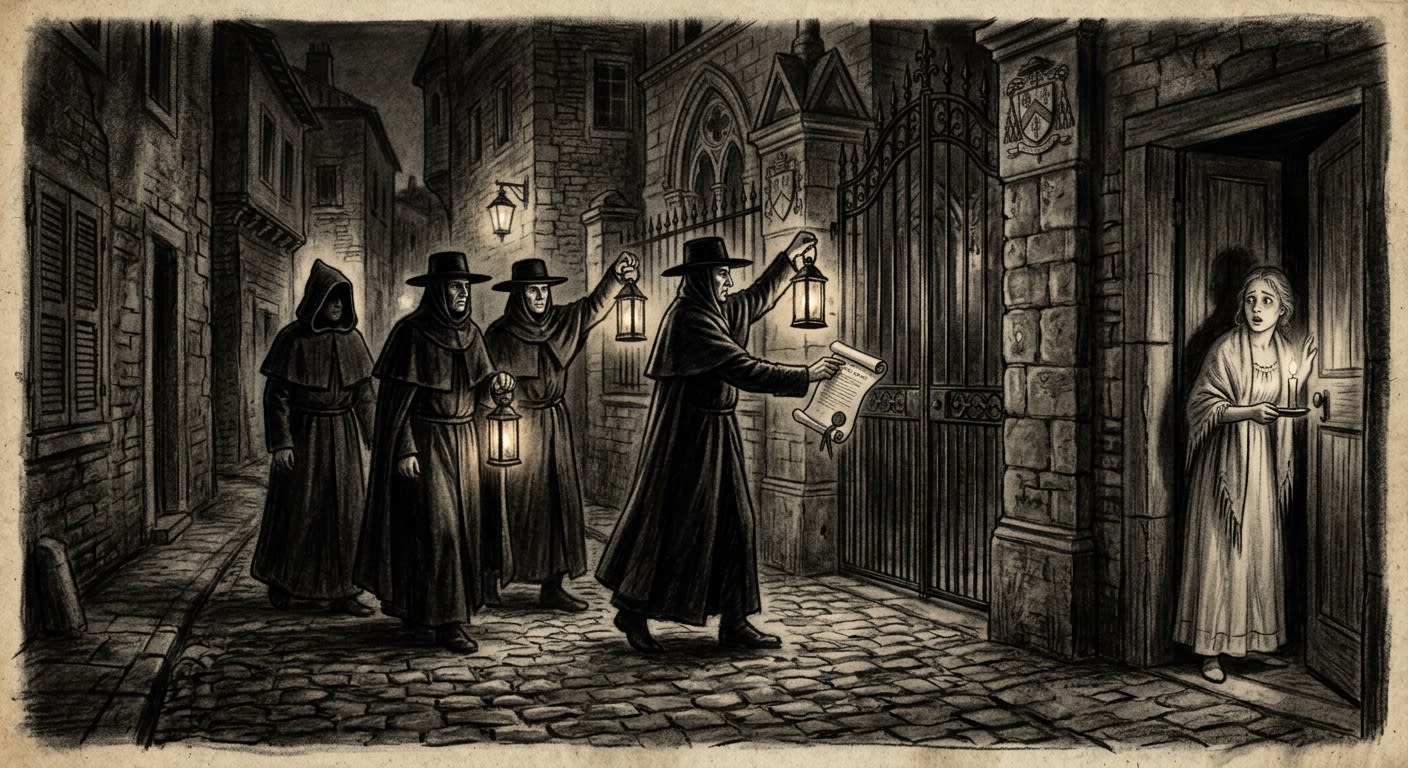
What the bishops had not anticipated was that Augustinus was not alone. Kratz and Sabine worked materially on the charter, including the mechanism by which local subscriptions could precede a bishop's consent. In A.S. 58, three years after issuance, the Night of Black Decrees carried writs through jurisdictions the emerging authority could reach. Their provenance varied: authentic, conditional, premature, and forged instruments appear in the account. The claim that exactly half were counterfeit remains a Bureau estimate, not a settled count.
In places where local accessions held, bishops faced congregations already committed to the Allegiance's protection and discipline. Drax's account of instant unanimity belongs to later institutional rhetoric; the seven pages became operative before Worms without making every diocese obedient at once.
#On the Council of Worms
The Council of Worms, convened in A.S. 87, ratified the Common Allegiance in a ceremony of such calculated grandeur that even Drax — who has attended every major ratification since A.S. 180 and regards pomp as a professional tool — must acknowledge it as a masterwork of theatre.
The Worms register bears three hundred and fourteen names, entered through personal, proxy, and documentary participation. It does not establish three hundred and fourteen bishops physically in the nave. The cathedral roof was incomplete; later paintings fill the space with mitres and rain. Augustinus presided, but the exact season, duration, and painter's intended scene remain unproved.
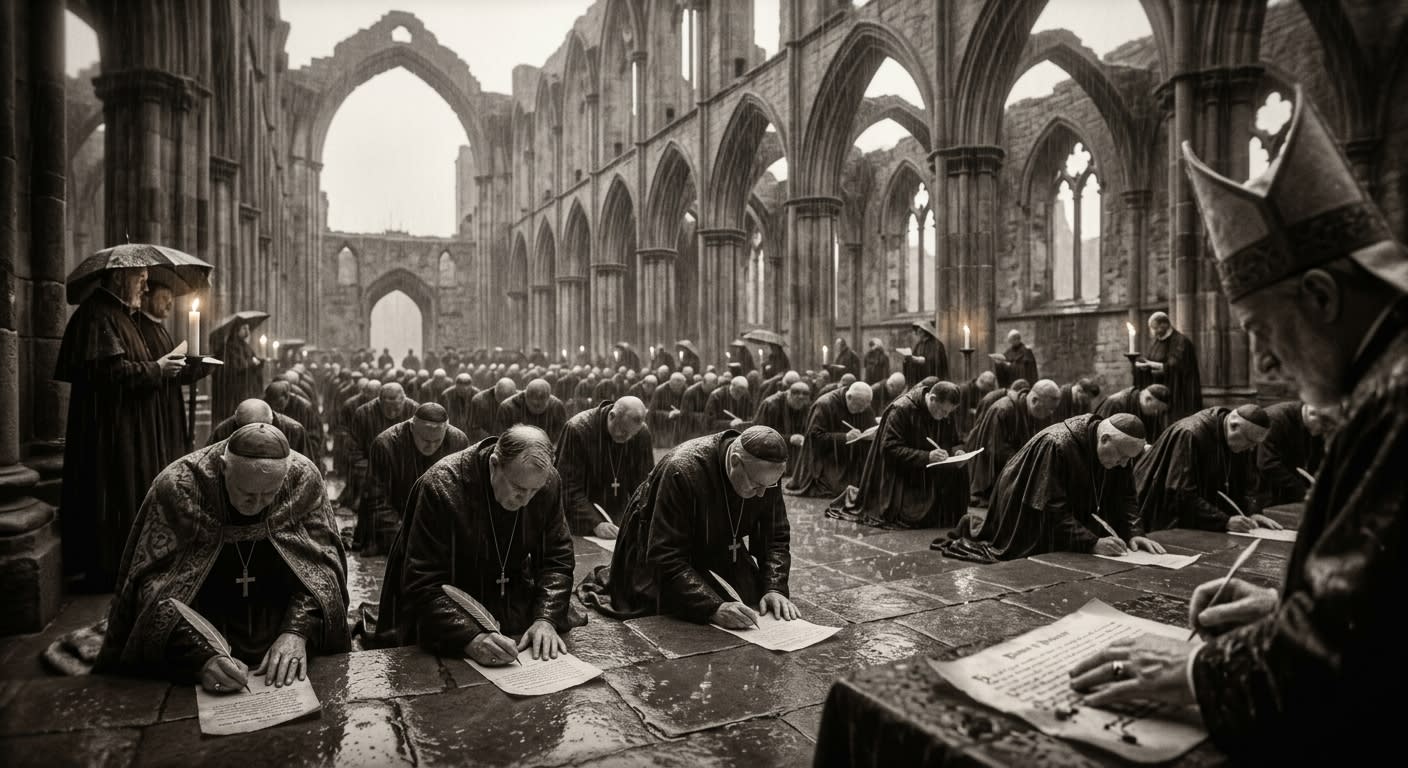
By A.S. 87 the Allegiance had been in use for decades. The Night of Black Decrees had accelerated its local accessions twenty-nine years earlier; Worms ratified the instrument without making every earlier seal clean or every absent name a person present. The ceremony gave conciliar force to existing practice, a sequence later invoked as Standard Ratification Protocol.
Augustinus presided. The miracles came: tongues of fire above the assembled bishops, as they had at his earlier convocations. Three bishops fainted. Their weights were logged by notaries of the proto-Bureau of Tithes, who had accompanied the delegation for precisely this purpose. The fire left no scorch-marks. The Bureau of Engineering, when consulted, said this was "thermally implausible but not our department." The Bureau of Doctrine said this was proof of divinity. I say that when a building is already missing its roof, the presence of divine fire overhead is difficult to distinguish from the meteorological, but I write this in a margin and not in the body of the text, which is the Warden's way of being honest without being heretical.
#On Its Consequences
The Common Allegiance made the Synod possible. This is the official position, and it has the virtue of being true, which is not always a quality the Bureau demands of its official positions but is in this instance a pleasant coincidence.
The Allegiance supplied one constitutional root of the Concordat of Strasbourg in A.S. 90. It operated within interim government before both founders died. Records and Purity had earlier organs, with major developments in A.S. 78 and 80; the A.S. 90 settlement formalized wider jurisdiction. Wartime works and a defensible, incomplete Sagittal Line around A.S. 65–68 likewise preceded the Concordat.
The Bureaucratic Synod claims the Allegiance as an origin of its present bell schedules, tithe structures, courts and files. That claim commemorates Augustinus's authority without erasing Kratz, Sabine, lay relief networks or the decades of provisional work that made a later constitution possible.
The Common Allegiance is taught in catechism schools and invoked at Concordat anniversaries. Hierarchs use it to remind recalcitrant bishops that obedience carries local as well as conciliar force. The authorized tale of one man alone at a writing desk is useful ceremony; the surviving instrument and its history require more names and more than one date. Drax can still hear the Great Deceiver's patient smile in the silence between those lines.
The Bureau has approved this reading. I have stamped it. The Ledger is satisfied.