
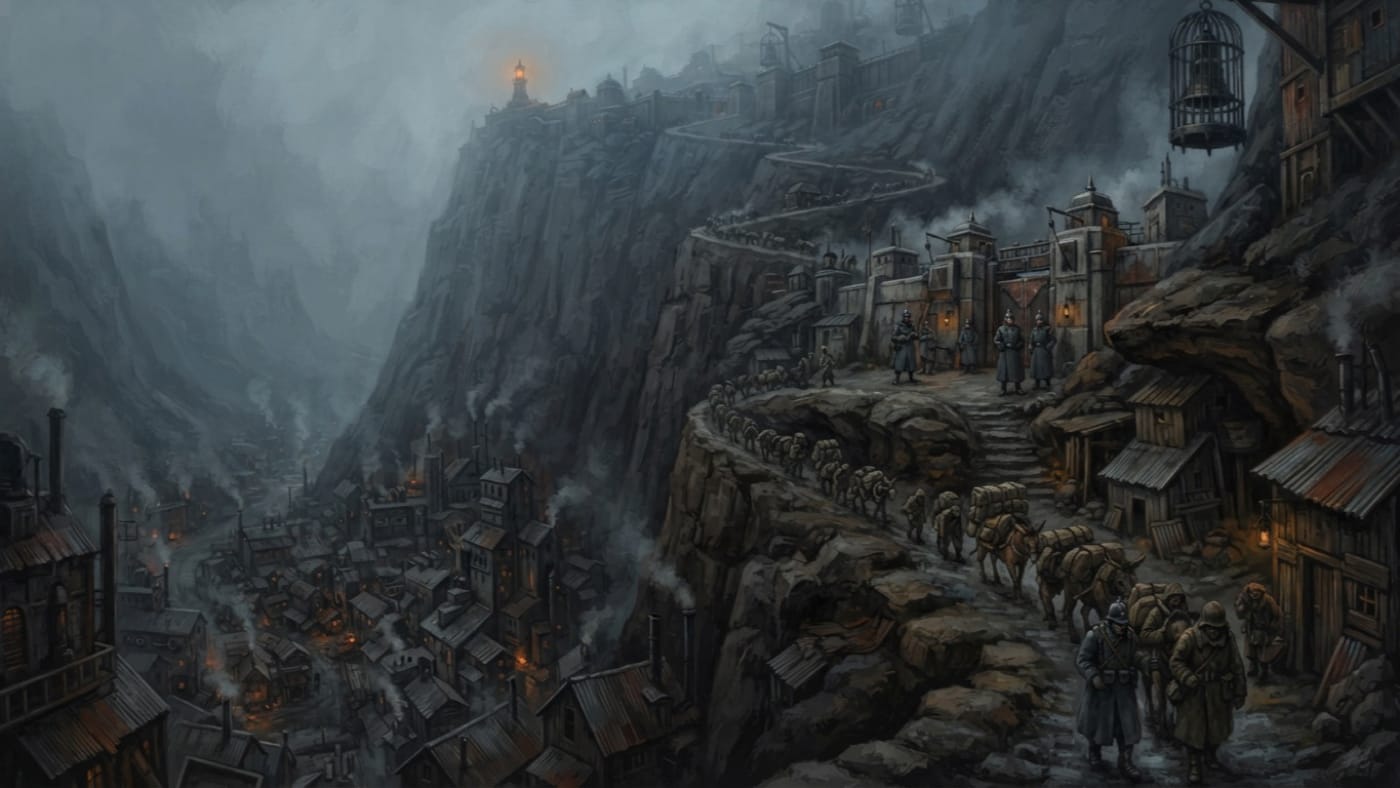
#On the Town Below the Ridge
"Dependent (supplies + conscripts)." — Classification of Lowvale Tallytown in the Station Three register of nearby places
The register at Third Light lists the station's neighbours by distance and by use. Fourth Light is an ally, three or four hours off along the ridge rope. Lowvale Tallytown is a town one day down the switchbacks, or two when the fog locks in, and its classification is a single word: dependent. A clerk capable of that classification understands the Church's accounting better than half the chapter houses of Strasbourg. The clerk who wrote that word had grain from below in his belly and oil from below in his lamp. He very likely had a bunkmate from below sleeping where a dead man had slept the season before. He wrote "dependent" anyway, in a fair hand. I admire the penmanship.
Lowvale is the short name of Lowvale Tallytown. The record says little about the town itself. I can give no founding year, no population, no magistrate and no plan of its streets, and I will not draw one to please the reader. What the record does show is the traffic. Goods go up the switchbacks from Lowvale, a few things come back down, and at the top men stand deciding whether either may pass. The ridge needs the town. The ridge also holds the permission, and at Third Light permission is sold rather than given.
The towers that this traffic keeps lit belong to the Beaconchain, which was raised after a convoy bound for Bastion-Przemyśl vanished in the passes in the winter of A.S. 72. The Sagittal Line was then defensible but unfinished. Third Light itself went up in A.S. 77. These are the towers' dates. The town has none on file. Nor do the papers explain the name Tallytown. The ridge pays in oil tallies; the name is on the register, and its derivation is not.
#On Oil, Glass, and the Ascent
The ridge lives on two things it cannot make. Lamp oil climbs from Lowvale Tallytown on mule-back and on porters' spines. Salvaged glass comes up the switchbacks by mule, when the mules arrive, from Lowvale and from whatever lies farther back behind it. I can't name the hands that pressed the oil or the ruins that gave up the glass. The record follows both as far as the town and no farther.
At the top, both are spent quickly. The oil feeds the relic-lantern on Beacon Tower Three and also warms the bunks, so every test flame the Lantern Shed burns costs some tender a night's warmth. The Lanternwright mechanics grind, seat and polish the glass, then clean it again after every four-hour cycle, because soot, ice and fog-damp will dull a lens before the bell next strikes. A cracked lens is repaired because nobody can promise a replacement. The station's own survey puts it with a bluntness I envy: without oil or lenses, the outpost is blind.
The ridge's other wants come after these two: rope, slate paper, wool, salt, nails and grain. I can't certify which of them pass through Lowvale and which arrive by other roads, so I charge the town only with the oil and the glass, which the record places in its hands.
The fog does not consult the lading bills. When it settles into the switchbacks, a day's descent becomes two. The mule strings stand where they are and the porters wait under their barrels. Up on the ridge the Lanternwright Knot knows, to the drop, how near the station stands to blindness, and it makes sure to be in the room whenever the barrels are counted.
#On the Men Sent Up
By its own count Third Light holds four hundred and thirty souls, and the count is falling. Lightning, falls, frost, thin air, the fog's misroutes and the long downward look from the Ropewalk that the garrison calls rope-stare take six to ten of them each season. Those figures belong to the ridge. I have none for Lowvale: not its numbers, not how many it sends, and not how many it can spare.
What the record does give is direction. Conscription from the valley towns replaces the dead, and the principal town it names is Lowvale Tallytown. The station's rules of access list a conscription transfer as one of the recognized ways onto the ridge, alongside the route writ and the escorted caravan. A conscript from below is entered on paper before he is ever seen at the Gate. A load may also enter under a route writ with bell-clearance or inside an escorted caravan. Without one of these three permissions it waits, and the weather keeps no office hours.
The same inventory lists the work that waits for him: beacon tender, bell rigger, lens polisher, oil porter, mule master, rescue winchman. Rotations are enforced by oath. Before cliff duty a worker lays both hands on the ledge and swears. Failure is logged as doctrinal breach. An error goes on the page as debt and is then worked off in night shifts, or in cliff work on iced ladders. The signal staff stand at the top of the order, with the Provosts and then the mechanics beneath them, and the tenders and porters below those. At the bottom are the fog-debt labourers, who hold nothing. A conscript joins at the lowest rung.
The parent assessment gives its own epitaph for such men: the unwilling become the competent or they become the dead. The ledger at the top enters each arrival from below as replenishment and each departure into the scree as attrition. Both kinds of entry go into the same column, in the same hand.
The ridge does keep one documented road home. Its list of institutional punishments includes exile down the switchbacks without escort. The switchbacks go down to Lowvale. I record which way they run and nothing more.
#On Permission and Its Price
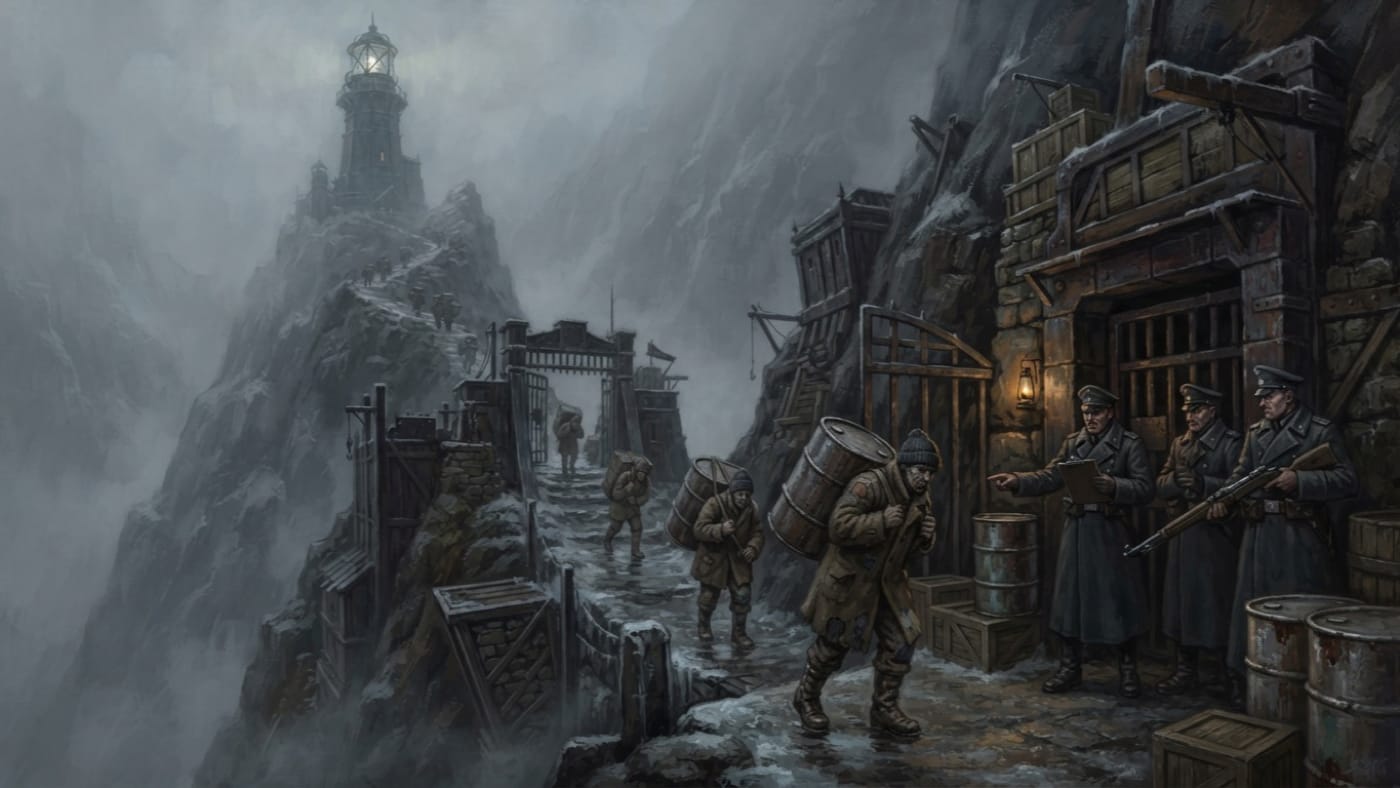
Nothing from Lowvale reaches the beacon without passing two counters. The first is the Signal Office, which certifies the route writ and the bell-clearance. The second is the Switchback Gate, held by the Gate Provosts under Harn, called Nail. The Gate carries out the log-checks, the searches and the tariffs, and it decides whether a mule carrying a perfectly good writ may go any farther. The writ costs one thing, and the Provost's willingness to honour it costs another. The station calls the sum the double-tithe. The Bureau of War considers it efficient. The Provosts' methods are entered as searches, tariffs and beatings; their night toll appears in no tariff schedule.
As far as I can find, neither office governs Lowvale. Their reach is shorter than that, and it is enough. They govern whether Lowvale's goods and Lowvale's sons may go up the hill. A town whose oil reaches the beacon only through a gate that charges in oil has one customer and two collectors, and the collectors keep the hours.
Coin is scarce above the snowline. The Gate takes lamp oil, clean paper, insulated gloves, and any clerical error that someone agrees to forget. So a porter climbing from Lowvale may pay the toll on a barrel out of the barrel. Some cargo may not pass under any writ: unlogged relics, unstamped messages, unsealed lantern parts, forbidden books, and coffins, which the station calls silent cargo. Searching for these gives a Provost lawful cause to open any pack on the road. Most travellers learn that the search goes quicker once it has been paid for.
The bell-signet cannot be forged. — Standing position of the Synod Signal Office.
Corrected. By A.S. 94, signal clerk Pell Oster had sold three weeks of forged clearance windows to a smuggling ring working out of the Lowvale. The clerical oath-collars followed his hanging. A writ certifying a load from below certifies only what some clerk was willing to press into wax.
#On Oster's Customers
The account is short, and I will keep it short. Bell-signets entered the record in A.S. 89. They were introduced by wartime Church authorities and frontier signal clerks, whom later Bureaus call the Signal Office, as they generally do with earlier work that went well. Before the clerical reform of A.S. 94, a clerk named Pell Oster was selling clearance windows that the timing wheel had never granted. His buyers were a smuggling ring working out of "the Lowvale." He was hanged from his own bell-cage, his execution was filed as equipment maintenance, and the oath-collars came afterwards. The house that keeps the record, the Loghouse of Slate Pages, still teaches his lesson to each new clerk who puts a collar on.
The record does not say what the ring was called, who belonged to it, where it kept its accounts or what became of it. It does say what the smugglers bought: three weeks of stamped permission, from the only counter on the ridge that sold it. They bought it at the Loghouse, the same place any honest muleteer would go.
I can't connect them to anyone carrying contraband today. The Ropewalkers run their undersong along the cables. The Knot sells selective blindness through glass angled just slightly wrong. Forged clearances still change hands on the ridge's black market. Those are three trades on record. The record never joins them into one, and it gives the Lowvale ring no heirs.
#On the Present Dependence
The Station Three assessment of A.S. 201 finds the arrangement unchanged and the ridge thinner. Oil still comes up from Lowvale, and glass still comes up whenever any can be found. Conscripts still march up to fill the bunks of the dead. Every one of them passes Nail's barrier, and every one pays. Down the switchbacks go repaired lantern components, route permissions and certified logs. As one companion account notes, the town can't eat the logs. It may at least file them.
The same assessment records a newer difficulty, and it touches the town more closely than anyone has told the town. Since the Alchemical Standards team left the ridge, the fog below has returned seven acknowledgments that the master timing wheel could not tell from Fourth Light's. They were entered as valid until Fourth Light reported that it had sent none of them. I offer no conclusion about what is answering. Lowvale's position does not depend on one. A clearance window certified against an acknowledgment that never left Fourth Light has been certified against nothing, and mule strings waiting below the Gate move only on certified windows. No Lowvale loss has been entered against the anomaly. The ridge's papers are not the place one would learn of it if there had been.
Beaconmaster Quill has asked for reinforcements and received paperwork. The paperwork, like everything else the ridge produces, will go down the hill.
The register's word stands. Lowvale Tallytown: dependent.