
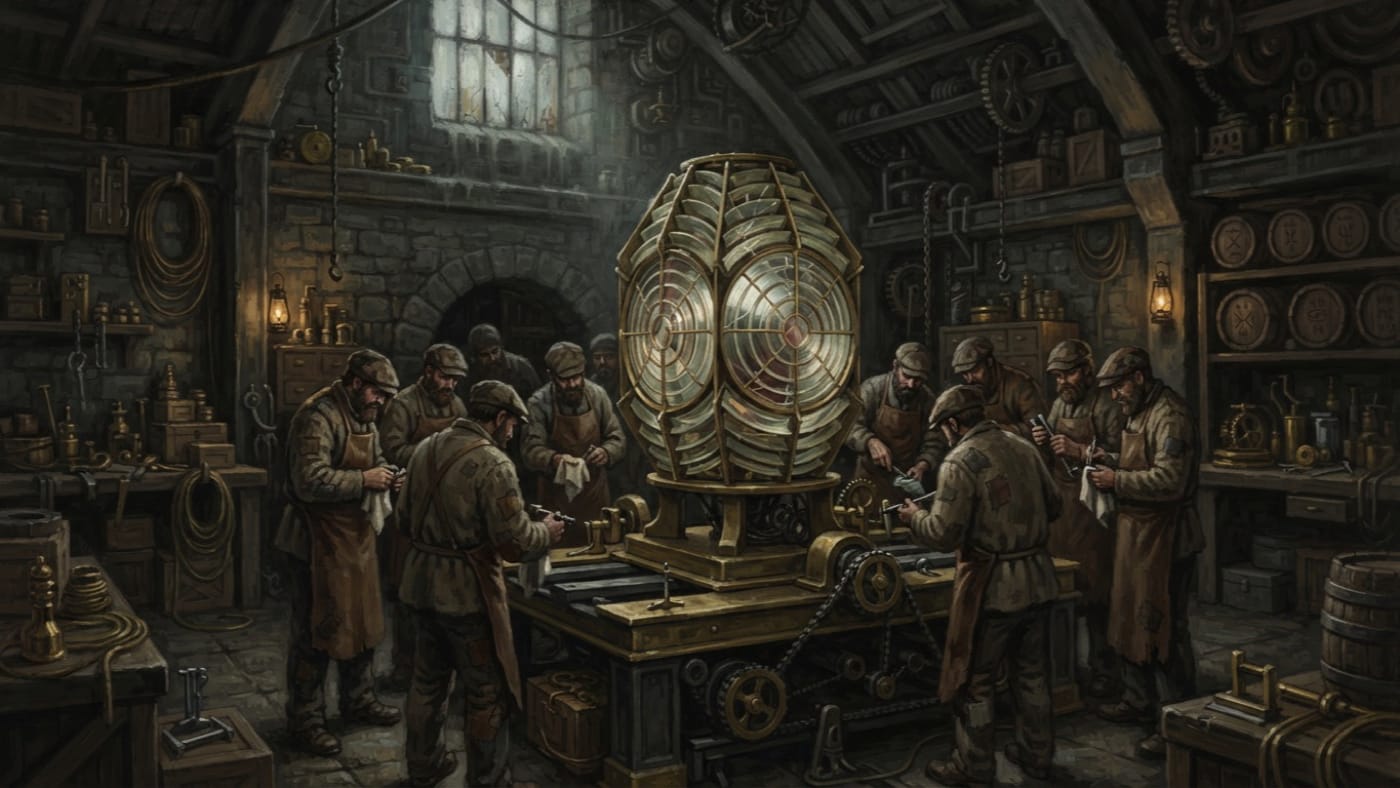
#On the Craft and Its Keepers
"Obedient." — Sister-Mechanic Vey Sable, describing the lenses of Beacon Tower Three
At Third Light, the Synod Signal Office owns the record and the Gate Provosts own the road. The Lanternwright Knot owns the one thing that both of them need before they can do anything at all: a lens that has been cleaned, seated and set true. The Knot is a craft guild in the old style. It has three grades, apprentice, journeyman and master, and it keeps its quarters in the Lantern Shed, where the station's relic-lanterns are taken to be mended. In public it speaks of maintenance pride. Its private ledger has more in it.
I asked for the guild's charter in the winter of A.S. 197, while I was inspecting the Beaconchain logs. I found no charter, no founder, no patron and no date of incorporation. The masters I asked treated it as the sort of question an apprentice would ask. The Knot does not count its members for visiting clerks. It counts lenses.
The name most often heard in connection with its work is Sister-Mechanic Vey Sable. She maintains the relic-lanterns and sings to them under her breath. No document in my possession says whether she holds rank in the Knot or only uses its tools. She did not say, and I did not press a woman who was holding consecrated glass.
#On the Lantern Shed
The Lantern Shed is a low stone building that smells of oil, old glass and the metallic sweetness peculiar to consecrated optics. Glass dust lies in the seams of the benches and the creases of the lanternwright gloves, and in the lungs of everyone who has worked there for more than a season. Lens polishers sit at one end and the oil is kept at the other. The distance between the two has been set with great care, and the reason is the station's history with fire.
The work is unglamorous. Salvaged lenses are ground, seated and polished. Relic-lanterns are trimmed, fitted and returned to the towers. The crown lens of Beacon Tower Three has cracked twice and been repaired three times. The Bureau of Doctrine has sanctified the cracks as "signs of endurance," which spares it the cost of a new lens. Repaired relic-lantern components go down the switchbacks as exports. They are among the few things Third Light sends below that are not paperwork or corpses.
The Knot's authority comes from its specifications. The grind, the seating and the bearing tolerances of each lens are kept in no ledger I was permitted to see. They pass from master to journeyman and from journeyman to apprentice in the same way a confessor's secrets do, by mouth and under supervision. The Knot also controls the parts, and so it controls when they arrive. Its recorded methods are parts control, delays and what the station calls "accidents," with the quotation marks spoken aloud. I can document no particular accident and decline to invent one. The Bureau has enough fiction on file already.
Lamp oil and glass are the station's two bottlenecks. Oil comes up from Lowvale Tallytown, a day's descent below, on the backs of porters who are paid in ration chits and contempt. Glass comes up seldom, and there is never enough of it. Without either one the outpost is blind, and the Knot knows to the drop and to the shard how close the station stands to that condition. Knowing this does not mean owning every barrel. It does mean that the Knot will be in the room whenever the barrels are counted.
#On Selective Blindness
The Knot sells a service it calls selective blindness. A lens is angled so that one particular convoy is not illuminated, or one signal is not relayed, or one movement on the ridge is not seen. The price is oil, always oil, because at this altitude oil is heat, light and wages, and it does not need a seal from Strasbourg to be accepted.
The guild that keeps the beacon true is the guild that will make it untrue for a fee. At Third Light this produces no visible scandal. The scandal comes from the evidence, or rather from how little of it there is. Pell Oster, the signal clerk who sold forged clearance windows in A.S. 94, left forgeries in the log, and he was hanged from his own bell-cage. A lanternwright who sells a missed observation leaves a lens set a fraction off its bearing. That is a maintenance finding. The Knot then corrects the fault it caused and bills the station for the oil.
The trade leaves no customer list, no contract and no tariff in any file I have read, and I will not draw one up to satisfy the Bureau's love of tables. What follows from it is plain enough. A relay that is never seen means a blank page in the Loghouse, and Beaconmaster Quill fears blank pages more than he fears the fog.
#On the Other Keepers of Third Light
The station divides its senses among several jealous custodians. The Synod Signal Office, under Beaconmaster Jorren Quill, keeps the logs and the master timing wheel and decides whether a signal cycle is valid or void. Its log procedures were standardised in A.S. 82, and the bell-signets followed in A.S. 89. Both reforms were made under the Church's frontier signal administration, before the Concordat of A.S. 90 gave the office its present name. As far as the surviving procedure shows, neither reform has anything to say about how glass is ground.
Quill can void a cycle. He cannot make a lens see. The Knot can make a lens see, but it cannot declare that what the lens saw is true. Each depends on the other, and neither enjoys it.
Gate Provost Harn, whom the garrison calls Nail, controls passage through the Switchback Gate, along with its searches and tariffs. The Ropewalkers' Brotherhood controls access to the cables, and its smuggling runs along their undersides. The Fog-Scouts guide contraband through the white below the ridge and claim to know when it opens visibility windows. Wherever passage is taxed, cables are hooked and windows are sold, there is a market for observations that never get made. No partnership between the Knot and any of these parties has been documented. None needs to be. The market exists either way.
Rank still holds. Signal staff stand above the provosts. Provosts stand above the mechanics, and the mechanics stand above the tenders, porters and fog-debt labourers. A lanternwright bows to a provost at the gate. Then he goes back to the Shed and decides what the provost will be able to see in the morning.
#On Calibration and the Answering Fog
At the start of each four-hour signal cycle, six times a day, twelve voices of the Knot sing a single flat note and hold it. They hold it until the lenses settle and the hum in the ropes falls back to its baseline. Twelve is the size of the chorus. The size of the guild is not recorded. The Bureau of Doctrine has not explained why singing should affect an optical instrument. The lenses work, and the Bureau is practical about its superstitions.
Since A.S. 194 the chorus has been one of three recorded countermeasures, alongside the grounding chains in the basalt and the salt lines on the catwalks. That was the year the Signal Office opened its file on the answering fog, and the year Sable stopped looking into the basin. In the earliest entries the problem appeared as a second acknowledgment, arriving between seventeen seconds and four minutes after the true one. It came from below, where there is no tower, and it matched the true signal in protocol and content. The countermeasures suppressed it for a day, a week or a month at a time, and then the second acknowledgment returned.
I record what follows from later documents. I did not witness it. In A.S. 199 the Bureau of Alchemical Standards investigated, and the echoes reportedly arrived half a beat late, then a quarter of a beat, then exactly on time. By the assessment of A.S. 201, seven acknowledgments entered as coming from Fourth Light had been exposed only because Fourth Light reported that it had never received the signals.
These two matters must be kept apart. The Knot's trade sells the absence of a signal. The fog supplies a signal that should not exist. No record I have read shows the guild forging those acknowledgments or serving whatever produces them. Beaconmaster Quill suspects that something has learned the Beaconchain's protocols and wants Third Light blind. That suspicion is his, and I have filed it under his name.
The Bureau of Alchemical Standards classified the answering fog as "acoustic refraction consistent with atmospheric layering," a natural phenomenon requiring no doctrinal intervention.
That classification has been suspended. No reclassification has replaced it. The chorus continues to sing in the meantime.
#On the Present Application
Sable has requested new lenses, to be ground to specifications that the Knot claims will "see through the echo." Whether such glass can be ground, by whom, and from what stock in a station that is always short of it, the application does not say. The Knot has not disclosed the specifications either. I am told the master craftsmen regard this as a matter of principle. The Bureau of Ordnance regards it as a reason to do nothing.
The Bureau of Ordnance replied with a memorandum suggesting that she recalibrate the existing lenses. Those lenses have been cracked twice and repaired three times, and they have been sanctified for it. No new lens has been made. None has been delivered, and none has been tested against the echo. The request stands, and so does the memorandum. Oil comes up the switchbacks a barrel at a time. Glass hardly comes at all. Twelve voices continue to hold their note at the start of every cycle.