
#On the Chain and the Passes
"The Chain never lies. Only men do." — Propaganda line current at Third Light
Picture a convoy halted below a Carpathian switchback. The mules are steaming, the drivers stamp at the cold, and a provost reads their route writ with the unhurried contempt of a man paid by the hour of other men's waiting. The convoy has grain, oil and a destination. It does not yet have a window, and until the mountain grants one it is freight parked on a ledge.
The window comes down the Beaconchain.
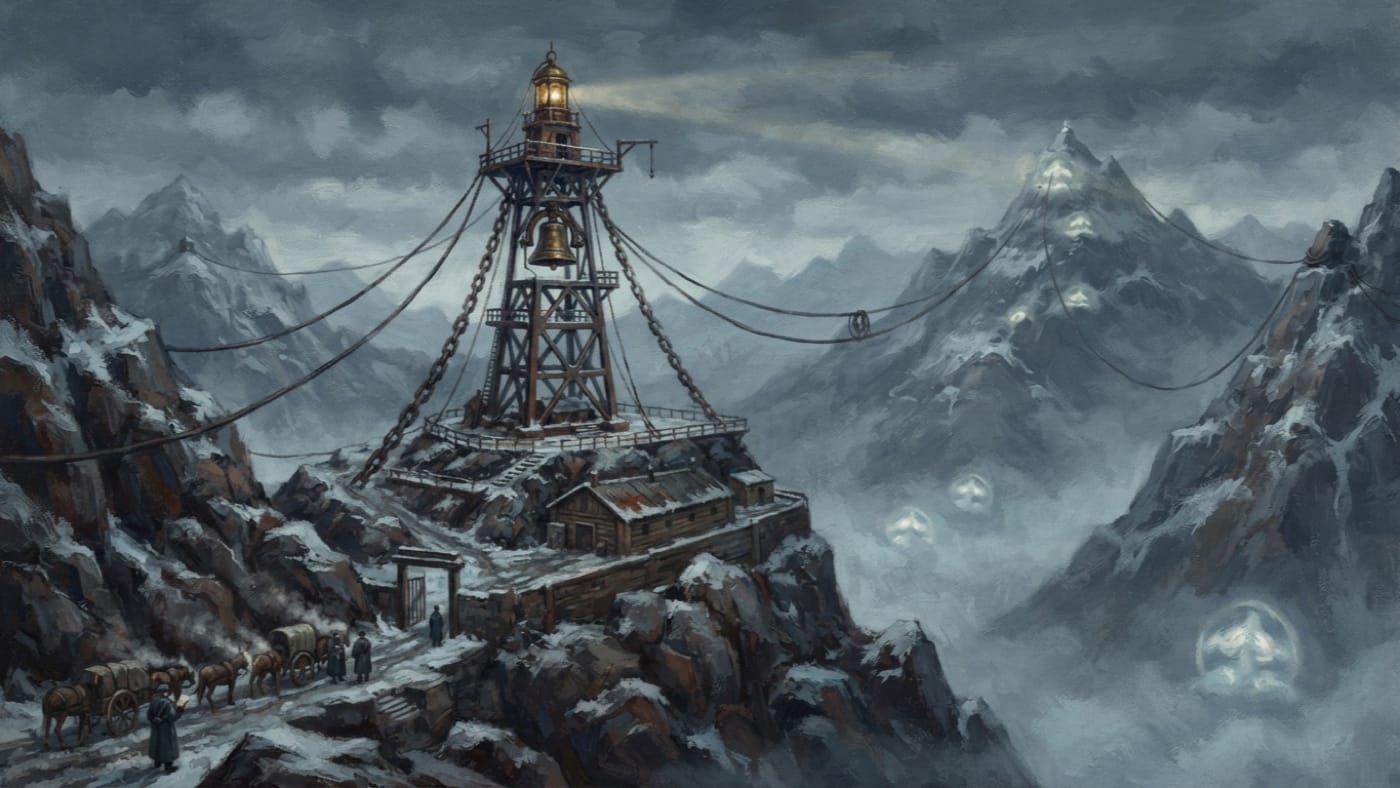
The Beaconchain is a relay of iron towers that steps from peak to peak across the ridge passes of the high Carpathians. Each tower carries a relic-lantern and a bell, and each keeps a certified record of what it sent and what it received. Through it pass convoy permissions, route clearances, storm warnings, and the timing signals by which every other message is judged. Elsewhere in the Church, beacon chains are warning lines: towers strung with lanterns and lit in sequence when Abominations stir. The Carpathian chain was built for that duty and for the duller one of deciding who may move. The duller one kills more people.
Four of its stations are named in the surviving record. First Light holds the northern crest. Second Light sits in the mid-ridge saddle. Third Light looks over both the northern passes and the southern switchbacks, and Fourth Light answers it across three or four hours of ridge rope. I make no claim that four is the whole of it. The chain's full length is kept in folios I have not been shown, and I have learned not to ask for a folio twice.
#On Its Raising
The record begins with a loss. In the winter of A.S. 72 (1782 CE), a convoy of eleven wagons and three hundred mules set out through the passes for Bastion-Przemyśl. At that time the Sagittal Line was defensible and far from finished, and its practices were still being hammered into standards. Supply through the passes ran on nerve and guesswork. According to the recorded account, the mules were recovered alive three weeks later. The men, the wagons and the grain were gone, and the seals were found unbroken. I give these particulars as they were written down and add nothing, because nothing I could add would improve them.
That same winter, the wartime authority later catalogued as the Bureau of War commissioned signal towers for the ridge. Commissioning is paperwork, and iron is slower. First and Second Lights were operating by A.S. 74 (1784 CE), and both served. In A.S. 76 (1786 CE) a single lightning storm destroyed them together.
Third Light was raised on higher ground in A.S. 77 (1787 CE). Its grounding chains were sunk forty feet into the basalt by men who had watched the previous towers burn. Second Light was rebuilt in A.S. 79. The Church's frontier signal clerks standardized the logs in A.S. 82 and introduced the bell-signet in A.S. 89. Their office has since been given its present title, retrospectively. The formal Synod did not yet exist to be credited with either reform, and it has accepted the credit anyway. That is how institutions acquire a past.
Oath-collars for clerks followed in A.S. 94 (1804 CE), after a clerk named Pell Oster was found to have sold forged clearance windows. The ridge has never reformed anything until someone was caught.
#On the Authorized Cycle
At Third Light the work runs in four-hour cycles, six to the day. I describe that station's practice because it is the one I watched. I do not certify that every tower keeps the same clock or the same apparatus.
The tower is fifty feet of riveted rust-iron at the highest point of the ridge. The relic-lantern sits at its crown behind a lens of consecrated glass, with a bronze bell in an iron cage beneath it. The bell opens each cycle. The lantern is unhooded and signals along its bearing toward Fourth Light, and Fourth Light answers. The bell then closes the cycle. In the Loghouse below, a clerk presses the bell-signet into wax on the page and checks the entry against the master timing wheel. The station calls the signet a sound-seal: it certifies that the strike, the signal and the answer came in their proper order.
I have heard engineers from Strasbourg explain how a bell's sounding can be held in wax. They gave three different explanations. I trust none of them and need none of them. The Loghouse does not ask how the seal works. It asks whether the seal is there.
A cycle exists only once the wheel agrees. A clearance entered in a valid cycle becomes a route writ. The writ goes down to the Switchback Gate, and the convoy on its ledge may become a convoy in motion. A lamp that burned without a matching entry is a lamp that burned and nothing more. It authorizes nothing. The institutions of the ridge enforce the recorded sequence and only that. A tender who swears he saw Fourth Light answer but has no signet to prove it has sworn to the weather.
Nobody sells the master timing wheel. At Third Light, late entries, corrected timestamps and lost pages all have a price. The wheel does not. Tampering with it means annihilation, and even the Ropewalkers treat that as a fixed tariff.
#On the Price of Passage
Nothing on the ridge runs without oil and glass. Without oil the lantern is cold, and without usable glass it is a cold lantern with a crack in it. Rope, salt, dry paper and conscript labour follow close behind. Lowvale Tallytown lies a day's descent below Third Light. It sends up supplies and conscripts in roughly equal measure and gets back certified logs, which cannot be eaten.
Scarcity has a market. The Lanternwright Knot maintains the lenses and keeps their specifications to itself. It also sells what the garrison calls selective blindness: a lens angled just badly enough that a particular movement is never seen. The Ropewalkers' Brotherhood holds the cables and runs contraband along their undersides. The Gate Provosts search and tariff every load at the Switchback Gate, where Harn, called Nail, counts his bribes like prayers. Beaconmaster Jorren Quill keeps the logs and fears a blank page more than a storm. Sister-Mechanic Vey Sable keeps the lenses, and the station sees only through glass she has maintained.
Error has its own economy. A clerk's mistake is logged as error debt and paid off in night shifts or cliff work. The debt goes on the page first and is then worked off on iced ladders by whoever made the mistake. A forged entry is paid for by somebody else.
A traveller should understand that a writ and a passage are two separate purchases. The Signal Office sells the writ, and the Provost sells the passage. The Bureau of Records recognizes only the writ. The mules recognize only the passage.
#On Answers Received from Below
Since A.S. 194 the Signal Office has kept a file on anomalous signal behaviour at Station Three. The file is still open. It describes a fog that answers.
The fog-basin under the ridge is called White Mouth. It has no recorded station, tower, lens or bell. The file records what happens after a legitimate cycle, once the lantern has signalled and Fourth Light's acknowledgment has been received. A second acknowledgment then arrives, apparently from White Mouth. It matches the true answer in content and tone, but it comes from the wrong place. At first it came late, and the difference was logged as clerical drift. By A.S. 199 the delay was narrowing. Tenders report bells ringing half a beat behind, lantern glow that leans, and a rope-hum that the ropewalkers insist has shaped itself into something like words.
Then came the latest folios. Seven acknowledgments were received, signeted, checked against the wheel, and entered as answers from Fourth Light. Fourth Light has disowned all seven. Every wax impression is in order, and the timing wheel found nothing to object to. The record is immaculate. The record is wrong.
The chain was built on the assumption that three things would stay together: what the tower appeared to receive, what the Loghouse validated, and what Fourth Light actually sent. On the ridge above the Line, those three have come apart. Any convoy that moved on one of those seven cycles moved on a clearance that was valid and false at once.
Countermeasures exist, and they work some of the time. Grounding chains drain the tower. Salt lines are laid along the catwalks. The Lanternwright Knot holds flat-sung calibration choruses, sustaining one note until the lenses settle and the rope-hum drops back. For a while after each, the fog stays quiet. Then it answers again.
The Bureau of Alchemical Standards classifies the answering fog as acoustic refraction consistent with atmospheric layering, requiring no doctrinal intervention.
That classification is suspended. No replacement has been issued.
What the fog is, how it answers, and whom it serves remain undetermined. The Bureau of Doctrine has not assigned it to the Great Deceiver or to anyone else, and I will not do Doctrine's filing for it. Quill suspects that something below has learned the chain's protocols, and that it wants Third Light blind. Those are his assessments, and he keeps them out of the log. The garrison keeps a proverb: if the fog repeats you, it is learning you. I wrote it down during my inspection and have regretted the ink since.
At Third Light the lantern is still unhooded six times a day, and the bell still strikes. The wax still takes its impression and the wheel still turns. Convoys below Przemyśl's passes still wait on their ledges for windows that come down the mountain correctly sealed. The Bureau of Records reports no discrepancy in the Station Three logs.
It is correct. There is none.