
#On the Shore That Feeds the Hinge
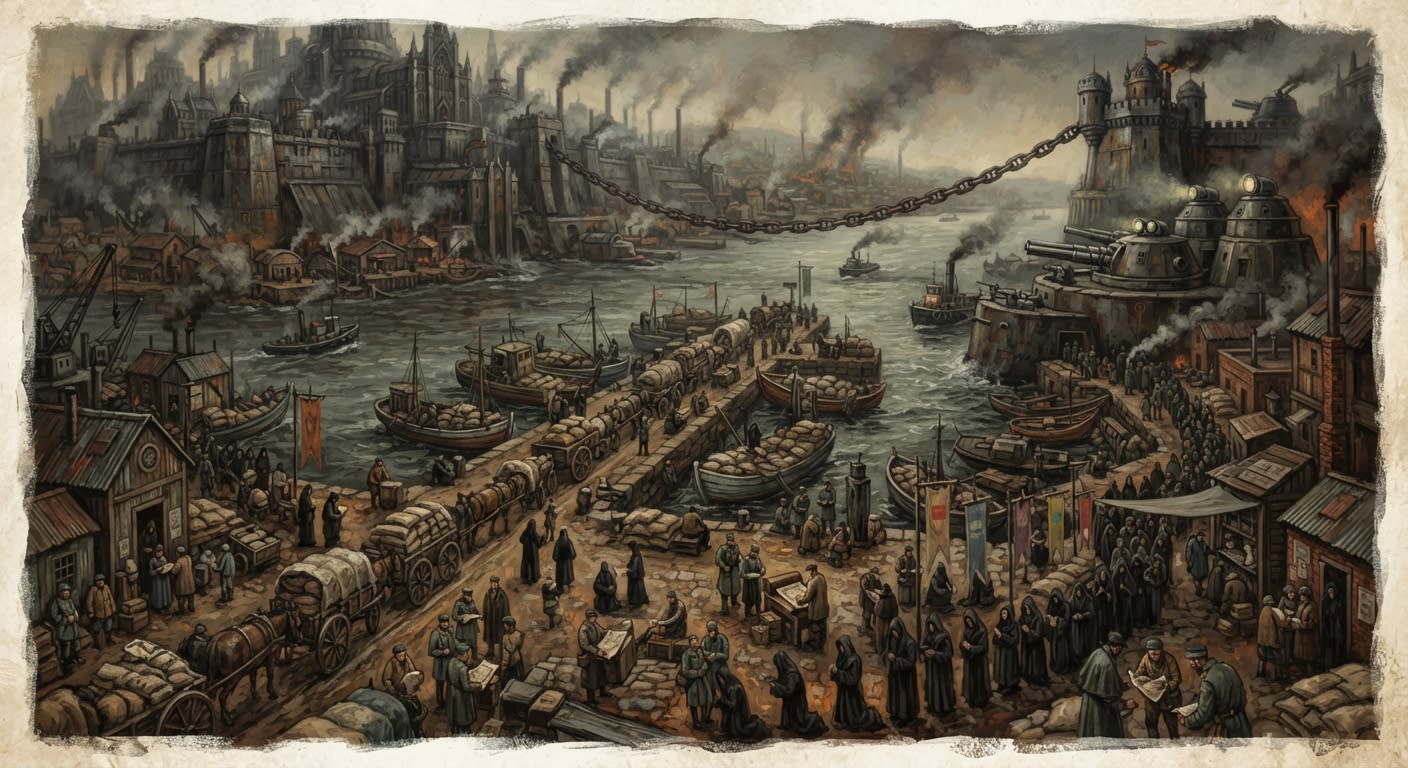
The Anatolian prefectures are the administrative name for Constantinople's appetite. They lie across the strait from Bastion-Constantinople, south and east along the Anatolian shore and inland as far as a tax cart will go without an escort. There are grain fields, fishing villages, sanctuary harbors, causeways, pilgrim roads, convoy yards and garrison towns, as well as certain pits the Bureau of Purity has never officially found. Together they keep the southern anchor of the Sagittal Line fed and heated. The Synod holds them. The Synod also counts them, which is a separate activity and a much less successful one.
Poets paid by the Bureau of Pilgrimage call this country the Green Shore. Quartermasters call it the Stomach. The Bureau of Tithes calls it the Purse. Nobody who has stood in a grain queue at the Anatolian piers before dawn calls it anything the Codex can print.
The prefectures did not win the stand that began on the Bosphorus in A.S. 47, but they made it possible to keep standing. While Maldrake's furnace-legions set the Thracian approaches alight, Anatolian wheat crossed the strait in ox-carts and fishing hulls to men who had forgotten the smell of an unburnt loaf. The Bureau of Rites credits several miracles for that survival. Records credits the harvest.
#On the Ordering of the Green
The present Synodal role of the prefectures began in A.S. 68, when the southern hinge was ratified and work began on the Harbor of Chains. That year the far shore was given a job. It would feed the fortress, guard the eastern end of the chain, and take the blame when either duty failed.
The Concordat of Strasbourg brought the Bureaus in A.S. 90, and the Bureaus brought forms. War took the forts. Tithes took the threshing floors. Records took the births, or as many as were reported. In A.S. 95 the Bureau of Settlement imposed its seven-colour discipline and painted the Pilgrim's Coast approach Green. It then spent a century learning that paint is not governance. Revisions in A.S. 130 and A.S. 155 extended the colour. The Redrawing of A.S. 188 then pushed displaced families into Green settlements that had no room for the families already living there.
The Synod did not found the prefectures. It requisitioned what was already there and measured it. Ever since, it has treated the measurement as a kind of birth.
The devotional handbook The Green Road to the Hinge, sold on pilgrim vessels out of Marseille and Genoa, describes the Anatolian prefectures as "a pastoral country of ordered fields and quiet chapels, where every sheaf is counted and every traveller blessed."
Corrected. The fields are ordered while an inspector is watching them. The chapels are quiet only once they have been converted into grain stores, and several have been. Every sheaf is counted twice, once by the farmer and once by Tithes, and the two totals have never agreed. The traveller is blessed and then charged a fee for the blessing. The fee is the only part of the process that works every time.
#On Grain, Pilgrims, and Other Obstructions
Grain leaves the prefectures by every method short of prayer, and some prayers ride in the same cart. Ox-carts bring it down from inland threshing floors. Mule trains bring it from granaries too remote to be worth a clerk's journey. Fishing hulls carry wheat one season and salt fish the next, and smell of both all year. The Anatolian grain convoys gather along the Green shore and wait for a crossing window. Then they cross to the Harbor of Chains, where Piers Eight through Eleven receive most of what arrives. What arrives is less than what left, but that belongs to a later section.
The causeways carry everything, and that is their trouble. The same stone road carries grain carts and pilgrims west. It brings back empty carts, penitents who have given up, conscripts on rotation, relic-sellers, lepers with the correct papers and lepers with the other kind. Pilgrims stop at every wayside shrine, and the shrines stand where the road narrows. A cart of spring wheat waiting behind a kneeling widow from Lyon loses about a sack an hour to damp, rats and the attention of strangers.
The Bureaus do not agree on what the prefectures are for. War sees a supply depot with civilians attached. Tithes sees a taxable surface. Records sees an enumeration problem whose subjects tend to die before they can be counted. Purity sees a porous frontier and sends Ordeal teams to stand in the road at irregular hours. The Bureau of Passage issues crossing windows, and Settlement issues permits. Every office has jurisdiction over part of every cart. None has jurisdiction over the ox.
The Chain of Saint Anakletos runs some twelve hundred yards from the southern tower to the Anatolian gun emplacement. The emplacement's garrison is posted from the city, but its bread, rope, lamp oil, laundresses and gossip come from the prefectures. Those who admire the Chain for holding the strait might remember that its eastern anchor eats Anatolian barley.
#On Prefects, Assignors, and the Arithmetic of Mercy
An Anatolian prefect holds a seal, a residence and a list of duties longer than the road he governs. His orders are obeyed in theory and worked around in practice. His name is kept in Records, but his authority sits with the forts, the granary factors, the harbor pilots and the women who decide which child runs the message.
Settlement's organic garrison towns are thickest here. A typical fort was built for two hundred soldiers and is now surrounded by twelve thousand people who wash, bake, mend, sell, bury, marry and smuggle for it. The commander buys his bread from a town he claims not to govern. He pays for it in coin minted by an office that denies the town exists. The Assignors are sent to make sense of all this, carrying satchels, maps and denial wax. An Assignor can revoke a household's Green permit before noon, but enforcing the revocation takes an escort. War escorts guard forts. Purity escorts want spectacle. Tithes escorts appear only where there is coin to count.
Order in the prefectures is performed more than it is achieved. The scales in the tariff chapels are blessed every quarter and calibrated less often. Queue lanes are roped according to Settlement's colours and walked according to hunger. On inspection days the whole shore stands straighter, the way a congregation does when the bishop arrives. When he leaves, the shore goes back to what it was doing. That is the only reason there is bread.
#On Hunger's Shore
The prefectures lie in Kargath the Devourer's theatre, and his method here is patience. He seldom burns a field. He lets it feed Constantinople and quietly subtracts from what it sends. A hull loads twelve hundred tons and unloads eleven hundred and forty. Barrels sealed correctly open short. Grain spoils one layer at a time, so the middle sacks turn black and warm while those above and below stay clean. Every manifest balances, and the ration doors open on an empty room. Tithes blames the weighing. The clerks blame the next page of the ledger, and the missing grain is never on it.
Maldrake is less subtle. In A.S. 143, the Year of Ash Rain, he set the Thracian forests alight, and ash fell for nine months. Crops failed across the eastern prefectures. The ash crusted the furrows and blackened the spring shoots at the stem, and Anatolian flour that year tasted of coal. The Ninth Bell Famine followed, and Records logged some sixty-eight thousand dead. The Bureau of Rites named it a refining tribulation. The farmers had their own name for it. I have filed that name under honest theology, and I will not print it.
Heat is the prefectures' other export. The Anatolian Pitlands seep crude that becomes black diesel. The fuel is condemned under Standing Order 14-K, taxed in private and denied in public. It is also burned in every Constantinople kitchen that would otherwise freeze. In A.S. 136, smoke from Anatolian crude formed lines of scripture above a furnace quarter of the city, and seventeen soldiers died firing into it. This was the Scripture-Smoke Incident. The seams were not closed afterward, because dangerous fuel sells for more.
Phaleron Bay lies seven miles off the Pilgrim's Coast, and the Iron Idol rests under its water. The Bureau of Engineering surveyed the site in A.S. 189 and filed one sentence: The survey is complete. Fishermen from the prefectures keep their nets away from that water. Along the shallows the Strait-Rats run ration coupons, pit-sludge and the odd deserter under tarpaulins marked net repair. Every lawful shipment here has an unlawful one sailing a little way behind it.
HARBOR RECORDS EXTRACT — CONVOY ANNEX, DATE WITHHELD Grain hull departed a Green pier at the evening bell, complement eleven, cargo barley. Logged passing the Phaleron no-net line at ██████. Not logged at the Chain. Recovered the following dawn at Pier Nine. Hold full. Crew absent. Manifest amended in an unknown hand to read delivered in full. Weighed: correct to the ounce. ████████ declined to issue the ration.
#Present Condition
As of A.S. 201 the Anatolian prefectures are Synod-held, indispensable, overtaxed, undercounted, and porous to anything with a permit or a price. The grain still crosses, lighter than when it set out. Pilgrims still kneel on the causeways. The gun emplacement still anchors a Chain that has not burned white since the Black Sea Armada of A.S. 162. Since A.S. 199 its crews have filed the same dark-night reports as the harbor, and they count the same links: three hundred forty at the forging and three hundred forty-seven now. Their count agrees with the city's, which makes it the only Anatolian figure that does.
Constantinople treats the far shore as both pantry and suspect. It eats the bread and then audits the baker. It burns the fuel and then hangs the carrier. It seals the famine dead into its Ossuary Rings, and the next season it asks Tithes why the eastern yield has fallen.