
#On the Grain That Holds the Wall
Every pilgrim to Bastion-Constantinople wants to see the bells. Some want the Chain, a few want the ossuaries, and the unwell ones want the marsh. Nobody sails from Genoa to kneel before a sack of Anatolian wheat. Yet since the siege years the wall has stood on four things: bell, chain, gun and grain. The Bureau of Doctrine has commissioned hymns to the first three. The fourth gets an invoice.
When the retreating Levy reached the Bosphorus in A.S. 47 and stopped because it could go no further, it did not live on faith. It ate what came across the water from the Anatolian shore. During the burning decades, while Maldrake's brass fell on the walls and breaches were filled with bodies and then concrete, the convoys kept moving through the coast south and east of the city. The Bureau of Rites has printed seventeen accounts of divine intervention in those years. None of them mentions a barge. All of them were written by men who had eaten that morning.
The convoys did not become Synodal property by charter, and I will not make one up for them. They became Synodal property the way everything in the South did: in A.S. 68 the Bastion was fixed as southern anchor, the Harbor of Chains took on its first real form, and the shore supplying both was ordered, counted and taxed under one name. The ships were older than the order. The order has spent a hundred and thirty-three years pretending it came first.
#On the Green Approach
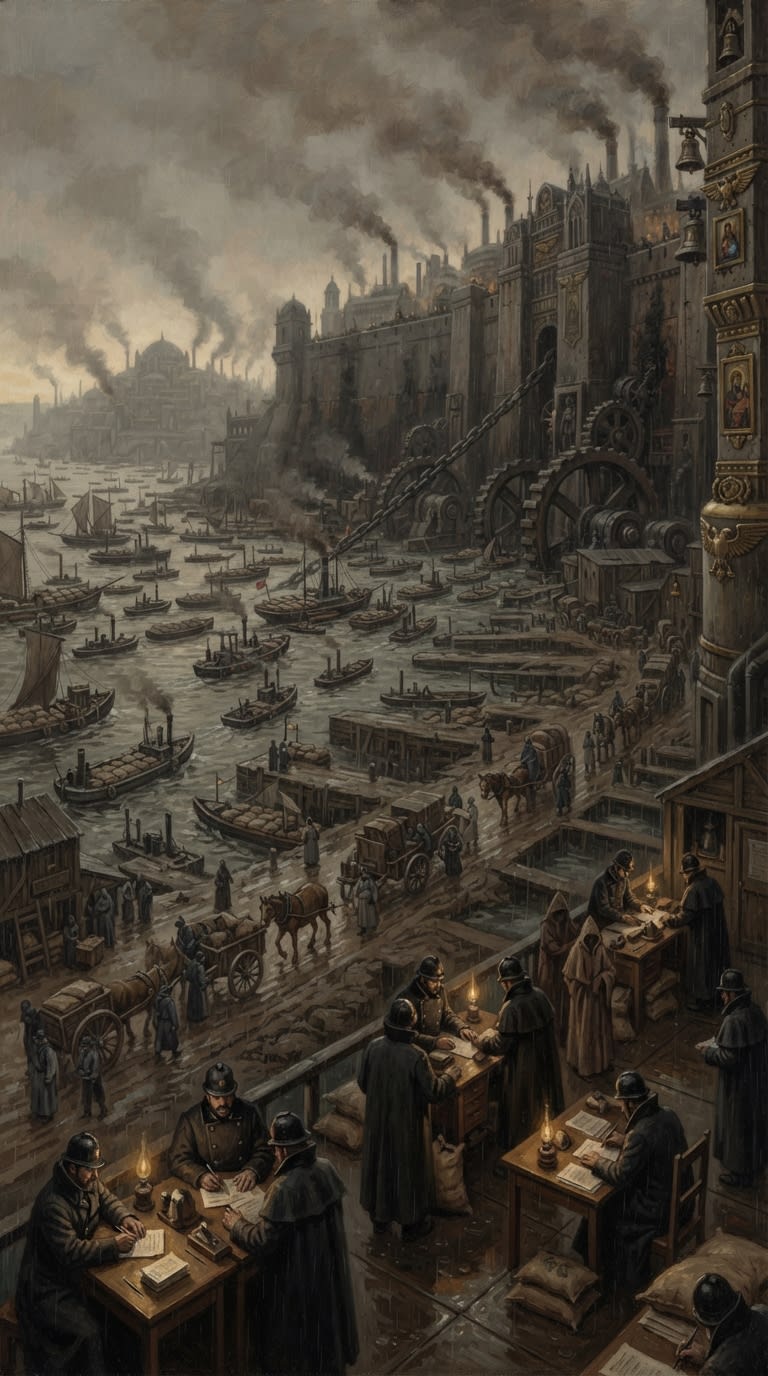
The grain loads on the Anatolian shore. It comes down in ox-carts from threshing floors, on mule trains from inland granaries, and in fishing hulls that carry wheat one season and salt fish the next. It gathers along the Pilgrim's Coast, which in A.S. 95 the Bureau of Settlement coloured Green in its seven-colour model. It then crosses in convoy to the Harbor of Chains, where Piers Eight through Eleven take commercial traffic, most of it Anatolian grain.
The Coast is a devotional landing, a convoy staging ground, a garrison support belt and a smuggling seam, and nobody has ever counted it properly. Grain carts use the same causeways as pilgrim processions. Ox teams wait in the lanes where Route-Stampers bless travel tokens. In the organic garrison towns, villages of twelve thousand grown around forts built for two hundred, the grain passes through more hands than a relic of the true boot. Each hand is licensed and taxed, and each is a little lighter afterwards.
Green permits govern the staging. A cart without one sits. A cart with one also sits, but with a documented grievance. A pilgrim ship arriving on the same tide as a grain convoy takes the causeway by right of piety. The grain waits, and the rain does not respect the queue.
The devotional literature of the Bureau of Pilgrimage describes the Anatolian convoys as "a procession of plenty, orderly as a litany, moving to the harbor in the same spirit of offering as the faithful who walk beside it."
Withdrawn for internal circulation. The convoys are not orderly. They are queued, and that is a different virtue. The faithful who walk beside them are mostly blocking them. Whatever offering takes place happens at the Tithes scale, involuntarily, and by weight.
#On Manifests, Bells, and Weighing
After the Concordat of Strasbourg in A.S. 90, the Bureau of Passage took formal authority over movement: convoy clearances, quarantine holds, queue licences and the right to decide which hull goes first. Its motto is No Name, No Passage. A grain ship has a name, a master, a manifest and a tonnage. Passage checks all four before it will look at the wheat.
What follows runs as a liturgy, though nobody wrote it as one. The Bureau of Tithes weighs the cargo, taxes it and explains any shortage by invoice. The Bureau of Records keeps the manifest, and missing food becomes a column. The Bureau of Purity inspects the sacks, the seals, the carters' tongues and anything in the load too eager to be eaten. The Bureau of War takes delivery and complains. Then the Bureau of Doctrine declares the ration holy.
Bells set the pace. A convoy that misses its crossing window waits for the next, and on the Bosphorus the next may not open before dusk. At dusk the Chain of Saint Anakletos goes up across roughly twelve hundred yards of strait to the Anatolian gun emplacement. It comes down at dawn. Ships caught outside it anchor in the dark and count their sacks until morning. The morning count is lower.
The Ravelin of Purity runs the worst of the inland inspection. At its first porch rations are weighed, at the second smelled, and at the third the men who ate them are asked what they remember eating. The practice began with one sack that passed every visual test and grew teeth in the kettle. The Ravelin has since learned that the scale can be fooled and the dogs can be fooled, but Kargath is careless about what men remember.
Since A.S. 119, and in the field revision for Line use since A.S. 157, every ration has been issued under the Doctrine of Enough, which teaches the soldier that his portion is exactly what the Creator intends him to have. The catechism is well made. The only trouble with it is the portion.
#On Kargath's Arithmetic
Kargath the Devourer is not a thief. Theft leaves a gap, and a gap can be investigated. Gluttony in his hands is a need that grows as it is fed, and along the convoy route it works in the ledger rather than the hold.
A hold loaded with twelve hundred tons comes in at eleven hundred and forty. Barrels sealed correctly open short. Salt fish rots in the middle layer while the top and bottom stay sound. A mule team arrives with every animal alive and half its feed missing. A ration cart with a perfectly valid stamp goes to the wrong ravelin. A warehouse ledger shows full stores beside an empty floor that smells of warm bread.
Sixty tons is a rounding error for Tithes. Across a season of convoys it is a company without supper. Across a decade it is a regiment that hears the dinner bell as a threat. Kargath need not breach the wall if he can shorten the man on it by one ration a week and let the Doctrine of Enough tell him he was never owed more.
I will not say how much of the missing grain belongs to the Devourer and how much to the Coast's own mathematicians. The Bureau has not said either, and I wrote the Bureau's position. The Grain Keepers hide what they can from the quota, having correctly read that a ration system controls obedience more reliably than a famine. The Strait-Rats cross where bell windows overlap, with reliquary crates whose paperwork says one thing and whose weight says another. All three produce the same entry: delivered, and never delivered.
#On the Harvest Convoy Season of A.S. 162
Here I must be exact, because the tradition is not.
In A.S. 143 Maldrake burned the Thracian forests, and ash fell on the South for nine months. The Ninth Bell Famine of A.S. 143–144 came from that ash: blackened fields, failed eastern harvests, soil that has not forgotten. The famine census of A.S. 145 confirmed 68,712 dead. The Anatolian convoys were the one supply the ash could not reach, and they were not enough.
Nineteen years later the Black Sea Armada came down the strait in late autumn, timed for harvest convoy season, when the Bosphorus was crowded with grain hulls. Its forty-seven ships were aimed as much at the convoys as at the walls. The Chain held and burned white for seven hours. Forty-three demon ships were destroyed against it and under the ravelin guns. Twenty-three grain ships went down, and the strait took an estimated nine hundred tons of wheat, rye and lamp-oil.
Certain parish chronicles, repeated in older harbor almanacs, state that the Ninth Bell Famine was "brought upon the city by the Armada's theft of the harvest fleet."
Corrected. The famine came nineteen years before the Armada and was caused by Maldrake's ash. The Armada caused its own loss, in its own year, which Records has counted separately. One catastrophe is not a footnote to another, however much tidier that would make the almanac.
The Bureau of Rites called the engagement a triumph of the Chain. The Bureau of Tithes called it twenty-three hulls and a revised quota. Both were right, and the southern ravelins ate the Tithes version that winter.
#On the Present Passage
As of A.S. 201 the convoys still sail. They load on the Anatolian shore, stage on the Green, wait on the bells, cross under the guns and unload at Piers Eight through Eleven, past the hulk of the Threnody at Pier Seven, which no grain master looks at twice. Above them the Vigil Ark Saint Barachiel patrols. Seven miles off Phaleron Bay the Iron Idol lies on the seabed, and the survey of A.S. 189 filed nothing about it beyond its own completion. Convoy pilots steer wide of it, and no regulation tells them to.
The Chain has lost its old certainty. On nights recorded between A.S. 199 and this year it stayed dark, and Harbor Patrol logged the cause as atmospheric interference. A convoy caught outside the boom on such a night anchors behind iron that may or may not answer. The masters have started carrying their own bells.
HARBOR OF CHAINS — MOORING REGISTER — A.S. 185–186 Saint Veritas, supply galleon, Records convoy pool. Absent from moorings after the third night of the Silence of Harbor Lamps. Returned six months later. Crew intact. Cargo declared at departure: ████████████████ Cargo witnessed on return: ████████████████ Difference: ████████ — NOT REFERRED TO TITHES.
The convoys will get no hymn. They will get a quota, a queue licence, a seal, a porch, a kettle and a catechism telling the man eating the bread that he has had enough. The wall will hold for as long as the ships arrive, and the Bureau will go on crediting the bells.