
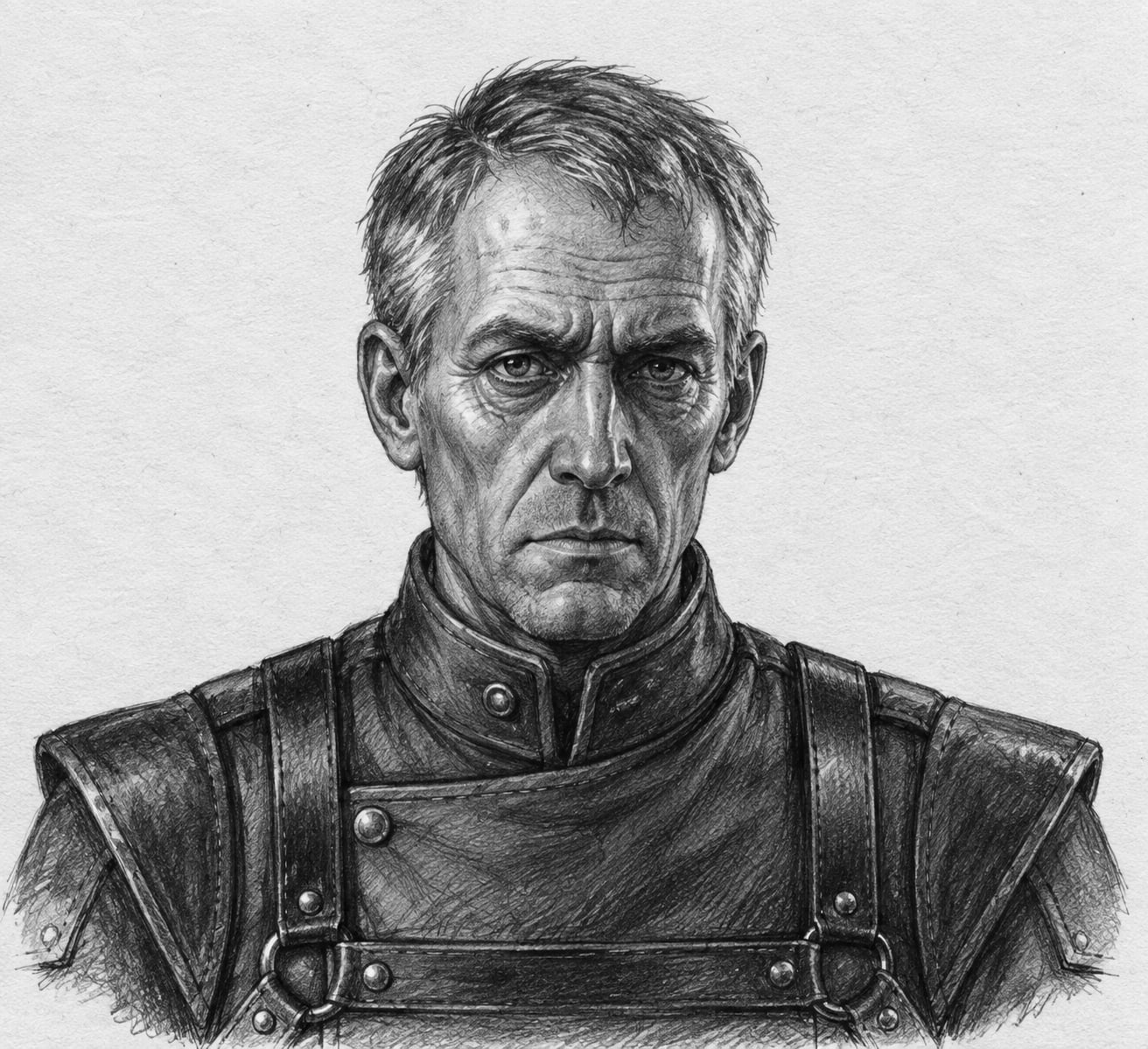
#On His Station
"Light three times. Speak once." — Lintel inscription, Beacon Tower Three
Beaconmaster Jorren Quill commands the Synod Signal Office (Unregistered) at Third Light, Station Three of the Carpathian Beaconchain. The lantern belongs to the Lanternwrights. The gate belongs to the Provost. The cables belong to the Ropewalkers, in every sense the Bureau of Records declines to acknowledge. Quill holds the page.
That page is a great deal to hold. A convoy may wait at the Switchback with forty mules and a route-writ, but it has nothing until the Loghouse enters a clearance against the cycle. A clearance outside the record carries no recognized authority, and a teamster who moves without one moves as a smuggler. A clearance entered falsely is worse. It sends living men down the switchbacks into a pass the fog has already taken, with the stamp and seal on their papers certifying it safe. On any given cycle, Quill's office decides which of those two errors the ridge will risk, and it decides in ink.
#On the Keeping of the Cycle
The office is older than its name. The convoy loss came in the winter of A.S. 72. At that time the Sagittal Line stood defensible but unfinished, and the war offices of the day had not yet learned to call themselves Bureaus. After the loss, the passes toward Bastion-Przemyśl were given towers. First and Second Lights were working by A.S. 74 and both burned in A.S. 76. Third Light went up on higher basalt in A.S. 77. The signal office took the Synod's name at the A.S. 90 settlement, but before then it standardized its logs in A.S. 82 and introduced bell-signets in A.S. 89. Oath-collars followed in A.S. 94, after Pell Oster sold forged clearance windows and was hanged from his own bell-cage. Quill had no part in any of it. He inherited the collars.
A cycle lasts four hours, six to a day. At the opening and close of each, the bell designated Relay Seven, Subsignet Three, is struck. At the moment of the strike, the clerk presses a bell-signet into the log: a wax impression of the tone pattern. The impression is then checked against the master timing wheel in the Loghouse of Slate Pages. If signet and wheel agree, the record holds that the beacon was lit on time, aimed on bearing, received at Fourth Light and acknowledged, in that order.
The Signal Office holds that a bell-signet cannot be forged. Everyone who has served a winter on the ridge believes otherwise and says so quietly. Late entries, corrected timestamps, lost pages and cargo exceptions all have prices in the Loghouse, and the prices are known. The wheel alone is exempt from this market. Tampering with it is an annihilation offence, and to the Bureau's knowledge nobody on the ridge has tried the experiment twice.
According to the current station assessment, Quill has not missed a cycle in eleven years. By my arithmetic that is some twenty-four thousand cycles, each one entered, stamped and aligned. I record the achievement with admiration, and with the suspicion that admiration requires. A complete log proves that every page has writing on it. Whether the writing is true is a separate examination, and a log cannot sit that examination on its own behalf.
#On the Gloves and the Blank Page
Quill's gloves are white kidskin, replaced every week at his own expense. His salary is one the Signal Office would call adequate and any tailor would call an insult. On a ridge where ink freezes in the nib and lamp-soot settles on every surface, a white glove lasts about one shift. He buys fresh pairs anyway. The gloves are vanity. They are also a declaration of clean hands, clean logs and a clean conscience. That is my reading of the man's wardrobe, and I set it down as a reading only, because kidskin certifies nothing. I have worn gloves before tribunals myself, for reasons I do not intend to enter here.
What frightens him is the blank page. The chain of consequence is short, and every link of it was forged in Strasbourg. A blank page is a missed cycle. A missed cycle is a gap in the record. A gap draws a question from Strasbourg, and at that altitude the question is apt to arrive phrased as a charge of heresy. The Bureau of Doctrine makes no distinction between a Beaconmaster who fell asleep and one who left the page open for the Great Deceiver. Both left a hole, and holes are examined.
His clerks confess their errors under silence hoods: canvas sacks drawn over the head so the room cannot see who kneels. Every confession is kept, and each one is a debt, a hold, and a small instrument of promotion or ruin. They sit in the Loghouse under the authority of Quill's office. I do not claim that he spends them. I claim only that he keeps them. A man who keeps such papers does not need to spend them for his keeping to be felt.
#On the Other Keepers
An order from the Beaconmaster travels as far as the person receiving it allows.
Sister-Mechanic Vey Sable (Unregistered) keeps the relic-lanterns. She sings calibration hymns under her breath, a flat drone that keeps the lenses, in her word, "obedient." She has not looked at the fog since A.S. 194. She fears a scandal over a fractured relic-lens more than she fears lightning, which at Third Light is a considered position. The Lanternwright Knot guards its lens specifications the way a guild guards its secrets. Quill may order a bearing corrected, but he cannot order glass into existence. When Sable requested new lenses, the Bureau of Ordnance sent a memorandum recommending that she recalibrate the old ones.
Gate Provost Harn, called Nail, holds the Switchback Gate. With it he holds the searches, the tariffs and the physical fact of passage. A route-writ from Quill's office costs one thing, and Nail's willingness to honour it costs another. He counts his bribes like prayers. By his own account he has heard the fog's "third answer" twice, and he has reported it to no one. Nothing in the record shows that he shares either the bribes or the fear with the Loghouse.
The two men meet on paper every eighteen months, when the Ropewalk cables are replaced and the replacement log needs both their signatures. A snapped cable has killed more of the garrison than any enemy, so this joint countersignature is the most consequential document either man signs, and neither can sign it alone. Below them, the Ropewalkers' Brotherhood runs its undersong on hooks beneath the spans, and the unlicensed Fog-Scouts walk where no lantern follows. Conscripts climb from Lowvale Tallytown to replace the dead. Quill's log records the movements the ridge admits to. Everything else moves by rope and by fog, out of his reach.
#On the Footprints Entered Against Him
The Silent Notch is an acoustic dead zone on the eastern spur, about forty yards from the Ropewalk terminus. Bells make no sound there, and a man can stand in it for a quarter-hour unheard, unwatched and unlogged. Since A.S. 195, footprints have been documented there that lead in from the Ropewalk side and never lead out.
On the 3rd of Argent, A.S. 198, a set of tracks entered the Notch in fresh snow and ended midstep. The boot-pattern matched Beaconmaster Quill's. At that hour Quill was in the Loghouse, three hundred yards away, and two clerks and a provost attested to it. The Bureau of Records entered the event as "environmental anomaly, no personnel unaccounted for," and every person was in fact accounted for. The finding is correct as far as it goes. It says nothing about the boots.
I did not see those prints. They were made a year after my single climb to Third Light, and I report them as the record stands. The record allows for a copied boot, a borrowed boot, a coincidence of cobblers, three false witnesses, or something the Bureau of Doctrine has not yet given a heading. It does not choose among these, and I will not choose for it in print, under seal.
#On the Answers Now Accepted
The fog at Third Light has answered the station's signals since A.S. 194. For years the answer came late. A legitimate acknowledgment would arrive from Fourth Light, and between seventeen seconds and four minutes afterward a second one would come up from the basin below, where there is no tower, lens or bell. The delay was a mercy, because a clerk who saw two answers could enter one. Grounding chains, salt lines on the catwalks and the Lanternwright Knot's flat-sung choruses quiet the fog for a day, a week, sometimes a month, and then it resumes. Their partial success is recorded. The reason for it is not.
By the present assessment, that mercy has been withdrawn. Seven acknowledgments passed the master timing wheel and were logged as valid Fourth Light answers in Quill's immaculate record. Fourth Light then reported that it had never received the corresponding signals. The wheel accepted all seven, and the signets aligned. Seven times the Loghouse certified a conversation with only one party in it.
The perfect record used to be his defence. Now it is the evidence. A log that was never supposed to hold a blank page has been shown to hold seven false ones, and each carries the stamp of the office he commands. No finding ties Quill to their making, and I enter none. His difficulty is the page itself: what he spent eleven years keeping clean has been used to certify something that did not happen.
According to the station assessment, Quill suspects that someone or something has learned the Beaconchain's protocols and wants Third Light blind. He has requested reinforcements and received paperwork. He goes on opening and closing six cycles a day, pressing the wax, consulting the wheel, and buying a fresh pair of gloves each week against the soot.
Prior editions of the Bureau of Alchemical Standards assessment classified the answering fog as "acoustic refraction consistent with atmospheric layering," a natural phenomenon requiring no doctrinal intervention.
That classification is suspended, and the Bureau has issued nothing in its place. Readers who relied on it when countersigning Station Three acknowledgments are advised that they relied on it.