
#On the Raising of the Tower
"Light three times. Speak once." — Painted on the lintel of Beacon Tower Three. Origin unknown. The paint is refreshed quarterly by standing order.
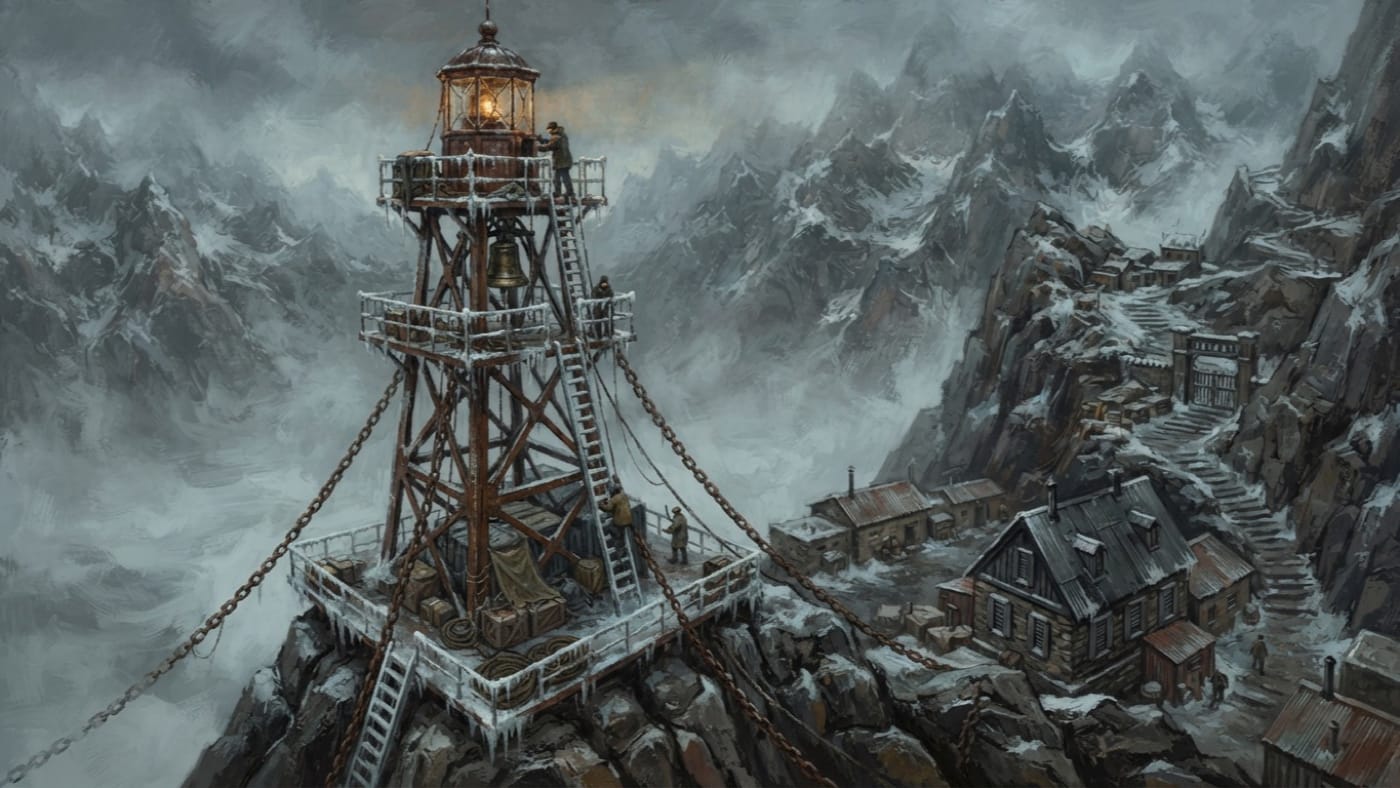
Beacon Tower Three is fifty feet of riveted rust-iron bolted to the highest point of the basalt knife-ridge that carries the hamlet of Third Light. The builders put it where the wind is worst because that is where the view is best. On a clear day its crown overlooks both the northern passes and the southern switchbacks, and the whole value of the station lies in that double sightline. The high Carpathians ration clear days more strictly than lamp oil. The tower was raised because the mountains so rarely let a man see where he is going.
It is the working apparatus of Station Three of the Beaconchain, the chain of iron towers that passes convoy permissions, route clearances and storm warnings from peak to peak. Its catwalks are exposed and its ladders are iced for half the year. Chains are riveted along its flanks, and it sings in any wind above a whisper.
The chain began with a disappearance. In the winter of A.S. 72, when the Sagittal Line could be defended but was still unfinished, a convoy of eleven wagons and three hundred mules left the low valleys for Bastion-Przemyśl and was swallowed by the passes. Searchers found the mules alive. They found the seals of the consignment unbroken. They found neither men nor wagons. The Church's war office, which the later ledgers style the Bureau of War, ordered a survey of the ridge passes, and the survey called for towers.
First Light and Second Light were working by A.S. 74. Both burned in A.S. 76, in a storm that rose from below the ridgeline. In A.S. 77 Third Light was set on higher ground to anchor the chain, and its tower's grounding chains were sunk forty feet into the basalt. The founders of the station left no record explaining the depth. The survivors of A.S. 76 did not need one.
#On the Lantern and the Bell
The crown carries a relic-lantern of consecrated glass. The maintenance record says the lens has been cracked twice and repaired thrice. The Bureau of Doctrine has declared the cracks sanctified "signs of endurance," which spared the Office the price of a new lens and gave the Church a new devotion.
The tower also holds a caged bell of cast bronze. It is publicly designated Relay Seven, Subsignet Three, Classification Restricted. The name it received at its casting is held in the files of the Office of Bells. That name was classified in A.S. 94, and the reason for classifying it was itself classified in A.S. 96. I have never asked for either, because I value my career.
A signal cycle lasts four hours, and there are six in a day. The bell is struck to open each cycle and struck again to close it. Between those two strikes the tenders light the lantern and turn it on the bearing of Fourth Light. The signal goes out, and the answer comes back across the ridges. In the Loghouse of Slate Pages, thirty yards below the tower, a clerk presses the bell-signet into the log. The signet is a wax sound-seal of the strike, and the entry is checked against the master timing wheel kept in the Loghouse. Only then does the cycle exist.
The distinction is lost on every visitor, so I will state it once. A lantern can burn on the right bearing at the right hour, and if no signet stands in the log, the Signal Office holds that it burned for nobody. A signet can stand in the log in perfect order over a signal nobody saw, and it will be honoured. The Office prefers the second failure because it can at least be filed.
The official position of the Synod Signal Office (Unregistered) is that a bell-signet cannot be forged. Everyone who has served a winter at Third Light holds a different position and keeps it off the page.
In the winter of A.S. 197 the Bureau of Doctrine sent me up the ridge to inspect the station's logs for procedural fidelity. I stood on the lower catwalk through one full cycle. My fingers went numb inside two layers of wool, and the rope-hum came up through my boot soles like a choir heard through a floor. At one point I opened my mouth to remark on the view. A tender of no rank whatever laid two fingers against my lips. Speaking during a cycle is forbidden. I have been silenced by archbishops with less effect.
#On the Keeping of the Tower
The tower consumes oil, glass, tarred rope, dry paper and men. The first four come up the switchbacks through the Switchback Gate, where the Gate Provost Harn, called Nail, decides at his own price how quickly they arrive. The fifth comes up conscripted. If oil or glass runs short, the station goes blind.
The procedures that govern the tower are older than the institution that now owns them. The Church's frontier signal clerks, whose office took the Synodal name after the settlement of A.S. 90, standardized the logs in A.S. 82 and introduced bell-signets in A.S. 89. Oath-collars for clerks followed in A.S. 94. They came after a signal clerk named Pell Oster sold three weeks of forged clearance windows to smugglers. Oster was hanged from the bell-cage, and the Bureau of Records filed his execution under equipment maintenance. I have always admired that entry.
Sister-Mechanic Vey Sable (Unregistered) keeps the relic-lanterns in the Lantern Shed, which smells of oil and glass dust. She calls her calibration hymns "flat-sung": a drone held on a single note until the lens settles and, in her word, turns "obedient." The Bureau has never corrected her vocabulary, because the lenses work.
The Lanternwright Knot guards the lens specifications as jealously as any cathedral chapter guards its relics. It also sells "selective blindness": a lens set a few degrees wrong, so that one convoy passes unlit and one signal is never relayed. The price is paid in oil.
Beaconmaster Jorren Quill holds routing and record authority. He wears white kidskin gloves, replaced weekly at his own expense, and he is afraid of blank pages. He has not missed a cycle in eleven years. The Bureau considers this admirable, and I consider it evidence.
At Third Light a late entry has a price, and so does a corrected timestamp or a lost page. The master timing wheel has no price. The station treats tampering with it as annihilation, and so everyone watches whoever comes near it.
The work maims in the ordinary ways. Ice glazes the catwalks, and hands burn on the bell-cage when a storm crawls up the chains. Lungs fail in the thin air, and lamp smoke collects in the lantern gallery. Salt lines run along the catwalks, a practice the Bureau of Doctrine has neither sanctioned nor forbidden. Nobody speaks a name on the catwalks, because names are said to draw the strike.
#On the Answer from Below
The Signal Office keeps a restricted file headed "Anomalous Signal Behaviour — Station Three — Ongoing." It has been ongoing since A.S. 194.
The file describes the following. A cycle opens, and the lantern sweeps the bearing of Fourth Light. The signal goes out and Fourth Light's acknowledgment returns. Then, between seventeen seconds and four minutes later, a second acknowledgment arrives. It comes from below the ridge, out of the fog basin the garrison calls White Mouth, where no station, tower, lens or bell has ever been recorded. It matches the true answer in protocol, content, tone and timing. Only its apparent origin is wrong: it comes up from beneath the tower instead of across from the next peak. Beyond that, nothing distinguishes it.
When I inspected in A.S. 197, I did not hear the answer. I did speak with Sister-Mechanic Sable, who told me she has not looked at the fog since A.S. 194. I did not ask her why. Her hands were steady. Her eyes were not.
In A.S. 199 the Bureau of Alchemical Standards sent a team with instruments. They stayed three weeks and measured pressures, frequencies and what they called "acoustic refraction indices." Their report runs to four pages, three of them redacted. The fourth reads: "Further study recommended. Team reassigned."
Later reports record an escalation. The echoes came back first half a beat late, then a quarter-beat late, then exactly on time. After that, seven acknowledgments were entered in the log as valid answers from Fourth Light, signeted and checked against the master wheel. Fourth Light then disowned all seven.
The countermeasures work for a while. When the grounding chains discharge, the salt lines stay unbroken and the flat-sung chorus holds its note, the fog stays silent for a day, a week or a month. Then it answers again, and the answer is always correct.
Beaconmaster Quill suspects that someone wants Third Light blind. The file records his suspicion. It does not record who that someone is, and the Bureau of Doctrine has no intention of guessing in writing.
The answering fog is classified as acoustic refraction consistent with atmospheric layering: a natural phenomenon requiring no doctrinal intervention.
The classification has been suspended. The suspension was never announced, so this erratum serves as the announcement.
#On the Present Condition
As of A.S. 201, Beacon Tower Three is operational under Class II Restricted Access. The lantern burns six cycles a day and the bell opens and closes each one. The Loghouse fills its slate pages with signets that match the wheel.
The hamlet below it numbers four hundred and thirty and is shrinking. Oil arrives short and glass arrives late. Quill has asked for reinforcements and received paperwork. Sable has asked for new lenses and received a memorandum telling her to recalibrate the old ones. Nail has asked for nothing, because he understands this mountain better than either of them.
Each cycle the fog below the ridge answers the tower in its own protocol, and the logs record whichever answer they are handed.