
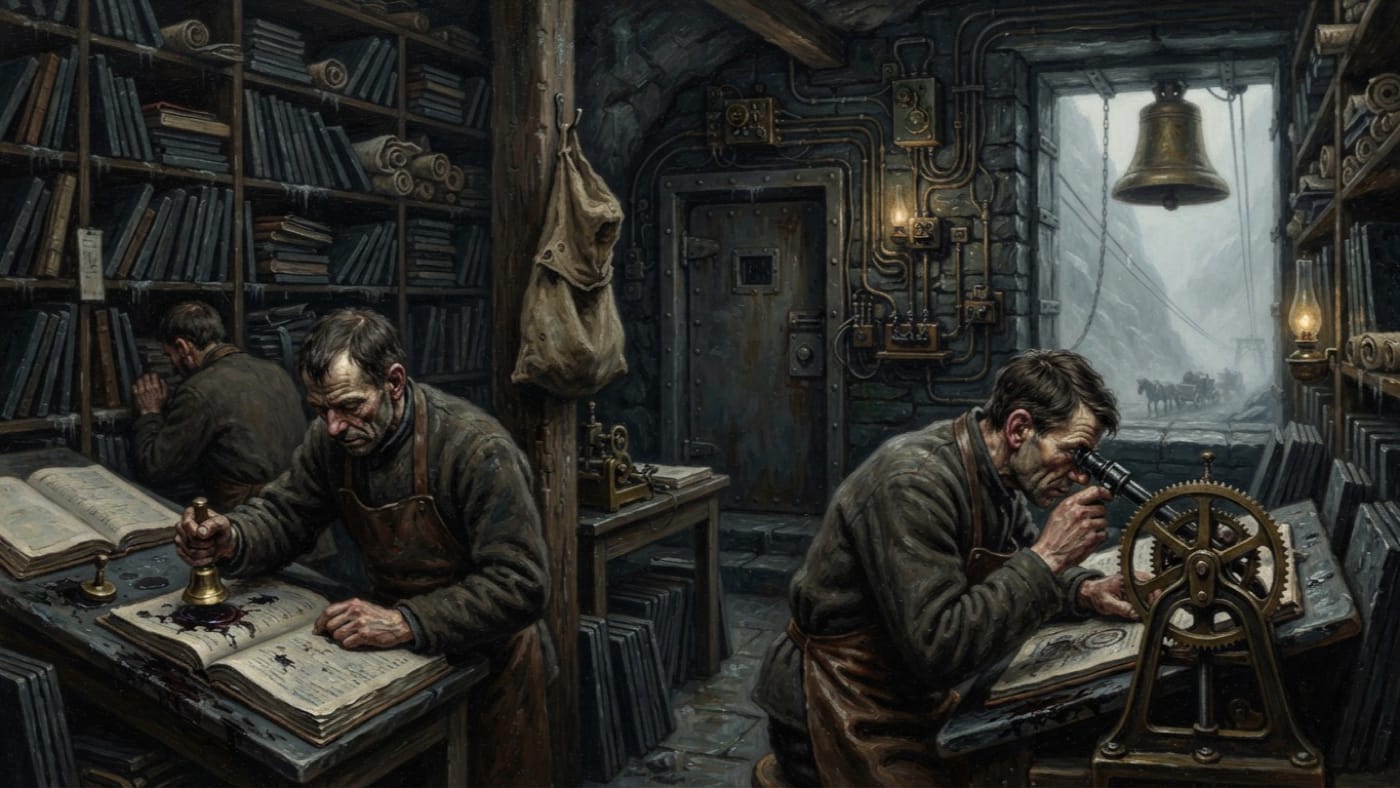
#On the House Below the Tower
Before a convoy leaves the staging shelf below the Switchback Gate, a clerk whose fingers have not been warm since enlistment has to find its route permission in the record. He confirms that the permission falls inside a certified signal cycle, then copies the writ in an ink that thickens as he writes. From that moment the convoy exists. It could of course walk off without him, since mules cannot read and porters read little better. But it walks off as nothing, and nothing is owed a relay, a storm warning or a line in the register of the dead.
The office that administers this sacrament is the Loghouse of Slate Pages. It is built into the cliff face thirty yards below Beacon Tower Three at Third Light, behind walls of dressed slate. It smells of damp ink and wet wool. The stone is cold through two pairs of stockings. Slate dust settles on the ledgers, on the wax and on the clerks' eyelashes. The house keeps time with the bell above it, so a man copying a storm warning feels the cycle turn in his back teeth before he hears it.
What follows is a companion to the Station Three assessment sealed in A.S. 201, and it confines itself to the house and its pages. The miseries of the hamlet are filed elsewhere, at length.
#On the Rules of Entry
I am not prepared to certify a founding date for the Loghouse. In these mountains the Sagittal Line was defensible but unfinished in the winter of A.S. 72 (1782 CE), when a convoy bound for Bastion-Przemyśl vanished in the passes, and the towers of the Beaconchain rose out of that loss. For the house, the station's account gives two dates that matter. The log procedures were standardized in A.S. 82, and the bell-signet entered the record in A.S. 89. Both reforms were the work of wartime Church authorities and frontier signal clerks, before the Concordat of Strasbourg created the formal Synod in A.S. 90. When I credit them to the Signal Office I am putting a later name on earlier hands. The Bureaus do this routinely with anything that went well.
The reform that formed the house's conscience came afterwards. By the station's account, in A.S. 94 a signal clerk named Pell Oster sold three weeks of forged clearance windows to a smuggling ring in the Lowvale. He was hanged from his own bell-cage, and the parent record reports that his execution was filed as equipment maintenance. Clerical oath-collars followed. Every clerk who has worn one since has learned Oster's lesson, which is about the cost of being caught rather than the sin of forging.
#On the Wheel and the Signet
Third Light keeps six cycles a day, each four hours long, and the tower bell marks the boundary of every one. A cycle becomes true by the following procedure.
When the bell strikes, a clerk presses a bell-signet into the record. This is a wax impression of the bell's tone pattern. How a tone gets into wax I cannot say, and the Signal Office (Unregistered) has never offered to explain it to an inspector from a rival floor. The impression is compared against the master timing wheel. If the two agree, the entry certifies four things: the beacon was lit at the correct time, the lantern held the correct bearing toward Fourth Light, Fourth Light received and acknowledged the signal, and all of this happened in its proper order. Under that certification sits the business of the cycle: convoy clearances, storm warnings, and route permissions granted, denied, or held pending clarification.
The last category deserves a collect of its own. A permission held pending clarification leaves a convoy suspended between existence and its opposite, while persons not named in the ledger find out what clarification costs.
The wheel, the house and the power to declare any cycle valid or void all belong to the Signal Office under Beaconmaster Jorren Quill. Its doctrine is simple and enforceable: a movement that is not logged did not happen. I will be precise here, as the Bureau is precise when it suits it. Ink cannot lift a wagon out of a pass or set one back down. The doctrine governs what the Church will acknowledge, supply, defend and mourn. On a ridge where fog can close over a convoy in the time it takes to say a collect, acknowledgment is the whole of rescue.
The official position is that a bell-signet cannot be forged. The garrison's position is that it can. Both positions are on record. Only one carries a stamp.
#On Corrections and Confessions
Everything in the Loghouse is for sale except one thing. A clerk can sell a late entry or a corrected timestamp. For a fee he can lose a page, and for a larger fee he can exempt a cargo from inspection. These favours pass among the clerks the way pardons pass along a cloister. Sister-Mechanic Vey Sable (Unregistered) keeps the relic-lanterns, but the Lanternwright Knot keeps the lens specifications and sells selective blindness. The Ropewalkers' Brotherhood keeps the cables and runs its traffic beneath them. A lens turned away is worth little if the page beneath it remembers.
The one thing not for sale is the master timing wheel. The penalty for tampering with it is annihilation, a word the station uses without ornament and without explanation. So no clerk sells the wheel. Clerks sell everything around it.
Errors are confessed under the silence hood, a plain canvas sack pulled over the penitent's head. Officially it stops him reading the other records on the table. In practice it stops his fellow clerks from seeing who is confessing. The confession is kept, always, and is used as leverage over his career, to be brought out when he grows principled or ambitious. Error debt turns into labour: first night shifts, then cliff work, where the ridge collects what the ledger excuses. A house short of hands has every reason to keep its clerks in debt. An indebted clerk fears an omission more than a forgery, because an omission leaves a blank and a forgery at least fills the line.
Quill fears blanks above all things. The station assessment credits him with eleven years without a missed cycle. That is a statement about the record's continuity. It says nothing about whether every line within that continuity is honest, and I will not say it on the assessment's behalf. His requests for reinforcements have produced paperwork.
The Loghouse rules the page, and its rule stops at the gate. A route writ certifies that passage is permitted. Whether passage actually happens is decided by Gate Provost Harn, called Nail, who charges separately for the decision. Even the cable-replacement logs, renewed every eighteen months, carry the Provost's signature beside the Beaconmaster's. The record is sovereign over truth. It shares the ropes.
#On the Seven Acknowledgments
My own warning is on file. In the winter of A.S. 197 the Bureau of Doctrine sent me up the switchbacks to test the logs for procedural fidelity. I asked for the week of the 14th of Corvus, A.S. 196, and a young clerk produced it promptly. Every entry matched, every signet agreed with the wheel, and every timestamp stood in sequence. I reported that the week was too perfect. Records filed my report under Observations — No Action Required, the shelf where Strasbourg keeps the observations it has decided it never made.
I do not claim that the week I inspected was false, and I make no claim about any other week. I record only that I named perfection as the symptom before anyone else had a word for it.
The station's file on the answering fog was opened in A.S. 194. The assessment describes its substance this way. A signal goes out toward Fourth Light and is acknowledged. Then it is acknowledged a second time, from the fog basin below the ridge, where no relay station is recorded. In the early instances the second reply matched the pattern of the first but came back after a delay of seventeen seconds to four minutes. The clerks could see that delay and the wheel could measure it. In A.S. 199 the Bureau of Alchemical Standards sent a team, which stayed three weeks. Its report runs to four pages. Three are redacted, and the fourth recommends further study. That same year the delays began to close.
By the time of the A.S. 201 assessment, seven acknowledgments had passed the timing test and been entered in the Loghouse as valid replies from Fourth Light. Each was certified and each carried its signet. Fourth Light then reported that it had never received the corresponding signals.
The clerk's position is exact. He did what the procedure required, and the procedure said yes. The record is immaculate, and the event it authenticates never occurred. The assessment does not establish how the replies were produced, whether any clerk helped produce them, or who or what stands below the ridge. Accepting a false acknowledgment does not prove that anyone touched the wheel. It proves only that the wheel could be satisfied. The assessment records Quill's suspicion that something wants Third Light blind, and I enter that suspicion here under his name.
The answering fog: acoustic refraction consistent with atmospheric layering; no doctrinal intervention required.
This classification, carried in earlier assessments by the Bureau of Alchemical Standards, is suspended. It cannot be reconciled with seven certified entries in the Loghouse record.
#On the Record Still in Force
Third Light remains operational. The bell still divides the day into six. Clerks still press wax beside each cycle and hold it to the wheel, and convoys still wait below the gate for writs bearing those impressions. No other proof is available, and the passes do not close for epistemology.
The seven entries have not been erased. Erasing them would leave blanks, and a blank is the one sin the house will not commit. They stay in the record with Fourth Light's denial filed beside them, two certified truths contradicting each other on adjoining shelves. The Signal Office goes on issuing certified entries, and Quill goes on counting unbroken cycles. The hood hangs on its peg.
Until further notice, I direct readers of this Codex to read a Loghouse certification as evidence that the procedure was followed.