
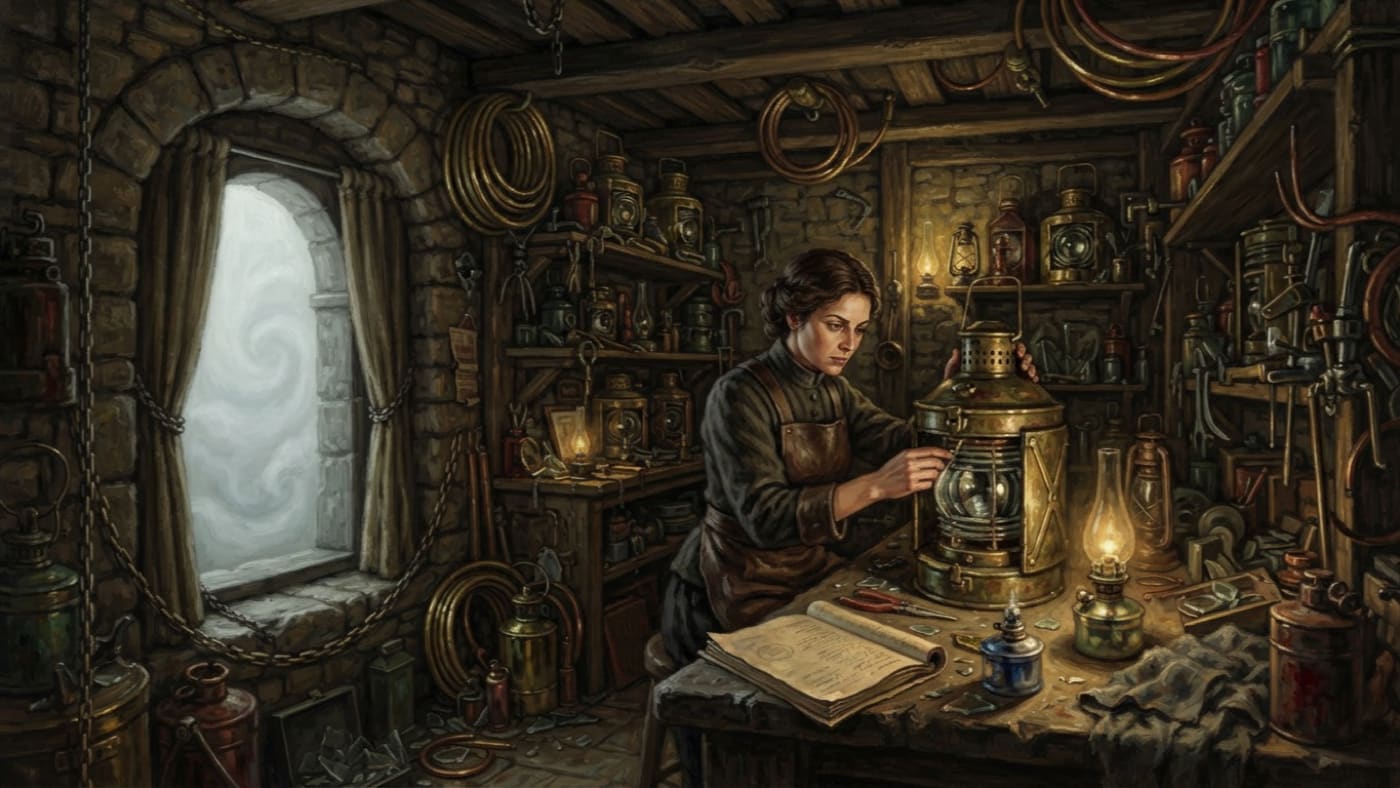
#On the Shed and Its Work
"Obedient." — Sister-Mechanic Vey Sable's word for a lens that holds its calibration. The Bureau of Doctrine has neither adopted the word nor corrected it.
The Lantern Shed is a low stone building on the ridge of Third Light. Without it, the station is a bell, a ledger and a great deal of expensive darkness. The tower speaks. The Loghouse swears to what the tower said. The Shed keeps the tower's one eye in its socket. Relic-lanterns come through its door cracked, clouded or out of true, and they go back out fit to sweep a bearing toward Fourth Light and carry a convoy's clearance across the gap. Repaired components travel further than that. The station sends them down the switchbacks with its certified logs and route permissions. That makes the Shed one of the few places on the ridge that exports an object rather than a signature.
I stood in it once, in the winter of A.S. 197, on Bureau business that had nothing to do with glass. It smelled of lamp oil, old glass and glass dust. Under all three ran the metallic sweetness that clings to consecrated optics the way incense clings to a cope. I remember the smell better than the room. Nobody has recorded the room. Nobody has recorded the year it was built either, an omission the Bureau of Records tolerates in a workshop and would hang a clerk for in a log.
#On Oil, Glass, and Calibration
The ridge lives on two things it cannot make. Oil climbs from Lowvale Tallytown on mule-back and porters' spines. The trip is a day's descent each way, and longer when the fog sits in the switchbacks. Glass arrives salvaged. The same oil fills the lanterns and warms the bunks, so every measure the Shed burns on a test flame is a measure some tender does not sleep beside. The station's own survey puts the matter with a bluntness I envy: without oil or lenses, the outpost is blind.
The work is plain, and I record it plainly, because the Bureau gilds whatever it does not understand. Polishers take the grit out of salvaged glass. Mechanics seat it, align it and fit the hoods that let a station light show its bearing to Fourth Light and nothing to the valleys. Every lantern must be ready for the bell. There are six cycles a day, four hours apiece, and each one opens and closes on the strike. A lens that has crept by a hair throws its beam a hair wide. Fourth Light sees nothing and the clearance does not relay. The convoy bound along the Sagittal Line toward Bastion-Przemyśl then has two choices. It can wait at the Switchback Gate and pay the Provost for every hour of waiting, or it can move on an assumption. The passes have opinions about assumptions.
The crown lens of Beacon Tower Three has been cracked twice and repaired three times. The Bureau of Doctrine has sanctified the cracks as "signs of endurance." In the Shed they are called cracks. I record both terms. I am paid for the first.
Certification happens elsewhere. Bell-signets are pressed into wax in the Loghouse and checked against the master timing wheel kept there, by clerks who outrank every mechanic on the ridge. The Shed makes a signal possible. The Loghouse decides whether it happened.
#On Sister-Mechanic Sable
Vey Sable maintains the relic-lanterns. She sings over them under her breath, a flat drone with no tune worth the name, to keep the lenses obedient. The station forbids singing off-crest, on the theory that bad acoustics invite lightning. It tolerates Sable, on the better theory that her lenses work. Doctrine has always been practical about its superstitions when the superstitions keep the convoys moving.
The station's own survey records her fear as a relic-lens fracture scandal. That would mean a cracked piece of consecrated glass, an inquiry, and a question from Strasbourg about whose hands had been on it. As I recorded in the Station Three assessment, her hands were steady while she worked. Her eyes were not. She told me she had not looked at the fog since A.S. 194. I did not ask what she had seen, and she did not offer. The matter sits in my notes exactly where she left it.
The window remains. Sable keeps her attention on the glass. Nobody has told me whether Ferrens's morning and her A.S. 194 belong in the same file. I have not presumed to bind them together for the Bureau.
#On the Lanternwright Knot
The Shed is the Knot's ground. The Lanternwright Knot is a craft guild of the old pattern, with apprentices, journeymen and masters. It holds the lenses, the oil, the parts and, above all, the specifications. It shows the station a face of maintenance pride. The survey lists its methods as parts control, delays and "accidents." The quotation marks are the survey's own, and they are the most honest punctuation on the mountain.
The guild hoards its lens specifications the way a chapter hoards relics, and for the same reason: whoever holds the pattern holds the supply. When glass runs short, the Knot decides whose lantern is mended first. The order of mending becomes the order of seeing.
It also sells the very thing the Shed exists to prevent. The trade is called selective blindness. A lens is angled a fraction so that a particular movement goes unlit or a particular signal fails to relay. The price is oil, always oil, because at that altitude oil buys warmth, light and favour in a single measure. I have no entry naming a seller, a buyer or a convoy. I have the trade, the price and the guild, and the guild keeps its premises in the Shed.
On paper the mechanics rank third, below the signal staff and the Gate Provosts. On the ridge that order reverses whenever a lantern fails. A clerk cannot stamp a cycle the lantern did not show. Nail cannot search a convoy his lamps cannot find. The station's siege doctrine is written for the day the pass is lost, and it orders the garrison to smash the lenses and blind the mountain. That is the most candid tribute the Church has ever paid to a workshop it otherwise ranks beneath its filing clerks.
#On the Echo and the Instruments
The fog below Third Light answers. A cycle opens, the lantern sweeps toward Fourth Light, and Fourth Light acknowledges. Then, seconds or minutes later, a second acknowledgment rises from the basin, where no station, tower or bell has ever been recorded. The Signal Office has kept a restricted file on it, "ongoing" since A.S. 194.
Three things belong in separate drawers. The echoes are recorded, and the logs show them. The garrison's belief that the fog is learning is a saying ("if the fog repeats you, it's learning you"), and a saying is not evidence, however unpleasant it is to write down. Beaconmaster Jorren Quill's suspicion that someone wants Third Light blind is a suspicion. It is held by the man who answers for every blank page in the log.
The Shed sits among all three, because every countermeasure ends at an instrument. Grounding chains are sunk in the basalt. Salt is laid along the catwalks. At the opening of cycles the Knot raises its flat-sung chorus of twelve voices and holds one note until the lenses settle and the rope-hum drops. Sometimes the fog falls quiet for a day, a week, a month. Then it answers again. Its answers have grown precise enough to enter the log as valid Fourth Light acknowledgments, and they stay there until Fourth Light reports that it received no such signal.
The Bureau of Alchemical Standards classified the answering fog as "acoustic refraction consistent with atmospheric layering," a natural phenomenon requiring no doctrinal intervention.
As corrected in the Station Three assessment of A.S. 201, that classification is suspended. A lens ground against weather cannot be expected to answer a phenomenon the Bureau has stopped calling weather.
#On the Unfilled Requisition
Sable has asked for new lenses, ground to specifications the Lanternwright Knot claims will "see through the echo." The claim belongs to the Knot. No such lens has been fitted at Third Light, so none has been tested there. The specifications stay with the guild that holds every other specification on the ridge.
The Bureau of Ordnance answered her request with a memorandum. It recommends that she recalibrate the existing lenses.
I have read worse memoranda, and I have written several. This one has the particular merit of costing less than glass. The existing lenses are the ones she already sings over. She will recalibrate them, because recalibration is the only work the memorandum leaves her. The bell will open the next cycle whether she has finished or not.
So the Shed carries on with old glass, rationed oil and cold hands, a flat note under the breath, six cycles a day. The requisition stays on file as requested. Nothing in the file says when it will become anything else.