
Sources checked. Writing the Gate Provosts article now.
#On the Office at the Gate
"The Chain never lies. Only men do." — Propaganda line of the Synod Signal Office, Third Light
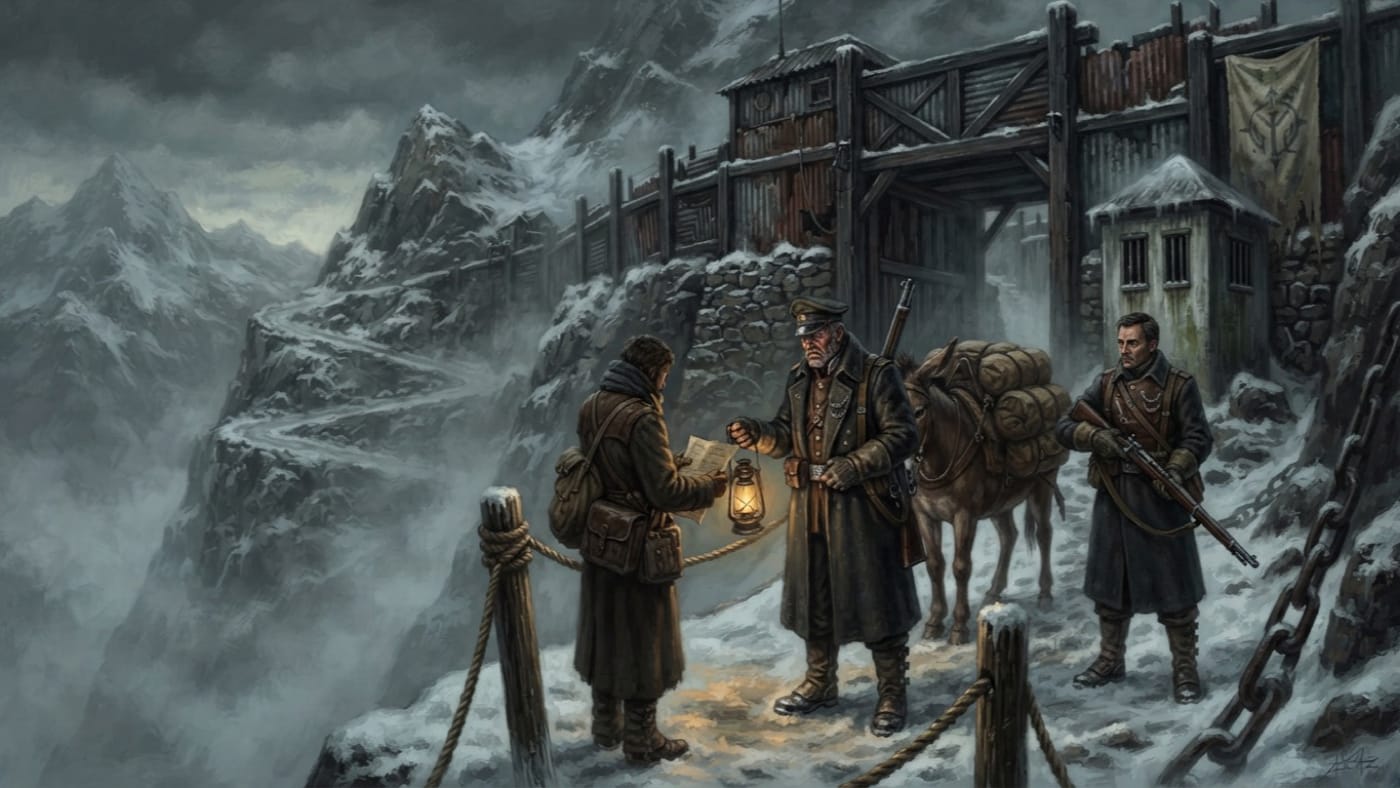
The Gate Provosts are the armed men who stand at the Switchback Gate, the only workable approach from the valley to Third Light. They are few. They are cold. Every mule, porter, conscript and sealed message that climbs from the switchbacks to the ridge goes past them. The station's own inventory calls them militia and police in the same breath. In a hamlet built on stamped paper, any man with a rifle and a ledger to check against is both.
Their commander at Third Light is Harn. The garrison calls him Nail, and everyone else calls him Sir. He counts his bribes like prayers. The rest of his character can be left in his own file.
There are three ways up the mountain. A traveller may climb with a route writ and its bell-clearance, with an escorted caravan, or with a conscription transfer, which is the same as climbing in chains with better paperwork. At the Gate, every writ is checked against the log. Permission is written above in the Loghouse of Slate Pages, under Beaconmaster Jorren Quill's immaculate gloves. Passage is granted below, in the cold, by men who were not consulted about the writing. A mule-string can be fully permitted and still stand in the snow for hours.
#On the Writ and the Second Tithe
The writ costs one thing. The Provost's willingness to honour it costs another. The published assessment of the station calls this the double-tithe. It also records that the Bureau of War knows of it and considers it efficient. I have searched for a statute that authorises the second tithe and found none. The Bureau of War has not found one either, and it has not looked very hard.
The Provosts call it a search, and on paper it is one. Certain goods may not pass the Gate under any writ. These are unlogged relics, unstamped messages, coffins (which the station calls "silent cargo"), forbidden books and lantern parts without their seals. A search for such things gives a Provost lawful reason to open any pack, unwrap any parcel and hold any mule until the light goes. Most travellers soon learn that a search is quicker when they pay for it.
Coin is rare on the ridge, so the Gate takes other payment. The Provosts accept lamp oil, clean paper, insulated gloves, and a clerical error that somebody agrees to forget. Ration chits, oil tallies, stamped paper and oath-notes circulate as currency above the snowline, and all of them reach the Gate eventually. I have found no fixed schedule of charges. Each price is set by the weather, the hour, how heavy the cargo is and how much patience the man holding the bayonet has left. The street-truth at Third Light holds that the Provosts sell "weather permission," and the hamlet speaks of a night toll. I record both rumours and leave them unratified.
The Provosts have other methods besides the price. They detain travellers, and they beat them. Where a writ is in order and the payment is not, the station's inventory lists both as ordinary practice.
The bell-signet cannot be forged. — Standing position of the Synod Signal Office.
Corrected. Before A.S. 94, signal clerk Pell Oster sold three weeks of forged clearance windows to a smuggling ring working out of the Lowvale. The oath-collars followed his hanging. Forged clearances are still traded on the ridge's black market. The Gate goes on honouring signets, because the only alternative is to honour nothing and do the arithmetic by hand.
#On the Detachment and Its Keepers
The detachment is small, and no record I hold gives its exact strength. Convoy escorts sometimes come up with the caravans and go down again with them. Only a fool or a census-taker would count them as Provosts. The detachment's insignia is the chain-badge, a short length of iron worn where a man can see it and a petitioner can count its links.
The station keeps its own order of rank. The Signal Office staff come first. The Provosts come next, above the Lanternwright mechanics, the tenders, the porters and the fog-debt labourers. That order says who steps aside on the catwalk. It does not say to whom Harn writes when something goes wrong, and the files I have consulted do not answer that either.
The Covenant Military lists the Gate Provosts among the local bodies it absorbs when they are useful and disowns when they become inconvenient. When the Gate holds, it is Covenant auxiliary work. When it extorts the wrong merchant, it is an irregular formation whose documents have been misread. Whether any particular Provost has sworn the Covenant oath is not recorded where I can read it. The Covenant's own account allows them one undeniable skill: they know every smuggler by his limp and his smell.
They need that skill, because the smuggling goes on all around them. Harn and Quill must countersign together every Ropewalk cable replacement, which falls due every eighteen months. A snapped cable has killed more men on this ridge than any enemy has. The Ropewalkers' Brotherhood hangs packages the size of a fist beneath those same cables. The Lanternwright Knot, under Sister-Mechanic Vey Sable's lenses, sells selective blindness for oil. The Provosts regularly hire the Fog-Scouts, whom the Bureau of Doctrine classifies as heretics. In practice, every party on the ridge sees exactly what it is paid to see, and the Provosts look over the barrier at anyone who climbs without the price.
#On Holding the Pass
The pass kills men without anyone's help. It has ice, falls, thin air that makes a sentry's hands shake, lightning that comes up from below, and fog that turns a familiar switchback into a drop. A Provost patrol works through all of it, with every breath it takes measured against the altitude.
The station's defence is written out in three clauses: control visibility, choke the pass, burn the logs before capture. The Switchback Gate is that choke, and the Provosts are the men who hold it closed. Station doctrine also has a blind protocol for the worst case. The defenders cut the ropes, smash the lenses and leave the mountain blind rather than let an enemy use its eyes. The doctrine belongs to the station as a whole. I have no record of the Gate ever being made to carry it out, and I do not propose to invent one for the reader's amusement.
A barrier only holds against what can be seen and checked. A Provost can turn back a forged writ if he recognises the forgery. He has no way to turn back a clearance that the Loghouse itself has wrongly accepted as true.
#On Oaths and the Answering Fog
The Provosts hold their oath-hearings at the edge of the Grounding Field, among forty-seven iron chains sunk into the basalt to draw down the lightning. In a storm the chains sing. The garrison believes a man who lies near them changes the pitch of the nearest chain. Doctrine calls this folklore and then holds its own interrogations in the same place. I have not seen proof that the chains catch a lie. I have seen men at Third Light choose their words very carefully when the wind is up.
The ordinary answering fog is now a matter of record. A signal goes to Fourth Light and is acknowledged. Then a second acknowledgment arrives, from below, where no tower stands. Harn fears something else. He fears what the garrison calls the fog's third answer, an echo that carries information nobody ever transmitted. He has heard it twice. He has reported it zero times.
I make no claim about what speaks from the fog, whom it serves, or why. Doctrine has not ruled on it. I am not going to rule ahead of Doctrine on paper that carries my name.
#On the Present Condition
As of A.S. 201, Third Light holds four hundred and thirty souls. The Signal Office describes that population as "collapsing," and the dead are replaced by conscripts from the valley towns, who pass the Gate on transfer orders. The Provosts guard a station that is getting smaller and collect their second tithe from a trade that grows more frightened each season.
The present assessment records seven false acknowledgments from Fourth Light. The master timing wheel accepted all seven, and the logs entered them as valid. Fourth Light later reported that it had never received the signals. So the clearances the Provosts check at the Gate can no longer be fully trusted, even when the clerk who wrote them was honest. Beaconmaster Quill suspects that someone or something wants Third Light blind. That suspicion is his, and it stays attributed to him.
Writs still come up the switchbacks every day. The Provosts check each one against the log, take their price and lift the rope barrier. Below them the fog rises and falls on its own schedule.