
#On the Name in the Later Register
"Nobody alive in it called it old. They called it the Church, and the dead are entitled to their own vocabulary."
This is a retrospective documentary survey, compiled in A.S. 201 / 1911 CE on commission from the Bureau of Doctrine. It covers a period. It does not record a founding. "Old Church" is a filing term, invented by later clerks for the Church as it stood before the Concordat of Strasbourg gave it a constitution in A.S. 90. That Church had bishops and dioceses, parish priests and cathedral chapters, monasteries and chanceries, pilgrim registers, and custodians who dusted the relics whether or not anyone had paid them that quarter.
It did not begin in A.S. 0. The calendar's zero marks a book printed in Amsterdam. By then the Church had centuries of its own paperwork behind it, and I will not sign my name to the date it began. Nor will I sign to its outer boundaries, to a complete hierarchy, or to any single office passed hand to hand without a break. Where the archive is silent, this survey says nothing.
#On Bishops, Parishes and the Missing Reliquary
The Holy See of Vienna was the continental chair. It held precedence, heard episcopal appeals, kept a chancery, and stored relics in vaults beneath Saint Stephen's. The Church was larger than the chair. Dioceses governed their own daily business. Parish priests answered to their bishops, and chapters sang the hours whether or not Vienna wrote that week.
The Year of Letters, A.S. −32 / 1678 CE, shows how these parts worked together. The Amsterdam triad posted their Bone Census to forty cities. It collated the recorded claims to relics of Saint Aldebrand, drawn from inventories and provenance notes. It opened no case and weighed no bone. It set sworn entries side by side and invited the holders to reconcile them.
Answers came from every level of the Church. Vienna's diocesan hierarchy, under Archbishop Rupert III, struck the Reliquary of Saint Aldebrand from the inventories, sealed the provenance ledgers and amended the pilgrimage records. The reliquary itself stayed in its vault, and an unnamed custodian kept polishing the case. Down the Rhine, Father Grauss of Saint Eligius in Düsseldorf ate his copy of the letter. A Rationalist-minded magistrate had him beaten and then gaoled him for three days. One answer went out through a chancery and reached every register it could. The other went through a single priest's teeth. Between them they show what the Old Church was: a chair issuing orders above, and parishes acting on their own authority below.
Neither man served a Bureau or sat in a Synod, and neither wrote a line in the Sacred Ledger. None of the three existed yet.
Earlier Records abstracts describe Archbishop Rupert III and Father Grauss as early officials of the Bureau system.
Withdrawn. The word Bureau in the surviving copy of Rupert's decree was inserted later. Grauss answered to his bishop and his altar. Both were classified as predecessor personnel long after their deaths. That classification is the Synod's claim to custody of their papers. It does not appoint them to anything.
#On the Faithful Commands
The Church fought the Atheist Wars, A.S. 10 to 30, without an army of its own. It had faithful commands instead: garrisons gathered around bishops and abbots, nobles sworn to defend the faithful, and relic companies. Each lived on local roads and local loyalty. They shared prayers more readily than grain.
At Aachen in A.S. 25, Lord-Protector Guillaume surrendered his citadel on terms offered by Colonel Verdane. Verdane wanted the place whole: its stores, its courier stables, its bridge warrants. He got all of them. Within hours the faithful courier relays failed. Dispatches went out on routes that no longer existed, and relief columns marched toward stores the enemy's clerks had already stamped. The northern front lost its junction. Worse, the Church lost the means of telling its own commanders what had happened to them.
In September A.S. 27 the First Council of Cologne sat for nine days. Seven proposed articles went unadopted. What survived was a narrow procedure for voluntary contact and requests, which bound only those who consented in writing. The faithful in that room could agree on how to write to one another. They could not agree to be governed.
#On the Dissolution at Regensburg
The Treaty of Regensburg, A.S. 30 / 1740 CE, ended the wars and gave Rationalist authority over the continent the form of law. An archbishop of Vienna, whose identity this survey leaves unsettled, signed away the See in his own blood with soldiers in the room. The treaty claimed far more than the See. Its articles replaced dioceses with Philosophical Prefectures, made monasteries state property, disbanded cathedral chapters and nationalized the Church's wealth. Captured clergy were offered public recantation. Those who refused were sent to what the documents called centres of rational correction. The New Dawn was proclaimed over the whole arrangement.
The claim must be kept apart from its enforcement. Property was confiscated. Priests were imprisoned, worship was suppressed, reliquaries were weighed for their metal and chains of custody were broken. The records attest every one of these. What the treaty could not do by being written down was kill every bishop, empty every chapter house and silence every parish. Law can dissolve an office in an afternoon. Dissolving the people who held it would have taken soldiers, informers and decades, and the Rationalists ran short of decades.
Catechism primers state that "the Church died at Regensburg and rose again at Strasbourg."
Corrected. Vienna's See was dissolved in law at Regensburg. The Church was not. Bishops, chapters, clergy and households outlived the treaty in many places, under persecution that varied with the reach of the local prefecture. The primer's phrasing may stay in children's recitation. It may not be used to date anything.
#On Those Who Remained
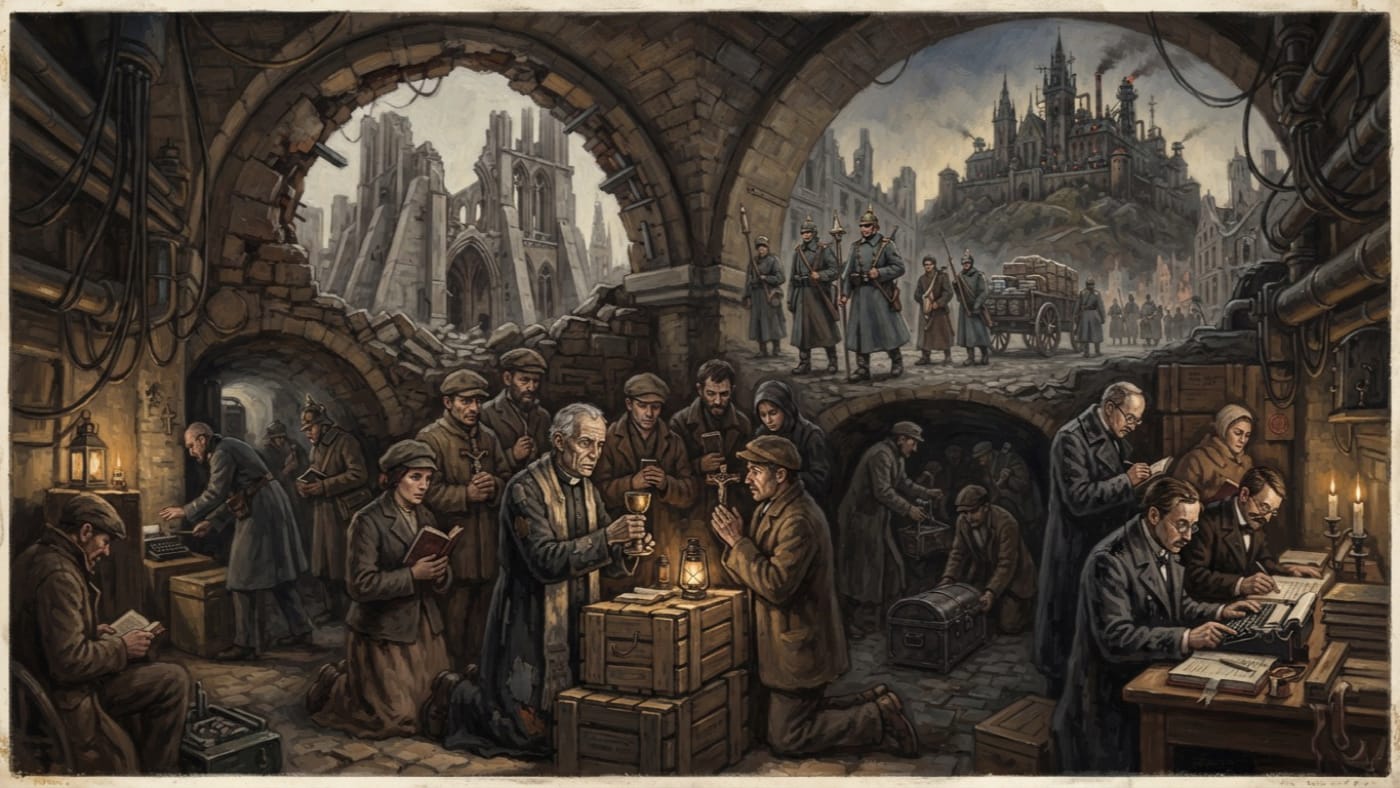
The fifteen years between Regensburg and the Sundering produced more than one form of survival. The Cellar Saints are the best remembered: loose and scattered communities, mostly lay households of bakers, midwives, parish clerks and their children, in the brewery cellars of Cologne, the caves above Innsbruck and the catacombs of Lyon. Surviving clergy, couriers and relief workers moved among them. Hosts were hidden in tobacco tins, and communion records were written on the backs of census forms. Many of the cells did not know the others existed.
They were not the whole of the surviving Church. Bishops and chapters kept going in other places, and the files describe how they did so unevenly. Worship continued, and so did relief. Records were kept and custody was maintained wherever someone could manage it. No underground headquarters directed any of this, and no clandestine command united it. No membership roll survives because none was ever drawn up. A household that kept a list was a household that could be hanged from it.
#On Public Government Before the Constitution
On 1 November A.S. 45 / 1755 CE came the Sundering. Central Rationalist command broke, though its western offices went on stamping papers for some time with nobody left to answer to. Doctrine reads the catastrophe as Providential rebuke. On how it actually happened, the Bureau has offered opinions, and this survey records them as opinions.
The Church came up out of its cellars and out of the chapter houses that had never closed, and it came up unevenly. It took on refugee relief first, then civil administration, and then wartime government in towns where someone had to issue the bread tickets. Around A.S. 50 a provisional council governed in practice. It was not the Synod. Offices grew, and they did work long before anyone settled what their jurisdiction was.
In A.S. 55 the Common Allegiance was issued under the authority of Augustinus, composed with Kratz and Sabine, and offered for local subscription. In A.S. 58 came the Night of Black Decrees. Couriers carried authentic, conditional, premature and forged writs to resistant jurisdictions within reach, and local accessions were pressed by coercion. Later propaganda had every diocese signing before dawn. The surviving acknowledgements show a narrower reach.
#On the Inheritance Sealed at Strasbourg
The Council of Worms ratified the instrument in A.S. 87. By A.S. 88 both founders were dead. The Concordat of Strasbourg in A.S. 90 / 1800 CE was the work of their successors. It constituted the formal Synod and adopted the Anno Synodi reckoning retrospectively, with its zero set ninety years back.
Nothing was abolished on that day. No second Church was closed so the Synod could open. The faithful who went to Mass the week before the Concordat went the week after, under a new seal. What changed was the claim. The Synod took the earlier clergy, dioceses, archives and relic vaults as its own inheritance, and from that point every bishop before A.S. 90 entered the registers as a predecessor. The dead were not asked whether they wished to be ancestors. They seldom are.
This survey stops at A.S. 90. The Bureaucratic Synod covers the government that followed.