
#On the Proclamation
"A dawn without God is no dawn." — V.D., marginal note to the Lore Book, Chapter I
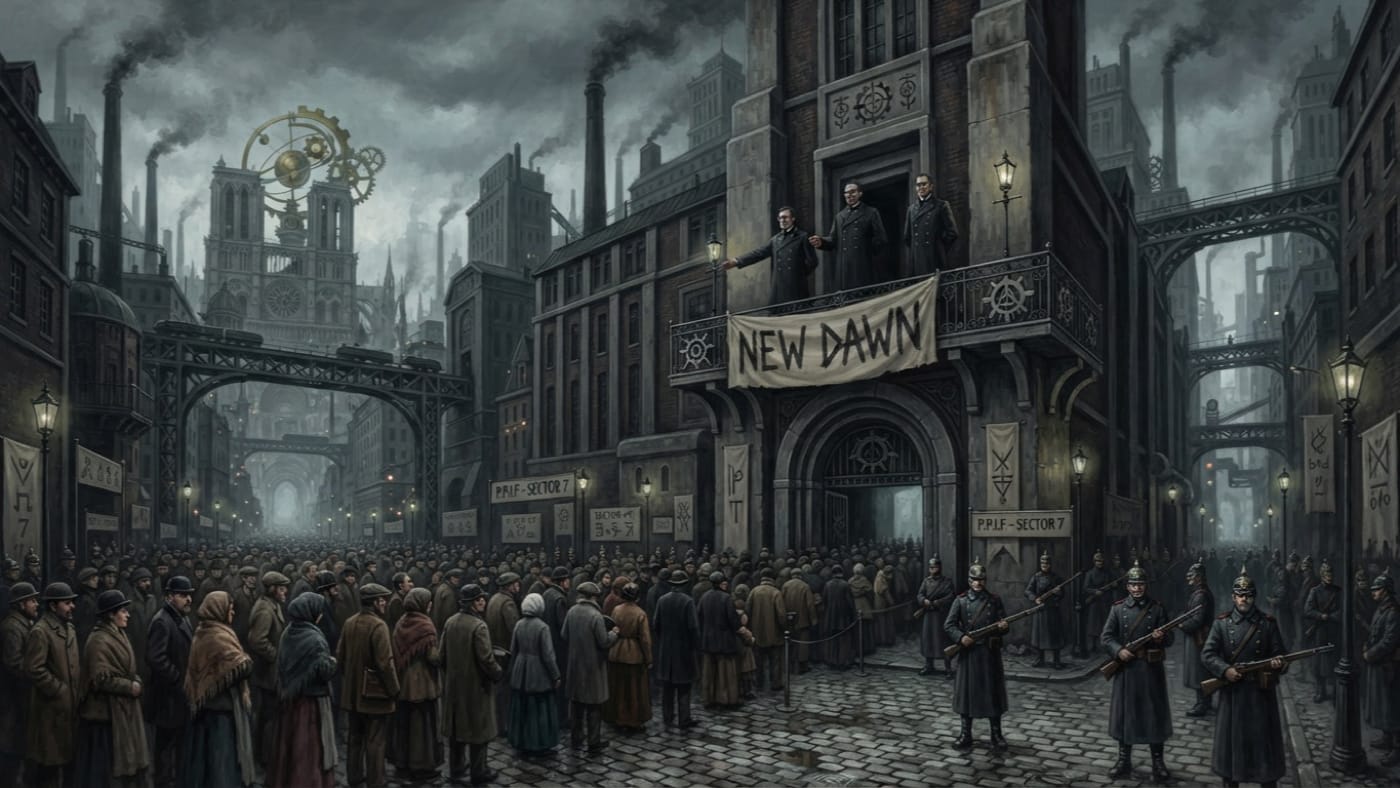
"New Dawn" is the name the Rationalists gave their victory, and of all their coinages it is the only one the Bureau has never troubled to ban. It belongs to A.S. 30 / 1740 CE and to the Treaty of Regensburg, which closed twenty years of Atheist Wars and put the continent under the Rationalist Republic. The Lore Book gives the essentials in a single breath. The Holy See of Vienna was dissolved at swordpoint, a "New Dawn" was proclaimed in the Treaty, and Rationalist leaders drank to the death of superstition and promised an age of liberty.
Readers expecting a charter will be disappointed. The Forbidden Stacks hold the Treaty itself under triple seal. They hold no separate instrument headed New Dawn, no decree number, and no attested orator. What survives is a slogan that travelled in the Treaty's baggage and appears wherever the Republic wished to sound like morning.
Two places must be kept apart. The settlement was signed at Regensburg, in the Reichssaal of the old Imperial Diet, beneath Broken Cross banners. According to the Codex's recorded account, it was in that room that the Archbishop of Vienna signed away his own See in his own blood. The Republic, however, governed from Vienna. The Republic's Codex entry has the Council of Nine announcing ratification from a palace balcony there. The Black Procession account has "New Dawn" cried from every lectern and balcony in the city. Both accounts can stand together, and neither supplies a date. I will not supply one either. A Warden who invents a feast day for the enemy has done half of the enemy's liturgical work.
#On the Liberty Advertised
The promise was liberty. The instrument was a change of jurisdiction.
The Republic was assembled from Rationalist administrations already governing parts of the continent before A.S. 30. Regensburg did not invent its prefects, its guards or its persecutions. It made them continental and gave them a constitution. The Concordats of Governance dissolved crown, diocese and ducal charter and redrew the map as thirty-seven Philosophical Prefectures, each under a Prefect of Reason answerable to Vienna. Canon law gave way to a single secular code. Oaths sworn on relics lost their standing in court. Sanctuary was declared void on the grounds that churches had ceased to exist in law. They were now "Public Instruction Facilities," and a man cannot claim asylum in a classroom.
Liberty from the tithe was delivered through confiscation. Under the Edict of Rational Allocation, altar plate, monastic acreage, bells and reliquaries were inventoried, weighed for metal and entered as public assets. Some went into coin, some into cannon, and some into the fire. I have handled confiscation inventories of the period. The columns are ruled with care, the weights run to the half-ounce, and in the remarks column a reliquary's contents are entered as "organic matter, no civic use." They are beautiful documents. I say so as a professional, and I would have the clerk who wrote them flogged as a Christian.
Liberty of conscience, as the Republic defined it, meant freedom to believe nothing, provided it was done in the right register and at the right office. Citizens were free to attend the Secular Gatherings that replaced Sunday worship. Those who failed to attend paid fines. An emancipation, in the Republic's hands, needed a form, a counter and a queue.
#On the Faithful Thus Emancipated
Churches were closed, stripped or put to other uses. In Vienna the Cathedral of Saint Stephen became the Republic's Academy, and a brass orrery turned where the cross had hung. Under the Treaty's closing articles, captured clergy were offered public recantation. Those who refused were sent to what the documents called centres of rational correction and what the survivors called prisons.
Two instruments of the period show the method. Under the Edict of Ironmouth, issued from the Prefecture of Paris, prayer spoken in the hearing of witnesses became treason, punished by the tongue. The First Black Census required each citizen to declare unbelief at a prefectural office, and a man who declared faith was struck from the register before he was struck from the world. Neither was a clause of some New Dawn charter, and I will not pretend every cruelty began on the day of the cheering. They belong to the same Concordats, the same prefectures and the same years of supremacy that the slogan introduced.
Below the balconies, prayer moved underground. The Cellar Saints (the name was given later, by grateful clerks) kept communion in the brewery cellars of Cologne, in the alpine caves above Innsbruck and in the sealed catacombs of Lyon. They were mostly lay households: bakers, midwives, parish clerks and their children. Surviving clergy, couriers carrying news and sacraments, and relief workers moved among them. Chalices went into aprons and hosts into tobacco tins. Their cells were loose, scattered and frequently unknown to one another, and they were not the whole of the surviving Church, which kept bishops and chapters of its own in other corners. The proclamation had announced that religion was over, and in Cologne a priest was keeping communion records on the backs of census forms.
#On the Morning After
The confidence of A.S. 30 lasted very briefly. Within days of Regensburg the Prefecture of Public Instruction in Vienna staged the Black Procession, burning saint-effigies in a public square on fires that the Codex account records as giving light but no heat. The Rationalists filed it as an atmospheric anomaly and cancelled the second day of celebrations.
In A.S. 32 / 1742 CE came the Year Without Dawn, when the sun failed to rise for forty days and the continent lived under a flat grey. I place it on its proper year and no closer. The Republic's astronomers published an eclipse hypothesis, and the farmers' account did better. A government that had named its triumph after the sunrise had to issue explanatory bulletins on the sunrise's absence. No Bureau satirist has improved on that, and the Bureau employs several.
The Red Flood of the Danube followed in A.S. 34 / 1744 CE: three weeks of crimson water and rotting fish, filed as runoff. The Eastern Silence of A.S. 38 / 1748 CE brought dead letters from Balkan villages and refugees on the western roads. The Republic answered with plague quarantine and a ban on travel. Each omen was measured, explained and published with the prefectural stamp.
On 1 November A.S. 45 / 1755 CE came the Sundering. Central command broke. Western offices, courts and guard posts carried on unevenly for some time afterwards, still collecting, still stamping, with no Vienna left to answer to. The Vienna remnant's final defeat in A.S. 95 is a separate matter with its own entry.
The Bureau of Doctrine reads the whole sequence, from the cold pyres to the opened Balkans, as Providential rebuke of the proclamation's pride, and it teaches that reading in every catechism school. I record Doctrine's classification under Doctrine's seal. On the mechanism by which the Sundering occurred, the Bureau has issued opinions rather than findings, and this entry does not presume to settle what the Bureau has not.
"They called it a Republic. They called it a New Dawn. They called it the future. It lasted fifteen years." — Bureau of Doctrine, Catechism Supplement 14-F, as printed at the head of this Codex's entry on the Republic
The fifteen years, A.S. 30 to A.S. 45, measure the Republic's continental supremacy. They do not measure its whole life. Rationalist administration governed some territories before Regensburg, and western offices survived unevenly after the Sundering. The correction stands as already entered under the Code of Rational Jurisprudence. Catechists may go on quoting the Supplement, but they may not use it to date anything.
#On the Phrase in Bureau Custody
The Bureau keeps the slogan the way a magistrate keeps a confession, ready to read aloud. Catechism instructors quote it so that children can be asked what became of it. Doctrine cites it as the Republic's own account of its expectations, set down in its own hand, and the Republic is the one witness the Bureau never needs to cross-examine.
My own interest is less edifying and more professional. The New Dawn had a balcony and a slogan. Behind them stood thirty-seven prefectures, a constitutional appendix sealed on every page, a confiscation schedule ruled to the half-ounce and a census that could make a family disappear with a single stroke. The Synod's offices have studied that machinery closely and adopted more of it than they acknowledge in print. The proclamation was the cheapest part of the whole apparatus. The prefectural registers did the real work, and they were very good registers.
The Republic announced a dawn and then administered fifteen years of supremacy. The dawn was the advertisement and the supremacy was what it sold. Doctrine has annulled the advertisement. The Bureau of Records has kept the inventories.