
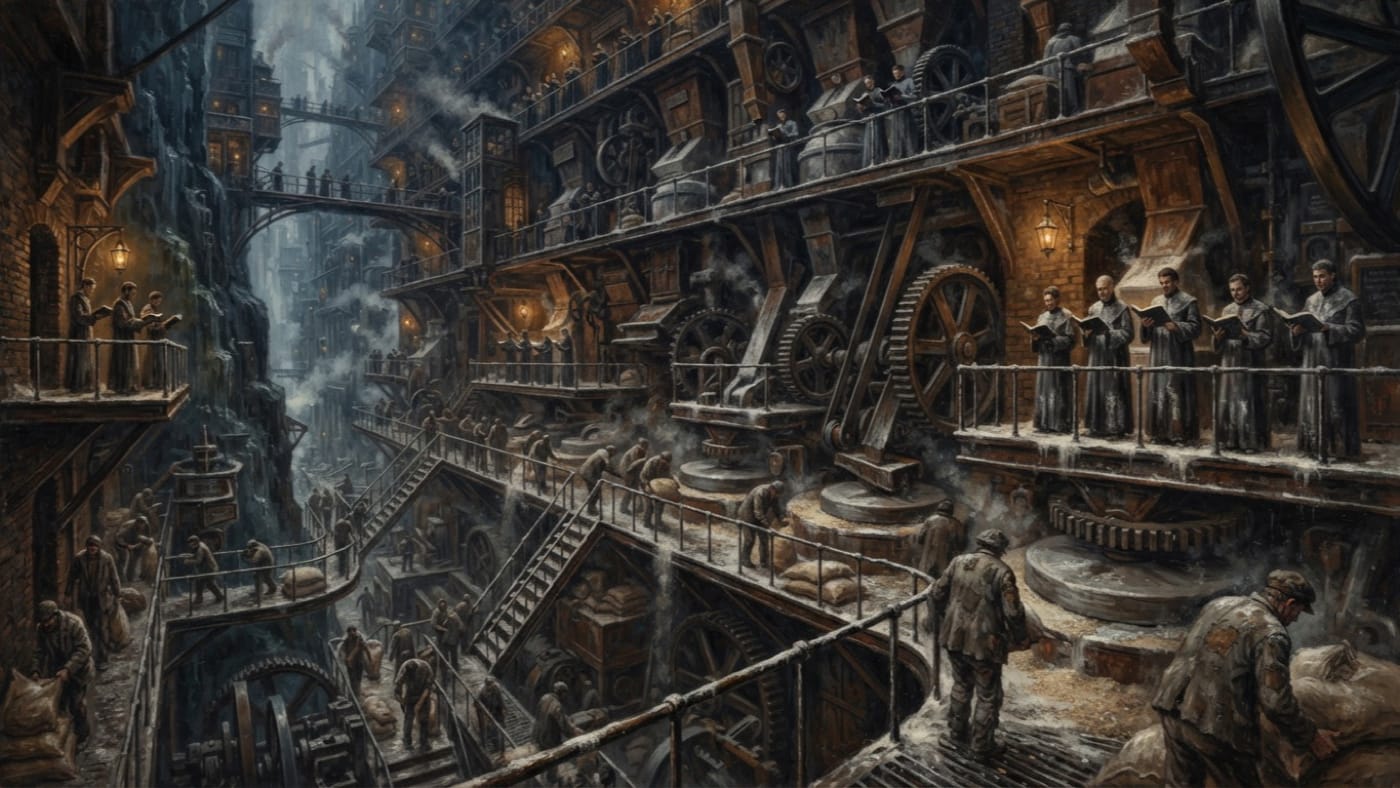
#On the Fourth Terrace
"Smells like flour-dust and hot gears." — Rheinscarp survey of A.S. 201, district entry for the fourth Step
The Mill-Crown Terraces hold the fourth of Rheinscarp's nine Steps. The First Step Market lies below them. Despite its name, the Market stands on the third terrace, because Rheinscarp numbers its stairs by the order of payment and not by the order of stone. Above the mills is the Ledger Cloister on the fifth terrace, the city's archive. The plural in the district's name refers to the milling bays stacked one above another against the cliff. It does not add a Step to the city, whatever a stair-runner may charge a stranger for the impression.
The fabric is the city's usual rust-iron, wet brick and bone-lime grout. Mill-chutes drop through the floors, and catwalks run across above them. The gearing runs hot enough that men stand back from it, and the terrace shakes under the feet. Flour hangs in the air until it settles somewhere: in a lung, on a cantor's collar, or in the gutter of a ledger, where it lies in pale drifts along the spine.
Grain comes up from the river. Barges unload at the Sump Docks, and the cargo passes the grates of Lockmouth. From there it climbs the Hundred Steps, the only sanctioned corridor for bulk cargo, or travels by licensed rope-lift, cage and chain-bridge. Every crossing between terraces requires authorized verse, payment and registration. A clipped brass stair-token is good for one crossing and is spent on it.
The river mills are older than the Church's public order. They and the Rationalist lockworks were grinding before the Sundering of A.S. 45 (1755 CE). No file I have been shown dates the present fourth district, with its bays and its singers. I will not take a date from the Silt Year of A.S. 78 (1788 CE). That flood killed four thousand people across the city and drove the survivors up the cliff. The flood explains why Rheinscarp lives upward, but it gives no date for a millstone.
#On the Mills and Their Purchased Cadence
The mills are hymn-timed. The Mill-Crown Cantors set the cadence. The cadence sets the output, the output sets the ration allocation, and the allocation decides who eats. A failed hymn can jam a mill, and a jammed mill can leave a terrace without bread. Synodal industrial doctrine files work songs as calibration specifications, written in stanza and rest the way a gauge is written in pressure. The doctrine does not say whether the hymn acts on the gears, on the crews who feed them, or on both. The Bureau of Doctrine has published no ruling on the question, and I will not publish one on its behalf.
The Cantors are a guild and a choir-order at once. They have choirs, hymn-books, foremen, and collars stained grey with ash. In public they say they sing the mills safe. The survey records a private ambition as well: a monopoly of bell-hour contracts. It records the ambition but not its achievement. Their recorded methods are cadence control, the blacklist, and misfires that are accidental by every official account. No dated case of sabotage has reached the Ledger.
A bell-hour is a measured span of sanctified ringing, licensed under the Bell Codex and bought so that labour may lawfully proceed inside it. Bell-Accountants turn bell-hours into time-credit windows, and the windows into ration priority. Nowhere on the fourth terrace is a rate posted between hours, wages, tokens and loaves. The rate exists. It is kept in a ledger above the heads of the people it governs.
These contracts all run through Cantor-Marshal Hrodric Venn. His sphere is Bell and War logistics. It covers the mill cadences, the bell-hour allotments, the time-credits, the Cantor Foundries on the eighth terrace, and the timing of the convoys that carry flour and ration chits across the Heartlands toward the Line. He heads no Bureau. He ranks below the Synod Chapterhouse, which governs with the Tribunal of Stairs and the Records annex. That Chapterhouse was consecrated in the local settlement of A.S. 92 (1802 CE), two years after the Concordat of Strasbourg. Neither date tells us when the mills first heard a hymn. The Foundries share the guild and the Marshal with the mills, but they are a separate district: coal and ozone up there, flour down here.
#On the Hands That Grind
The mill-hand belongs to Rheinscarp's fourth class: hungry, and taxed for every movement. The fourth terrace has its own ways to kill. Flour-lung closes the chest slowly. The gearing takes fingers, then hands, then sleeves with the arms still in them. Men fall from the catwalks into the chutes. A dense enough haze can explode. The Codex has no dated explosion on file for this district and no tally of the dead. The hazard is recorded as a condition of the terrace, like its heat.
The terrace takes its fees as surely as its injuries. A hand who lodges on another Step pays a token to come to work and another to go home. A hand who stumbles on the stair verse can be entered as absent, and the only cure is confession, which Rheinscarp bills by the sitting. There are quota tithes besides, and the debt on the tokens grows faster than the tokens do. On top of all this sits the time-credit window. A hand who misses it loses ration priority entirely, and the street calls such a household bell-broke. In the evenings the bathhouses run on warm return-water from the mills, so the workforce can at least go hungry clean.
Grinding flour does not entitle anyone to flour. A hand draws bread at a ration window like any other petitioner. The window checks the ration card. The card has to match a registered name, and the name has to match the terrace entry. The hand's twelve hours at the millstone play no part in the check.
#On the Grain Entered Twice
"Variance." — Bureau of Tithes classification, A.S. 198
In A.S. 198 (1908 CE) one real consignment of grain was counted twice, allocated twice and delivered once. One allocation went to the Mill-Crown Terraces and the other to the Widowlight Quarter on the sixth Step. Both terraces recorded the grain as received. Both receipts carried authentic stamps. Both terraces starved. Forty-one people died, and that figure is the total for both districts together.
The two districts are a single Step apart, with the Ledger Cloister in between. A mill-hand who wanted to see whether the Widowlight's warehouses were full would have needed two crossings, two tokens and two clean recitations. The Cloister on the way held the very books that said both terraces had already eaten.
The Bureau of Records audited the discrepancy. Its findings were that the stamps, the entries and the grain were all genuine. The Bureau of Tithes called the shortfall a variance. Doctrine later revised the classification, and its ruling stands.
Several things remain unrecorded: which terrace received the real delivery, what the consignment weighed, how the forty-one divide between the mills and the Widowlight, and whose hand wrote the second receipt. The famine is documented as a failure of allocation. No source connects it to a misfire, a blacklist or any Cantor's tempo. No accepted record shows that the city's present governors held their offices that year.
Mill-Crown ration entries for A.S. 198 carry the Bureau of Tithes classification: variance.
That classification is superseded. The governing finding is administrative incident, non-recurring (Bureau of Doctrine). Forty-one deaths are entered for the Mill-Crown Terraces and the Widowlight Quarter together. Any page that divides the forty-one between the two terraces does so without authority and is to be read as unfiled.
#On the Names Removed
The audit found more than a duplicated receipt. Through Records, the mills share an absence quota. Living people are corrected out of the entitlement count so that rations which cannot feed the registered city balance on paper anyway. The famine of A.S. 198 exposed the practice. Nobody has shown that the famine started it, and the Codex gives the quota no founding year.
The Bureau publishes no rate. The street says one in forty each quarter. I report that as testimony from the queue, not as a figure from the Ledger. Nor does a corrected name prove that its owner has vanished. In Rheinscarp, administrative absence is a ledger status. It is fully compatible with a body that still walks, works, coughs flour, and stands at the ration window to be told it is not there.
The fourth terrace produces flour. Entitlement to that flour is decided elsewhere. Praetor-Registrar Ysabeau Kelm's Records administration decides which names are recognized. Its chanting is done by the Registry Choir, also called the Quill-Choir, in the Cloister upstairs, which has no connection to the Cantors in the mills. When hunger turns bodies into pledged cremains, Damas Rohe's Ash Exchange takes the collateral. Each of these offices keeps its own column. No evidence of a joint design has been filed, and the columns would still add up without one.
#On the Present Condition
The mills still run. In the bays, below the level of the catwalks, crews hum cadence songs that no Cantor has licensed. By the survey's account those songs keep the gears in step without a single purchased bell-hour. That makes them a threat to the whole contract. A song a crew can carry for nothing undercuts every hour the Cantors sell. Unlicensed ringing is a red line in Rheinscarp, prosecuted as tempo heresy. The record has not settled whether a hummed stanza counts as ringing. No rival choir, prosecution or reform appears on file.
Above the mills, the Bureau of Mercy's hunger-waiver advocates argue that a body standing at a ration window should be fed whatever its paper says. The Tribunal and the Tithes liaison reply that toll sanctity is doctrinal, and that hunger is not a doctrinal argument. Neither side has prevailed. Meanwhile the hymns are bought, the chutes run, and the flour keeps settling in the ledger gutters.