
#On the Bell-Accountant's Office
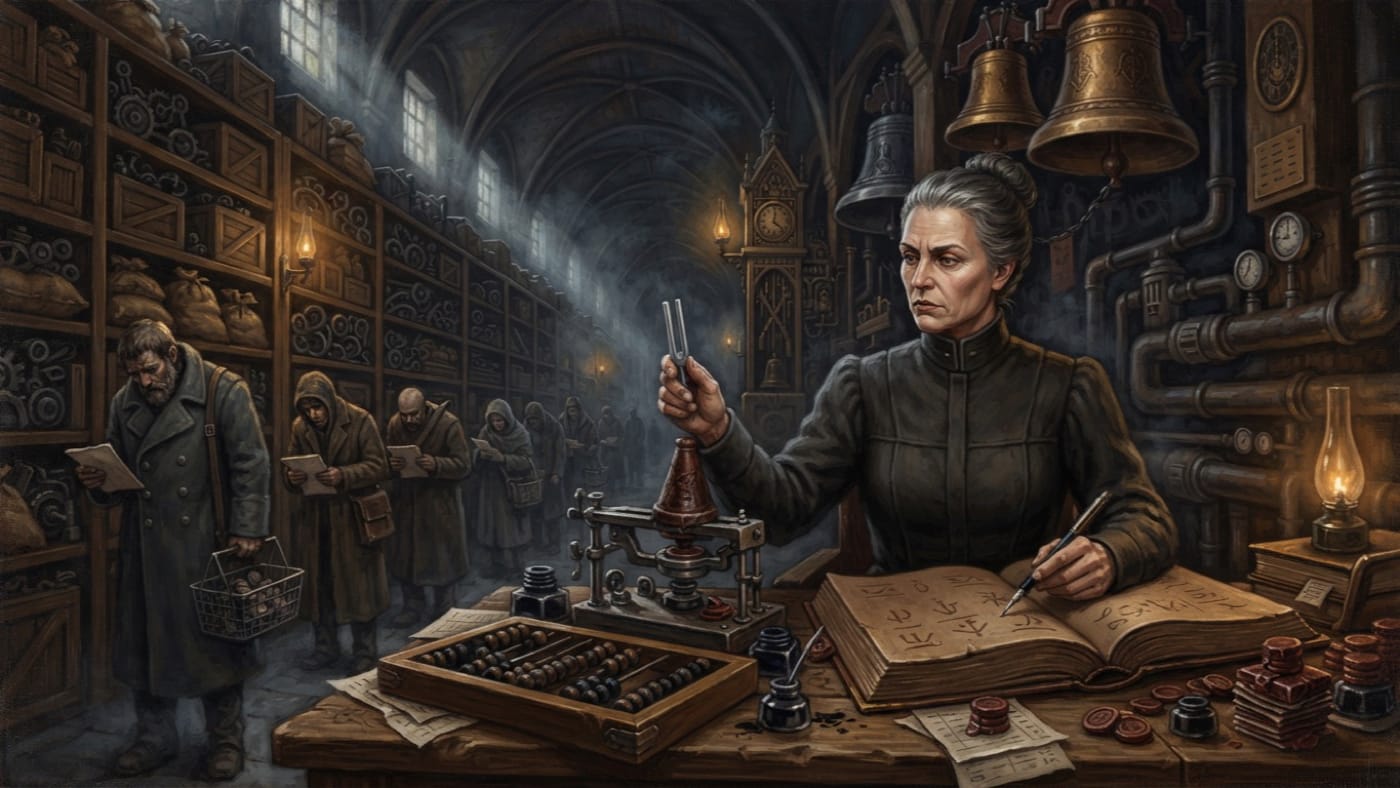
The Bell-Accountant is a clerk. Other offices on the Sagittal Line prefer to forget this, so it goes first. The post is held by men and women alike. They carry no rifle and hear no confessions. They are not ordained and they do not stand sentry. They sit at a desk with a ledger, a pen and an abacus whose beads have been sanctified with candle-wax. With these they decide when the Synod's goods are allowed to exist.
Their ledgers record two things. The first is the number of crates. The second is the number of hours within which those crates must move. A storehouse that counts only crates is a barn with good manners. Once the hours are counted as well, it is an instrument of state. The Bell-Accountant keeps that second column, and it is the column that feeds people.
Their doctrine is short enough to cut into a lintel. Goods that have been made but not entered are rumour. Goods that have been entered but not timed are clutter. Only goods that are made, entered and timed belong to the Church, and only those may be eaten, fired, fitted or burned by lawful hands.
#On Crates, Hours and Ration Priority
The Bell-Accountant's native house is the Processional Storehouse. Its aisles are laid out like naves and its shelves are kept like reliquaries. Bells toll the shifts. Choruses recite the inventory aloud, and relic-crates are hauled on chains from one nave to the next. Visitors take it for chaos. The Synod takes it for choreography and bills the visitors for the tour.
The storehouse has other officers. Priors of Salt sing each measure of salt into the ledger. Wardens of Shot govern the ammunition stacks and log each round as a possible absolution. Neither office ranks above or below the Bell-Accountant. They are neighbours in the same nave. The Priors weigh salt and the Wardens count shot, while the Bell-Accountant counts time and bills both of them for it.
The instrument of that billing is the time-credit. Each convoy that leaves a storehouse is given a portion of bell-hours, and those hours are converted into ration priority. A convoy with credit moves at its appointed toll. A convoy without credit waits in the yard until the ledger remembers it. Meanwhile the drivers smoke, the mules grow philosophical and the bread in the wagons starts its slow conversion into gravel.
The storehouse catechism gives an example that every novice clerk learns by heart. A loaf of bread costs flour and fire, and it also costs three tolls of Saint Odric's Bell, one absolution slip and a signed hymn from the choir. It is an illustration and not a tariff, and anyone who tries to settle a debt at that rate in a forward bastion will learn how the forward bastions settle debts. The lesson holds regardless. Bread has an administrative cost, the Bell-Accountant sets it, and the price is paid in hours before anyone pays it in coin.
#On Wax and the Living Hymn
The office might have stayed in the storehouse, counting loaves and minding tolls, if Syrion had not learned to sing through plumbing.
In A.S. 163 the Unhymn Infiltration at Bastion-Shipka carried hostile sleep-tones through poorly maintained diesel resonance conduits, and a district garrison failed to wake through an entire dawn cycle. The casualty figures remain classified. The pipes had done their duty and carried the signal, and this time the signal was a lullaby.
In A.S. 164 came the Seal Standardisation Edict. It required authorized hymn-gaskets throughout the resonance infrastructure. Each seal needed purity wax cooled under the Sixth Canticle of Industry, a triple office stamp and a custody record. The Bureau of Bells gained the right to inspect wax memory. Records wanted the documents, Tithes wanted the fees, Engineering wanted the seals to hold, and Doctrine wanted the song. The treated Shipka lines rejected the known sleep-cadence. That result was earned and deserves to be written down. The shortage followed within the season, as dependably as a creditor.
The Counterfeit Wax Plague of A.S. 178 moved through Shipka and Irongate, carried by purity wax that had never heard the Canticle. Fourteen suppliers were immured at Przemyśl. Workshops were burned and stock destroyed, and the counterfeits were back within six months. Doctrine's answer was living-hymn verification. A Bell-Accountant strikes a tuning fork, holds it to the wax and judges its authenticity by resonance.
That is how the clerk of loaves became the magistrate of seals.
The office's distinctions are exact, and they matter more than anything else in this entry. A seal can hold pressure, and a seal can pass the material assays. According to Doctrine, a seal can do both of those things and still lack the song cooled into it by the Sixth Canticle. Engineering answers the first question and the assayers answer the second. The Bell-Accountant, with a fork and a trained ear, answers the third. The Bureau of Bells teaches that wax remembers what it was sung, and the fork asks it to repeat that. Wax that answers correctly passes onto the ledger. Wax that answers wrongly or stays silent becomes evidence, whatever its tensile strength.
#On Witnesses Under Emergency
Przemyśl is where the fork meets sleet.
In A.S. 164 the Split-Ring Disaster tore through seventeen engine pits beneath the western district of the Wire Orchard over nine hours, and forty-three men died. The inquiry found that a senior mechanic had shortened the cleansing verse under time pressure. Residual wax stayed in the grooves, the gaskets seated badly, and pressure found the gap. Operational Classification 7-G licensed the Gasket-Hymn Mechanic as a formal craft, and the Sabotage Reforms made undocumented repair a prosecutable offence. Those instruments belong to the mechanics. Their paperwork was handed to the Bell-Accountants to countersign.
Every emergency at the Orchard now arrives already accused. When a strand dies in sleet, the Warden who hears it must summon a licensed mechanic. The mechanic must then produce wax that will satisfy verification, have the verse witnessed and have the torque noted. Atheron's Pride-host has never shown any respect for this sequence. The mechanics adapted with field notes, false times, pre-sung wax, signatures in the excellent handwriting of dead men, and sympathetic Bell-Accountants.
The sympathetic accountant is the hinge. Suppose a clerk accepts a cake of wax that was sung in a warm chapel three days earlier as though it had been sung at the pit. Suppose the clerk records the repair at the hour it should have happened and not the hour it did. Suppose the clerk treats a dead colleague's signature as a formality and does not ask whether he was present. That clerk has turned an emergency into a lawful entry. Most accountants do not do this. Some do it once and are caught. Some do it quietly for years, and their pits hold.
The accountants who refuse are not all cowards or pedants. The Split-Ring dead were killed by a shortened verse, and the ledger has not forgotten it. An accountant who rejects a doubtful seal at the ninth bell may be all that stands between a district and a second Split-Ring. An accountant who rejects a sound seal at the ninth bell may be all that stands between Atheron and the wire. The fork cannot tell which case it is. The clerk has to decide anyway, with a line of freezing men waiting at the desk.
Diesel Resonance Plumbers maintain the lines, mechanics fit the seals, and Bellwardens keep the bells and police the acoustic works. The Bell-Accountant holds none of those tools and holds the pen over all of them. That is enough power for one desk, and the Bureau of Bells prefers to call it modest.
Przemyśl training manuals once stated that the Split-Ring Disaster "confirmed the sufficiency of full-sequence compliance in all critical seal contexts."
Corrected, from the countersigning desk. The Bell-Accountant's own entries show that complete sequence cannot be performed with stock that has not arrived. They show that verification held back for want of lawful wax has left strands dead through a sleet-watch, and that repairs later entered under false times kept wire live that the true times would have left slack. The omitted verse killed forty-three men, and the delayed crate has killed others in its turn. The manual was amended to remove the word "all." The Bureau considers the matter closed. The pits do not.
#On Present Application
As of A.S. 201 the Edict remains in force across all seven bastions, and the Bell-Accountants still sit at its gate. They still insist that wax remembers. They still strike the fork, and they still bill convoys for hours. Plumbers still keep illegal stock in dry niches behind their tool shelves. Mechanics still know which counterfeiters sing well. A few clerks still know the right hour to write down, and why.
The storehouse bells still toll the shifts. Somewhere a wagon of bread is waiting for its three tolls, and somewhere a gasket is waiting for its fork. The resonance lines carry what they carry, and whatever they carry has been entered on a ledger first.