
#On the Mills and Their Singers
"We sing the mills safe." — Public declaration of the Mill-Crown Cantors, as entered in the Rheinscarp survey
The ration mills of Rheinscarp stand on the Mill-Crown Terraces, the fourth of the city's nine Steps. They grind the flour that a registered city is permitted to eat. The air there is flour-dust and gear-heat. The haze settles in the gutters of the ledgers and in the lungs of the mill-hands, and the local name for what it does to the lungs, flour-lung, needs no gloss. A mill of that size cannot run on goodwill. Its crews must feed, lift, engage and release in time, and its gears must meet at the speed they were set for. A dust-choked mill that loses its rhythm can jam. A mill that thick with flour can also explode.
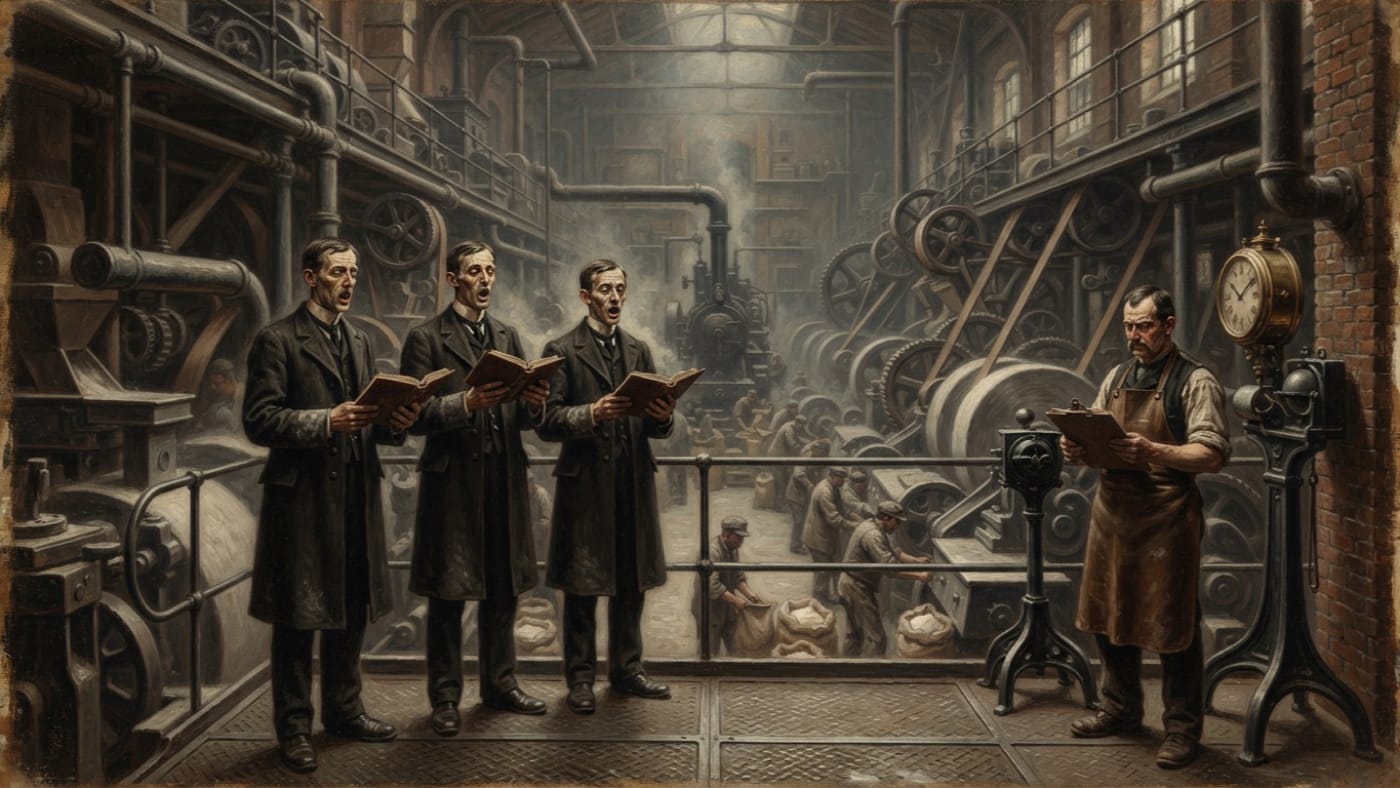
The Mill-Crown Cantors keep that rhythm. They are a guild and a choir-order at once, with ash-stained collars, open hymn-books and foremen at their elbows. Their claim is that they sing the mills safe, and I grant the claim its due. A terrace that eats by the output of its mills has every reason to want the mills in step, and somebody has to keep the step. The Cantors have arranged matters so that the somebody is always them, and they are always paid.
#On Cadence and Purchased Hours
Synodal industrial doctrine treats the work song as a calibration specification: stanza and rest set a machine as a gauge sets a valve. In Rheinscarp the specification is sung. The Cantors' cadence sets the tempo at which the gears engage, the tempo sets output, output sets the ration allocation, and the allocation decides who eats. Each link is documented. The chain is short enough to recite at a tollhouse window, and most of the fourth terrace could recite it.
The tempo is sold by contract. A cadence contract binds a working bay, a crew and a purchased span of ringing into one obligation. The ringing is the bell-hour, a measured portion of sanctified sound licensed by the Bureau of Bells under the Bell Codex and bought so that labour may lawfully go on inside it. No purchased hour means no lawful tempo. A mill may stand oiled and manned at dawn and wait until noon for its paper.
Then the paper travels. Bell-Accountants assign time-credits and convert bell-hours into ration priority. A shift worked inside its window feeds the terrace. A missed window collapses the priority, and the family attached to it becomes what the street calls bell-broke. I have found no published tariff of hours against loaves. The rate exists. It is simply not posted where the hungry stand.
The same guild serves the Cantor Foundries on the eighth terrace, four stairs and four tollgates above the mills. The two districts are distinct: flour below, coal, metal and ozone above. The record does not say that the furnaces and the millstones hear the same hymn. It says they answer to the same choir and the same purchasing office, so a failure at either end is billed to both.
#On the Marshal and the Contract
The Cantors answer to Cantor-Marshal Hrodric Venn. His documented sphere is Bell and War logistics, and his desk sits in the High Step Precinct. He controls the mill cadences, the Foundries, the bell-hour allotments, the time-credits and the convoys that leave for the Line on his schedule. The Bureau of War receives the convoys. He heads no Bureau. His reporting line and his ordination are not on file, and I decline to invent them to give the reader a tidier chain of command.
Above Venn stands the Synod Chapterhouse. Together with the Tribunal of Stairs and the Records annex, it makes up the city's lawful government. The Cantors are a guild under an officer under a hierarchy. They are no city government and no sovereign order, though a mill-hand waiting on a late hymn may be forgiven for not noticing the difference.
Their objective is a monopoly of bell-hour contracts across the mills and the foundry terraces. The survey records it as an ambition and does not record it as achieved. Their methods are entered plainly: cadence control, the blacklist, and the misfire that arrives, by every official account, by accident. A blacklisted singer does not sing for pay. A blacklisted rival choir loses its contracts, and a foreman who hires one may lose his own. Every mill whose cadence fails becomes a fresh argument for paying the Cantors more.
I am recording capacity. No named victim, no dated campaign and no adjudicated case of sabotage has reached the Ledger, and no order of Venn's commanding a misfire is on file. The Cantors could jam a mill, and a jammed mill can starve a terrace. Rheinscarp drew the inference long ago and did not wait for the Tribunal.
#On Unpurchased Song
This is where the Cantors' theology leaks. Unsanctioned cadence songs keep the mills in step without a single purchased bell-hour. Mill-hands hum them and Cantors hunt them. So far as the record shows, the machinery accepts them.
That is the whole commercial danger. If the safety lies in the cadence, and any cadence a crew can carry will serve, then the Cantors sell something the crew can supply for itself between breaths. If the safety lies in the Cantors alone, the unpaid songs ought to fail, and nobody has filed a report that they reliably do. The guild's safety claim requires the hum to be dangerous. The guild's revenue requires it to be forbidden. These are two separate requirements, and the Cantors have taken care to meet the second.
Local law helps them. Unauthorized ringing is one of Rheinscarp's red lines and is prosecuted as tempo heresy, and a song that makes the purchased bell unnecessary stands uncomfortably near that line. The record does not settle whether a given work song crosses it, or what happens to the singer if it does. Sentences in Rheinscarp vary with the terrace, the clerk and the hour. The Cantors would call that cadence.
The survey lists one trigger for the guild's alarm: a rival cadence spreads. It names no rival choir and records no completed uprising. Neither is needed. A song only has to be learned by enough mouths before the contract starts to look like a tax.
#On the Ration Ledger
"Variance." — Bureau of Tithes classification, A.S. 198
The double-entry famine of A.S. 198 (1908 CE) shows what happens when output and entitlement part company. One genuine grain shipment was counted twice and allocated twice, once to the Mill-Crown Terraces and once to the Widowlight Quarter, but it was delivered only once. Both ledgers bore authentic stamps. Both districts starved, and forty-one people died. The Bureau of Tithes called it a variance. The Bureau of Doctrine later revised that to "administrative incident, non-recurring."
No hymn misfired. The mills could have run in perfect cadence that season and still ground only the half of the shipment that existed, because the shortfall was in the receipts. The record names no author of the duplicate receipt and no destination for the grain that was delivered. It records no Cantor order of sabotage, and it does not establish who held Venn's office that year.
The inquiry did expose the absence quota that the mills share with Records. Each quarter, a portion of the population is corrected out of the registers so that rations balance on paper. The inquiry did not establish when the quota began. The Bureau will not state the rate. The street says one in forty, and I cite the street as the street.
The Cantors' share in this is quiet but real. Their cadence produces the output. Praetor-Registrar Ysabeau Kelm's annex decides whose name may draw on a purchased hour. A crew corrected into absence cannot eat by a cadence it sang. Kelm's chanting belongs to the Registry Choir of the Ledger Cloister, a separate choir serving Records under a separate tariff. At the bottom of the arithmetic, Damas Rohe's Ash Exchange takes the collateral that hunger leaves behind. Each office keeps its own column, and no evidence of a joint design exists. The columns agree anyway.
By A.S. 92, when the first Bureaus received their formal constitutions under the Concordat
The formal Synod and its constitutional settlement date to A.S. 90, under the Concordat of Strasbourg. The Chapterhouse consecration and the Tribunal of Stairs charter of A.S. 92 were later local stages in Rheinscarp. None of these years dates the Mill-Crown Cantors. Their foundation is not on file.
#On the Present Application
As of the Rheinscarp survey of A.S. 201 (1911 CE), the Cantors remain active under Venn and sing the fourth and eighth terraces to purchased hours. Their monopoly is still an objective. The unpaid songs are still in circulation, as the hunting of them shows. Above the mills, the hunger-waiver advocates of the Bureau of Mercy argue that starving people should eat regardless of stamp status. The Tribunal of Stairs and the Tithes office reply that toll sanctity is doctrine, and doctrine does not accept appetite as evidence. No reform has been sealed and no uprising is on file.
The Cantors' public position has not changed. They sing the mills safe at the contracted rate, inside the purchased window, with a foreman counting the stanzas. A bay that runs without a contract is entered in the time-credit ledger as idle, whatever the flour on the floor says.