
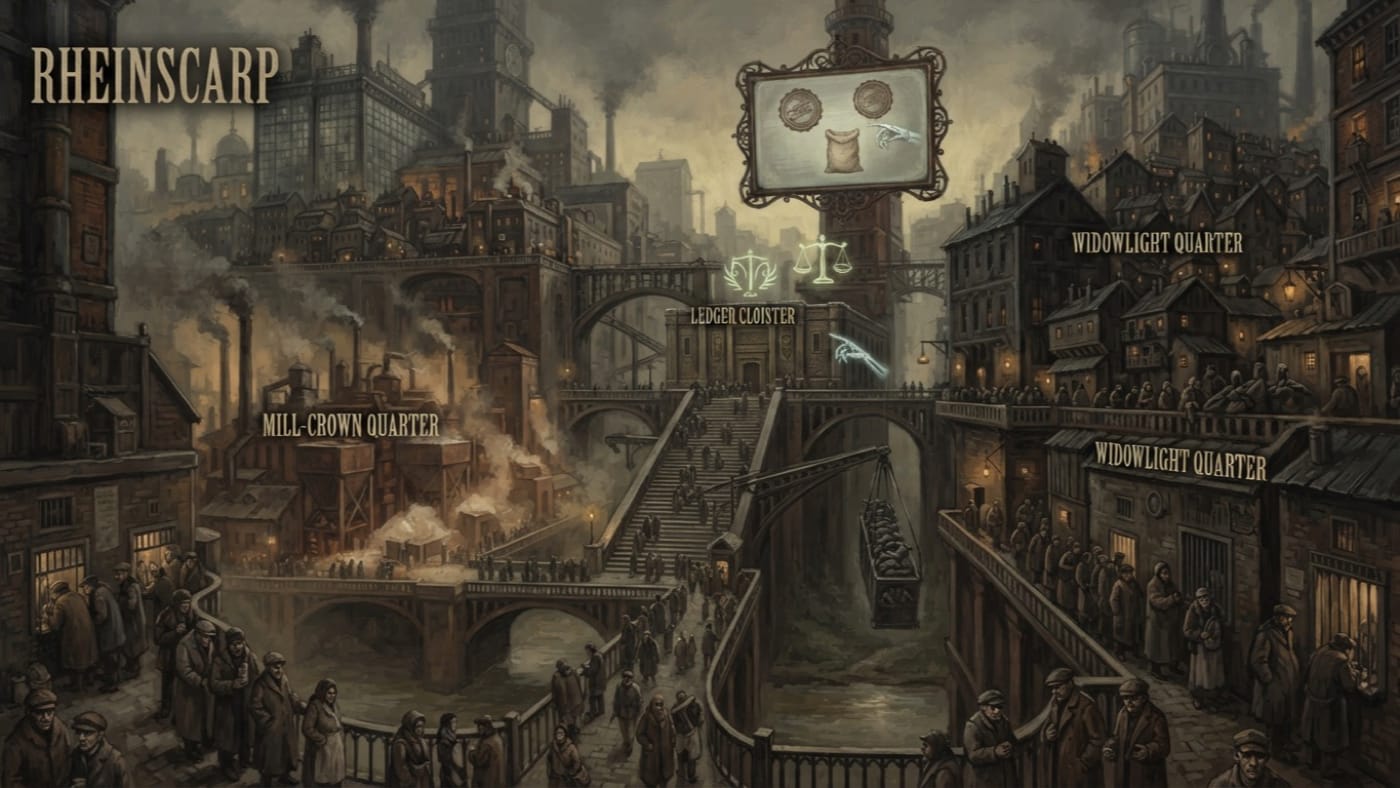
#On the Two Receipts
"Variance": Rheinscarp street usage for "someone stole your food."
In A.S. 198 one consignment of grain entered the ration ledgers of Rheinscarp and was received twice. The Mill-Crown Terraces recorded its arrival. The Widowlight Quarter recorded its arrival. Both entries carried stamps, both stamps were authentic, and both terraces starved. Forty-one people died. As far as any auditor has been able to establish, the grain was real and existed once.
Before the confusion spreads among the educated, the Codex corrects it. Double-entry bookkeeping is a respectable discipline. Every transaction is written twice, once where it leaves and once where it arrives, so that the two columns check each other and the clerk may sleep. What happened in Rheinscarp turned the method inside out. One arrival was written as two arrivals, and no column remained to object. The ledgers balanced. The bowls did not.
#On the Mills and the Widowlight
"A clean name is warmer than a coat." — Rheinscarp proverb
The two afflicted districts lie one terrace apart. Between them, on the fifth step, sits the Ledger Cloister, like a clerk seated between two petitioners. Below it, on the fourth, the Mill-Crown grinds the city's ration flour in a haze that settles on lungs and ledgers with equal thoroughness. Above it, on the sixth, the Widowlight Quarter keeps its night warehouses. They are staffed by drafted widows who work lamp-oil shifts to service debts their husbands left them, together with their surnames.
Neither district eats by its own labour. A mill-hand who has ground flour since the first bell draws bread at a ration window like any other petitioner, and the window consults the entitlement before it looks at the hand. A widow who has counted sacks by tallow-light until curfew stands in the same queue, with the further risk that her shift may be credited to a dead man's line. In Rheinscarp, entitlement is a correspondence. The name must match the terrace entry, the entry must match the ration card, and the card must match the movement record. The claimant must present all of it within the bell-credit window allotted to her terrace. If she misses the window, her priority collapses. If she lacks the brass token for a crossing, the next terrace's warehouse might as well be in Strasbourg.
For a famine this has a simple consequence. Neither terrace could climb or descend to the other's stores and ask. Authenticated paper told each that its grain had come.
#On the Audit of Genuine Things
The Bureau of Records sent auditors, as it does when the dead begin to accumulate faster than the parishes can absorb them quietly. Their findings are the most honest document Rheinscarp produced that year. They are honest in the way a confession is honest when the penitent has been caught holding the chalice.
The stamps were genuine. Each terrace's receipt bore the correct impression in the correct wax. The entries were genuine. No forger had worked on the folios, and no page had been cut out and resewn. The grain was genuine too. It had been carried up from the river and entered in the ration books. Then it was counted twice, allocated twice and delivered once.
The rest of it lived in the Ledger Cloister. Three pages of immaculate penmanship recorded stores that occupied no warehouse on any terrace. Rheinscarp fines a widow for a smudged lamp-tag. In those three pages it held the cleanest record of food in its archive, and the food did not exist.
The audit leaves some things unsaid. The surviving accounts do not name the terrace that received the single real delivery. They do not give the consignment's weight or divide the forty-one between the Mill-Crown and the Widowlight. The finding is that both starved. Whether the real grain fed one terrace short rations or was absorbed somewhere on the stair, the records do not say, and the Codex will not supply a destination for a sack it never weighed.
The accounts also do not name the hand that wrote the second receipt. Authentic paper has many authors. A stamp proves that an office acted. It cannot prove that anything happened.
#On the Burial Rolls and the Revised Classification
Every office that touched the famine gave it a name, and every name was smaller than forty-one.
The Bureau of Tithes has charge of harvest and levy. It entered the shortfall as a variance and the deaths as seasonal. Records, having found the duplication, called it a reconciliation irregularity. The phrase describes a mismatched column with great precision and a corpse with none. Rheinscarp memoranda of the period put the whole affair down to clerk fatigue and miscommunication between terraces.
The parish burial rolls disagreed. A parish buries what it is given, and these parishes had been given forty-one bodies with names, terraces and no plausible season to blame. The rolls went up the stair. The Bureau of Doctrine received them and issued the final classification, which stands: administrative incident, non-recurring.
Earlier Rheinscarp memoranda, and summaries copied from them, describe the forty-one deaths as within seasonal parameters and attribute them to clerk fatigue and miscommunication between the Mill-Crown and Widowlight terraces.
Withdrawn. The parish burial rolls substantiate forty-one deaths from want of grain that the ledgers recorded as received. The Bureau of Doctrine's classification, administrative incident, non-recurring, governs. The clerks were tired, and the terraces did miscommunicate. Both conditions were products of the ledger system under audit and are not accepted as its explanation.
#On the Quota Exposed
The auditors went looking for one false receipt and found the arithmetic that made false receipts survivable. Rheinscarp's mills do not grind enough for its registered population, reckoned now at some two hundred and forty thousand names. The tables balance anyway, quarter after quarter, because the mills and Records share the arrangement the street calls the Absence Quota. Each quarter a portion of the living is corrected out of the count. Grain that is enough for the remainder is then declared enough for the city.
The famine did not create this practice. It made the practice legible. A duplicated receipt can pass unnoticed only in a system already used to rations that do not match mouths. Following the three phantom pages backward, the auditors kept finding the routine adjustments that had removed other mouths. A.S. 198 is the year of exposure. No published account establishes the year the quota began.
No official percentage has ever been disclosed. The street says one in forty per quarter. The street is not certified, but it queues at the windows and has standing to estimate.
Correction is quiet. A name loses a letter. A terrace residence is suspended. A ration line is marked already satisfied. The body presents itself at the flour window, and the window reads only paper, so it does not see the body. The corrected may appeal to the Tribunal of Stairs. The Tribunal sits in the High Step Precinct at the summit, and reaching it means tokens and a recognised status at every tollhouse on the way. That status is the very presence the appeal seeks to restore. The full procedure is set out in the Codex tract on the quota. I decline to repeat it here, because repetition would only lengthen the stair.
Three parties benefit. The Tribunal gains order, with fewer claimants contradicting the tariff. Records gains control, since a population taught that spelling is survival approaches the clerk in a posture close to worship. The Ash Exchange gains collateral, and according to the published account it opens burial-precredit against persons whose records have begun to drift. These benefits are structural. They do not identify who wrote the second receipt for the A.S. 198 consignment, or anyone who ordered the forty-one to die, and the Codex makes no such identification.
#On the Arithmetic That Survived
The famine cost Rheinscarp a word. In every terrace below the summit, "variance" now openly means what the street always said it meant. The Codex can document no other loss to the city. No record shows compensation paid to the households of the forty-one, a prosecution brought, or a reform enacted.
The city's present governors administer the same arithmetic. Praetor-Registrar Ysabeau Kelm holds the names through Records. Cantor-Marshal Hrodric Venn holds the bell-hours, the time-credits and the convoys. Broker-Saintsman "Uncle" Damas Rohe holds the Ash Exchange. The published record does not establish whether they held these stations in A.S. 198 or what part any of them played in the famine. As of A.S. 201, Kelm denies that the quota exists. Venn denies that bell-hour schedules are adjusted to hasten absence. Rohe denies nothing in particular.
The Bureau of Mercy's hunger-waiver advocates argue that a body standing at a ration window should be fed whether or not its paper agrees. The Tribunal and the Tithes liaison reply that toll sanctity is doctrinal, and that hunger is not a doctrinal argument. The dust-futures scandal of A.S. 199 complicated the dispute without settling it. It was a separate affair, in which the Ash Exchange was found trading futures on the cremains of persons still living. As of A.S. 201 the Rheinscarp quota is denied in principle and practised in mechanism. The ration tables still fail without it.
The three pages remain in the Ledger Cloister. By the auditors' account, they are beautifully written.