
#On the Fifth Terrace
"Every terrace in Rheinscarp sells something. The fifth sells you back to yourself, corrected." — Drax, annotation to a Rheinscarp crossing receipt
The Ledger Cloister occupies the fifth of Rheinscarp's nine terraces. Below it are the Mill-Crown Terraces, where the flour is ground. Above it is the Widowlight Quarter, where the lamp-oil is packed by women whose husbands went to the Line and did not return. Grain leaves the mills and climbs toward the mouths that need it, and it passes through the Cloister on the way as a number. Whoever placed the Records offices at this height understood the order of operations. The bread may reach you later. The arithmetic gets there first.
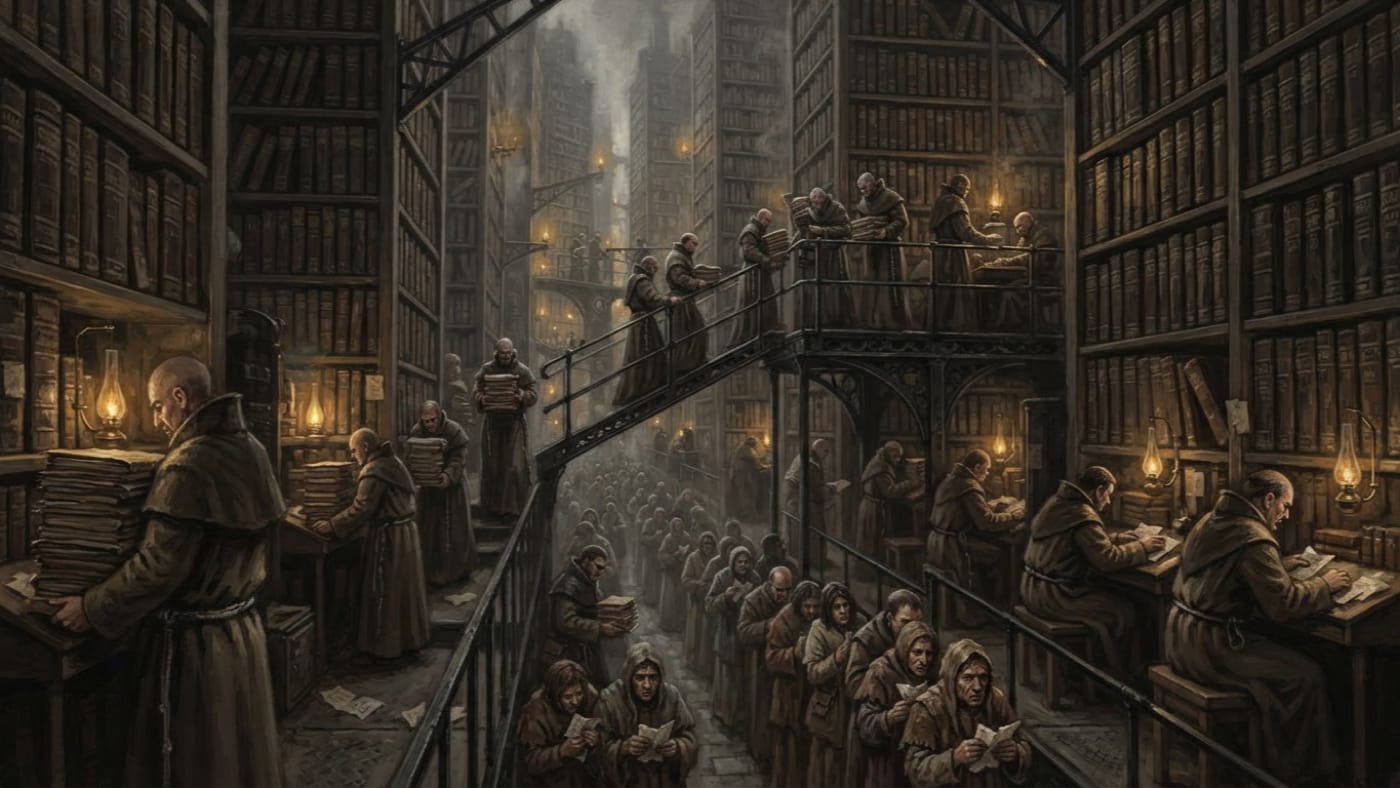
The Cloister is a paper labyrinth. Records offices open onto archive-houses, the archive-houses open onto more offices, and the passages between them are shelved so densely with ledgers that a clerk carrying a folio must turn sideways to let a petitioner by. The air is wax, old paper and lamp-oil in about equal parts. It is technically breathable. After one afternoon the lungs file a complaint, and like every other complaint on this terrace, it waits.
The Bureau of Records has never published a survey of its fifth-terrace holdings, and I will not draw one for it. The clerks know the corridors because they walk them, and the petitioners know them because they get lost in them. Those two groups do not compare notes. The Cloister's founding goes undated in every register I have been allowed to read. A building that exists to keep dates has lost its own, and the Bureau does not find this amusing, which is why nobody has corrected it.
Most people arrive carrying a single sheet, the crossing receipt. They came to file it. That this is a small errand is the first thing the Cloister corrects.
#On Passage and the Registered Name
"The body is evidence. The spelling is proof." — Records maxim, Rheinscarp annex
Crossing from one Rheinscarp terrace to the next is a rite, and the rite has three parts: authorized verse, coin and stamp. Coin buys the stair-token, a clipped brass plaque good for exactly one crossing. Verse is recited at the tollhouse window. The stamp records that both were given. Out of that transaction comes the receipt, and the receipt makes its way to the fifth terrace to be reconciled against the register.
The register holds your name as the Bureau spells it. Your ration card holds your name as the Bureau spelled it the last time anyone checked. When the two agree, you eat. When they disagree, you have a discrepancy, and in Rheinscarp a discrepancy is a condition the way consumption is a condition: it spreads, it costs money to treat, and it is often fatal to the poor.
Any failure along the way can produce absence. A stumbled verse, a clipped token rejected as underweight, or a receipt that names a man one vowel off from his ration card may each leave him recorded as absent. Absence can be reversed by confession. Confession in Rheinscarp is a billable service. A man who files his confession in the Cloister and pays for it may recover his standing. While the filing waits, he does not have it.
I have written elsewhere in this Codex that a person walks into the Ledger Cloister to file a crossing receipt and walks out three days later with a confession penalty, a revised name, and the strong sense of having been processed the way a mill processes grain. I stand by the description. The three days are no statutory term. They are only what the waiting usually costs.
A body can stand at a ration window coughing flour and be entirely real to every sense the Creator gave it. The window does not consult the senses. It consults the fifth terrace, and the fifth terrace replies, after due reconciliation, in ink.
#On the Praetor-Registrar and the Quill-Choir
The clerks of the Cloister answer to Praetor-Registrar Ysabeau Kelm, who holds the Rheinscarp annex of the Bureau of Records and, with it, the names. The annex was installed on the cliff in A.S. 92, two years after the Concordat of Strasbourg gave the Synod its formal constitution in A.S. 90. That later date marks the arrival of the annex on the cliff. It is not the Cloister's foundation stone, and it is not the date of Kelm's appointment. I do not have the first. The second the annex has not offered.
The Registry Choir, which the terraces call the Quill-Choir, works in the Cloister and chants at Kelm's tempo. Its declared purpose is to chant the ledger true. Its methods are redaction and errata. Its talent, which everyone discusses and nobody files, is correcting the spelling of a rival's name until the man in the register and the man on the ration card are, as far as Records is concerned, two different men, and the ration card is useful only as a keepsake.
Some distinctions are required, because the Cloister does several different things to a name, and the petitioners in the corridors confuse them at their own expense:
- Correction is ordinary work. It mends a clerk's slip, and most of the time it is exactly what it says it is.
- Punitive misspelling is correction aimed at someone. Nothing in it is unlawful. The register says only what it now says.
- Absence follows a failed rite or an unreconciled discrepancy. It is grave, and it can be undone by confession, at a price.
- Administrative dissolution is the Praetor-Registrar's last resort. Black grid lines are drawn across the entry, and the subject is left present but annihilated: the name can still be read, and the standing is gone. In Rheinscarp, her last resort comes around with suspicious frequency.
The names do not stand alone. Cantor-Marshal Hrodric Venn keeps the bell-hours and time-credits, and a name that fails to match on the fifth terrace cannot draw its hours from the eighth. Broker-Saintsman Damas Rohe keeps the Ash Exchange, whose dust futures and cremains vaults depend on knowing exactly whose dust is whose. Kelm administers neither of these. Both depend on her spelling.
#On the Three Pages of Grain
"Variance" is the official word for "someone stole your food." — Common knowledge, Rheinscarp
In A.S. 198, the year 1908 by the common reckoning, one grain shipment was credited to two terraces. The Mill-Crown and the Widowlight Quarter each received it on paper. Each ledger showed delivery and carried authentic stamps. Both terraces went hungry.
The Bureau of Records sent auditors. They found the stamps genuine, the entries genuine and the grain genuine. It had been counted twice, allocated twice and delivered once. The missing half existed only in the Ledger Cloister's files, where it took up three pages of immaculate penmanship and no warehouse space at all.
Forty-one people died.
The Bureau of Tithes reviewed the matter and called it a variance. The Bureau of Doctrine issued its own classification of the deaths, which it has since revised:
The death toll was initially reported as "within acceptable seasonal parameters."
The Bureau of Doctrine, having reviewed the parish burial records, revises the classification to "administrative incident, non-recurring." The variance stands as the Bureau of Tithes filed it. The three pages remain in the Ledger Cloister, accurate in every stamp.
The Bureau has not said whose hand wrote those three pages, and I will not supply a hand it has not named. Nor has the annex certified whether the present Praetor-Registrar already held her seal that season. The stamp is genuine. It is as honest about its author as it is about the grain.
The famine exposed what the terraces already suspected. The mills and Records share an absence quota: every quarter, some portion of the population is corrected out of the ration count, so that grain which cannot feed every registered mouth can be made to balance on paper. The Bureau does not publish the portion. The street says one in forty. That figure is a street figure, and I enter it here as one.
#On the Unattended Quill and the Present Register
Somewhere in the Cloister's paper labyrinth there is a room where quills write without hands. Clerks of the annex attest to it. I have not been shown the room or the pages, and the Bureau has not published what the quills write or about whom. People do vanish in the Cloister's filing. Whether they vanish in that room, or because of it, is a question nobody has answered.
Rheinscarp knows the general phenomenon. Certain tollhouse booths on the lower crossings produce perfect entries on night shifts when no clerk is on duty. Coins disappear from their trays, and the people named in those phantom entries go on to misfortune. The Cloister's room may keep the same habits or entirely different ones. I decline to give it the booths' record on assumption. Self-writing instruments have been reported at other Synodal crossings as well, and the Bureau has not identified a cause at any of them. It has not identified one here either.
The present quarrel is old and still unsettled. Hunger-waiver advocates in the Bureau of Mercy argue that a starving person should be fed whatever their stamp status. The Tribunal of Stairs, supported by Tithes, holds that toll sanctity is doctrinal and that doctrine does not accept hunger as a counter-argument. An absent person may appeal to the Tribunal on the High Step. To get there, they must climb four terraces above the Cloister, presenting verse, coin and stamp at every window, under a standing they no longer have. Every failed crossing is recorded as a fresh absence and sent down to the fifth terrace for reconciliation.
The Cloister reconciles it. The wax holds, the lamps burn their quota, and the clerks turn sideways in the corridors to let the petitioners pass.