
#On the Seventh Terrace
"Grief spoils. Ash keeps." — Brokers' proverb, Ash Exchange gallery. It appears in no approved collection.
The Ash Exchange sits on the seventh of Rheinscarp's Nine Steps. Below it lies the lamp-smoke of the Widowlight Quarter and above it the coal breath of the Cantor Foundries, so a widow coming off her oil shift has one toll-stair to climb before she learns what her husband is worth. The architects understood proximity. Grief sits below and bells above. Between them runs a long gallery cut into the cliff, where the price of the dead is chalked on slate and wiped clean at every bell.
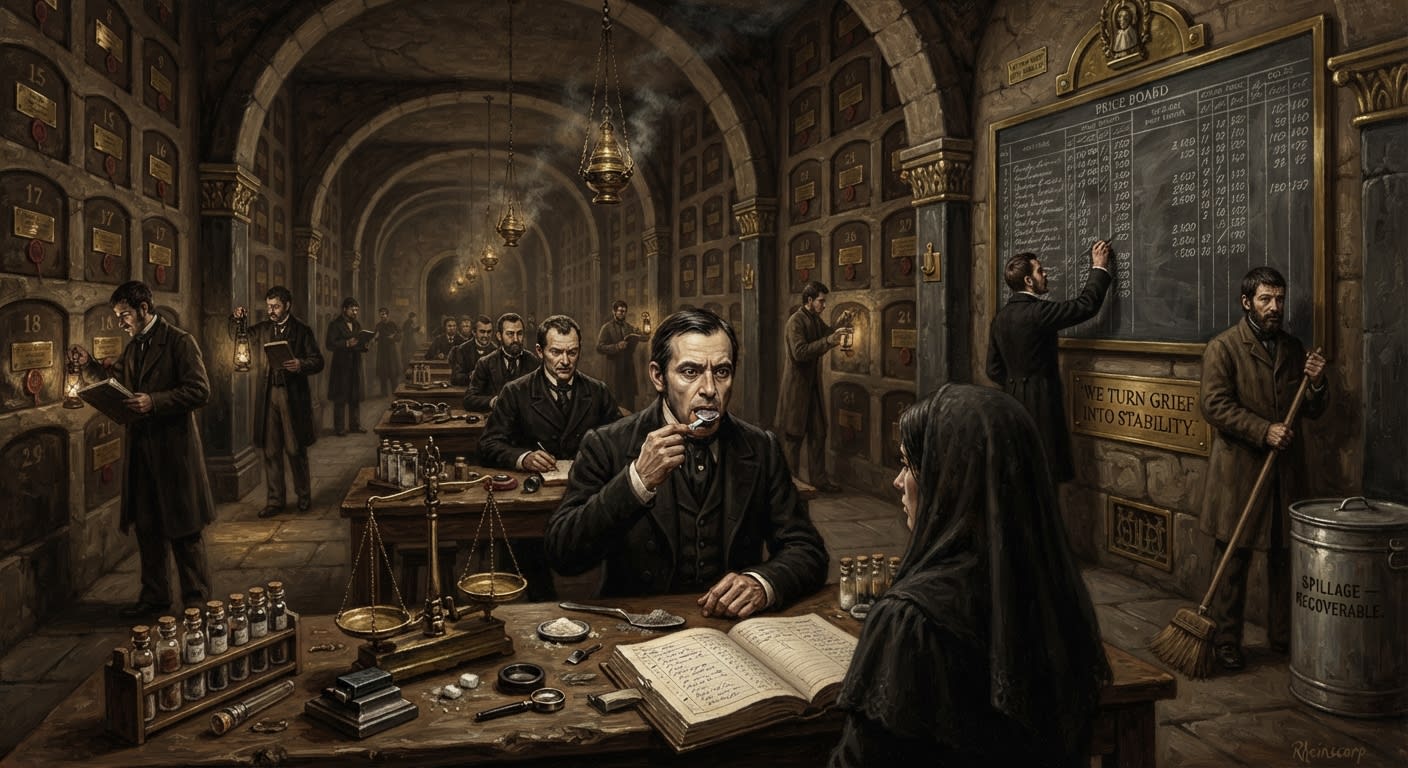
The gallery smells of chalk and cold incense. The chalk comes from the price boards. The incense comes from brass censers hung at the vault mouths. The brokers say they are lit for reverence. The porters say they are kept burning because ash in quantity gives off an odour that reverence cannot survive without help. Dark oak weighing desks line the gallery. Each holds a scale, a loupe, a notary's press, and a rack of stoppered vials in which the departed wait to be priced like tea. Behind the desks the cremains vaults run back into the rock along numbered corridors, and brokers in black frock coats walk them with lamps and ledgers. The brokers smile all the time. On the seventh terrace a smile means the price is final, and I have never seen a more cheerful district.
The Exchange's public motto, lettered in gilt above the Widowlight stair, reads: We turn grief into stability. In the gallery below it a porter stands with a broom and a sealed bin marked SPILLAGE — RECOVERABLE.
#On Saint Pelagia, Insofar as She Is Available
The Exchange trades under the patronage of Saint Pelagia, and that is where my knowledge of her ends. It is where everyone's ends. The Bureau of Hagiography keeps a file under her name, and I requested it. The file refers the reader to the Exchange's charter. The charter refers the reader back to the Hagiography file. Two offices closed that circle with a single stamp, and neither has reopened it since.
At the opening bell the brokers invoke her and touch the small wax medallions fixed to their desks. When I asked one of them who she had been, he answered that she was paid up. I have heard worse theology from better-dressed men.
Bureau of Tithes circulars describe the Ash Exchange of Saint Pelagia as "a mourning exchange for the stabilisation of bereaved households."
Corrected. The Ash Exchange is a collateral market. Its instruments are secured against the dead, underwritten by the living, and enforced on both. The bereaved are stabilised the way a debtor's cot is stabilised: bolted to the floor.
#On Dust as Tender
A cremains vault is custody. The family pays for a numbered niche and a notarised seal, and so long as the fees are paid, their dead stay theirs. When the fees lapse, the dead become the Exchange's.
A saint-share is a fractional claim on a vault lot certified as relic-grade: the ash of the devout, the martyred, the conveniently edifying. Saint-shares rise when a deceased's cause is whispered about in Hagiography and fall when Purity asks questions. They are the only security in the Church whose value depends on the posthumous conduct of its collateral.
A dust future is a contract for ash not yet delivered. A dust mortgage lets a household borrow against the eventual cremains of one of its living members. Burial-precredit is the humblest instrument and the cruellest: grain today against ashes tomorrow. It is signed at the Widowlight stair by women who have already buried one husband and have calculated, correctly, that their children eat this week only if they pledge themselves.
The Bureau of Tithes holds that consecrated remains are lawful tender. That follows, Tithes argues, from the doctrine that nothing the Creator made may lie idle. The Bureau of Mercy holds that this is obscene, and it files that objection each quarter on forms the Exchange prints. Tithes eats. Mercy weeps. Both draw a salary from the same terrace.
#On Uncle Rohe
Three powers govern Rheinscarp. Praetor-Registrar Ysabeau Kelm of the Bureau of Records owns your name. Cantor-Marshal Hrodric Venn owns your hours. Broker-Saintsman Damas Rohe, called "Uncle" by the brokers and by nobody else, owns the one certainty the other two cannot revoke. Kelm can correct you out of existence and Venn can schedule you into starvation. Both are working for Rohe without meaning to.
He is a patient man. He wears a plain coat on the gallery floor, remembers the names of the widows' children, and has been known to forgive a vault fee for a season at a rate of interest nobody has survived long enough to calculate. The brokers love him the way a ledger loves a sum that reconciles. He never raises his voice. Nothing in his trade has ever hurried.
His fear, which the terrace knows and never says aloud, is becoming currency while he is still alive. He is said to have forbidden any broker to write a future on him. That prohibition tells you everything about how well he knows his brokers.
#On Appraisal, Taste, and Vaults
Remains reach the Exchange by a fixed road. The family petitions at the Widowlight stair. A licensed Dead-Goods Tariffer invokes Saint Morin of the Sealed Mouth, classifies the remains by category and provenance, and issues an ash transfer writ. The writ and the urn climb one terrace. A broker then breaks the seal and performs the appraisal.
The appraisal includes a taste. Hearth-ash, chalk, ground horse-bone and bakehouse sweepings have all been presented at the desks as somebody's grandmother, and the Exchange trusts no instrument over the tongue. The broker takes a pinch on a silver spatula, places it on his tongue, and holds it there while he looks at the family, never at the ash. Then he swallows, rinses from a pewter cup, and names a figure to three decimal places. Senior brokers claim they can tell a starved man's ash from a fed one. I believe them. I was offered the spatula as a courtesy to the Bureau and declined it. The broker smiled, and I understood that my refusal had also been priced.
Once assayed, the ash goes into a numbered niche, and the niche goes onto the board. The lower corridors are the oldest. Porters dislike them after the curfew bell. They report settling in the niches, cold that the censers cannot touch, and in the mornings, fine ash lying on the corridor floor in lines that look very like handwriting. The porters sweep it into the SPILLAGE bin before the brokers arrive. The Exchange files these reports as ventilation variance. That phrase is borrowed, with no acknowledgement, from the Records language used after the First Ossuary Panic, and I respect a thief who steals only from the best.
#On the Scandals
The double-entry famine of A.S. 198 exposed the absence quota, the quarterly practice by which Records and the ration mills correct a share of the living out of the registers so the grain on paper will feed the mouths on paper. The Exchange took no part in the correcting. It only noticed who had been corrected. A person struck from the ration ledger still has a body, and a body has a burial right, and a burial right can be written as precredit before anyone has troubled to die. Absent households came to the Widowlight stair for grain. The Exchange lent it. The collateral was their own absence, notarised.
The dust futures scandal of A.S. 199 followed quite naturally. Auditors found futures trading on the cremains of persons not yet dead, set out in tranches, rated by terrace, and settled on the gallery board between the Silt Year saint-shares and the relic-grade lots. The Exchange's defence was that a future is by definition a claim on something that has not yet occurred. The auditors had no reply to this, because it is true. The matter now sits between the Mercy clerics pressing for hunger waivers and the Tithes and Tribunal axis insisting on the sanctity of the toll. No ruling has come down. The tranches have been renamed.
#On the Present Condition
As of A.S. 201 the Ash Exchange of Saint Pelagia is open, solvent, and indispensable. Rheinscarp's treasury rests on its vault receipts, and its instruments travel the Rhine Corridor to Metz and the ash-credit desks of Cologne. Tithes calls it predatory only in private correspondence. Mercy calls it predatory in public and draws its rations through it.
This year the Exchange bought the rights to three drowned cemeteries along the Rhine and has declined to explain why. The graves are under water. Nothing in them can be tasted, weighed, sealed or listed. Uncle Rohe does not buy what he cannot price, so either he has priced them or he has found a use for them that does not need a scale. I cannot tell you which of those possibilities disturbs me more.
TITHES LIAISON NOTE — A.S. 201, SEALED Acquisition: three submerged burial grounds, Rhine bank, names withheld at buyer's request. Stated purpose: "Forward custody." Assessor query: custody of what, if remains are unrecoverable? Broker response: "████████████████████████." Assessor disposition: query withdrawn; assessor transferred to Widowlight audit.
The chalk goes up at every bell. The widows climb one stair. The brokers smile.