
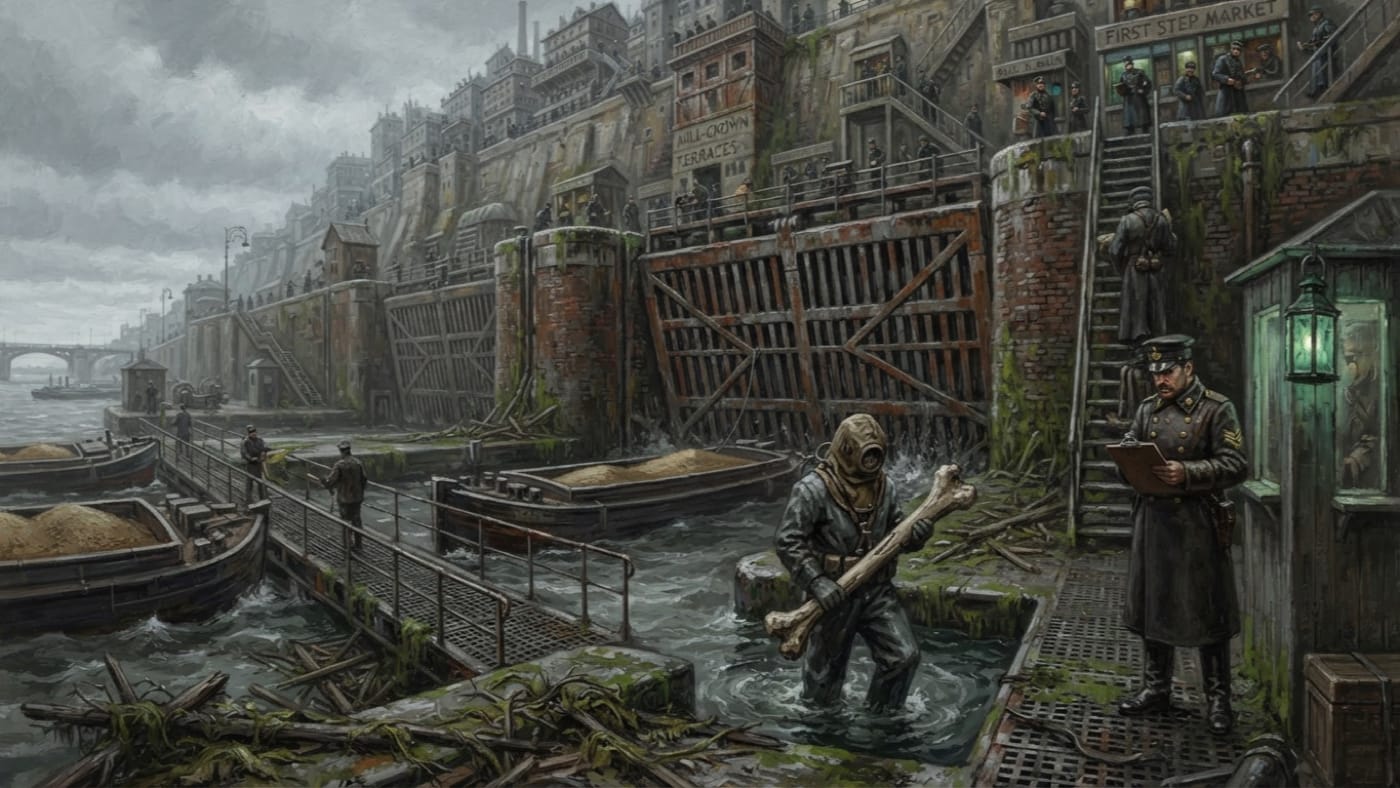
#On the River Entrance
"We keep the river from eating you." — Public declaration of the Lockmouth Brotherhood
Everything that feeds Rheinscarp comes by water, and the iron of Lockmouth has to let it in first. The Works hold the second shelf of the cliff. Below them are the barge yards of the Sump Docks. Above them are the stair-token booths of the First Step Market. Between the two stand canalized inlet locks and harbor-control grates so large that a hauler at their foot has to lean back to find where the rust ends.
The building materials are rust-iron, wet brick and bone-lime grout. Salvaged-glass lock-lanterns hang along the work edge, and no two panes are the same green, because the glass came from wherever glass could be had. The air smells of wet iron and crushed algae. Silt covers everything below the tide-mark and most things above it.
Barges wait in the inlet for the grates to lift, with the grain still in them. Up on the Mill-Crown Terraces the ration mills wait for that grain. The convoys Rheinscarp schedules for the Line wait on the mills. If a barge is held at Lockmouth for one bell, someone is inconvenienced. If it is held for a day, the delay shows up in a ration figure, and in this city a ration figure is a list of who will eat.
#On the Old Works and the Silt Year
"The river was free until they taught it to count." — Street saying, Rheinscarp; entered here as rhetoric, not as history
The locks are older than the Church's public order on the Rhine. Rationalist engineers canalized the inlet. A secular tollhouse at the cliff base took coin, and river mills ground grain for whoever paid. No surviving document gives the year the first grate was hung, and the Bureau will not invent one to flatter a heretic's masonry. The street saying gets its particulars wrong, because barges paid the secular tollhouse long before any terrace demanded a verse. It gets the tone right, which is why people still say it.
The Sundering of 1 November A.S. 45 (1755 CE) drove refugees west. It also gave the Rhine a new job as a supply road for entrenchments that would take two more decades to become defensible. Lockmouth admitted more barges than before, and admitted them more slowly.
Then came the Silt Year. In the spring of A.S. 78 (1788 CE), by the reckoning of the Bureau of Records, floodwater surged through the Lockmouth grates and drowned the lower terraces. Four thousand people died. The record establishes the water, the grates and the count. It does not establish a breach, a sabotaged gate or a negligent engineer, and the Codex will not make one up to give the drowned a villain. The survivors climbed. A river-warden recorded only as Warden K. enacted the first stair-toll regime. The first law of upward Rheinscarp was therefore written by someone whose full name the city failed to keep.
The Codex entry on Rheinscarp places the year in which "the first Bureaus received their formal constitutions under the Concordat" at A.S. 92.
The Concordat of Strasbourg and the formal Synod date to A.S. 90 (1800 CE). Rheinscarp's local settlement followed in A.S. 92 (1802 CE): the Synod Chapterhouse was consecrated, the Bureau of Tithes installed its liaison, and the Tribunal of Stairs received its charter. These are two separate years and both stand. The river has kept count of fewer things than the Ledger and confused none of them.
#On the Brotherhood and the Hours
"Tolls are mercy; stairs are discipline." — Official formula of the city
Two trades work Lockmouth, and the upper terraces would prefer not to smell either of them. Barge haulers drag hulls in and out of the inlet. Lock-grate divers go under the water. The divers wear tar coats, which keep out the cold for the first minutes and nothing after that. Their job is to clear the grates of silt, timber, weed and whatever else the Rhine sends without a manifest. The undertow at the grates kills divers who misjudge it, and on a bad day it kills some who judge it correctly. Silt-borne fever takes others. The street calls a diver who died at Lockmouth a "grate-saint." No Bureau has yet agreed to canonize the category.
Divers are paid in ration priority, which means a place in the queue for bread, held through a time-credit assignment. Throughout the processional storehouses of the Synod, the Bell-Accountants convert convoy bell-hours into ration priority. Rheinscarp performs the same conversion at the waterline, using wet men. If a diver misses a time-credit window, the diver's priority collapses whatever the diver did that morning. The undertow does not keep bell-hours. The ledger does.
The Lockmouth Brotherhood is the union of these trades and their militia. It is based in the docks and the lockworks. It holds divers, keys and river maps. Officially, it says it keeps the river from eating you. Its actual aim is to control the lock schedules and to take a share of the time-credits that pass through them. Its instruments are strikes, threats of sabotage and partnerships with smugglers. The Codex lists these as instruments and does not catalogue them as deeds. A key does not have to be turned to be worth something. Its owner only has to be seen standing near the lock.
Lockmouth runs two systems of permission, and the newcomer should not confuse them. The Lockmouth cargo seal clears a hull and its cargo at the river. It does not carry anyone up a single step. Above the locks, toll-provosts in brass sashes and clerks in gray wax demand verse, coin and stamp at every terrace crossing, and every crossing is paid again. The Brotherhood does not enforce the stairs, and the provosts do not dive.
Cantor-Marshal Hrodric Venn controls bell-hours, time-credits and convoy logistics, so every barge's schedule falls within his concern. The keys that open the grates belong to the Brotherhood. I have seen no document that places either beneath the other. Ysabeau Kelm owns the names of those who arrive, and Damas Rohe will in time own whatever remains of them. The Synod Chapterhouse holds formal authority over all of these people, and that authority is formally complete.
#On the Drowned and Their Registration
Every flood season brings the Lock Blessings. The grates are anointed, and the divers recite the names of the drowned at the iron that drowned them. At Flood-Remembrance the names are read aloud again and the grates are wrapped in black cloth. Neither observance has a fixed date in any record I have consulted, because both follow the water.
Bones jam the grates. When that happens the mechanism stops, a diver goes down, and something comes up.
I toured the Works in A.S. 197. A diver surfaced holding a bone that was not in the ledger. The foreman stamped it, filed it and went back to lunch. I record the order of operations because it was correct. The bone has not been identified. This entry does not identify it, and any reader who claims to know whose it was can submit that claim to the Bureau of Records in triplicate.
Notice what the river keeps. At the Blessing it gives the divers names without bones. At the grates it gives the clerks bones without names. Nobody has reconciled the two columns. During the Blessing the divers recite from a list. The bone went into a drawer.
The grates groan when they shift. Locals say Lockmouth sounds like an animal. The Bureau of Engineering says it sounds like iron under stress. The Bureau of Doctrine permits both descriptions and has not authorized a third.
#On the Present Condition
In A.S. 201 Lockmouth is operational and the river is high on schedule. Flood season returns every year, and with it the Blessings, the black cloth, the strike talk on the docks and the Brotherhood's annual reminder of what a closed grate costs a terrace. The garrison's defensive doctrine treats the lock-grates as kill-zones. The divers treat them that way in peacetime and are not consulted about the doctrine.
The city's public plans include expanding Lockmouth and adding a tenth Step. Both are proposals. Rheinscarp has nine terraces, and the Works have the grates they have.
The double-entry famine of A.S. 198 began with grain that arrived the way all Rheinscarp's grain arrives, up the river and through these locks. The auditors located the fault five terraces higher, in the Ledger Cloister, and recorded no fault at Lockmouth. The dust-futures scandal of A.S. 199 belongs to the Ash Exchange and stays there. The water has no interest in either.
Barges still wait in the inlet. Divers still go down in tar coats with their priority riding on the bell. Venn's office keeps the schedule, the Brotherhood keeps the keys, and the Chapterhouse keeps formal authority over both.