
#On the Rosary's Station
"Keep the city afloat." — Public face of the Chainwright Rosary, as entered in the Flotilla's local survey
The Chainwright Rosary is the chainwrights' guild of the Black Sea Reliquary Flotilla, the drifting city that sailors call Saints Afloat and the Chapterhouse calls, in its correspondence, a jurisdiction. The Flotilla rides the Black Sea between the Bosphorus approaches below Bastion-Constantinople and the deltas of the eastern shore. The crews call their organisation a union. The Bureau prefers guild, because a guild can be audited and a union can only be endured. The Rosary is stationed at the Grand Lash. The survey lists its resources as chains, tools and crews, in that order, which I take to be the order of their replacement cost. Its chief is Chainmaster Olt, called Rosary-Iron for hands that are more callus than flesh and for his habit of counting links as other men count beads.
Its public purpose is to keep the city afloat. The survey records its other purpose with unusual candour: to turn the control of lashings into sovereignty.
Formal command belongs to the Maritime Reliquary Chapterhouse under Admiral-Prior Veyra Salt-Crown. Her signature appears on every docking permit and every relic writ. Each of those documents assumes a deck that is still attached to something. The Rosary sees to the attachment.
Readers from the Aegean should be corrected at once. Thessaloniki has Chainwrights of its own, the Custodians of the Chain, who keep the harbour-chains of the Elder and Younger Towers. They share a trade-name with the Rosary and a respect for iron. No record I have read joins the two by common command, shared constitution or branch arrangement. A chainwright of Thessaloniki keeps a gate. A chainwright of Saints Afloat keeps a city that never stays where he left it.
#On the Keeping of the Grand Lash
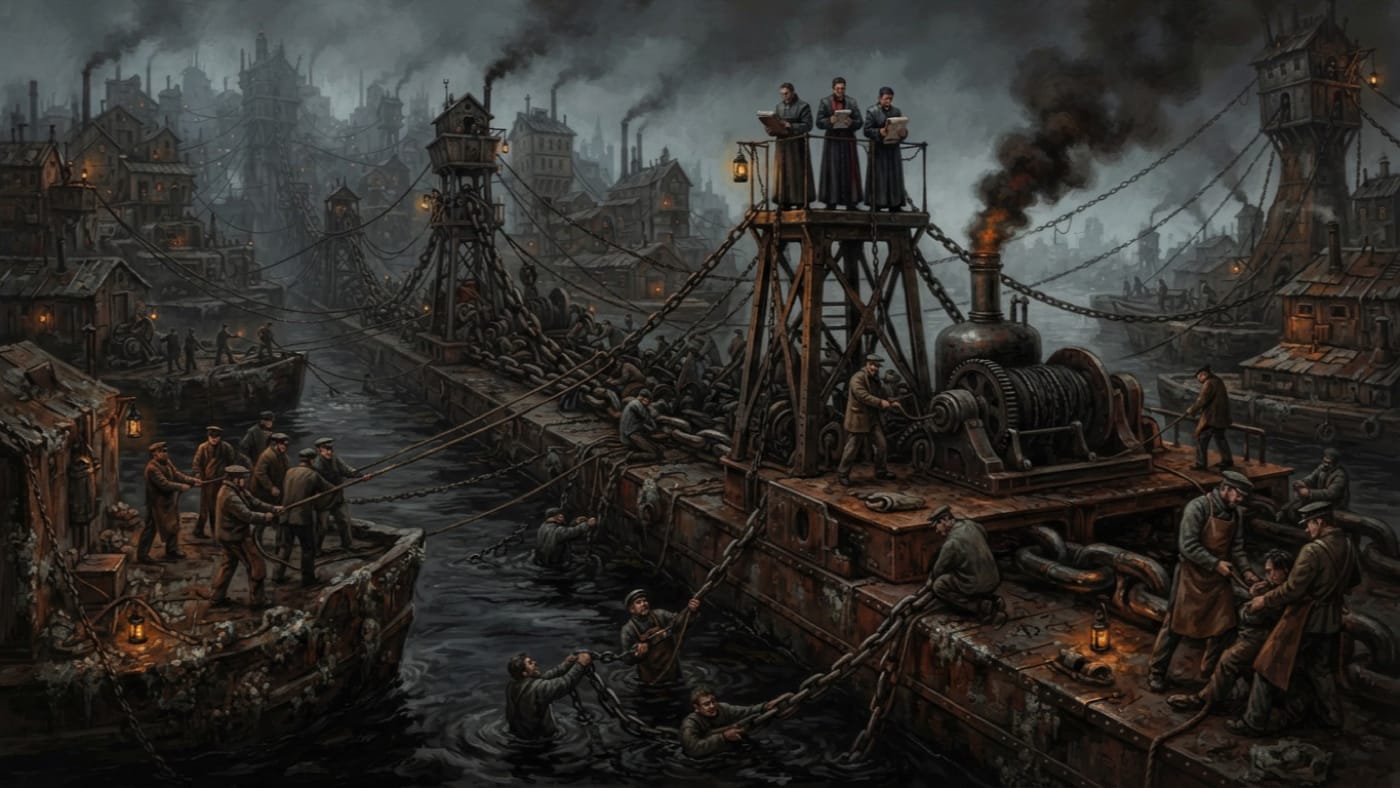
The Grand Lash is the main chain-spine of Saints Afloat. Iron watch-towers stand on pontoon bases along its length, every district radiates from it, and it smells of tar, rust and wet rope. Together with the outer chain gate it makes up the Flotilla's single bottleneck. If either fails, the city fragments or it starves. The survey does not say which is preferable.
The Rosary's work falls under four heads: inspection, maintenance, storm re-lashing and cut-loose work. Inspection decides which link is replaced and which is merely noted. Maintenance decides which barge meets a squall with sound iron at its side. Re-lashing decides, once the squall has passed, which barge is hauled back beside which neighbour. Cut-loose work decides which barge is not hauled back at all.
Each of the four is a craft, and each has its consequence in the Ledger. A storm that rearranges the barges rearranges the parishes with them. Tithe schedules, debt jurisdictions, rights of passage and access to drywater all move with the parishes. The Knot-Scribes redraw the parish map in vinegar ink. Seal-Justice Miran Kest and the Drift Court decide which parish inherits which obligation. The Rosary holds no seat on that tribunal and seals no judgement. It only supplies, in chain, the facts the tribunal will afterwards adjudicate. The signal grid of the Bell Choir of Hymnworks runs along the same iron, so wherever the Lash parts, the bell-relay parts with it.
Hidden cut-points along the Lash can sever an entire barge from the Flotilla in nine seconds. Their existence is public record. Their positions are known to the Rosary and to the Creator, and nobody has invited the Bureau to make a third. I enter no location here and no method. A reader who wants either may apply to the sea.
The Flotilla enforces one distinction with its life. Separating a single barge is a measure of emergency, mercy or punishment, depending on who is standing on the deck. Cutting the Grand Lash itself is one of the Flotilla's few red lines, along with forging a saint's seal and moving a relic without witness tones.
#On the Petitions and the Stoppages
Three times the Rosary has petitioned the Maritime Reliquary Chapterhouse for an independent charter, and three times the Chapterhouse has refused. The register gives no dates for the petitions, and it holds no text or terms. I have none to supply. A guild that asks three times for the same thing is in no confusion about what it wants.
Chainwright Rosary granted charter; lashings standardized into doctrine.
This line appears in an inherited local history of the Flotilla. It carries no charter text, terms, date or seal, and it does not distinguish a limited guild grant from the independence the Rosary has petitioned for. The Chapterhouse record lists three petitions for an independent charter and three denials. The Bureau of Records enters the grant as an unsupported inherited claim. It is not a present legal fact, and nothing in this entry should be read as recording its revocation.
The survey lists the Rosary's methods without commentary, and I follow its example. They are work stoppages, cut-loose incidents for which the source puts the word "accidental" in inverted commas, and anchor maps the guild keeps to itself. The recorded trigger is a tithe increase. The record does not say which increase, of what amount, answered by which stoppage, or whether anything was conceded. I decline to fill that silence with plausible furniture.
According to the published accounts, after each refusal the next storm showed that certain barges had been lashed with unusual care and others with unusual carelessness. That association stands in the record. Suspicion of retaliation stands in the corridors of Seal Row. No finding stands in the Drift Court. There is no confession, no named victim, and no adjudicated offence against the Rosary or its Chainmaster. A Hieromnemon who certifies an accusation the tribunal has not heard is a pamphleteer with a better seal.
The leverage needs no gloss. Salt-Crown can command anything the chain permits. The Rosary can withhold anything the law does not compel. Kest invoices both.
#On the Crews in the Water
"Storms move wood; courts move lives." — Proverb of the Flotilla, unattributed
The guild that petitions for sovereignty is staffed in large part by people who have surrendered their own names. Many chain crews are debt-bonded labourers who traded name and labour for a dry berth. I hold no record showing that every crewman signed the same terms, and I do not pretend otherwise.
The Re-Lashing Mass follows every storm. Chaplains sing hymns of structural integrity from the bell-towers while the crews stand in black water and haul the barges back together by lantern-light. The Bureau of Rites counts the Mass among the Flotilla's sacraments. The Bureau of Mercy calls the shifts "intensive." The crews call them other things, which the Bureau of Doctrine does not permit in print. Crush injuries are the leading cause of death on the Grand Lash. Drowning and hypothermia come next, and after them the entry the roll-calls make only as an absence. While the spine lies open the bell-grid lies in pieces, and the things under the barges know the hour of the Mass as well as any chaplain does. The Great Deceiver has never waited for an invitation to a liturgy.
The crews are paid in prayer beads. They are exempt from the chain-maintenance tithe that falls on every other soul aboard. The Bureau of Tithes calls this a concession. The crews call it the one courtesy the Flotilla has ever shown them. No rate is entered. Nothing in the record lets me certify that the Chainmaster profits from the arrangement, and I have not lowered the standard of certification to oblige the gossip of the Market of Anchors.
Maise Knot-Hand, another named Chainwright, counts by scars. Her office, her seniority and her relation to Olt are unrecorded, and I leave her as the record leaves her. The Rosary keeps two tallies of the same labour. One is kept in links and the other in skin.
At the spring Chain Blessing the Grand Lash is anointed with holy oil and the crews receive half a day's rest. No record I hold fixes the date. The debts go on accruing through the afternoon.
#On the Present Arrangement
As of A.S. 201, reparishings that once came with the seasons come every month. Each storm puts more of the city into the water and more work into the Rosary's hands. Each Re-Lashing leaves the Chapterhouse more dependent on crews who answer to the guild before they answer to the Admiral-Prior. The Flotilla registered two hundred and thirty-seven hulls at the A.S. 200 census. That figure belongs to the Flotilla. The Rosary's own strength is not entered, and the Bureau does not count a guild's members by counting the boats they hold together.
The Bureau of Engineering calls the shifting of the barges a structural stress response. The Bureau of Rites calls it providential reconfiguration. The Rosary says the sea is choosing. These are three institutional descriptions of a single event, and none of them proves its mechanism. The Engineers would add that the number is the number. The Rosary would reply that the number changes after every storm and that somebody has to go into the water to count it again. In Strasbourg's files the Rosary appears as one party to that quarrel and as nothing more. It is no department of the Foundry Archive, and the Foundry Archive has never claimed it.
The guild's position for the present year can be stated briefly. It is not chartered, because the Chapterhouse has said so three times. It cannot be dispensed with, because the city hangs from the iron it keeps. It is watched by the Admiral-Prior, the Drift Court and the Choir, and all three do their watching from barges the Rosary maintains.