
#On the Great Reparishing
In A.S. 93, 1803 by the old reckoning, a storm on the Black Sea took fourteen barges of the Black Sea Reliquary Flotilla out of the parishes they belonged to and left them in other parishes. Seven jurisdictions were affected. For nine days afterward the Flotilla had no functioning court. When a court returned, it was a new one: the Drift Tribunal, which the chain crews of my own century call the Drift Court and which the Bureau of War has spent most of the intervening century calling its own.
The Ledger gives me those three figures and very little else. Fourteen, seven and nine are good, hard numbers, the kind an archivist can stand on. Beyond them the documentary record is thin. My account is therefore assembled from the figures, from what the Flotilla's own mechanics make unavoidable, and from the plain fact that a later Bureau tried to rewrite the year.
#On a Parish Made of Hulls
The Flotilla's charter was filed in A.S. 72, twenty-seven years after the Sundering closed the roads to anything carrying a saint. Someone requisitioned seventeen merchant hulls in a harbour the Ledger declines to name, chained them gunwale to gunwale, loaded them with the bones of four hundred saints, and put them to sea. By A.S. 80 there were forty vessels. After that the record stops counting, at least for my purposes, and it does not resume until long after the storm. I cannot tell you how many hulls rode the chain in 93, and I will not borrow a figure from a later census to make the paragraph look tidier.
The charter-writers of 72 wrote under the authority of the Church as it then stood: provisional, wartime and still growing its offices. The formal Synod came only with the Concordat of Strasbourg in A.S. 90, three years before the storm. Any document that describes the Flotilla's founding in later Synodal titles is describing it in hindsight.
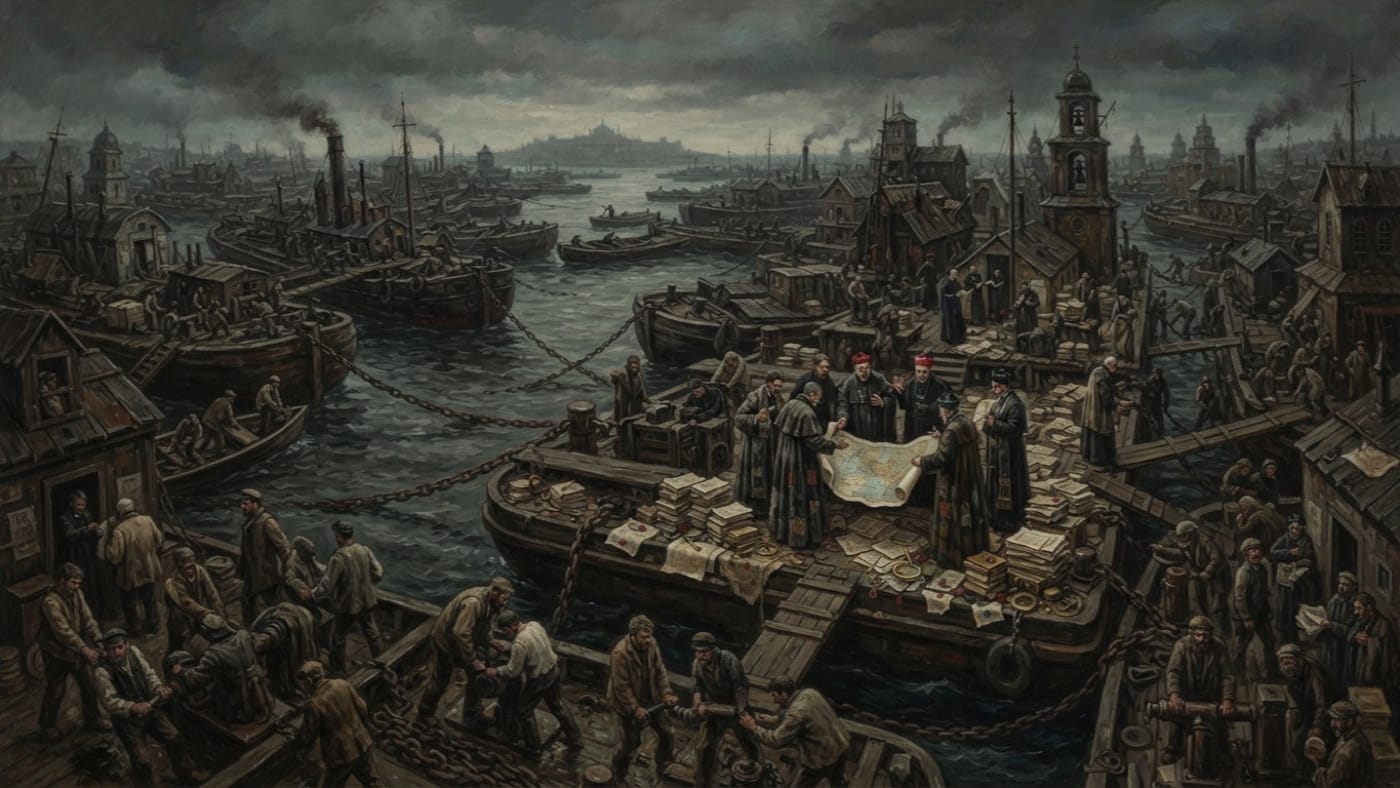
The arrangement was simple to describe and miserable to live on. Chapel-barges, ossuary skiffs and bell-towers built on hulls were lashed into rings around a central bell-keep. Each hull rode a particular chain. The chain placed it in a district, and the district placed it under a parish. That parish held its tithe roll, heard its confessions, kept its debts and supplied the bailiff who collected them.
So jurisdiction on the Flotilla was a matter of position. A man's obligations were fixed by where his barge lay in the lashing, whatever the name on his papers said. On land, the parish is the ground under the church. On the Flotilla it is an address, and the sea can change addresses.
#On the Storm
The surviving record describes the storm only by what it did. It has no duration, no wind-strength, no compass bearing and no hour of onset. I will not add any, and the Bureau of Doctrine has never assigned it a cause beyond weather. I am not authorised to improve upon the weather.
The mechanism, by contrast, is known, because it has happened in every decade since. Squall-load comes onto the lashings. Chain takes the strain until a link or a shackle or a rotten bollard gives way. Then the hulls drift apart, swing around, strike one another and spread into open water. Between the barges the undertow pulls at anything that falls. The decks are tarred timber made slick with brine. Iron chain under tension does not care whose hand is on it.
When the weather had passed, fourteen barges were lying in the wrong places. That figure counts the hulls that were moved. It is not a tally of the sunk. The record says nothing about the drowned, and I decline to read that silence as zero. A storm strong enough to tear fourteen hulls from their chains did not do it gently.
Then the chain crews went into the water, as they always have, to haul the iron back. In my century this work is done under the Re-Lashing Mass, with chaplains singing from the bell-towers while the crews take crush injuries below. No record tells me what liturgy, if any, accompanied the work in 93. The hulls came back into the lashing, though not to their old positions. Timber can be hauled back. The obligations attached to it were another matter.
#On the Nine Days
Nine days without a court is a narrower thing than nine days without law. Nothing in the record says that worship stopped, that the bells went silent, or that the ledgers were abandoned. It does not say that order collapsed or that debts were forgiven. I will not stage a riot for the reader's enjoyment. The record says only that for nine days no court on the Flotilla could rule, and that was bad enough.
Look at what a reparishing does to a debt. A creditor in one parish is owed money by a man whose barge now rides another parish's chain. Neither parish's bailiff can be sure which of them has the right to collect. A tithe falls due to the parish that held the chapel last week, while the parish that holds it this week demands the same sum. A berth was rented under one parish's rules and is now lived in under another's. A confession was stamped by a chaplain whose authority may or may not still reach the barge the penitent sleeps on. Any of these questions can be answered, but only by a court with standing over both parishes. In 93 there was none. Each parish court could rule over its own chain, and the dispute ran across two chains.
So the creditor waited, the tithe went unpaid or was paid twice, and the berth stayed with whoever was sleeping in it. Hulls had come loose before. The Flotilla's own dedicated lore remembers an earlier storm that split the fleet, from which the record has kept no lawsuits. This one left the clergy of seven jurisdictions arguing over a map that had been redrawn while they slept.
#On the Tribunal and Its Charter
The remedy came from the parishes themselves. My own published account of the Flotilla describes the Drift Tribunal as established by spontaneous ecclesiastical consensus after the storm. I stand by every word of that, including the convenient ones. The clergy whose jurisdictions had been scrambled agreed to create a court with authority over all of them. Its purpose was to decide which parish inherits which obligation once the sea has redrawn the map. Its mandate, then and now, is to adjudicate parish debt after storms.
I cannot give you a founding judge, a convenor, a list of signatories, a set of clauses or a building where it first sat, and I will not make them up. "Spontaneous" is the Ledger's word for an agreement nobody can be shown to have proposed.
The Bureau of War came afterward. Its part, as far as the record allows me to tell it, was to stamp the Tribunal's charter after the fact and claim credit in its quarterly report. The stamp is real and the claim is real, but the credit was taken by a Bureau that had done none of the work. The record also leaves the date of War's stamp unstated. Indexing this event under 93 does not prove the surviving charter was sealed in 93. All we can say is that the agreement came first and the ratification came later.
War's version was a good one. In it, a decree from the Bureau created the Tribunal in A.S. 94, and the parishes obeyed. The order of events was reversed, and the year was moved to the one in which War's paperwork caught up with what had already happened.
The Drift Tribunal of the Black Sea Reliquary Flotilla was founded by decree of the Bureau of War in A.S. 94.
The Drift Tribunal was established by ecclesiastical consensus after the Great Reparishing of A.S. 93. The Bureau of War stamped its charter after the fact and claimed the result in its quarterly report. A.S. 94 is the year of the rejected attribution. It is not evidence for the date of the stamp.
The Bureau of Records has filed the correction. The Bureau of War has filed nothing in response. That is how it concedes, and I have learned to accept it.
#On the Inheritance of the Reparishing
What follows describes my own century, A.S. 201. It is not a reconstruction of 93.
The Drift Court now sits on a barge of its own, permanently damp and permanently in session. Its jurisdiction grows after every storm, because every storm produces debts whose parish has drifted away from them. The Chainwright Rosary hauls the hulls back into the lashing. The Knot-Scribes of the Parish Map redraw the district boundaries in vinegar ink before the chains are fully tight. The Bell Choir of Hymnworks restores the signal grid, a practice older than the Bell Codex of A.S. 115 that now governs it. Then the Court assigns every orphaned obligation to its new address. Parish papers, confession receipts, berth tokens and quarantine clearances all depend on that assignment. A storm moves the timber, and the Court decides who pays for it.
None of these offices can be shown in their 93 form. Their purpose was settled during those nine days. The Flotilla now patrols the approaches to Bastion-Constantinople with a court that exists because one storm proved a mobile city could not be governed by a map of fixed parishes. In 93 the clergy of seven jurisdictions recognised the problem and agreed on a remedy. The Bureau of War recognised it afterward, in its quarterly report.