
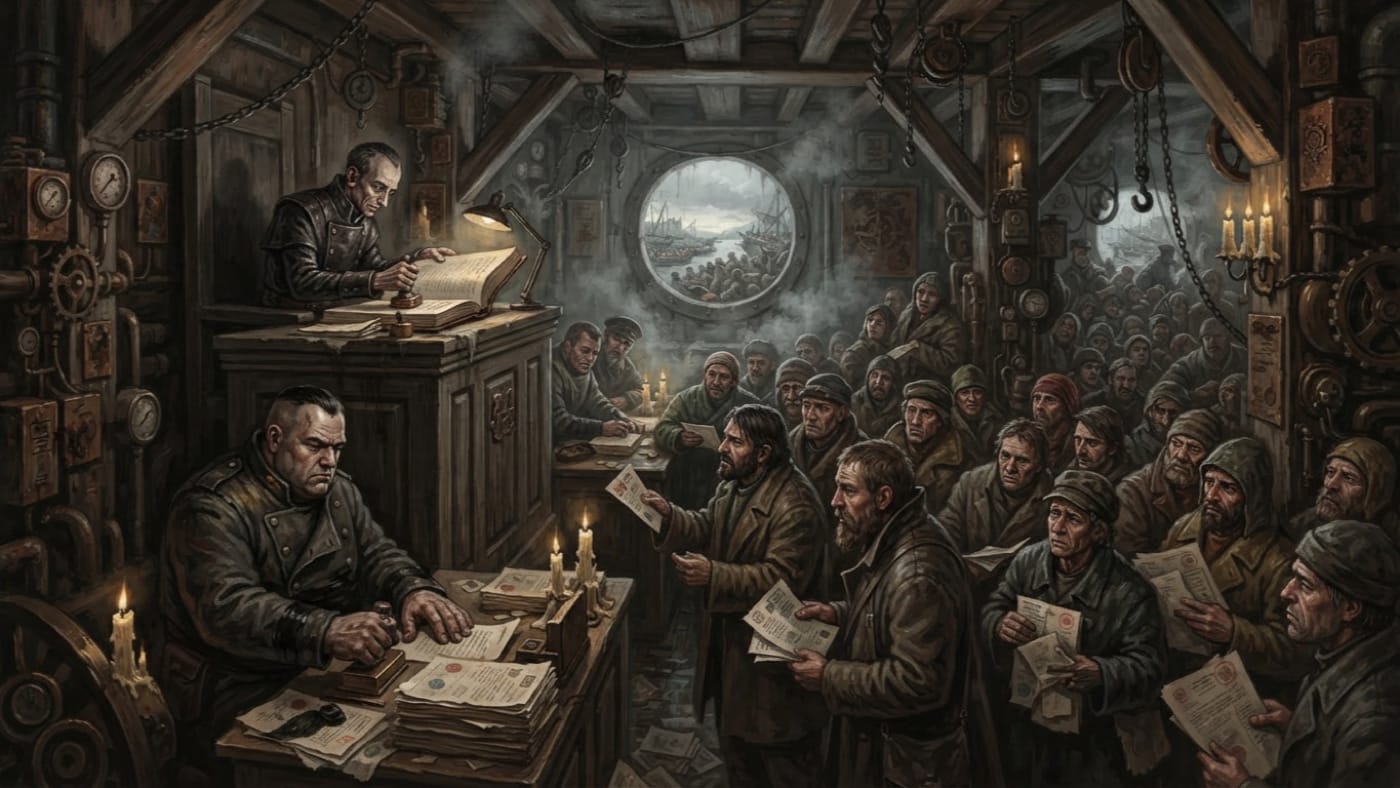
#On the Court's Station and Origin
"Storms move wood; courts move lives." — Flotilla proverb, repeated in every district and claimed by none
The Drift Court is two things, and the Flotilla does not trouble to distinguish them. It is a barge, a single broad hull counted among the nine districts of the Black Sea Reliquary Flotilla. It is permanently damp and permanently occupied, and it smells of wet timber, candle smoke, and the vinegar ink in which the Flotilla writes everything it intends to enforce. It is also the clique that sits aboard that barge. The Chapterhouse's own survey calls it the Drift Tribunal. Petitioners call it the Court of Tides when they wish to sound more resigned than they are. All three names describe one apparatus, and anyone who offers you a fourth is selling something.
I defend its necessity without reservation. A city of chapel-barges and ossuary skiffs, lashed by chain in the Bosphorus approaches below Bastion-Constantinople, cannot keep its geography. A squall parts the lashings and the hulls swing. The Chainwrights haul them back into whatever order the chain will bear. By morning a cabin that has not moved a hand's breadth sits in a different parish, under a different tithe, answerable to a different chaplain. Somebody must say what follows from that, and somebody must say it by noon.
The Flotilla learned this in A.S. 93 (1803 CE), in the Great Reparishing. A single storm redistributed fourteen barges across seven jurisdictions, and the city went nine days without a functioning court. Nine days is a long time for a debt to go unowned. The record calls the remedy spontaneous ecclesiastical consensus. That is the Church's phrase for frightened clergy agreeing on something before anyone senior can forbid it. The Tribunal convened, and the Bureau of War stamped its charter afterward.
Previous editions attributed the founding of the Drift Tribunal to a decree of the Bureau of War in A.S. 94.
The Drift Tribunal arose by ecclesiastical consensus following the Great Reparishing of A.S. 93. The Bureau of War's stamp was applied after the fact. The Bureau of War's quarterly report has been informed of this correction. The quarterly report has not been amended.
That was a hundred and eight years ago. The barge has since grown more crowded and the docket has grown faster. The Chapterhouse's chart of governance lists the Tribunal among its ruling instruments in one column and declines to draw it in the next. Every petitioner on the Flotilla can find it by smell.
#On the Reassignment of Debt
Follow a single debtor through a storm. He goes to sleep in his berth. His berth token names that berth on that barge, and the token is still good in the morning. The Flotilla is scrupulous on this point, because a token that dissolved with every squall would be worthless to the men who speculate in them. His body wakes where it lay down, and his neighbours know his face.
Everything else has moved. The Knot-Scribes of the Parish Map redraw the boundaries in vinegar ink while the Re-Lashing Mass is still being sung over the crews below. When the ink dries, his barge belongs to a parish that did not hold it at sunset. His parish paper records his name, district, tithe status, confession history and quarantine clearance, and it now names a district that no longer contains him. His confession receipt carries the stamp of a chaplain who may now serve elsewhere. Whether that stamp still lets him cross a chain-bridge is a question for the Court. His debts were contracted under one parish's rules and may now be collectible under another's, if they are collectible at all.
The storm moves the wood. The Scribes draw the line. The Court decides what the line means, and the Court's share of that labour is the profitable one.
After a reparishing the docket fills with the usual wreckage. There are debts orphaned by a vanished jurisdiction and contracts whose parish of origin has drifted into someone else's waters. There are marriages split down a district line, and receipts of uncertain authority. Seal-Justice Miran Kest decides which parish inherits which obligation. A creditor whose debtor drifted into a lenient parish petitions to have the debt follow the man. The debtor petitions to have it stay behind with the water. Kest hears both and rules. The published survey of the Flotilla says that he does not sell justice; he sells jurisdiction. I record this without contradicting it, since contradicting it would require evidence the Court has not supplied.
The same survey preserves the standard anecdote. A debtor who had been reparished three times in a single month argued before Kest that he was, in law, three different people. Kest accepted the argument and fined all three.
A judgment against a man without coin does not lapse. It converts into chain labour on the Grand Lash, porter duty on the Quarantine Rafts, shifts on the bell-tuning decks, or forced pilgrimage service. Confiscation follows the berth token where it can. A seized berth passes to a speculator who bought tokens on barges he expected to drift toward the Saintward. Fresh water is rationed by parish, so a change of parish means a change of ration, and the debtor discovers terms he never signed.
#On the Officers and Their Dependencies
Kest is a small man with a clerk's posture and a judge's appetite. The description comes from the Flotilla's published survey. I add only that a clerk's posture comes from bending over ledgers and a judge's appetite from reading them. The Ledger records no birth for him, no appointment and no predecessor. He presides now, and on the Flotilla the Court recognizes no other tense.
Bailiff Sonn carries out what Kest decides. The Chapterhouse's survey gives him one attribute: quiet hands. The Court's officers wear black ink sashes. The bailiffs serve the judgments and take the confiscations, and they keep the seal dies, the cut bronze that makes a page true. A Drift Court writ is folded three times. This is so widely known that the Grey Keel Syndicate folds its own passes twice, on the reasoning that an imitation too faithful deserves the fire.
The Court rules the city's paper. It does not rule the city's iron. Admiral-Prior Veyra Salt-Crown and the Maritime Reliquary Chapterhouse hold the Flotilla's formal government, and her name heads the docking permits whatever Kest writes beneath it. Chainmaster Olt and the Chainwright Rosary decide which barges are lashed and which are cut loose. Kest may rule that a debt follows a barge, but he cannot keep the barge from drifting off. The Knot-Scribes hold the maps and registries, which supply the facts every judgment starts from. The Salt and Ash Office keeps its own power to detain, test and release, and a debtor in quarantine custody belongs to the Wardens before he belongs to the Court. The Bell Choir of Hymnworks controls the signal grid. A petitioner who answers a bell-challenge with the wrong tone never reaches the barge.
That makes five powers in one city. The Court sits where their authority overlaps and charges for the seat.
#On Forged Jurisdiction
Every official map is wrong for some hours after a storm. The Scribes are quick, but their maps lag behind the water. Grey Keel lives in those hours.
The Syndicate's published account describes its trade. It sells forged passage through the Underkeel Lanes and storm-proof papers priced in names. It also removes names from lists before those lists reach Kest and grow teeth. A name that never arrives at the barge cannot have a debt reassigned to it. A body moved under three hulls during a bell-change needs no confession receipt for a bridge it never crosses. The Syndicate does not argue jurisdiction before the Court; it manufactures a smaller jurisdiction underneath.
The Court condemns this. Forged jurisdiction is a standing heading in its judgments, and the Syndicate's tar-smelling passes are burned when seized, along with any bearer the Court can reach. The same Grey Keel account records that the Drift Court buys information from Underkeel sellers: which names went below, which hatch moved a family, which berth sits empty under a living tenant's token. I find no evidence of an alliance, a treaty or a shared command. Two bodies that depend on being able to deny each other do not need one. Selective dealing suffices, and the Bureau of Shadows watches whatever part of it can be watched.
The Syndicate's methods have also been reported in the boat tunnels beneath the Chalk Redoubt of Calais, where a separate Salt Tribunal pursues them on its own authority. The Drift Court has no writ there. Its three folds mean nothing to a Calais clerk, which the Court regards as Calais's misfortune.
#On the Present Docket
By the Chapterhouse's own account, reparishings that once came with the seasons now come monthly. Each one brings its docket, so the Court sits in permanent emergency session. The Flotilla's published survey treats this as the natural condition of a city that has no non-emergencies. The benches stay damp, the candles gutter, and the chain groans against the timber walls while petitioners queue on the planking with papers that were correct yesterday.
The Court's usefulness has not shrunk. Abolish it tomorrow and the Flotilla returns to the nine days of A.S. 93, with more barges and more debts owed to nobody. Creditors would hunt debtors across re-mapped districts on their own authority, and the Sagittal Line's southern waters would gain one more lawless parish. The Chapterhouse's assessment names a mass debt riot as the event that would truly test the clique. The Ledger records no such riot. The bailiffs prepare as though the Ledger had fallen behind.
Some petitioners leave the barge without valid papers. The Flotilla calls them Cut-Loose, the same word it uses for a severed barge, and a judgment that voids a soul's paper produces one as reliably as a Chainwright's axe produces the other. The survey separately notes that some souls fail to relocate after a reparishing and are later found holding blank papers. I have read every judgment I was permitted to read, and none of them accounts for this. The Court does not claim it, and I do not assign it to the Court.