
#On the Parish Map
"Storms move wood; courts move lives." — Flotilla proverb, unattributed
The proverb leaves out the clerk who stands between the wood and the lives.
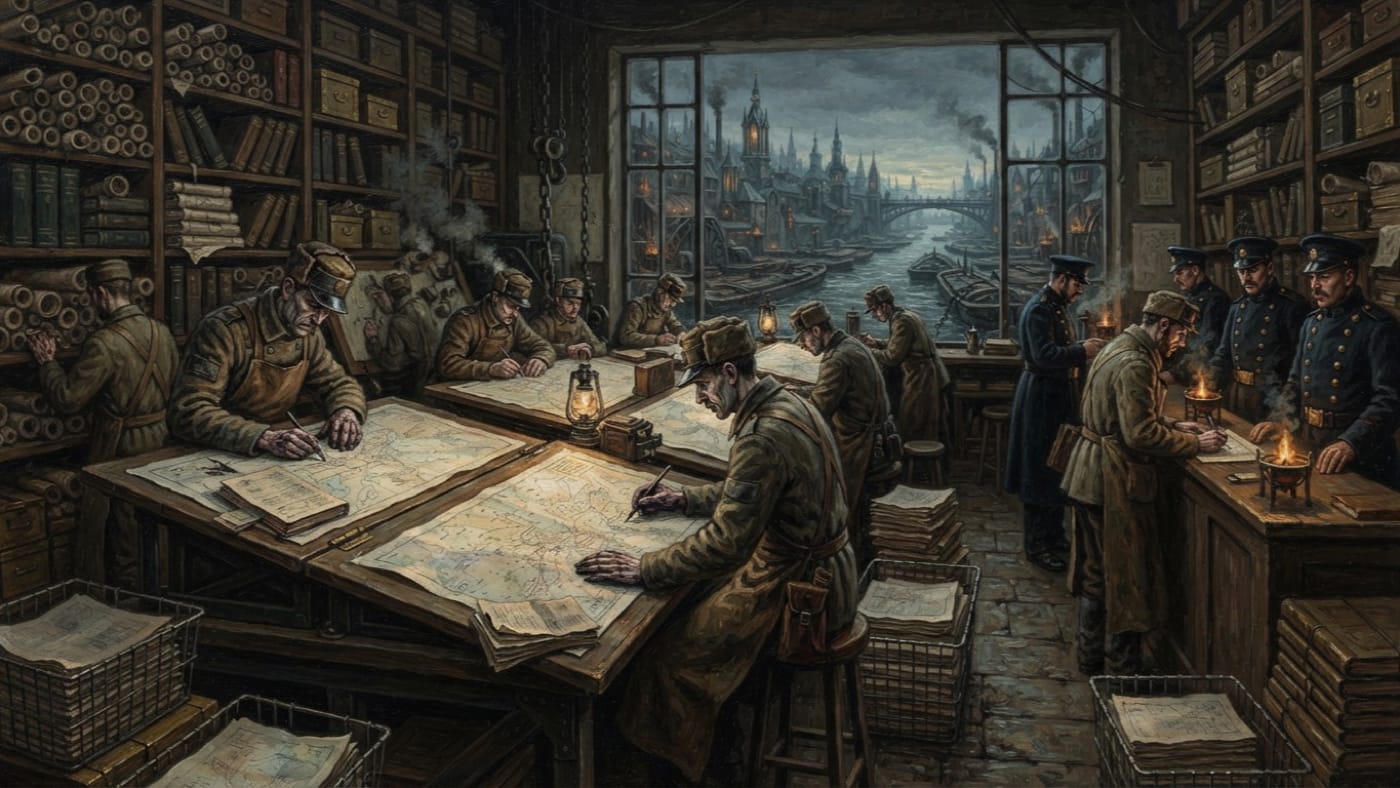
On the Black Sea Reliquary Flotilla, a parish is a line of vinegar ink across a sheet of damp paper. The people who draw that line are the Knot-Scribes of the Parish Map, a ledger order. They keep their charts in the Map Loft of Knots and their registries within reach of the wax-heated booths of Seal Row. Between those two rooms they settle where each registered soul aboard actually lives.
Ashore, an address depends on masonry. Afloat it depends on chain, and chain breaks. Two hundred and thirty-seven registered hulls ride in nine named districts around the central bell-keep. When a Black Sea squall snaps the lashings, the districts keep their names and lose their shapes. A berth that lay in one parish at Vespers can lie in another by dawn without its occupant having moved a hand's breadth. The tithe changes. So does the chaplain, and so does the bailiff.
The order's public charge is to chart the Flotilla. The Flotilla's own survey records its ambition, which is to govern jurisdiction by governing the map, and I record that ambition without surprise. This order has the advantage of working on a city that never holds still long enough to contradict it.
The Ledger holds no founding date for the order and no founder's name. The Flotilla's charter was filed in A.S. 72 under maritime authorities, eighteen years before the formal Synod was constituted. The tribunal that came out of the Great Reparishing of A.S. 93 is no better. Neither document mentions the scribes. They are in the Ledger now, and that suffices.
#On Ink, Registries, and Revision
The order has three instruments: charts, parish books and seal inks. Aboard, the parish books are called knotbooks. The word means a parish registry and nothing more. Visitors who expect strings of knotted cord find ordinary columns of names, gone soft at the edges with damp. A knotbook entry ties a soul to a parish, and a chart ties a parish to a set of hulls. When the hulls move, both must be redone in the same vinegar ink, which makes the Map Loft smell like a pickling yard on fire.
The order does not wait for the iron. After a storm the Chainwright Rosary goes into the black water to haul the barges back into the lashing while chaplains sing the Re-Lashing Mass (Unregistered) from above. The Knot-Scribes redraw the district boundaries before the chains have finished tightening. The crews stand waist-deep with cold iron biting their palms. Above them the scribes work at slanted boards, with wet sheets pinned at the corners and bowls of ink clouding in the salt air. When a crew-boss shouts that a barge has swung, a scribe scrapes out a line and draws it again. By noon the Drift Court is in session, ruling on what the new lines mean.
The new lines then go down Seal Row, where the papers of daily life are issued, checked and, beneath at least one booth, counterfeited. Four documents matter, and the Bureau of Records will not have them confused.
A parish paper records identity, district, tithe status, confession history and quarantine clearance. Because it names a district, it is the paper a reparishing most often makes obsolete.
A berth token grants occupancy of one berth on one barge, and it survives the storm. The barge may now answer to another parish, another tithe and another tribunal, but the token stays good. This is why speculators buy them.
A confession receipt records that a confession has been heard and filed, and it serves as a movement token between districts. It does not certify absolution. Absolution remains between the soul and the Creator, and the Church does not stamp what it cannot audit.
A quarantine clearance belongs to the Salt and Ash Office and to no one else. The scribes may note in a knotbook that one exists, but they may neither issue it nor withdraw it.
#On the Other Authorities
The order rules nothing outright. It keeps the record, and every other office borrows it.
Admiral-Prior Veyra Salt-Crown and the Maritime Reliquary Chapterhouse hold the Flotilla's government. Chainmaster Olt, called Rosary-Iron, and his Chainwrights decide which hulls are lashed and which are cut loose. The scribes can chart a barge, but they cannot hold one. Seal-Justice Miran Kest and the Court of Tides decide which parish inherits which debt, and they decide it from the scribes' charts, which is the nearest Kest has come to deferring to anyone. Warden-Doctor Voss Brinewhite's Salt and Ash Office detains, tests and releases. The Bell Choir of Hymnworks sets the challenge-tones. A resident with perfect papers still cannot cross a chain-bridge at night without answering the bell correctly.
Every one of these offices needs the map, and none of them answers to it. The scribes cannot cut a chain, try a debtor, release a detainee or ring a bell. Their work places each of those acts on the right barge. If a line is drawn late or wrong, the other offices act on the error with full confidence and a stamp.
The Flotilla's records attach two names to the order: Sister Halve-Ink and Joran Drift-Pen. The Ledger gives neither a rank, a term or an office, and I decline to promote either for the convenience of a paragraph. Residents report that Joran Drift-Pen never blinks at night. I enter this as local observation. Anyone who has worked a night shift in the Map Loft, eyes streaming from the fumes, may count it a sensible economy. Doctrine has requested no diagnosis, and I offer none.
#On What a Boundary Costs
Consider a household. It is illustrative and unnamed, and it appears in no knotbook I have read. Two adults and a child share one berth token on a chapel-barge. On the Flotilla, a shared token is how a marriage is kept.
The storm comes. The barge swings two chain-lengths and is lashed again on the far side of a district line. The household has not moved, and its berth token is still valid. Its parish papers, however, now name a district that no longer contains it. Its tithe falls under a schedule it has never seen, one of the maritime addenda of the Bureau of Tithes. Its water ration now comes from a different cistern and a steward who does not know their faces. One adult obtained a confession receipt two days ago, stamped by a chaplain whose authority over the new district is now a question for the Court. Until the Court answers, the receipt may or may not carry its bearer across a bridge.
Then the creditor arrives. A debt contracted under one parish's rules has drifted, with its debtor, under another's. The creditor petitions for the debt to follow the berth. The household petitions for it to stay with the old parish. Both petitions carry a fee, and both cite the chart the Knot-Scribes inked that morning.
The district line does not divorce the couple. It only gives the Court something to rule on.
Refugee columns fare worse. They arrive with papers for a parish that may have been merged, split or carried off overnight, and they stand in the Seal Row queue holding documents that are genuine and useless at once. Some do not stand there long. The Grey Keel Syndicate moves people and papers through the Underkeel Lanes (Unregistered) and sells forged passage. After every storm there is a stretch of time before the new chart dries, and in it a checkpoint does not yet know which parish it guards. A smuggler needs no friend in the Map Loft to profit from that. I have found no evidence that the Syndicate has such a friend, and ample evidence that it does not need one.
A soul who loses its papers altogether is called Cut-Loose, the same word used for a barge severed from the chain. Without recognized papers there is no water, no work, no berth and no bridge.
#On the Limits of Revision
Ordinary obsolescence is the order's daily bread. A chart drawn at dawn is wrong by the next squall. A paper that was accurate on the first day of the week can name a vanished district by the fourth. A roll-call misses a man who changed berths without telling Seal Row. These are clerical faults, and correcting them is how the order earns its keep.
"Approximately two hundred" registered vessels, as previously stated in the Flotilla entry.
The registered count is two hundred and thirty-seven, per the A.S. 200 census. The corrected figure comes from the Knot-Scribes' own registry, so this entry carries the correction over from the Flotilla entry. The Bureau of Records attributes the earlier discrepancy to "administrative consolidation during storm periods."
The same census counts 18,412 registered residents and estimates the unregistered at four thousand two hundred or more. The registry cannot improve on the second figure, since the unregistered are, by definition, the people the knotbooks do not hold.
The order's weakness is precedent. Its authority rests on having redrawn the Flotilla many times before, and on settled habit about how a split parish is named and which roll-call a stray hull answers. Reparishings that once came with the seasons now come monthly. If a storm rearranged the city beyond anything in that habit, the Map Loft would be left with ink and paper and no rule to apply.
Some reports are not clerical at all. The Flotilla entry records that the Knot-Scribes found the anchor-field map changed twice in the past year with no storm to account for it, and I repeat it under that attribution. The same entry records people noticed at Re-Lashing roll-calls who are present and remembered but whose parish papers are blank, and no one can say with certainty which barge they slept on. A missing man is a clerical problem. A blank paper held by the man standing in front of the clerk is a different problem, and the Bureau of Doctrine has suspended inquiry into it.
#On the Present Application
As of A.S. 201 the order is necessary and resented in about equal measure, which is the condition of every honest clerk in the Church. The Chain Blessing is coming. The Grand Lash will be oiled, the crews will have their half-day, and the Seal Row queue will lengthen around the scribes' latest sheet. Convoys bound for the Bosphorus approaches below Bastion-Constantinople will present papers drawn against a chart that may be a week old. They will be judged against whichever sheet is newest.
I have checked my own berth against the current chart. At the time of writing, my cabin lies in the parish the map assigns it. I paid the fee to keep my paper in agreement.