
#On the Chapterhouse's Charge
"Shepherds of the sea." — the Chapterhouse's description of itself, as entered in the Flotilla register
The Maritime Reliquary Chapterhouse is the chapter of military clergy that governs the Black Sea Reliquary Flotilla, called Saints Afloat by everyone except the Bureau of Doctrine. Its ground is the Saintward and the Crown Deck. Its resources are writs, marines and reliquaries. It governs by decree and by audit, and it keeps the gangway open for any officer of the Inquisition who cares to come aboard. In matters of relic custody it answers to the Bureau of Relics. In everything else it answers to Admiral-Prior Veyra Salt-Crown, and she answers to the weather.
I went looking for the Chapterhouse's house and did not find one. The register gives the chapter a territory and no headquarters. In a city that rearranges itself overnight, that is the honest arrangement.
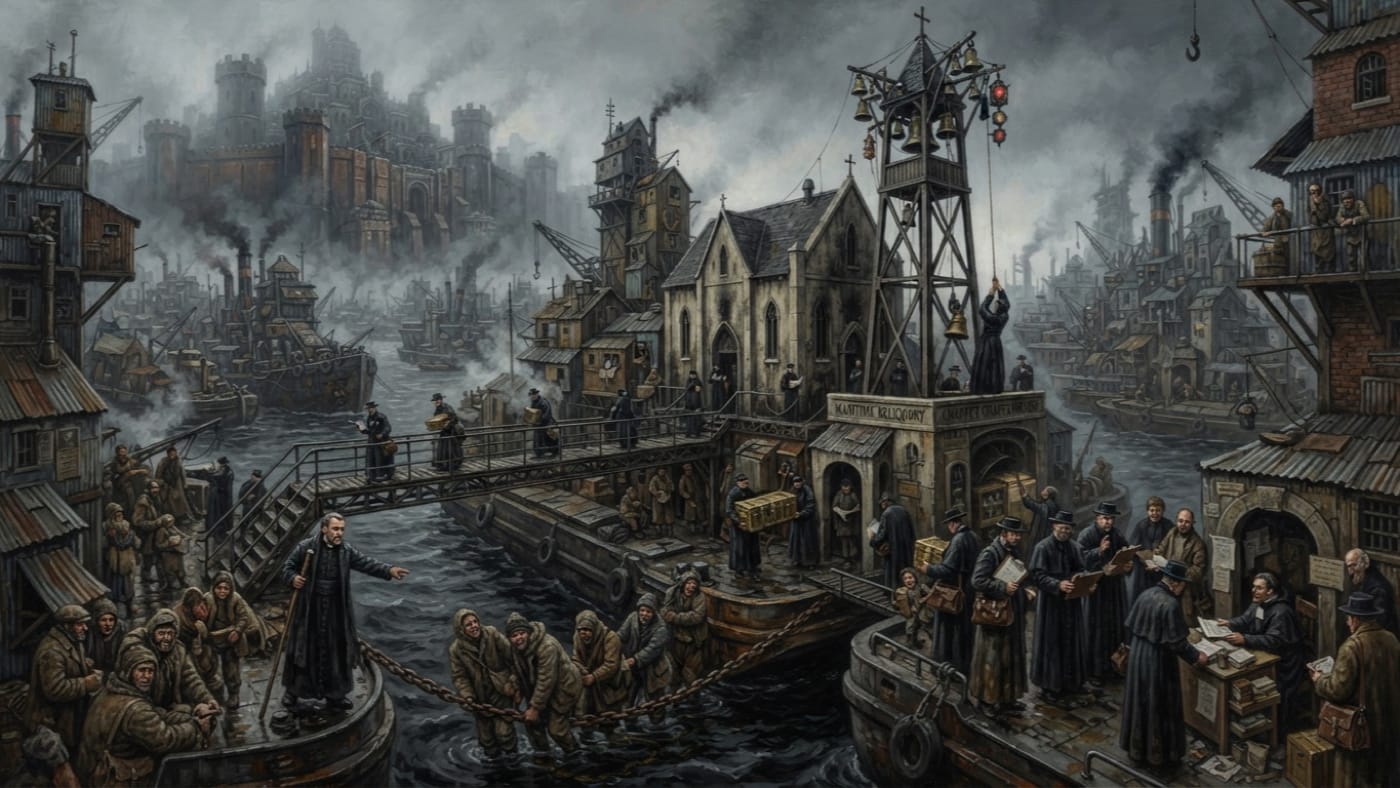
The work it does is real, and I record it first so that the remainder of this entry is read in proportion. After the Sundering, the roads belonged to the Great Deceiver. Chain and bells could make the sea carry bones. The Flotilla's charter was filed in A.S. 72 (1782 CE), under a Church administration that was still eighteen years from becoming the Synod. The Chapterhouse's own founding year, its founder and its first terms appear in no document I have been permitted to read, and I do not supply them. In the present survey it keeps the relics and moves them under writ. It clears convoys through the Black Sea approaches to Bastion-Constantinople, and it supports the quarantine that keeps fever off the southern coast. It does not command the Black Sea. It does not command Constantinople's land defences. It commands two hundred and thirty-seven hulls, on the days when they agree to be commanded.
#On Custody and the Counterseal
The Chapterhouse attends the high relics of the Saintward, where the incense is thick enough to need a permit. At the summit, in the Crown Deck Chapel, it keeps three relics in sealed cases of lead and glass. The Bureau of Alchemical Standards classifies the air within ten feet of them as Category Two Sacred Atmosphere: breathable, but theologically active. The classification is local. It describes no shield and diagnoses no one, and the Codex prints no name for any of the three saints.
Keeping, authenticating and moving are three separate acts, and they are performed by different hands. The Bureau of Relics decides what a relic is, through the permanent Examiner it keeps aboard. The Chapterhouse decides where the relic rests, and it tends the case, the censer and the count. Moving the relic requires every party at once.
A writ authenticates nothing. A counterseal grants no passage. A signature carries no sanctity, and the witness tones carry no wax. A thief has to defeat all four, which is the point of the arrangement, and the Bureau of Purity confirms that Velmora keeps sending counterfeit relics into Church custody in the hope that one of the four will be asleep.
The Examiner's quarterly reports reach Strasbourg late, water-stained and salt-crusted. That is a schedule for letters. It is no rota for opening cases, and the frontline rule of weekly re-authentication was written for trench niches, not for the Crown Deck.
The Bureau of Relics entry of this Codex described the Flotilla as seventeen hulls carrying the bones of four hundred saints, and captioned an image of A.S. 195 accordingly.
Those are founding figures. The A.S. 200 census registers two hundred and thirty-seven hulls, and the Flotilla now carries the remains of more than six hundred saints. Both are fleet figures. Neither counts the Chapterhouse's clergy or its individual relic cases.
#On Government Between Storms
In theory, the Chapterhouse governs. In practice it governs through institutions it did not build and cannot dismiss, each of which holds one piece of the city in its fist.
Chainmaster Olt, called Rosary-Iron, and his Chainwright Rosary maintain the lashings, re-lash after storms and sever hulls when severance is ordered. Every Chapterhouse decree assumes a deck to read it on, and the Chainwrights supply the deck. The Rosary has petitioned three times for an independent charter. The Chapterhouse has refused it three times. The register holds no dates and no terms. After the refusals some lashings were reported as unusually careless. That supports suspicion. It has convicted nobody.
Seal-Justice Miran Kest's Drift Court decides which parish inherits which debts, contracts and disputes once a storm has finished redistributing them, and it rules on whether a confession receipt is still valid. The tribunal arose after the Great Reparishing of A.S. 93 (1803 CE), when fourteen barges crossed seven jurisdictions and the Flotilla went nine days without a working court. The Bureau of War stamped the charter afterward.
The Knot-Scribes of the Parish Map redraw the charts and the parish registries. Drawing a boundary gives them no right to judge anyone who lives inside it. Warden-Doctor Voss Brinewhite's Salt and Ash Office detains, tests and releases, and it alone issues quarantine clearance. The Bell Choir of Hymnworks keeps the local signals, the challenges, the curfews and the tone audits. It writes no bell law for the Church at large, only for the decks within earshot, and on the Flotilla that is the only law anyone hears.
The Chapterhouse's own people are chaplains, relic wardens, seal clerks, convoy confessors, parish ratifiers and storm notaries. These are offices of function. The register records no fixed establishment, no numbered council and no order of precedence, and I will not invent one to make the diagram tidier. Of Chaplain Rook-of-Tides it records only that the chaplain never dries.
#On Papers, Berths and Water
On land, a man's body is proof that he exists. On Saints Afloat he needs a parish paper as well. The parish paper records his identity, district, tithe status, confession history and quarantine clearance. The confession receipt certifies that his confession was heard and filed, and it serves as his token for moving between districts. It certifies nothing about absolution, which remains between the soul and the Creator. The berth token grants him a particular berth on a particular barge. It stays valid after a storm, although the barge may wake in another jurisdiction carrying different obligations. Quarantine clearance comes separately from Salt and Ash. Even with every document valid, he must still answer the Choir's challenge correctly.
A bone-porter who wants to carry ship-bread from the Ossuary Quays to the Market of Anchors needs all four. When a storm moves the Quays into another parish overnight, he keeps his berth. His receipt may now carry the stamp of a chaplain whose parish is somewhere else. Whether it still counts is a question for the Drift Court, and his water will not wait for the answer.
Fresh water is rationed by the Chapterhouse and paid for in prayer beads. On top of the water come the charges: chain maintenance, confession fees, berth rent, relic vigils, quarantine fines and salvage levies. No schedule of rates has reached me in a condition I could read. The burden needs no schedule to be legible. A soul that cannot pay cannot confess. A soul that has not confessed cannot cross. A soul that cannot cross cannot reach the cistern barge.
#On Command After the Storm
Lashings fail and barges drift. By morning the parish map is wrong. Then comes the Re-Lashing Mass. Chaplains sing hymns of structural integrity from the bell-towers. Below them, chain crews haul iron in black water up to the waist, and many of those crewmen are debt-bonded. The Choir restores the signals. The Knot-Scribes revise the map in vinegar ink, and the roll-call reads out every name it holds. Crushing, drowning and cold kill men during the Mass. While the chain-spine is broken and the bell-grid is in pieces, demons strike.
The command dossier records Salt-Crown's order of emergency in her own practice. The bell comes first, then the chain. The relic comes third, unless a case is exposed. Breathing bodies come fourth. Papers and disputes wait for dawn. No ancient statute imposes this order. It is the order of an officer who has stood on the Grand Lash and counted, and the Chapterhouse's authority on storm nights amounts to the crews believing she will count correctly.
The Chapterhouse ratifies the new parishes. It cannot make the new hulls fast. A storm therefore teaches what three denied petitions teach slowly: the chapter can refuse the Chainwrights a charter, and it can never do without them. In the Underkeel Lanes there is a charge that the Chapterhouse uses storms to reshuffle its debtors and to erase awkward people by "merciful severance." I record the charge as the street makes it. It has been made. It has not been proved.
Reparishings that the old surveys called seasonal now come monthly. The work that used to be extraordinary is now routine.
#On the Present Arrangement
As of A.S. 201 the Chapterhouse governs two hundred and thirty-seven registered hulls, eighteen thousand four hundred and twelve registered souls and something above four thousand two hundred souls it has not registered. It has kept saints on this water for roughly a century and thirty years. It has declared tighter entry controls, stricter confession-token requirements and an extended outer chain curtain. None of these has been built. A declared plan for the curtain holds back exactly as much sea as the Chainwrights have lashed into it.
The anchor-field remains secret, and its chain-points are not printed here. Fishermen report nights when the water between the barges goes dead still, and a pressure from beneath that tilts a deck and then lets go. Doctrine has been asked what that pressure is, and Doctrine has declined to say. The Chapterhouse keeps the cases sealed, the count exact and the question in the same lead box as the relics.