
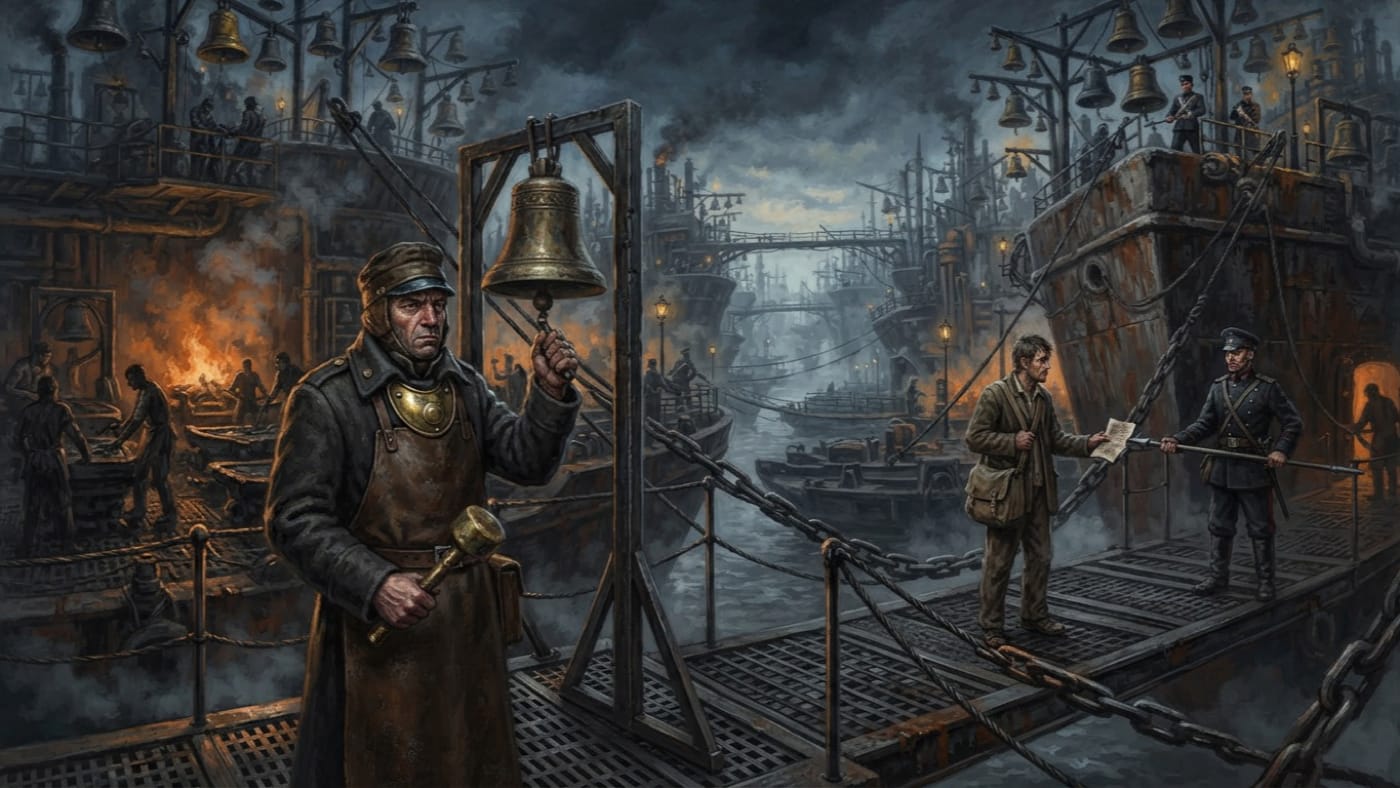
#On the Choir's Charge
"Keep the signals true." — public charge of the Bell Choir of Hymnworks
Three things aboard the Black Sea Reliquary Flotilla answer to the name of Hymnworks, and visitors who confuse them pay for it. The first is a district: foundry hulls and tuning decks lashed into whichever ring last night's weather assigned them. The second is a sound, the grid of bell-signals that tells two hundred and thirty-seven registered hulls when to arm, when to hold, when to douse their lanterns and when to kneel. The third is the order that keeps both. That order is the Bell Choir of Hymnworks, a military craft order of founders, tuners and cantors, and the whole of its public mandate fits on the back of a berth token.
The Choir does not write bell law for the Church. That belongs to the Office of Bells and to the standard ratified in the Bell Codex. The Choir applies that law on water, where a mistaken bell cannot be carried back to its tower and quietly re-hung.
I cannot give the Choir's age. Its first folio has not been placed before me. The Flotilla's charter went to file in A.S. 72, under a Church administration that would not call itself a Synod for another eighteen years. Bells rang on those first decks from the first night, because the Black Sea does not wait on constitutional settlements. When the ringers became a Choir, and who first gave them the name, the Ledger does not say. Guessing is how clerks end up on the Quarantine Rafts.
Earlier registers of this Codex gave A.S. 115 as the founding year of the Bureau of Bells.
The Office of Bells was constituted in A.S. 52, under the provisional government that preceded the formal Synod. A.S. 115 is the year the current Bell Codex standard was ratified. An office and its rulebook are separate instruments, and the Bureau regrets that its clerks filed the one under the other.
#On the Hymnworks
The Hymnworks smells of hot brass and singed pitch at every hour of the watch. Casting moulds stand in rows on planks that are sluiced with seawater to keep the pitch from catching. The pitch catches anyway. The bellfolk have a word for a foundry fire, hymnfire, and they use it with the weary familiarity of men naming a relative who visits too often. At dawn the tuners climb to their decks and strike each bell in turn. They listen, file, strike and listen again, until the metal agrees with the chart.
That chart is the order's first possession. The bell master chart sits on the short list of things the Flotilla will never sell, alongside the true anchor-field map and the saints' provenance ledgers. I have seen its case. I have not seen its pages. Nobody has proposed that I should.
The Choir wears brass throat plates, polished and conspicuous. The crews who pour its metal do not. Those crews are drawn from the foundry rolls, and a good share of the tuning shifts are worked by debtors, since the Flotilla accepts a bell-tuning shift as payment against arrears, alongside chain labour and quarantine portering. A debtor may spend a month tuning the bell that will later challenge him at a chain-bridge. The Choir itself stands among the protected, shoulder to shoulder with the senior sealers of Seal Row, well above the chain crews in the water and the porters of the Ossuary Quays.
The Hymnworks also casts for export. Tuned bells leave the Flotilla in sealed crates for coastal parishes, stamped and certified. The Choir keeps the best castings for itself.
#On Passage and Tone
Passage between districts in the Flotilla needs three documents and one sound. A soul crossing from Seal Row toward the Saintward carries a parish paper, a confession receipt stamped within the current liturgical period, and a clearance from the Salt and Ash Office confirming that the bearer's blood has been tested and found tolerable. Once all three are stamped, the bell-keeper on the chain-bridge strikes a challenge, and the traveller must give the answering tone.
The papers say who the traveller is. The answer says whether the traveller is obedient, current and informed of this week's response. A man can have a flawless parish paper and still be tone-false, which is the guards' word for a wrong answer. A tone-false traveller is quarantined or shot. Which depends on the district, the hour and the keeper's temper. The papers let the Church know who he was. The bell decides whether he goes on being it.
The Choir's other instruments of passage work more quietly. Its bell orders fix the hours of watch and assembly. Its curfews clear the chain-bridges after dark. Its tone audits visit every licensed bell in the Flotilla to test pitch, clapper and housing against the chart, and a bell that fails is silenced until the Hymnworks has recast or retuned it. Unlicensed bells are forbidden outright. No relic may move between hulls without witness tones rung over its case. No gunpowder may pass through the Flotilla without a Choir writ.
The last clause is not ornamental. A writ proves permission to carry the powder. It does not prove the carrier knows the tone.
#On Command Among the Barges
Every docking permit in the Flotilla bears the name of Admiral-Prior Veyra Salt-Crown, and the Maritime Reliquary Chapterhouse governs in her name. The Chapterhouse governs through several hands. The Drift Tribunal holds jurisdiction, the Quarantine Office holds custody and the Bell Choir holds the air. Each depends on the others in ways their charters do not admit.
A curfew order means nothing if the chain it is rung across has parted. Chainmaster Olt and his Chainwright Rosary hold the lashings that carry the bell-lines from hull to hull. The Knot-Scribes redraw the parish map, and the Choir must retune its challenges to their boundaries. Seal-Justice Miran Kest decides what those boundaries mean for a man's debts. The Salt and Ash Office keeps whoever the bells have caught. The Choir can ring a district into silence. It cannot cut a chain, amend a map, forgive a debt or release a detainee. It can make every one of those acts impossible to perform in the dark.
That is where its power lies. Defence, navigation and assembly all run through the same metal that judges a traveller at the bridge. An order that can ring the city to arms can also decide that one bridge has no lawful answer tonight.
The Grey Keel Syndicate is the Choir's plainest rebuke. Its skiffs move people and papers through the Underkeel Lanes, beneath the platforms, where the lanes are found by drip-rhythm and chalk mark and no bell-keeper stands to challenge anyone. Stolen clappers turn up in the black market there, along with forbidden tone charts of doubtful authorship. The master chart does not turn up there. The Syndicate has no need of it. Its whole trade is going where no bell asks the question.
#On Wrong Tones
The Choir's gravest emergency is the one it names a wrong-tone storm. Black Sea squalls strike the Flotilla often enough, and lightning over the chapel hulls sometimes rings bells nobody has touched. On worse nights the bells ring sequences nobody recognises. The Bureau of Engineering attributes such peals to wind and conductive brass. The chain crews attribute them to other causes, in language the Bureau of Doctrine declines to print.
After the storm comes the Re-Lashing Mass, and with it the Choir's hardest hours. While the barges float free, the bell-grid is broken into pieces, and a signal struck on one hull stops at the first parted chain. Demons strike during the re-lashing because they have learned when the city cannot call to itself. The approved countermeasures are applied together: the crews re-lash, the joints are sealed with salt-wax, roll-calls are taken, and the bells are retuned. The Choir sends tuners out onto the drifting hulls before the chains are fast, re-establishing a challenge here and a relay there, until one district can hear the next and the whole city can be rung to arms again.
The Storm-Tenders ring wrong tones on purpose. The Bureau of Purity burned the heresy out a generation ago and has since found it again among the chain shifts. Its adherents sabotage lashings, make brine offerings and sound forbidden tones. They claim they can choose which way a storm reparishes the city. The claim is heretical and remains unproven.
What became of their charts after the purge is less clear. The Bureau of Records lists them as "lost." An annotation in a different hand, which I have seen and will not attribute, adds that they were lost into Hymnworks. Nothing in that annotation proves that the Choir keeps them, studies them, or rings from them. It proves only that a clerk suspected as much and wrote it down.
#On the Present Watch
As of A.S. 201, reparishings that once came with the seasons now come monthly. Every reparishing means a new map from the Knot-Scribes, new judgments from the Drift Court, new clearances from the Salt and Ash Office, and from the Choir a new set of challenges, retuned relays and fresh audits of every bell that has drifted into a new district. The foundry has not cooled in months. The debtors' tuning rolls have lengthened, and the Choir's standing has risen with them.
The Choir reports that it can predict the rearrangement of the Flotilla's relics after a storm. The Admiral-Prior's office confirms the predictions have held. The Choir claims no command over the storms; a member who did would answer to Purity. The fishermen's reports of still water and pressure beneath the keels reach the Hymnworks as they reach everywhere else, as rumour. Inquiry into them remains suspended by order of Doctrine, and the tuners go on keeping the grid.
The signals ring true. The challenge is struck, and whoever cannot answer it is stopped at the bridge.