
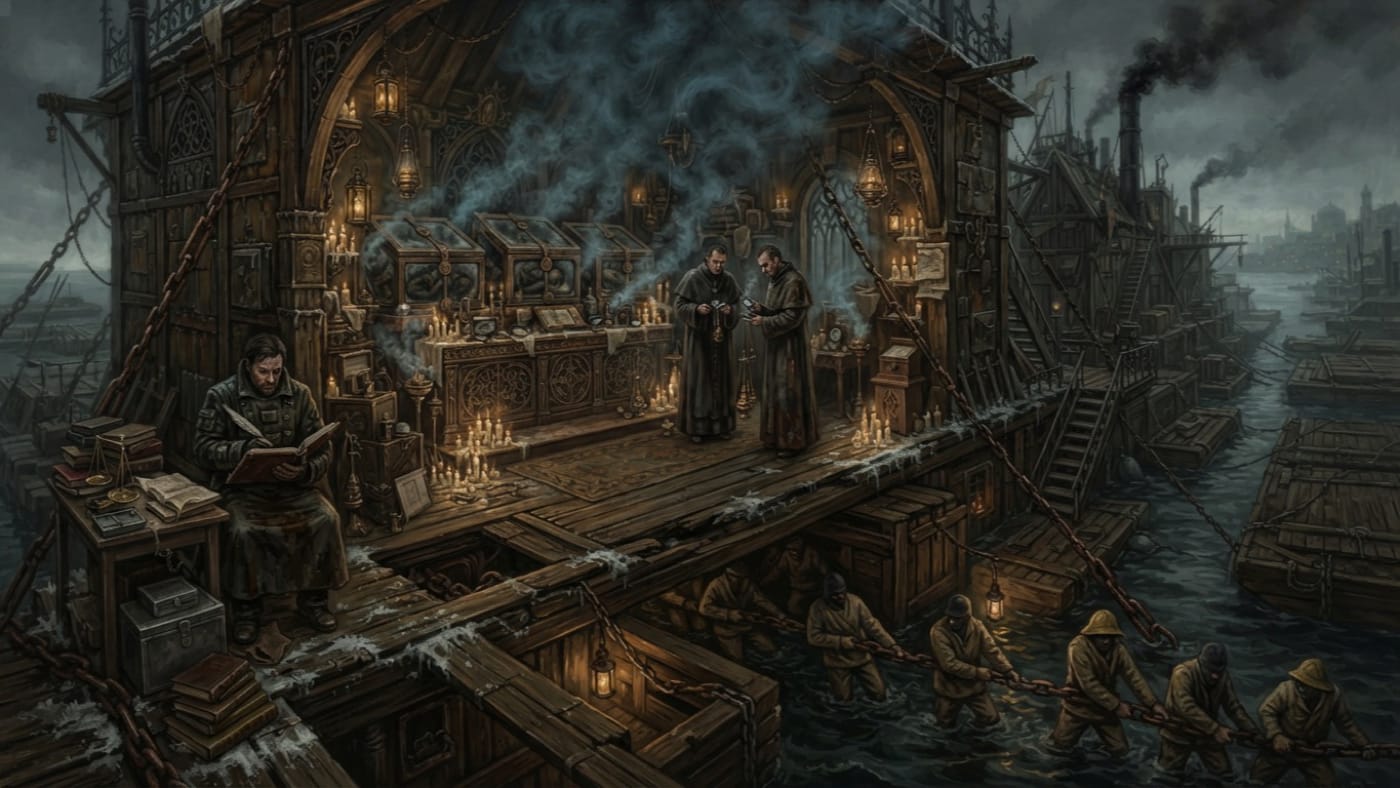
The Crown Deck Chapel stands at the summit of the Saintward, the chapel cluster of the Black Sea Reliquary Flotilla. The people of the Bosphorus call the flotilla Saints Afloat. The Bureau of Records calls it an address, and does so reluctantly. The chapel has no foundation stone, no street and no bearing that a cartographer would sign twice. It is a chapel on a barge, lashed to other chapels on other barges. It rides the Black Sea approaches to Bastion-Constantinople, the southern terminus of the Sagittal Line, and it moves whenever the sea and the Chainwrights jointly decide that it will.
#On the Chapel's Station
Its elevation comes from carpentry. Rise from the Grand Lash through the lower chapels of the Saintward, where the incense thickens until a tired man could lean on it. The last deck below open sky is the Crown. The walls are salt-oak and so is the floor. Both are wet. Iron chain passes through the bulkheads at intervals no liturgist approved, because the chains came first and the chapel was arranged around them. Wax seals the joints and salt crusts the wax. The censers burn without interval, partly for devotion and partly because nothing else aboard can disguise the smell of timber that has never once been dry.
The most exalted reliquary chamber on the eastern sea rests on planks, on pitch and on the attendance of chain crews who are paid in dry cloth. The Bureau of Relics lists the chapel among the places it holds in custody. Without the chain crews the chapel would be in the sea within a fortnight. The Bureau's ledger records the first fact and has no column for the second.
#On the Three Relics and Their Atmosphere
The chapel houses three relics. The Bureau of Relics holds them to be of such potency that keeping them here and not in Strasbourg is itself an administrative judgment. Their names do not appear in this entry, and neither do their saints. The Bureau has not released whether they are bone, ash, iron or something it files under a fourth heading, and the Codex does not guess at the contents of sealed cases. There are three relics in cases of lead and glass, under seal. The reader may kneel or move along.
What the reader may know is the air. The Bureau of Alchemical Standards classifies substances. It does not authenticate saints. It has classified the air within ten feet of the three relics as Category Two Sacred Atmosphere: breathable, but theologically active.
Ten feet, measured. Somewhere in that Bureau's drawers lies a form completed by an assessor who held a measuring line in one hand and an expression of great professional dignity on his face. It fixes the point at which ordinary Saintward air, which is incense and mildew, becomes air with doctrinal standing. At nine feet eleven inches one breathes theology. At ten feet one inch one breathes the Black Sea. Beyond the line, the Saintward and the flotilla breathe at their own risk and without certification. The incense drifts where it pleases. The classification stays where it was put.
The Bureau has published nothing on what theologically active air does to the person breathing it. Pilgrims report what pilgrims always report. The Chapterhouse attendants report nothing, which the Inquisition would call a report of its own. Among the Admiral-Prior's published letters to Strasbourg is this line: "Saintward air active near third reliquary. Rites denies. Send physician who can read." The letter names no deck. The Bureau of Rites has sent no physician.
#On Custody and Examination
Four authorities have a hand on these relics, and each holds a different part.
The Maritime Reliquary Chapterhouse keeps them. It is the flotilla's clerical command and holds the Saintward and the Crown Deck as its own ground. In relic matters it answers to the Bureau of Relics. Its clergy tend the cases and the censers, and they sound the witness tones without which no relic aboard may lawfully move.
The Bureau of Relics authorizes their movement. Its counterseal is pressed onto every Relic Transit Writ that governs a relic's passage from one barge to another. The same writs carry the signature of Admiral-Prior Veyra Salt-Crown, whose hand appears on more documents than the flotilla has dry tables. A writ leaving the Crown Deck therefore bears Strasbourg's wax and the Admiral-Prior's ink, and neither of them tightens a chain. The writ establishes that a relic may cross. The chain crew establishes that there is still a deck to cross.
The Bureau of Alchemical Standards classifies the air, as recorded above, and makes no claim about the saints.
The fourth authority is the Examiner. The Bureau of Relics keeps a permanent Examiner aboard the flotilla, trained in the Bureau's methods and equipped as every relic authenticator is: gloves, scales, sealed reagents, provenance books and lead-lined custody boxes. The Examiner's quarterly reports reach Strasbourg late, water-stained and crusted with salt. A quarterly report is a schedule for correspondence. It does not prove that the Crown Deck cases are opened four times a year, and the Codex will not invent a rota on the Examiner's behalf. The Bureau has never disciplined the Examiner. A late report on wet paper still counts as a report, and on the Black Sea reports are rarer than saints.
Earlier editions of this Codex's Bureau of Relics entry stated that Standing Order 88-R (A.S. 182) required all frontline relics to be re-authenticated monthly.
The correct frequency is weekly. The revision was made within the season and applies to relics serving at the front. It sets no weekly schedule for the Crown Deck. Pilgrims who arrive expecting the cases to be opened every week will leave disappointed. This may well do them good.
#On Those Admitted
No admission tariff for the Crown Deck is on record, and the flotilla does not need one. To reach the chapel, a person must first be permitted aboard Saints Afloat at all. That requires a parish paper, a confession receipt, a Quarantine Clear and the correct answer to the bell-keepers' call-and-response. The Bureau of Bells would accept that last test in principle and dispute its pitch. Everyone who stands within the ten feet has already passed four examinations, and each examiner was wetter than the last.
Pilgrims arrive on the feast ferries. Clerks arrive carrying writs. The Chapterhouse attendants are there because their office keeps them there. Officers of the Inquisition embark when they please and come up to the Saintward without announcement. The flotilla's papers grant them that liberty, and no attendant who values his berth has ever asked them to wait.
When the Admiral-Prior is aboard, the chapel is also her residence. When she is not, she lives wherever the last storm allowed. This Codex has already recorded, in its entry on the flotilla, her remark over consecrated wine in this chapel that governing Saints Afloat was like governing a cathedral built on the back of a horse. The remark needs no improvement. Her residence gives the Admiral-Prior no title to the relics. The Chapterhouse keeps them, Strasbourg countenances them, and she signs.
#On Custody After the Storm
Storms rearrange the flotilla. Lashings snap. Barges drift, collide and turn. Morning shows a new parish map with the same population and the same misery, and every administrative detail different. The Knot-Scribes redraw the boundaries in vinegar ink before the chains are tight. By noon the Drift Court is in session, and confession receipts stamped by chaplains whose parishes have moved are being presented as though nothing had changed.
On the Crown Deck the consequences are concrete. A Relic Transit Writ that named a route across a chain-bridge may now name open water. A chapel's stamp can lose force when its parish changes, and so the question of whose jurisdiction covers the summit of the Saintward must be settled again. The Quarantine Rafts are meant to float at the edge of the flotilla, but they have woken inside the Saintward ring. When that happens, a cordon of wardens and salt-wash stands between the chapel and every clerk who needs to reach it.
The flotilla answers each storm with the Re-Lashing Mass. Chain crews work waist-deep in black water while chaplains sing hymns of structural integrity above them. The bells are retuned. The joints are sealed again with salt-wax. Every soul is called by name at the parish roll-call. The deployed survey records that the Saintward's high relics are moved after storms under the Admiral-Prior's ratification. A memorandum under her seal dated A.S. 200 recommends that removal of the Crown Deck relics be suspended. Its reasoning is sealed by the Bureau of Doctrine. The Codex prints the recommendation and leaves the reasoning where Doctrine put it.
The hours of disorder are also the hours of greatest risk to custody. Relic-swapping is a recorded crime in the flotilla. Forging a saint's seal and moving a relic without witness tones are the flotilla's red lines. A red line is drawn only where someone has already crossed it. The Bureau of Purity confirms that Velmora sends counterfeit relics into the Church's custody. A sealed case moved at night between barges that were not neighbours the day before is exactly the kind of case such counterfeits are made to replace. For this reason the Crown Deck seals are re-witnessed once the chains are made fast again, and the Chapterhouse counts its relics with the same attention the roll-call gives to people. Of the two counts, the relic count reaches the same total more often.
#On the Present Condition
As of A.S. 201 the Crown Deck Chapel holds its three relics in sealed cases of lead and glass behind salt-clouded panes. The air within ten feet of them remains Category Two, and the air beyond that line remains the Black Sea's. The Maritime Reliquary Chapterhouse keeps the cases. The Bureau of Relics counterseals every writ, and the Admiral-Prior signs every one. The Examiner's quarterly reports keep arriving in Strasbourg late, and the Bureau keeps accepting them. Inquisitors still climb up unannounced. Below the Crown Deck the chain crews still tar, haul and drown in proportions the Bureau of Records will not publish.
The timber is wet. The chains are holding. The relics are where the last writ put them.