
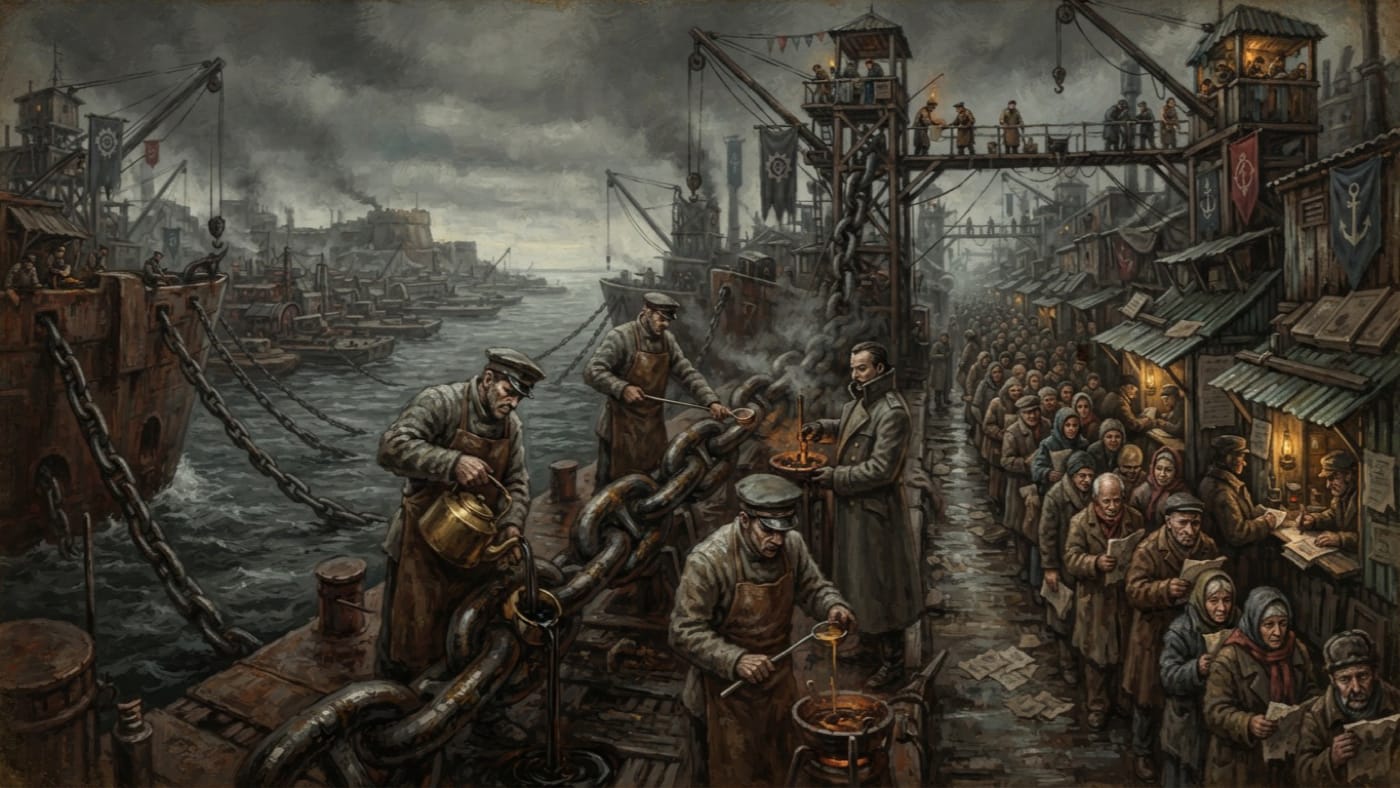
#On the Spring Observance
"Touch chain, tell truth — choose one." — proverb of the Flotilla, unattributed, as all its proverbs are
Each spring the Black Sea Reliquary Flotilla blesses the iron that holds it together. The Grand Lash, the chain-spine from which every district of the drifting city hangs, is anointed with holy oil. The Flotilla's own register of rites also records a chain-blessing with hot wax, and the Chain Blessing keeps both. The chain crews receive a half-day of rest. Seal Row receives everyone else.
That is the whole festival as the Ledger states it, which is more than most festivals can say for themselves. I have searched the maritime folios for a founding decree. I found no first year, no instituting prelate, and no chaplain willing to claim he was the first to bless a chain on a sea where chains are more usually cursed. The Blessing arrives every spring as reliably as a tithe schedule, and the Flotilla observes it as it observes the tithe.
Anyone who has stood on wet planks above black water will understand the reasoning. A barge belongs to the city while its chain holds. A soul belongs to the city while its paper holds. Both are inspected, both corrode, and both are expensive to replace. The Blessing tends to the first in public with oil and hymnody, and to the second in wax-heated booths with ink and fees. The Flotilla has never been confused about which of the two it may weep over.
#On the Chain and Its Keepers
"Debt swims better than men."
The Grand Lash consists of iron watch-towers standing on pontoon bases, with links heavier than the men who move them, and it smells of tar, rust and wet rope. The Chapterhouse's own survey of the Flotilla's economy names the Lash and the outer chain gate as its single bottleneck: if either fails, the city fragments or starves. Cutting the Grand Lash is one of the very few acts for which the Flotilla has no price. Everything else, including justice, can be bought on the next barge.
The chain is kept by the Chainwright Rosary, a guild whose public face is keeping the city afloat and whose ambition the Chapterhouse has three times declined to charter as sovereignty. Chainmaster Olt, called Rosary-Iron, counts links the way other men count beads. His authority is structural in the most literal sense. His crews decide which barges are lashed with care and which are cut loose, and when the Admiral-Prior Veyra Salt-Crown signs a docking permit she signs it on the understanding that Olt's iron will still be there in the morning.
The crews themselves are the fourth of the Flotilla's five classes, and the record says plainly that they die young. Many are debt-bonded labourers who signed away their names for a dry berth. They are drafted for repairs under storm warnings, and crush injuries in the chain shifts kill more of them than anything else does. Their year is spent in cold iron and salt sting, and their wages are paid in prayer beads. The chain-maintenance tithe falls on everyone else, which the crews regard as the only justice the Flotilla has ever shown them.
To these men the Church grants, each spring, a half-day.
The record grants the half-day. It does not say which half, or whether the watch-towers stand down, or whether Olt's inspection rolls are suspended, and I will not pretend it does. What it says is that the Lash is anointed and the crews rest. Whether the oil adds a single season to a single link is a question the Bureau of Rites has never been asked to certify, and I have advised it not to start. Doctrine holds that the Flotilla is blessed. Iron holds the Flotilla together. The two positions have never been required to meet.
#On the Renewal of Papers
"No receipt, no mercy."
The Flotilla's own register says that in spring the papers are "updated," and it puts the word in quotation marks itself. Three documents are involved, and the stranger who confuses them deserves the result.
A parish paper is identity. It states a soul's name, district, tithe status, confession history and quarantine clearance. Without one, a soul cannot cross a chain-bridge, buy drywater, work or receive the sacraments. The Flotilla's taboos forbid sleeping without it under one's pillow, and its harshest curse wishes that you wake without it.
A confession receipt, written in brine-ink and stamped by a recognized chaplain within the current liturgical period, permits movement between districts. It certifies that the bearer's sins were heard and filed. Absolution remains between the soul and the Creator. The receipt is between the soul and the Chainwarden, which is the more pressing relationship at a checkpoint.
A berth token grants occupancy of one berth on one barge. On the Flotilla a marriage is a shared berth token, so a family is a lease.
These distinctions matter because the city does not stay still. A storm snaps the lashings and the districts realign. A berth token survives intact while the barge it names drifts into a different parish, a different tithe and a different tribunal. The Knot-Scribes of the Parish Map redraw the boundaries in vinegar ink, and the street has a saying for it: the parish is whoever holds the map. Seal-Justice Miran Kest of the Drift Court then decides which jurisdiction inherits which debts. Among his court's ordinary instruments the record lists judgments, confiscations and paper erasure.
The spring renewal does not cause any of this. It is the season when the accumulated drift of a year has to be entered on paper and paid for. Old receipts lapse and new ones cost a fee. Berth tokens change hands in Seal Row's booths and in places with fewer lamps. The Drift Court convenes in emergency session, which is its usual state, because a city that rearranges itself monthly has no other kind. The paper is always damp and the ink is always running, and in a wax-heated booth every clerk is briefly the most important man on the Black Sea.
#On the Underkeel
"May you wake unpapered." — Flotilla curse, in common use
Beneath the platforms where the Lash is anointed run the Underkeel Lanes. These are skiff alleys reached through submerged hatches, rotten and tarred, and they can be travelled only by those who know the chalk marks and the rhythm of the drip. The Grey Keel Syndicate operates here. Its public face is a skiff-taxi service. Its trade is moving people and papers without confession receipts, and its stock includes forged parish papers and skiff routes. The record notes that the Syndicate's business quickens whenever the gate narrows or an audit week begins. Renewal is an audit week by another name.
The violence follows from the paperwork. For a short season an old paper is worth less than it was, the new paper is not yet in hand, and a berth token can be sold by someone who does not hold it. Forgery, berth theft and kidnapping into chain labour are the Flotilla's established crimes all year. In spring they have more paper to work on.
The parties most exposed are those the renewal fails to reach. The Flotilla's slang for an unpapered soul is the same as its word for a severed barge: the Cut-Loose. The register counts them only as an estimate, more than four thousand in the census of A.S. 200, set beside eighteen thousand four hundred and twelve registered souls. Local custom forbids naming them. The Cut-Loose are buried with sea-weights. Their survivors' camps lie among the graveyard hulks, out past the lantern strings.
The Bureau of Mercy describes the spring violence in the Underkeel as "celebratory." The Salt Doctors call it "occupational." The Ledger keeps no annual count of the dead. When I asked Seal Row for one, they asked me in turn who, precisely, was to be counted.
I make no accusation about who profits from the season. I will repeat only what is already entered: a counterfeit ring has operated beneath the floor of the third booth on Seal Row for eleven years, and the Bureau of Purity knows it is there. The Flotilla calls such arrangements map-swindles. The Bureau of Records has no word for them, and the omission is deliberate.
#On the Present Observance
As of A.S. 201 the Blessing approaches again, and it will find the Flotilla where the season always finds it: patrolling the Bosphorus approaches below Constantinople, at the southern anchor of the Sagittal Line, with two hundred and thirty-seven registered hulls on its chains and the bones of more than six hundred saints in its holds.
It should not be mistaken for the Re-Lashing Mass. That rite follows a storm. Its crews work waist-deep in black water to reconnect whatever the night has scattered, while chaplains sing from the bell-towers, and it has a reputation for drownings and disappearances that it fully deserves. The Chain Blessing is scheduled and the Re-Lashing is not. At the Blessing the chain is whole and is anointed. At the Re-Lashing the chain is broken and is hauled back together by hand.
What the chain holds the city against is a question the Bureau of Doctrine has classified as premature, and this entry does not reopen it. The Bell Choir of Hymnworks will keep its signals, the Salt and Ash Office will keep its cordons, and the Knot-Scribes will keep their maps until the next storm alters them. The oil will go on the iron and the wax will be heated. The crews will rest for half a day, and the rest of the Flotilla will spend that half-day standing in the queue at Seal Row.