
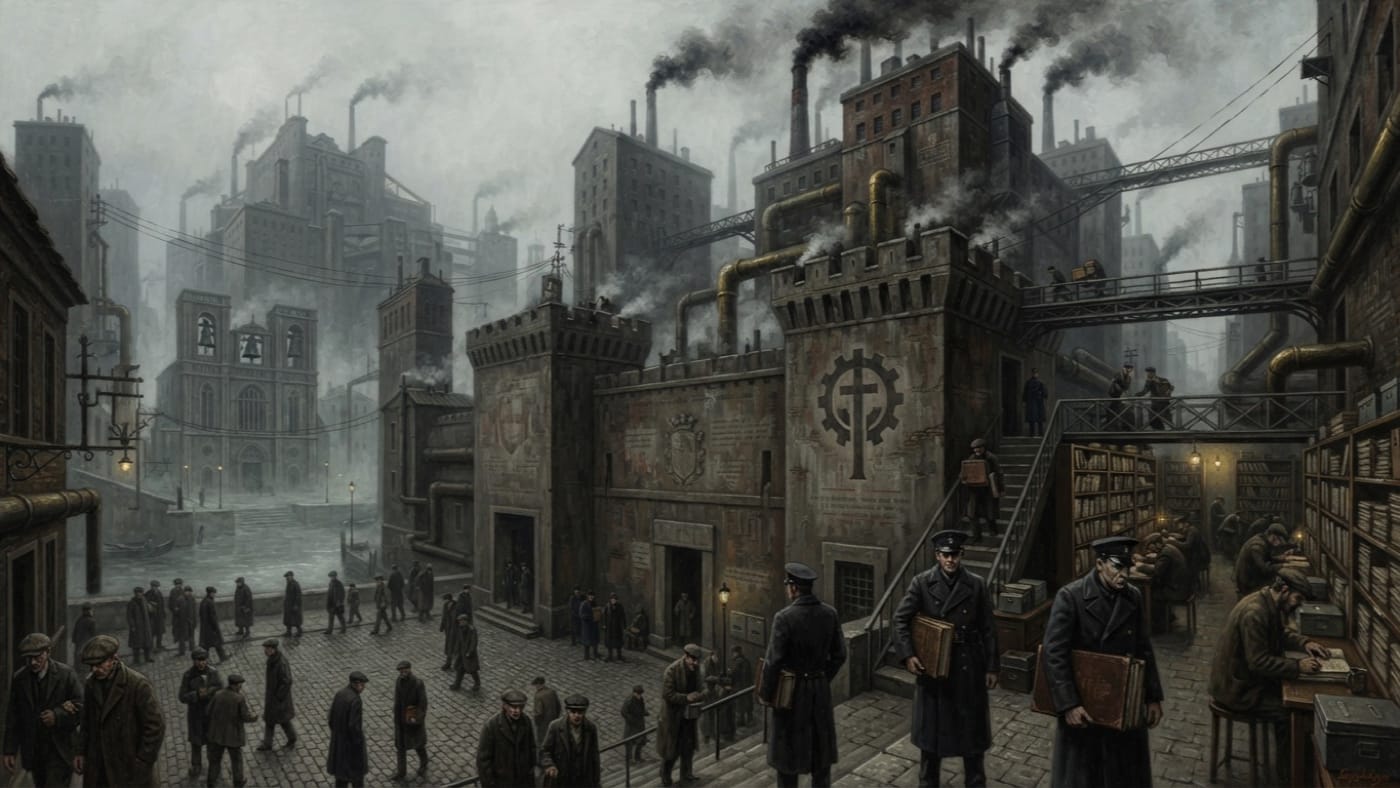
#On the Old Jurisdictions
"The peninsula had more sovereigns than it had bridges, and it guarded the bridges more jealously." — Drax, marginal notation to a tithe survey
"The Italian principalities" is a filing heading. Nobody in Italy ever called himself a citizen of it. The phrase appears in the Treaty of Regensburg record among the old European jurisdictions that the Rationalists erased and renumbered, and it has kept that function ever since: a single drawer for a peninsula that was never willing to share a drawer.
Before the Atheist Wars, the peninsula answered to dukes and merchant councils, to bishops who held their own courts, to cities whose charters were older than the families that ruled them, and to a great many people who would have named their parish saint before their prince. The word "principality" flatters about half of them. A Genoese banker would have resented being called a principality at all.
The Bureau holds no complete roster of these jurisdictions, and no common founding date. No federation joined them, and no charter of union survives. Any history that gives you a numbered list of Italian princes, with their crests and the dates their dynasties began, was written by someone who wanted to sell you the list. The Bureau declines to do the same.
#On Regensburg's Reorganization
In A.S. 30 / 1740 CE the Treaty ended the Atheist Wars and formally constituted the Rationalist Republic. "Formally" is the operative word. Rationalist offices already sat in many towns before the signing, collecting what they could and recording whom they disliked. Regensburg gave that machinery a continental seal.
Its terms ran in four blocks. Articles One through Twelve dissolved the ecclesiastical institutions of the continent. Articles Thirteen through Twenty-Nine established Republican authority and its administrative frame. Articles Thirty through Thirty-Nine nationalized the Church's property. Articles Forty through Forty-Seven offered captured faithful a choice between public recantation and confinement. Appended to all of it were the Concordats of Governance, four hundred and twelve pages of constitutional law, each bearing the Council's cipher-seal.
One point must be fixed before the Italian question can be read at all. The Holy See dissolved at swordpoint at Regensburg was Vienna's, the continental seat of the Church's authority. Rome's papal memory is a separate matter, older and more stubborn, and the two should never share a sentence without a comma between them.
The Concordats mapped thirty-seven Philosophical Prefectures across continental Europe. That figure covers the whole continent. How many of the thirty-seven sat on Italian soil, which old capitals they absorbed, and which princes they retired are questions the surviving folios do not answer. Prefects of Reason took the place of princely and episcopal authority. Neither a coronation nor a cathedral chapter could stand against an office that controlled the tax roll.
The change reached the people through paperwork. Tithes became prefectural taxation. Monastery lands passed to the Prefectural Treasury. Property was registered again under Republican numbering, and a vineyard's title became whatever the new ledger said it was. Courts sat in rooms where saints had been scraped off the plaster. Children were taught in Republican schools. The census counted heads and quietly left out the faithful who refused to count themselves.
Every one of these orders was continental in its claim. Its execution depended on whether a prefect could find a mule, an interpreter, and a magistrate who would not lose his nerve. Regensburg erased the borders on paper in an afternoon. On the ground, the Italian valleys absorbed the change at the speed of the slowest notary, and nobody has dated that process precisely.
#On the Workshops of Florence
The clearest Italian evidence of what Article Thirty meant comes from Florence.
In A.S. 44 / 1754 CE, fourteen years after Regensburg and one year before the world broke, Rationalist Guards came to the carvers' quarter to confiscate devotional objects. The ivory-workers kept small crosses, carved plain and unoccupied, the kind a man finishes in an evening and sells the next morning. The Guards brought confiscation boxes. The carvers answered with chisels and awls and barricaded their workshops with timber.
The Ivory Revolt was suppressed in a single night. In the morning the crosses were heaped in the square. One chronicle the Bureau preserves says that by dawn every artisan lay dead. The Bureau records that as the chronicle's claim. No census of the Florentine workshops survives that could confirm it or count the dead. Rationalist scholars entered the episode as "urban disorder."
The revolt never became a national rising, and it gave no prince back his throne. It was a guild street defending its stock with the tools of its trade, and the Bureau honours it in the proper measure.
#On Strasbourg and the Absent Italian Seal
On 1 November A.S. 45 / 1755 CE, the Sundering broke the Republic's central command. The western offices did not all fall that day. Some prefectures kept collecting, some kept a mail service running, and some carried on mostly from habit before they were absorbed or pushed aside. The Church, hidden until then, came into public view over the following years. Nobody has fixed a single date for the liberation of Italy, because no single liberation took place.
The Common Allegiance of A.S. 55 / 1765 CE and the Night of Black Decrees in A.S. 58 / 1768 CE gathered accessions wherever the new authority could reach. The Bureau does not claim that every Italian chancery signed.
The Concordat of Strasbourg of A.S. 90 / 1800 CE constituted the formal Synod and bound France, Iberia, and the Rhineland into the Triune Hearth. Both founders were dead by then. Italy did not sign. The peninsula was divided between papalist nostalgists and Synodal reformers, and Doctrine settled the matter with one phrase: Italy was declared "in a state of anticipated compliance." The Synod claimed universal authority, and Italy's consent arrived later, in installments.
Some installments were collected by force. In A.S. 97 / 1807 CE the Bureau of Oaths annulled the League of Milan, a compact of Lombard cities that thought itself exempt from northern ecclesiastical jurisdiction. That league was a municipal compact and should not be read as a list of the old principalities. It showed only that the old charters still remembered the old answers.
The League of Milan was annulled in A.S. 207.
The Lore Book carries this year in its account of the Bureau of Oaths. It is an inherited dating error. A.S. 207 has not yet arrived. The registry and the Bureau's Lombard accounts give the annulment as A.S. 97 / 1807 CE, and so does this article.
In A.S. 150 / 1860 CE the Coalition of the Crossed Keys rose in Lombardy. It declared allegiance to a man its members called the True Successor of Rome, and it held Como, Milan, and a third city whose name remains under seal. The suppression is remembered as the Drowning of Lombardy.
#On the Jurisdictions That Persist
The principalities are gone from every map the Synod prints, but they still show up in court.
Lombardy is fully administered and not fully pacified. Its towns remember charters, guild compacts, and the paired keys of the Coalition. Children cross two fingers in front of inspectors to see what happens. The sealed name of the third city keeps every Lombard town suspicious of its neighbour, and the Bureau finds that useful.
Rome is the Old Chair, under supervision. Observers from Doctrine, Records, Purity, Relics, Tithes, and Pilgrimage walk its catacombs, and papalist nostalgia trades openly in its markets alongside relics of doubtful provenance. The city produces more grievances than any other on the peninsula, and the Bureau has learned to file them by street.
Genoa holds the Bureau of War's primary naval contracts, and its banking houses finance a good share of the southern war. It has always been independent-minded. Its present compliance is grudging and profitable, and Strasbourg chooses not to look closely at the difference.
Venice controls the sea lane between Italy and Dalmatia and supplies the southern Line. The Bureau of Records keeps a lagoon-vault archive there. The canals have never fully submitted to the clerks. A city where every street floods and every parish has its own customs schedule can be administered, but it cannot be tidied.
Florence still carves. Its workshops produce devotional objects under the scrutiny of the Bureau of Relics, and the square where the crosses were heaped is crossed every morning by apprentices who know the story better than their catechism.
#On the Present Classification
As of A.S. 201 / 1911 CE, the Italian territories lie in the safe west, well behind the Line, under Synodal administration. Northern Italy is counted among the central heartlands. Every city keeps its own file: Lombardy under watch, Rome under supervision, Genoa under contract, Venice under negotiation, Florence under scrutiny. The Creator has assigned the peninsula to the Church. The Great Deceiver has done better work elsewhere and need not be blamed for Italian obstinacy, which is older than both the Republic and the Synod.
The heading "Italian principalities" remains in the index. It covers a set of jurisdictions that the Rationalists dissolved, the Treaty renumbered, and the Bureau inherited without ever counting.