
#On the Rising of the Switchbacks
"Turn by turn, the faithful arrive." — Inscription above the Turn of Saint Odrin, carved in bone-lime mortar, A.S. 81
The Reliquary Switchbacks were built because men kept dying on the mountain and the Synod found their deaths insufficiently documented.
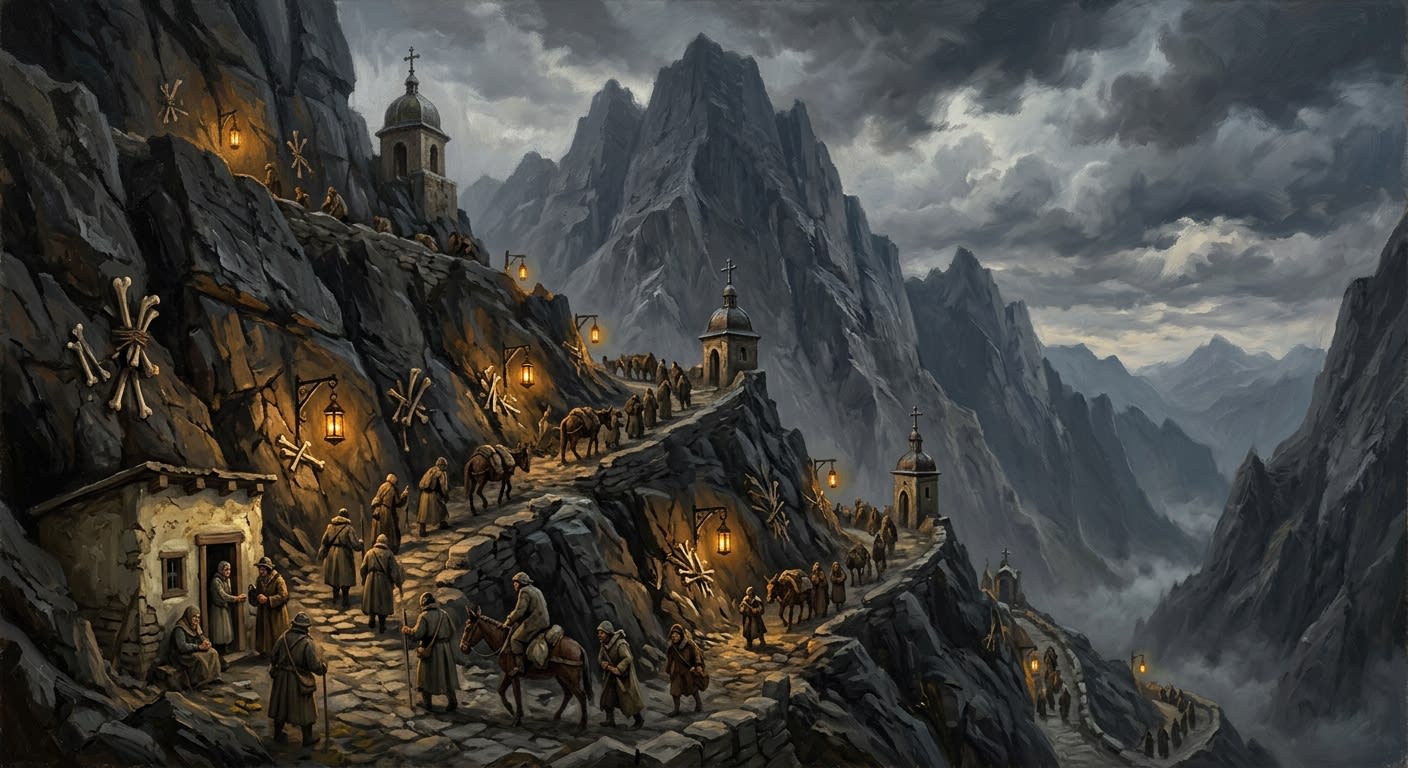
Before the Switchbacks had a name, before the Registry had a seal, before any clerk had cause to stamp a femur into shale — there was a shepherd's track. A goat-path, to be precise, scratched into the Carpathian chalks between the forward bastions and the rearward supply basins, used by local herdsmen who had no conception of relics, martyrdom, or the Bureau of Records, and who were therefore both happier and less theologically useful than anyone who would follow them. The track climbed two thousand feet in four miles. It killed a mule every season. Nobody counted.
The Synod found the track in A.S. 74, two years after the Bastion-Przemyśl convoy disaster that prompted the Beaconchain construction. A Bureau of War logistics survey — the Sixth Carpathian Route Audit, if you care for filing numbers, and the Bureau insists that you do — identified the pass as the sole viable corridor for moving relics between the highland bastions and the lowland rail spurs without crossing Velmora's gold-corrupted supply routes through the Transylvanian basin. The track was widened. Shrines were added. The Bureau of War called the shrines "waypoints." The Bureau of Pilgrimage called them "devotional stations." The Bureau of Tithes called them "revenue opportunities." All three were correct, which is the Synod's way of saying that money changes hands at altitude and the Creator takes His percentage.
The first femur was nailed into the shale in A.S. 76, two years after the initial widening, following an avalanche that killed forty-seven porters and fourteen mules on what was then called the Third Turn. The Bureau of Records declared the dead "martyrs of supply" — a designation that required neither miracles nor theological review, only a notary and a willingness to redefine martyrdom downward. The bones of seventeen dead were recovered. Their femurs were driven into the rock face at the turn where they died, and the turn was named for the most legible name on the most intact service tag. Saint Odrin. Nobody knows if Odrin was pious. His tag was simply the least blood-soaked.
By A.S. 82, every turn on the Switchbacks bore a name, a femur, and a toll. By A.S. 92, the Relic Registry Office had formalised licensing for relic passage, requiring a stamped Turn License, a Relic Handling Certificate, and a confession at each of the eight shrine stations — the confessions recorded on slate, copied to paper, and filed in a sub-archive beneath the Turn of Saint Odrin that nobody has inventoried since A.S. 140, because the clerk sent to do it was last seen entering the crawlspace and his replacement was promoted for discovering the crawlspace did not, officially, exist.
#On the Geography and the Climb
The Switchbacks occupy a knife-ridge in the Carpathian highlands, somewhere between 47° and 48° North — the Bureau of Records declines to publish the precise coordinates, citing "doctrinal cartographic discretion," which is the Bureau's way of saying that they do not wish smugglers to own accurate maps. The corridor runs approximately four miles from the lower registry at the Turn of Saint Odrin to the Summit Gate Reliquary, climbing two thousand feet through eight named districts arranged vertically along the mountain's flank like the rungs of a ladder built by a committee that could not agree on the spacing.
The terrain is shale and chalk and ice. The weather is whiteout and wind. The wind at altitude carries syllables — the locals call it "name-wind," and they do not mean this poetically. The sound is produced, the Bureau of Alchemical Standards assures us, by air compression through the shrine spires and femur-hollows, creating acoustic patterns that the human ear parses as speech. The Bureau of Alchemical Standards has not explained why the speech occasionally includes names that are not on the Registry's martyr list. The Bureau of Alchemical Standards has been asked to stop investigating.
The eight districts ascend as follows: the Turn of Saint Odrin, where passage begins and paperwork multiplies; the Marrow Market, where tallow smoke and chalk dust fill the air and bone-craft is sold to pilgrims who believe that proximity to a femur marker constitutes proximity to the Creator; the Porter Yards, where mule-lines form at dawn and the smell of leather and pine tar competes with something fouler that nobody admits is fear; the Shrine-Court of Seven Nails, which administers justice, licensing, and punishment with the efficient economy of an institution that sees no difference between the three; the Switchback Inns, where bunks are auctioned by body-heat contribution and a warm corner costs more than a clean conscience; the Cairnfield Terrace, where memorial stones conceal caches that the Bureau of Purity cannot find because the Cairn Wardens bless every stone and a blessing is, in the Synod's jurisdiction, a search warrant in reverse; the Hanging Mile, a catwalk bolted to the cliff face where the drop is a thousand feet and the chain rail vibrates in the wind like the string of an instrument tuned to a note the ear refuses; and the Summit Gate Reliquary, where the final seal is applied, the final confession extracted, and the mountain releases you into the highland basins with the distinct impression that it has permitted your survival as a bureaucratic courtesy.
#On the Inhabitants and the Economy
Eleven thousand souls live on the Reliquary Switchbacks. That is the Registry's number. The Porter Guild's number is higher. The Bureau of Tithes' number is higher still, because the Bureau of Tithes counts debt as population and on the Switchbacks, debt is immortal.
The economy runs on relic transport. Every bone, every splinter, every saint's tooth and martyr's knuckle that passes between the forward bastions and the rearward reliquary vaults must traverse the Switchbacks, must be stamped at each turn, must be witnessed by a licensed handler, must be confessed over by a shrine clerk, and must — above all — be paid for. The currency is plural: coin, ration chits, stamped papers, bone tokens, and "martyr-credits," which are Registry-backed devotion tokens that prove the bearer has contributed sufficiently to the martyrological record and may therefore skip certain scrutinies. Martyr-credits can be purchased. The Registry insists they cannot. The Registry's insistence has a price, and that price is also martyr-credits.
The Porter Guild — "the Knots," in local parlance — controls labour. No crate moves uphill without a porter, no porter works without a knot-mark card, and no knot-mark card is issued without a winter debt pledge that binds the bearer to the Guild's service schedule, the Guild's ration allocation, and the Guild's understanding of what constitutes a voluntary arrangement. Porter-Master Jaro "Knot" Ilwyn runs the Guild from the Porter Yards with hands like clamps and a friendliness that is genuine right up to the moment it becomes a threat. He knows every rope route, every hidden culvert, every mule that can carry and every mule that will die on the Hanging Mile. He charges accordingly.
The Marrow Makers process bone into wax, tallow, and bone-lime mortar. Their vats in the Marrow Market run day and night, producing the fat-smoke haze that gives the second turn its signature stench and its signature economy. What goes into the vats is supposed to be certified animal bone, blessed and tagged. What actually goes into the vats includes relic fragments skimmed from transport crates, unmarked bones of uncertain provenance, and — during one memorable audit in A.S. 191 — the left femur of a recently deceased auditor, which the Marrow Makers insisted was a processing error and the Bureau of Purity insisted was a confession waiting to happen.
#On the Shrine-Court of Seven Nails
The Shrine-Court of Seven Nails administers law on the Switchbacks, and the word "administers" is doing considerable work in that sentence.
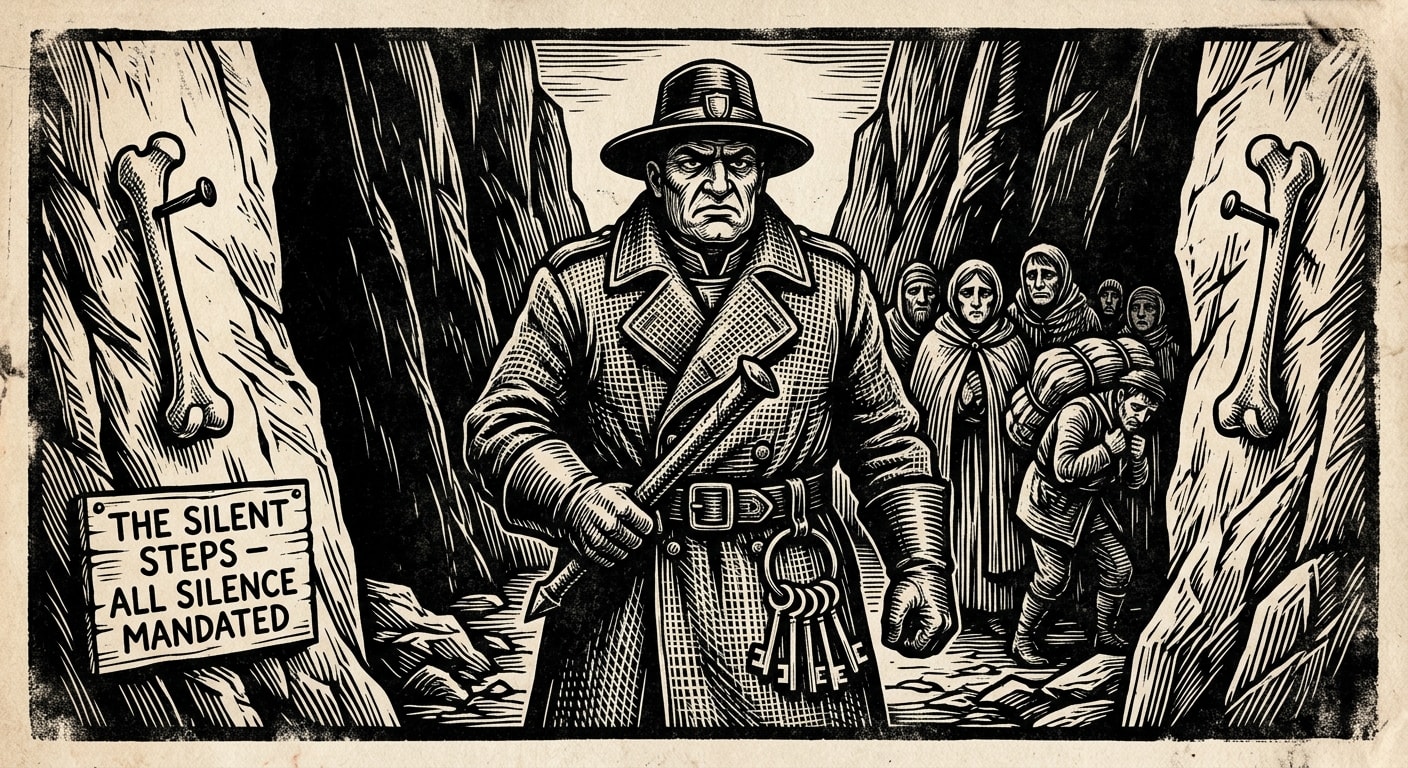
Warden-Captain Bronn commands the Court. He carries seven nail-keys on an iron ring at his belt — one for each of the seven catwalk locks on the Hanging Mile — and he hates laughter with a specificity that suggests laughter once cost him something he has not recovered. His wardens patrol the turns with nail-batons: short iron rods tipped with the same shale-nails used to pin femur markers into the rock. The symbolism is official. The bruises are also official. The Bureau of Doctrine certified the nail-baton as a "pastoral correction instrument" in A.S. 94, the same year oath-collars were mandated for smugglers on the Beaconchain, and has not revisited the certification since.
Prior editions of this Codex described the Shrine-Court of Seven Nails as a "judicial body operating under the standard Relic Registry charter."
The Court operates under a special dispensation granted A.S. 178 following the Counterfeit Crisis, which permits summary punishment without Registry appeal for offences classified as "relic-adjacent." The dispensation's definition of "relic-adjacent" has expanded in every annual review since its ratification and now covers speech violations, unlicensed songs, martyr-name mispronunciation, insufficient shrine donations, carrying untagged bones, and "demeanour inconsistent with the sanctity of the corridor," which Warden-Captain Bronn interprets at his discretion.
The Court's jurisdiction includes the Silent Steps — a segment of the path between the fourth and fifth turns where speech is fined. The official purpose is devotional silence. The practical purpose is that every word uttered on the Silent Steps is recorded by wardens positioned behind shrine walls, and speech fines are calibrated to extract confessions from those who protest them. A man fined for coughing on the Silent Steps may appeal; the appeal requires a spoken statement; the spoken statement incurs a second fine; the second fine requires a third confession; and by the time the process concludes, the Bureau of Records has a file on the appellant that would impress a seasoned inquisitor. Warden-Captain Bronn calls this "procedural efficiency." The porters call it something else, but they say it quietly, and they say it below the Silent Steps.
#On the Name-Drift and the Blank Saints
The Name-Drift began in A.S. 199, or it began earlier and was only classified in A.S. 199, or it has always been happening and the Registry chose A.S. 199 to acknowledge it because acknowledgment became cheaper than concealment. The Bureau of Alchemical Standards' report is inconclusive. Registrar-Mother Elske Vane's report is conclusive but classified. The mountain's report is written in bone and wind and does not require a seal.
During heavy storms — whiteouts that seal the corridor for days, driving porters and pilgrims into the Switchback Inns where bunks are auctioned at predatory rates and warmth becomes a commodity — the wind carries names. This is established. What is new is that some of the names are not on the Registry's martyr list. They appear as whispered syllables in the gusts, as vibrations in the femur markers, as ink that bleeds on slate in shapes the clerks can read but cannot source. And after the storm passes, the Registry adds the name. Retroactively. With a ledger entry, a femur marker, and a toll.
The Blank Saints believe the Registry is fabricating the names. They believe — and they have forged Registry slates, stolen seals, and storm knowledge to support their belief — that the martyr list is manufactured, that new turns are being created to generate new tolls, and that the Name-Drift is being exploited, or engineered, to justify those "discoveries." They operate from under-inn crawlspaces and behind cairn-backs on the Cairnfield Terrace, swapping turn-names, forging registry slates, and waiting for the storm that will carry a name so wrong that even the Registry cannot stamp it into legitimacy.
The Bureau of Purity has been informed. The Bureau of Purity has dispatched auditors. The auditors have climbed the Switchbacks, examined the slates, interviewed the wardens, and filed reports concluding that the Registry's records are in order and that the Blank Saints are heretics whose theology is "incompatible with the established martyrological framework." The auditors' reports do not address why new toll-turns keep appearing after storms. The auditors were portered down the mountain by Guild carriers and did not look back.
#On the Hanging Mile
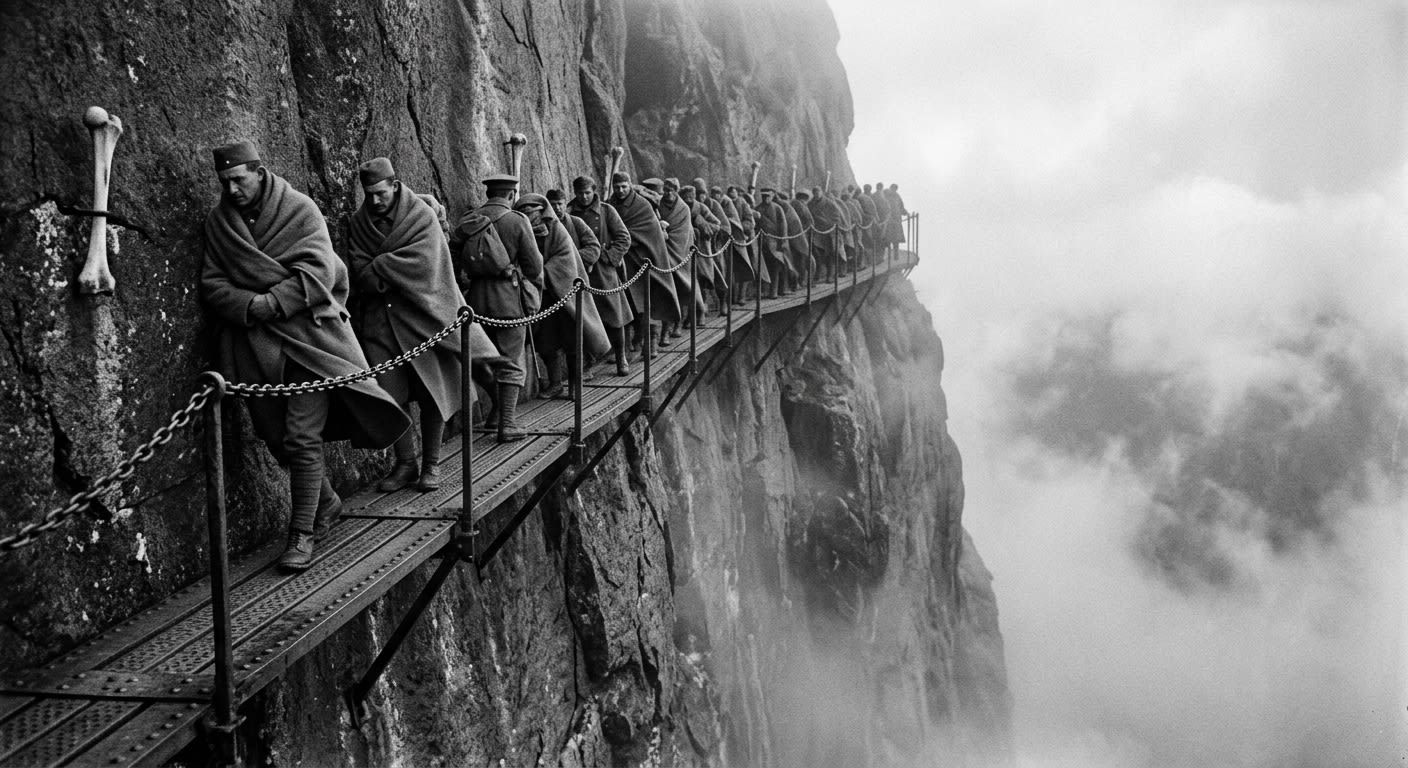
The Hanging Mile is a catwalk bolted to the cliff face between the Cairnfield Terrace and the Summit Gate. It is one mile long, the drop beneath it is one thousand feet, and the chain rail that prevents you from falling is locked at seven points by Warden-Captain Bronn's seven nail-keys, so that sections of the mile can be sealed at his discretion — during storms, during audits, during "purity seasons," and during whatever private calculations Bronn conducts with his ring of keys and his hatred of laughter.
The catwalk is three feet wide. The wind at this altitude arrives horizontally. The chain rail vibrates. The femur markers nailed into the cliff at ten-pace intervals creak like rigging on a ship whose keel is the entire mountain, and the sound the bone makes when the temperature drops below freezing — a high, thin, sustained note — is classified by the Bureau of Alchemical Standards as a "Category Two Localised Acoustic Anomaly" and by the porters as "the mountain singing for the dead."
Beneath the catwalk, the smugglers of the Quiet Turn use the underside rope routes to move relics, fugitives, and contraband between the Cairnfield Terrace caches and the Summit Gate. Their routes are invisible from above — braided cord and anchor bolts driven into the underside of the catwalk's iron frame, used at night when the wardens patrol the surface and the wind is too loud for footsteps to carry. The Quiet Turn's leader is unknown. Their product is passage. Their price is silence, and on the Hanging Mile, silence is the one currency that never loses value.
#On the Present Condition
The Reliquary Switchbacks are, as of A.S. 201, operational. The Bureau of War classifies their status as Amber — which means the corridor functions, the relic traffic moves, and the deaths remain within acceptable statistical parameters, where "acceptable" is a number the Bureau revises upward each year with the quiet industry of men who have learned that adjusting the threshold is cheaper than adjusting the mountain.
The Name-Drift storms intensify. New turn-names appear without paperwork. The Registry stamps them into the ledger and nails fresh femurs into fresh shale and charges fresh tolls, and the cycle accelerates with the smooth momentum of an institution that has discovered it can mint revenue from weather. The Blank Saints grow bolder. The Shrine-Court of Seven Nails grows harsher. The Porter Guild grows restive, because winter debts convert to conscription and the inns become death-houses when the summit gate seals, and the porters have begun to notice that the gate seals more often, and earlier, and that each sealing generates precisely the kind of panic from which the Registry extracts the most confessions.
Registrar-Mother Elske Vane sits in her office at the Turn of Saint Odrin with a soft voice and a stamp that has never been wrong on paper. Warden-Captain Bronn patrols the Hanging Mile with his seven keys and his iron contempt. Porter-Master Ilwyn watches from the Yards with hands like clamps and a tally of debts that grows longer than the mountain is tall. And the wind carries names. New names. Impossible names. Names that the Registry should not recognise but does, names that appear on slates before the clerks have written them, names that the femur markers vibrate to in the dark.
The mountain remembers. The Registry records. The two activities are, Registrar-Mother Vane assures me, identical.
This Codex entry originally contained a margin note questioning the theological basis for martyr-credit commerce. The note has been removed at the request of the Relic Registry Office, which assures the Bureau of Doctrine that all commerce on the Switchbacks is devotional in character and that the distinction between toll and tithe is, on a mountain where God watches from every femur, "a matter of altitude, not avarice."
The Bureau of Doctrine accepts this clarification. The Bureau of Doctrine notes that acceptance and belief are, in certain administrative contexts, distinct operations.