
#On the Guild and Its Market
"Warmth is a currency that spends itself." — proverb of the Reliquary Switchbacks
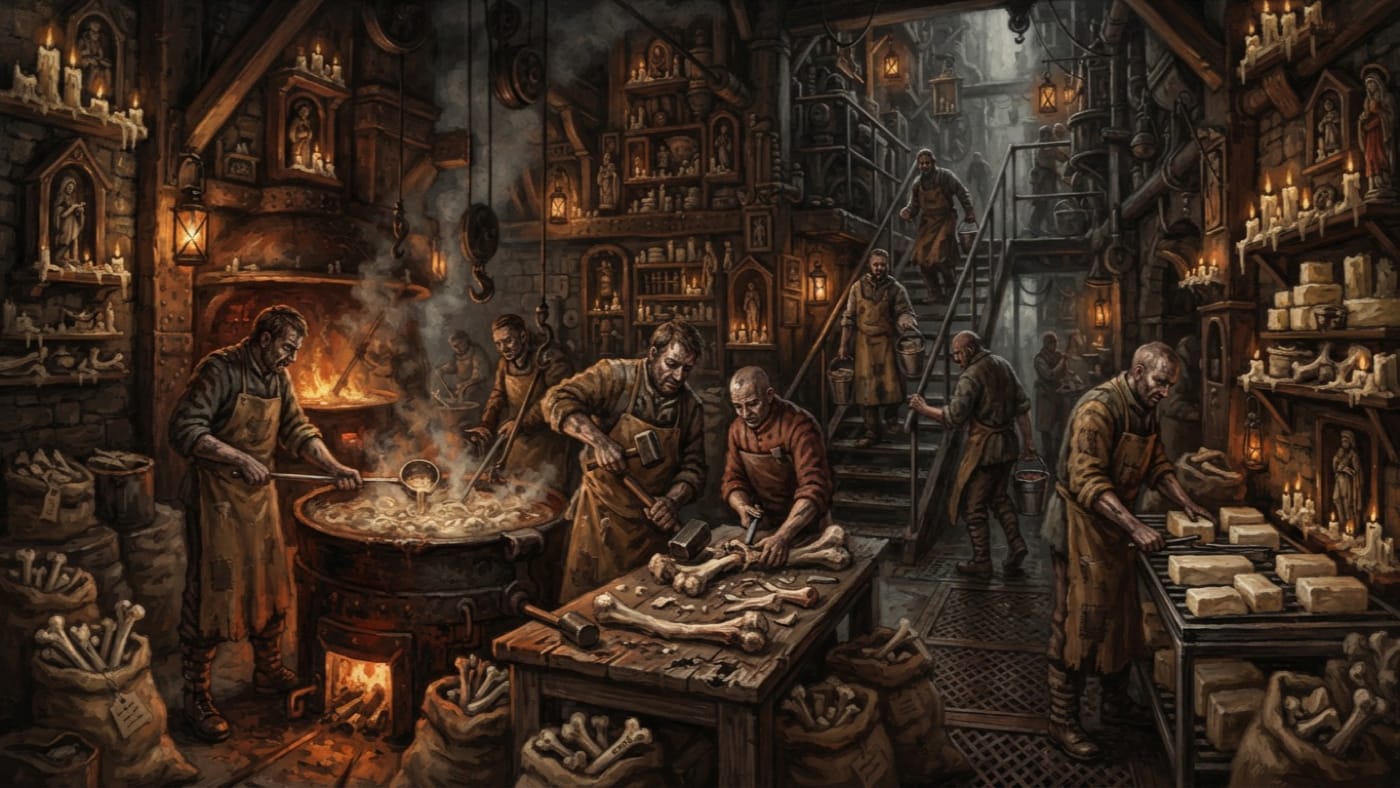
On the Reliquary Switchbacks, the second turn smells of fat smoke and chalk dust, and the smell belongs to the Marrow Makers. They are a craft guild. They hold the Marrow Market the way a parish holds its bells: by long habit, by indispensability, and by a charter that the Codex has not been shown. Their premises are vats and smokehouses. Their customers are the shrines, eight turns of them, each with lamps to keep, confession hatches to light, femur markers to anoint and pilgrims to impress.
If the Makers stopped work, the corridor would go dark within a week. Every lantern raised on the Lantern Anointing Steps and every candle set before a shrine clerk's slate comes out of these vats or competes with something that did. So does every block of tallow handed over at an inn as warmth tax. The bone-lime mortar that patches shrine walls against the frost comes from the second turn as well, and so does the stock that thickens the broth in the porters' bowls. The Bureau of War does not count candles among its strategic assets. It should, and so should anyone who has climbed past the Cairnfield Terrace after dark.
The hands at the vats belong to wax-makers and marrow-scrapers, two of the oldest trades on the mountain. Scraping marrow is also one of the accepted ways to pay down a winter debt on the Switchbacks. How many of the guild's scrapers are working off a debt and how many are earning a wage is a figure the Makers have never volunteered, and the Codex has not asked twice.
#On the Vats and the Shrine Trade
The vats burn day and night. They produce wax, tallow and bone-lime mortar, and the Relic Registry Office's licensing language is very clear about what they may consume: certified animal bone, blessed and tagged. The tag is the bone's passport. It names a beast and a source, it carries a blessing, and it lets a sack of shanks climb past the Turn of Saint Odrin with the same dignity as a saint's knuckle, though at a lower toll.
The marrow and fat are rendered and go into the tallow and the blend. The stripped bone goes to the fire that turns it into lime, and the lime comes back as mortar. The Codex declines to publish the proportions, partly from respect for trade secrets and mostly because nobody has supplied them. The work itself is easy enough to describe: scalded forearms, lungs coated in chalk, a fire risk the Shrine-Court lists among the corridor's ordinary hazards, and a smoke so thick that pilgrims climbing from the first turn smell the second before they see it.
Tallow is money on the Switchbacks. Coin is scarce at altitude, ration chits are counted twice, and martyr-credits are for people with Registry friends. Tallow, by contrast, can be burned, eaten in a hard winter, or handed to a warden. Innfolk pay their warmth tax in it. Petty dues are settled in it, and petty bribes go along in the same parcel. Every shrine buys light, every pilgrim pays the shrine for a candle, and the Makers sell to both, which makes them the only party on the mountain that profits from devotion and darkness together.
All bone entering the Marrow Market vats is certified animal bone, blessed and tagged.
The sentence above reproduced the Relic Registry Office's licensing terms and was taken by the compiler as a description of fact. The Codex's own survey of the Switchbacks records that the vats also receive relic fragments skimmed from transport crates and unmarked bones of uncertain provenance. The licensing terms are accurate. They describe the licence.
#On the Holy Blend
Every relic moving between the forward bastions and the rearward reliquary vaults has to pass the second turn, in crates that are opened, stamped, witnessed, confessed over and closed again. A crate opened that many times loses things. A splinter goes, then a chip, then a sliver of something the manifest calls "fragmentary, assorted." Among the local types the Switchbacks have learned to recognise is the marrow-scraper who pockets fragments "for warmth," and the phrase deserves more respect than it gets. In this trade warmth means tallow, and tallow with a saint in it fetches a better price.
The guild calls the product holy tallow. More precisely, the guild never writes the words down. It leaves them to rumor, which is one of its three recognised methods, alongside blending and bribery. The blend is the craft: a fragment of relic, the fat of a certified beast, perhaps an unmarked bone whose owner left no tag behind, all rendered together into a block that smells of the second turn and sells for more than the last block did. The rumor is the marketing. A pilgrim told that his lantern-wax "came off the saint's own crate" will pay without asking which saint or which crate. The bribery takes care of the clerks who might ask.
Here the matter turns into theology, which is why my office has been asked to rule on it. A relic is holy because its custody is documented. It has a tag, a Relic Handling Certificate, and a chain of stamped hands running back to a grave or a battlefield. A Relic Authenticator attests to that chain. Whether the Creator answers a particular bone is a separate question, and the Bureau of Relics files its answers to that question somewhere else. Once a fragment is rendered, the chain is gone. The certificate refers to an object that no longer exists. Holy tallow therefore cannot be certified holy, and for the same reason it cannot be certified otherwise. The Makers have built a lucrative trade inside that gap in the paperwork.
None of this means every candle on the mountain is a stolen saint, or that every apron at the vats is complicit. Honest wax is made on the second turn every day. Unfortunately it looks exactly like the other kind.
#On Weights and Examination
The Makers' trouble comes from arithmetic, not prayer.
A tag records a weight. The Registry knows how much certified bone climbed to the second turn, and anyone with a scale and a working memory knows roughly how much tallow that bone can yield. If a vat renders more than its tags allow, something without a tag went into it. The audit of tallow weights is therefore the one inspection on the Switchbacks that no amount of blessing can satisfy. Auditors arrive, every block is weighed, and the guild's chief fear is having its tallow weighed.
Three authorities take an interest, and each has its own reasons. The Relic Registry Office, under Registrar-Mother Elske Vane, controls the licences and authenticity stamps without which the Makers cannot legally receive a single certified shank, and it collects on every crate whose contents the Makers later blend. The Shrine-Court of Seven Nails, under Warden-Captain Bronn, holds a special dispensation granted in A.S. 178 after the Counterfeit Crisis, which permits summary punishment without Registry appeal for any offence classed as relic-adjacent. Carrying untagged bones is forbidden on the corridor. A vat full of them is about as relic-adjacent as an offence can get. The Bureau of Purity is interested in the contents of the vats themselves.
All three buy the product. The Registry's booths burn the guild's candles, the Court's cells are lit by them, and wardens are paid in them. The Synod inspects the trade it depends on with real rigour and pays for the inspection in tallow.
The Codex's survey of the Switchbacks records one audit, held in A.S. 191, at which the inputs awaiting processing were found to include the left femur of a recently deceased auditor. The Marrow Makers called it a processing error. The Bureau of Purity treated it as grounds for investigation. No other account of the episode has reached this office. The Codex records the two explanations as the parties gave them, it does not name the auditor, and it does not publish a finding that has not been filed. The Bureau of Records has been asked to locate one.
#On the Present Trade
As of A.S. 201, the year of the Codex's survey of the corridor, the Switchbacks hold Amber status under Bureau of War Logistics Command, and the vats on the second turn have not gone out. Shrine demand climbs with the pilgrim count. Relic traffic climbs with the war. Every crate that passes the Marrow Market leaves a little of itself behind.
Among the heretics there is talk of a "wax hymn," tallow that is said to sing. It circulates among people already condemned for worse speech, and the Bureau of Doctrine has not dignified it with an inquiry. The Codex records it as a rumor. No authenticated candle has said anything.
The Bureau of Tithes has noted, with some regret, that tallow dues cannot be raised without raising the price of the shrines' own light. Wax is a serious business wherever the Synod keeps its seals, as the Candlewick Palatinate could tell anyone who asked, and the Makers are its mountain branch. Their product is smaller and smokier, and its pedigree is a good deal harder to document.
The Marrow Makers remain licensed. Their weights remain subject to audit. Their candles remain lit in every office that audits them.