
#On the Second Turn
"Every turn is paid twice: once in coin, once in breath." — proverb of the Reliquary Switchbacks
Pilgrims leaving the Turn of Saint Odrin, Turn Licenses still tacky with Registry ink, smell the Marrow Market before they see it. Fat smoke comes down the carved steps to meet them. Chalk dust comes with it, as fine as flour and a good deal less nourishing. By the time the path doubles back above the lower registry their tongues taste of tallow and their cuffs have gone white. This is the second of the eight established districts of the Reliquary Switchbacks. It lies between the paperwork below and the mule-lines of the Porter Yards above, and it is a market only in the sense that a confessional is a conversation.
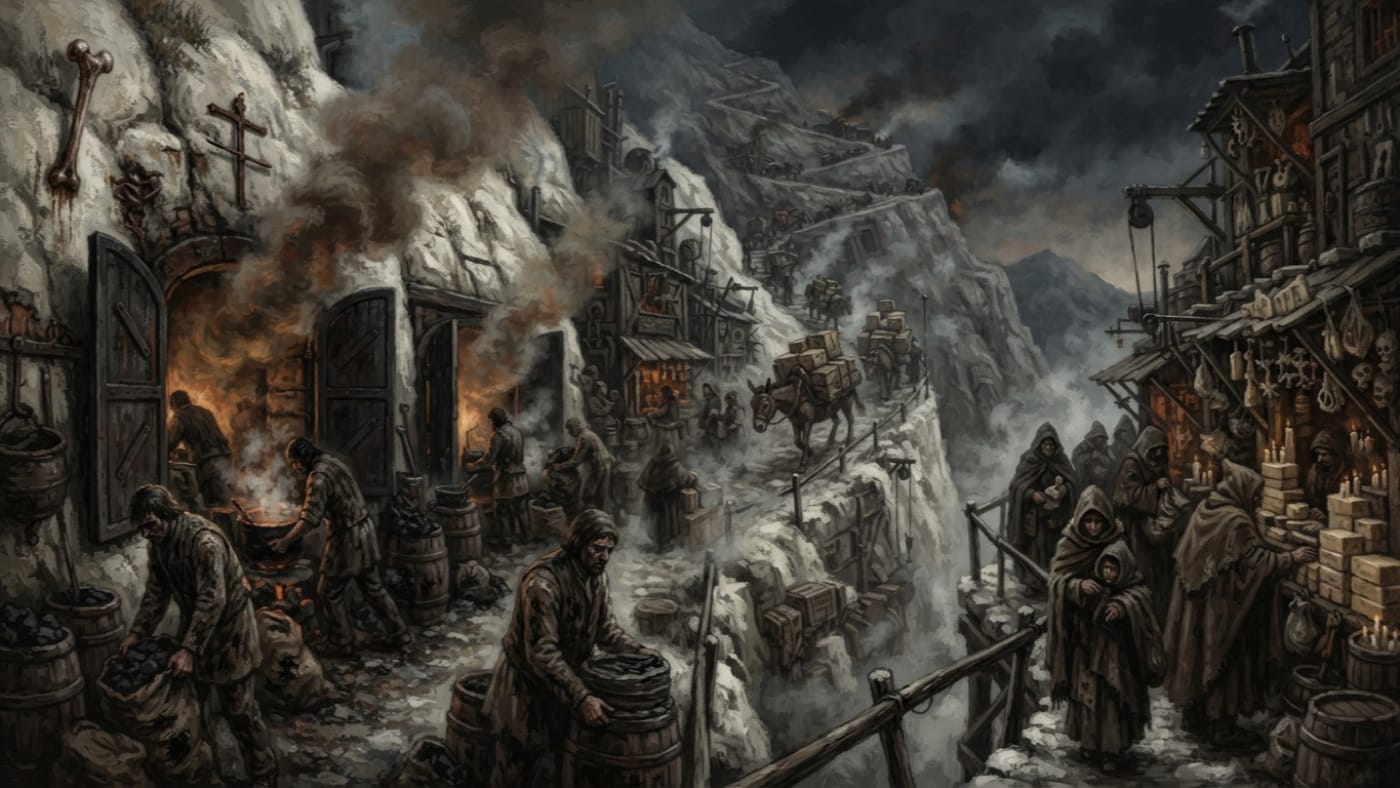
Do not picture a square. The Switchbacks own no level ground. They have a shelf of shale and a cliff to lean on. On the uphill side the vat-houses are cut back into the chalky rock. On the downhill side, wherever the drop permits, stalls sell bone-craft. Between them runs a path wide enough for two mules, provided neither mule has opinions. A femur marker is nailed into the rock above the vat doors with rusted iron, as at every turn. Heat pours out of those doors into air that has come straight off the snow shelves. Customers haggle with their faces roasting and their backs freezing, which the shrine-keepers call a foretaste of judgment.
Nobody has told the Codex when the first vat was lit. Before the Switchbacks there was a shepherd's track. In A.S. 74 the Church's wartime logistics offices, catalogued since the constitutional settlement of A.S. 90 under the Bureau of War, widened it. By A.S. 82 every turn had a name, a femur and a toll. Shrines want candles, lanterns want tallow and femur markers want mortar, so the trade settled where the traffic was forced to slow. That is all the history the second turn will admit to, and it admits it with smoke in its mouth.
#On the Vats and the Hands
The Marrow Makers hold the vats and the smokehouses. They are a craft guild, and their declared trade is wax and marrow products for the shrines. The parent survey adds tallow and bone-lime mortar to that list and records that the vats run day and night. Fat and marrow go toward the tallow. Stripped bone goes toward the lime, and the lime goes back up the mountain as the mortar that patches shrine walls and holds the inscriptions in place. The Codex will not publish yields, temperatures or proportions. Nobody has supplied them, and a Hieromnemon who guessed at them would deserve whatever the Bureau of Purity charged him with.
None of it grows at altitude. Coal and char climb from the basins, as do iron nails, cloth and paper, and every sack rides on a Porter Guild back that Porter-Master Jaro "Knot" Ilwyn has allotted and priced from the Yards one turn up. The Makers sell warmth and pay for the fire that makes it, which is a theology of its own, and the Guild collects on both ends.
Two trades do the work. Wax-makers tend the vats and pour the blocks. Marrow-scrapers clear the bone, and scraping marrow is one of the recognised ways to pay off a winter debt on the Switchbacks, which says enough about the work. The scrapers' knuckles split in the cold and blister at the vats, often within the hour. The chalk gets into their lungs and does not leave. On the mountain the marrow-scraper is said to pocket fragments "for warmth," and the saying fits a trade in which a man's pay is calculated as the part of the debt he has not yet worked off.
The honest product is useful, and the Codex says so plainly. It lights confession hatches and lanterns, mortars shrine walls against frost, and thickens the broth in porters' bowls. The dishonest product looks the same in the block. The difference lies in what went into the vat, which leaves no trace in the wax that a pilgrim could detect.
#On What May Be Sold
On the Switchbacks every bone needs a document. A relic moving between the forward bastions and the rearward vaults carries a Turn License and a Relic Handling Certificate. It travels under witness and custody marks, and it is confessed over at each shrine station on slate, which clerks below later copy to paper. Unregistered relics are forbidden cargo. Untagged bones are forbidden cargo as well, and in local speech an unnamed bone is a "blank saint," a term of abuse the Codex keeps distinct from the heretic cell that has borrowed it. The Makers' licensed input passes under the same system, since animal bone must be certified, blessed and tagged before it may enter a vat.
All the relic traffic on the mountain passes the vat doors, and the mule-lines bunch there before the climb to the Porter Yards. The Makers needed no monopoly or franchise of any kind, because the mountain put every relic crate within reach of the vat doors. The corridor's own lore records smugglers hiding relics in marrow casks. The traffic, in short, has gone both ways.
The market takes whatever the mountain spends: coin, ration chits, stamped papers, bone tokens and oath-notes. Martyr-credits circulate as well, but they are the Registry's to issue, and a Maker who claimed otherwise would be explaining himself to the Registry soon after. Tallow has a currency of its own. It settles dues, and it goes along as the bribe inside the dues. The innfolk call their tallow payments the warmth tax. The shrine-keepers buy candles by the crate. Pilgrims buy bone-craft trinkets in the belief that being near a femur marker means being near the Creator. The Codex is not invited to rule on that belief, and the trinket-sellers have priced it with care.
Then there is holy tallow, also sold as holy blend. Its price includes the rumour of what went into it, and the guild's documented methods are blending, rumour and bribery, in roughly the order a customer meets them. The Bureau of Tithes has no column for a rumour, and so the rumour goes untaxed.
The Relic Authenticator exists for this kind of trade, with provenance records, certificates and seals, and confiscation for whatever fails them. An authenticator could name the knuckle in a crate. Once the knuckle has been rendered into a block of tallow there is nothing left to name.
#On Weights and Examination
Three authorities reach into the second turn, and none of them has an office there.
Registrar-Mother Elske Vane issues licences and authenticity stamps from the Turn of Saint Odrin, one turn below. Her clerks climb up with slate satchels and a scale. Warden-Captain Bronn commands the Shrine-Court of Seven Nails from higher up. Since A.S. 178, his court has held a special dispensation that allows summary punishment, without Registry appeal, for offences ruled relic-adjacent, and the list of such offences now includes carrying untagged bones. The Bureau of Purity holds no seat on the mountain but takes a professional interest in vats.
The audit is a matter of arithmetic. A given quantity of certified bone should produce a given quantity of tallow and lime. A surplus of tallow means the vat consumed something nobody tagged. The parent survey names the audit of tallow weights as the Makers' pressure point, and the scale explains why: it measures what a confession hatch never will.
Earlier drafts of this entry described the Marrow Market vats as rendering certified animal bone, blessed and tagged.
That is the licensed input. The Codex has no proof that it is the actual input. The corridor survey reports relic fragments skimmed from transport crates and unmarked bones of uncertain origin entering the vats, and the Codex does not confuse what a licence permits with what a vat consumes.
The corridor survey records one audit in particular. In A.S. 191, by its account, examiners found the left femur of a recently deceased auditor in the vats. The Makers called it a processing error. The Bureau of Purity called it grounds for investigation. The survey gives no name for the auditor, no finding on how the femur arrived, no perpetrator and no verdict, and the Codex adds none. It notes only that each institution gave its account in its own professional vocabulary, and that one of those vocabularies includes the word "error."
#On the Present Trade
As of A.S. 201 the market operates. The Synod's Bureau of War Logistics Command rates the whole corridor Amber, and the second turn shares that rating, having none of its own. The vats run, the crates pass, the pilgrims buy and the scale is carried up from Saint Odrin.
Winter applies the pressure. When the First Snow Seal closes the summit, debts convert, the inns fill and the warmth tax rises at the same rate as the cold. More scrapers come to the vats on debt. More inspections come down from Seven Nails. More rumours about the blend go out with the tallow, and the Bureau of Pilgrimage records the faithful who buy it as devotional traffic.
Heretics on the mountain speak of a "wax hymn," a block of tallow that sings. The Codex records it as a rumour attributed to heretics. No candle has been authenticated as speaking, no vat has been shown to have anything to do with the storms, and the Name-Drift remains the corridor's phenomenon, explained in several conflicting ways. The Codex does not settle that dispute in a district that cannot document its own first fire.