
#On the Terrace and the Climb
"If the turn speaks first, don't answer." — Porters' saying, the Reliquary Switchbacks
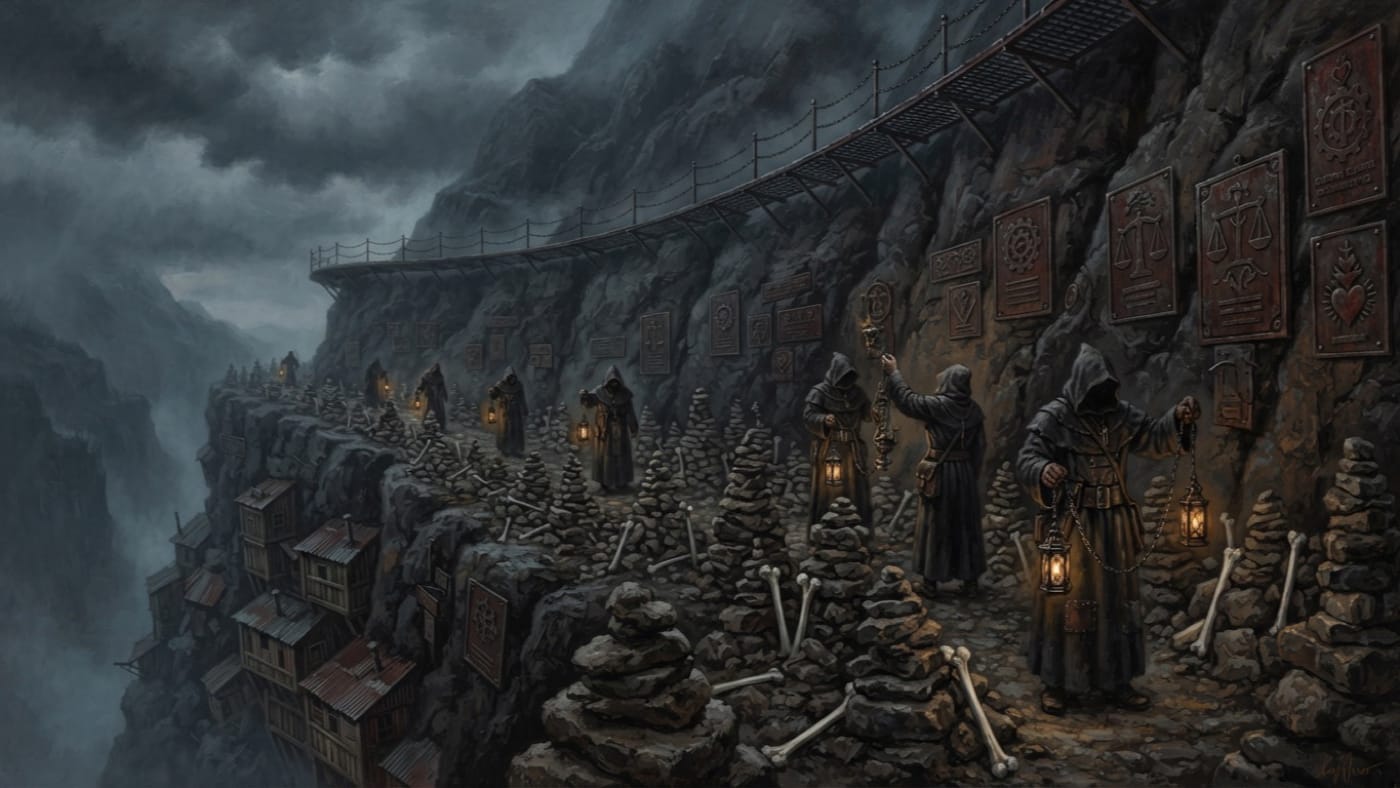
Cairnfield Terrace is the sixth district of the Reliquary Switchbacks. It is the last ground on the climb where a traveller can stand on something level before the mountain takes that privilege away. Below it are the Switchback Inns, where bunks are auctioned by body heat. Above it the Hanging Mile begins: three feet of bolted iron over a thousand feet of drop. Between the two, on a shelf of cold shale furred with lichen, the dead are kept in heaps.
The heaps are cairns, and there are a great many of them. The Bureau of Records has never surveyed the Terrace to its own satisfaction. It keeps corridor totals for the Carpathian ascent: four miles, two thousand feet of climb, eleven thousand registered souls. It declines to divide them by eight, on the grounds that the mountain does not share out its dead evenly and the Registry sees no reason to start. Nobody lives on the Terrace in any sense the census recognises. A good many people are there at night.
Cairns stood on the pass before clerks did. Shepherds piled stones to mark the track long before the Church's emerging logistics offices widened it in A.S. 74, drove the first femur into the shale in A.S. 76, and by A.S. 82 had named, marked and tolled every turn. No ledger I have been allowed to see records when the present Terrace took its name or its keepers. The Bureau considers the gap tidy. I consider it convenient, and on this mountain those are the same quality in different gloves.
#On the Stones and Their Keepers
The Switchbacks bury their dead the mountain way. The body is laid on the shelf and weighted with stone. More stone is added until the shape becomes a cairn, and in time the cairn becomes property. Before the weighting, if the deceased is suitable and the licence is in order, a licensed hand takes the femur. That bone goes to replenish the markers nailed along the route, the white stakes that stop any pilgrim from claiming he lost the way. The cairn keeps everything else. The Registry treats the two as entirely separate, and you should too: the stones are memorials and the femurs are infrastructure. The Terrace mourns one and inventories the other.
The Cairn Wardens keep the stones. They are either a militia that prays or a monastery that patrols. The Registry's word for them is "hybrid," which is what clerks call a thing when they would rather not decide what it is. Their public duty is to protect the memorial field from theft, desecration and careless boots. They walk the Terrace in blessing patrols, with tallow-wax lanterns swinging on lengths of salvaged chain, and they bless every stone they pass. Every stone, every day in fair weather, and more often when an inspector is expected.
The Bureau of Purity has noticed how often. Its searchers climb with warrants to open whatever needs opening. They find that a cairn blessed that morning is ground in active pastoral use, that the Warden who blessed it will say so at length, and that the question of whether a warrant outranks a blessing has been referred upward so many times the answer now sits somewhere in the Church that no searcher has ever reached. In the parent entry I called a Warden's blessing a search warrant in reverse. The Wardens have taken the phrase as a compliment, and I have not withdrawn it.
The Wardens also hold keys. What those keys open is not published. They have no connection to the seven nail-keys on Warden-Captain Bronn's ring, which lock the chain rail of the Hanging Mile and belong to the Shrine-Court of Seven Nails (Unregistered). Bronn's keys are counted, ringed and worn openly on a belt. The Wardens' keys are kept less publicly. They also keep lookout posts above the field, from which a patrol can watch the climb arrive long before the climb sees the patrol.
#On the Traffic Behind the Cairns
The corridor's real accounts are kept behind the cairns. Its black market works the Terrace and the crawlspaces under the inns, dealing in forged shrine marks, swapped relic tags and passage by bypass routes the Registry has never tolled. Porters call those routes ghost turns. Payment is in coin, ration chits, stamped papers, bone tokens and martyr-credits of varying honesty. Above the inns the currencies of altitude also apply: heat, a reliable porter, a spare pair of gloves.
Goods do not wait out in the open. They wait under the cairns. A cairn is a heap of stones on a body, and nobody measures how far down the heap goes. At night caches are moved beneath the stones, and fires are lit behind memorial slabs where the wind cannot carry the light downhill. The Wardens control which stones are disturbed and when. On any given night their patrols are either somewhere else or exactly here, under arrangements the Bureau has not been shown.
One heap is called Saint's Cairn, and it hides the mouth of a culvert. The corridor's under-step culverts were cut to carry runoff. This one carries other things. No document available to this office says which saint the cairn honours, who lies beneath it or when it was raised. The name may be devotion or it may be a porter's joke. The Switchbacks file both in the same drawer.
Demand needs no sermon to explain it. Winter debts turn into porter conscription. Every turn has its licence and every licence its fee. The Summit Gate seals in bad weather, and the inns become altitude prisons until it opens again. A porter with a winter debt and a sealed gate above him has three choices: wait out the whiteout at bunk-auction prices, sign his back over to the Guild, or find a hole behind a stone. Porter-Master Jaro "Knot" Ilwyn runs the Guild from the Porter Yards, not from this Terrace. He knows every culvert on the mountain, though, and he knows whose backs carry crates by night. Registrar-Mother Elske Vane governs the Terrace from the Turn of Saint Odrin in her own way: every forged mark sold behind these stones is an imitation of one of her stamps.
The Quiet Turn smugglers use the Terrace caches as the lower anchor of their route. Relics, fugitives and contraband rest under the stones, then go up by the braided ropes slung beneath the Hanging Mile toward the Summit Gate Reliquary (Unregistered). The Quiet Turn's leader is unknown. Rumour says it pays wardens without saying which ones. What can be certified is that the Wardens control the ground and the Quiet Turn uses it. Whether that use is rented, tolerated or simply not prevented, I cannot say. The porters who know will not discuss it on a Terrace where every stone has been blessed by someone within earshot.
The market behind the cairns sells nearly everything. It cannot sell the true seal of the Summit Gate.
#On Names and Unregistered Bones
Not every cairn has a name. The Terrace holds a number of what porters call blank saints, in lowercase: bones under stones with no legible tag and no line in the ledger. The Registry treats them as a paperwork shortfall awaiting correction. The Blank Saints, capitalised and organised and heretical, treat them as evidence.
The cell works from the backs of cairns on this Terrace and from the crawlspaces under the inns below. According to the Bureau of Purity's files, it aims to prove the martyr list was manufactured and to end the Registry's control of names. Its methods are swapped turn-names and forged Registry slates, and its resources are stolen seals and an uncomfortably good knowledge of the weather.
The weather is the problem. In heavy storms on the Switchbacks the wind carries syllables, the femur markers vibrate, and ink bleeds across slate into shapes the clerks can read but cannot trace to any source. Once the storm passes, the Registry adds a name, a marker and a toll. Porters also report that after a whiteout the cairns on the Terrace are no longer where they were, that the stones have been rearranged overnight with no hand anyone will admit to. Some put it down to wind and some to frost-heave. Some blame the Wardens and some the mountain. The Blank Saints blame the Registry, at least for the names, and they say the storms are being exploited, or engineered, to justify each new "discovery." The Bureau of Purity's auditors have climbed up, examined the slates and found the records in order.
The Registry answers with its certificate of A.S. 200, which confirms martyrological integrity and is counter-signed at Strasbourg by the Bureau of Records.
That certificate settles the provenance of every bone on the Terrace, named and blank alike, and the Blank Saints' case along with it.
The A.S. 200 certification confirms that the Relic Registry's records are in order, and it remains in force. By its own terms it does not examine what lies under a cairn. An orderly ledger proves that the ledger is orderly. The Bureau of Doctrine withdraws the inference and keeps the certificate.
#On the Present Condition
In A.S. 201 the Bureau of War rates the whole corridor Amber, meaning operational and within acceptable losses. The Terrace shares that rating as the sixth part of eight and receives no separate assessment. The Summit Gate seals more often and earlier than it used to. Auditors rotate faster. The Wardens bless more often to keep pace with them. The Blank Saints wait for a storm that will bring a name so wrong even the Registry cannot stamp it into legitimacy, and the Quiet Turn moves whatever the storm leaves behind. Above the field Warden-Captain Bronn locks and unlocks the Hanging Mile on his own judgement. Below it Porter-Master Ilwyn's book of winter debts keeps getting longer.
The cold has no stake in any of this. It does settle into the lichen and the stones and the hands of anyone who digs at night. The Terrace smells of cold stone and old blood. The second smell the Registry attributes to the burial practice, and the burial practice is licensed.
Disposition: Cairnfield Terrace remains memorial ground under the jurisdiction of the Relic Registry and the Shrine Courts, and in the practical keeping of the Cairn Wardens. Any inspection will be applied for, blessed and referred upward in the usual way.