
#On the Unregistered Name
"If the turn speaks first, don't answer." — porters' saying, the Porter Yards
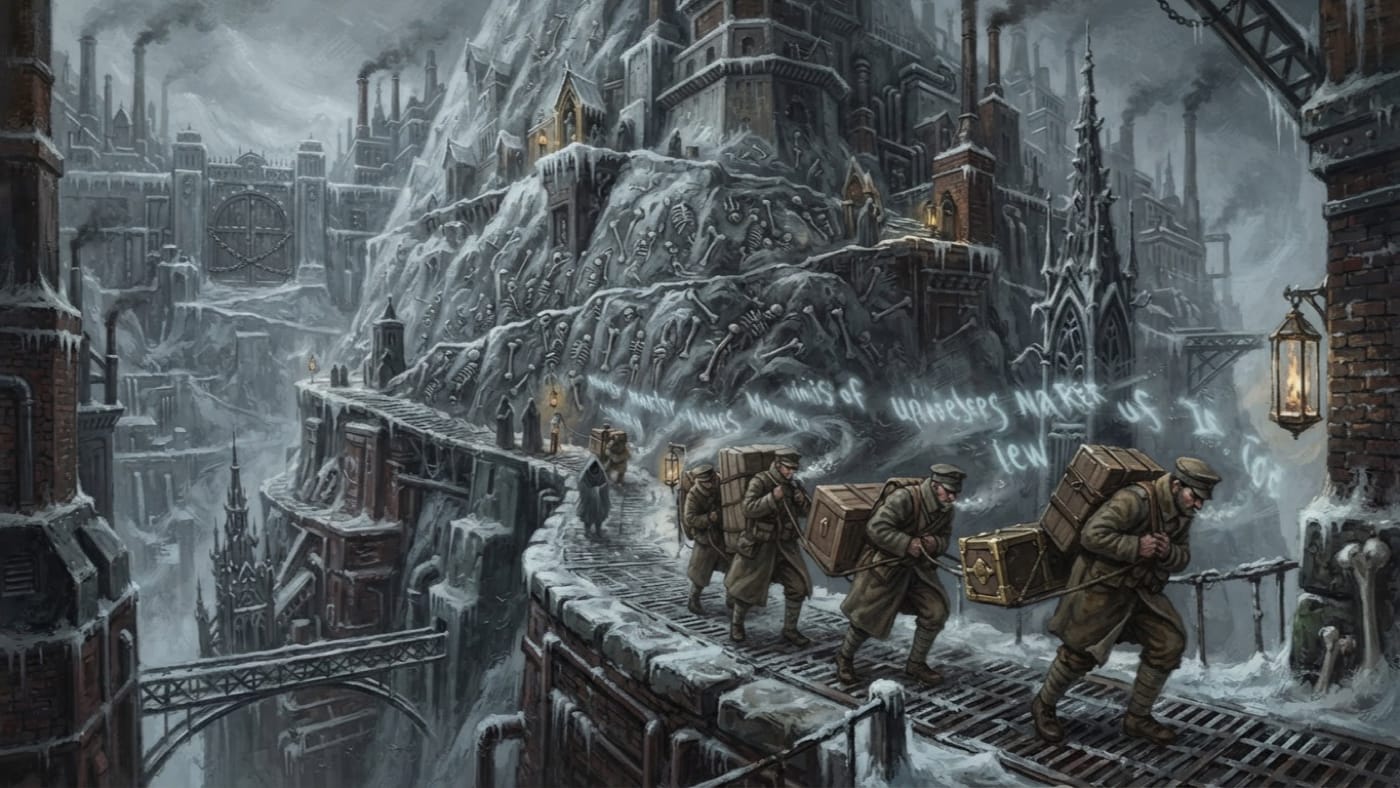
Every name on the Reliquary Switchbacks belongs to someone, and that someone is the Relic Registry Office. Saint Odrin holds the first turn because a clerk granted him the lease. The femur in the shale is the deed. The toll is the rent.
On the corridor, Name-Drift is the word for a name that arrives without a deed.
It must be kept apart from name-wind, which is only weather. Name-wind is the whistle a Carpathian gale makes through shrine spires and bone-hollows on the four-mile climb. The ear insists on hearing it as syllables, and every porter who has hauled a crate past the Marrow Market has heard it and kept hauling. Name-wind repeats the list. Name-Drift, going by the testimony the Registry itself now files, is a heavy storm that carries a martyr-name found nowhere on the list. The name is clear enough to read, specific, and has no source.
The Registry entered the phenomenon in its records in A.S. 199. The Registry does not claim that A.S. 199 was the first storm to do this, and I will not claim it for them. Acknowledgment is a clerical event. The beginning belongs to the mountain, and the mountain keeps no register.
The corridor is not afraid of hearing the name. It is afraid of repeating it.
#On the Storm's Evidence
Four manifestations are reported, and the Registry's own clerks supply most of the reports. Syllables come in the gusts, whispered rather than whistled, shaped like a name and without the repetition of name-wind. The femur markers vibrate, a buzz in the bone that anyone foolish enough to lay a bare palm on one in a whiteout can feel. Ink bleeds on the confession slates at the shrine stations and spreads through the chalk film into letters a clerk can read but cannot trace. And the tallow lanterns along the turns flatten: the flames lie sideways against the glass while the wick goes on burning.
None of this counts as a miracle by any Bureau standard. All of it is on file.
The Bureau of Alchemical Standards puts the speechlike sounds down to compressed air forced through spires and femur-hollows. As an account of name-wind, that will do. As an account of a name missing from the Registry's list, it explains nothing. Compressed air has never seen the list and cannot be blamed for straying from it. The Bureau's inquiry into that leftover was stopped. I have not been shown who stopped it, and I do not intend to guess in print.
The bone-note of the Hanging Mile in hard frost and the creak of chain rail have files of their own. Porters' testimony runs them together with the Drift. My account keeps them apart.
The corridor protects itself the way corridors do. At the Turn of Saint Odrin the Registry sells sanctioned bell-card charms, stamped and priced, with no guarantee printed on them. Pilgrims have their tongues ritually waxed before a storm. Nobody has tested whether the rite works, and nobody doubts that it hurts. Porters prefer to climb with a witness, a second person who says the traveller's true name at intervals, so the traveller hears their own name more often than whatever the turn is saying. I record these practices. I certify none of them.
#On the Names Entered Afterward
The storm passes. The Registry writes.
The name heard in the storm goes into the martyr ledger after the fact. A femur marker is assigned to it, and a toll follows. Where the mountain once had eight turns and eight names, it now has new turn-names and toll-turns, and the porters learn them the way they learn ice: by paying for them.
I am asked whether these new toll-turns are new bends in the road. The road has not changed. There are still eight districts, from the Turn of Saint Odrin to the Summit Gate Reliquary, and no surveyor has added a ninth. The sources do not say whether the new toll-turns are renamed bends, extra charging stations, or something the Registry has not yet described to me. The toll-collectors do not care which.
Passage already requires a stamped Turn License, a Relic Handling Certificate, and a confession at each of the eight shrine stations. The confession is taken on slate, copied to paper and filed. Registrar-Mother Elske Vane holds the licences and the authenticity stamps. A name entered under her stamp becomes a martyr. The martyr becomes a marker, and the marker becomes a place where a licensed handler must stop, confess and pay. Every storm-name adds a line to the porter's account and a line to the receipts of the Bureau of Tithes. Some call this profiting from bad weather. The Registry calls it completing the record, and the Registry holds the pen.
Martyr-credits circulate alongside the tolls. They are devotional tokens backed by the Registry, sold although the Registry denies selling them, and they spare the bearer certain checks at certain stations. No document I have seen says they protect anyone from the storm.
#On Those Called to Court
People who repeat an unregistered storm-name are later summoned before the shrine courts, which porters call the cold court, to answer for crimes they did not commit.
Do not ask me to explain the sequence. The reports name no fixed interval and establish no rule, and not everyone who heard the name has been called. Whether the court invents the charges, whether the summons runs ahead of something, or whether the person called has somehow become someone else on paper, I cannot say which is true and I will not choose one for the reader's comfort. The porters' records are thin, the court's are thick, and neither explains why.
The machinery that receives them is easy to describe. Warden-Captain Bronn commands the Shrine-Court of Seven Nails under the dispensation of A.S. 178. That dispensation allows summary punishment, with no appeal to the Registry, for offences classed as relic-adjacent, and the class has grown at every annual review. It now covers speech violations and the mispronunciation of martyr-names. Saying a martyr-name the Registry does not recognise is enough to put a person within Bronn's reach. It does not explain why the charge read out against them is a different crime, and one they did not commit.
The accused speaks in their own defence, and the defence goes on slate. Between the fourth and fifth turns lie the Silent Steps, where speech is fined and an appeal against the fine has to be spoken aloud. Each word of protest becomes a new liability, each liability calls for a confession, and each confession is copied for the Bureau of Records. A porter who repeated a name in a bunkhouse at the Switchback Inns may find that their best defence, at the court of seven nails, is the one thing the corridor charges for.
#On the Blank Saints and the Certified Record
Lowercase blank saints are the corridor's slur for unnamed bones, femurs with no entry. The capitalised Blank Saints are a heretic cell. They work from crawlspaces under the Switchback Inns and from behind the memorial cairns of the Cairnfield Terrace, and they mean to prove the martyr list is fabricated.
Their public charge is that the Registry invents martyrs to create new toll-turns, and that it uses the Name-Drift storms to justify these discoveries, or produces the storms itself. The cell has not decided which of those it is alleging, and I record that it has not.
Their evidence condemns itself. The Blank Saints swap turn-names, forge Registry slates, hold stolen seals, and claim a knowledge of storms they do not explain. A cell that forges slates to prove that slates are forged has supplied the prosecution and the defence with the same exhibit. Any odd ink on any slate on the mountain could now be theirs, and the Registry says so whenever it is convenient.
Auditors from the Bureau of Purity climbed the corridor, examined the slates, and found the Registry's records in order. They condemned the cell's theology as incompatible with the established martyrological framework. The Registry's integrity was then certified and countersigned at Strasbourg.
The integrity certification of A.S. 200 establishes the lawful provenance of every martyr-name entered on the Switchbacks after a storm.
The certification confirms that the Registry's records are in order. It says nothing about where any storm-name came from. The Bureau of Doctrine regrets reading a ledger's tidiness as a witness to its contents.
Registrar-Mother Vane's own report on the phenomenon is described as conclusive. It is also classified. Its contents are not available to this Codex, and I will not reconstruct them from her silence, her stamp, or her tone of voice.
#On the Present Condition
As of A.S. 201 the storms are getting worse. New turn-names appear without paperwork and are then given paperwork. Toll claims multiply on a mountain that has not grown. Auditors come and go more often, and each one leaves the records exactly as orderly as the last one found them.
The porters pay for all of it. The Summit Gate seals more often and earlier in the season. When it does, the Switchback Inns auction bunks by body heat, winter debt turns into conscription, and the corridor's people sit out the whiteout in close quarters where somebody always repeats what the wind said. Porter-Master Jaro "Knot" Ilwyn keeps the Guild's tally in the Porter Yards. Every new toll-turn is one more crate-stop his porters must pay for out of wages they have already pledged.
The Bureau of Doctrine has received the Bureau of Alchemical Standards' account of compressed air, the Bureau of Purity's finding of good order, the Strasbourg countersignature, and notice that a report exists. It has received no explanation for the names, and none for the summonses.
Disposition: Name-Drift is held as an unresolved corridor anomaly under the handling of the Relic Registry Office, pending the Registrar-Mother's declassification or another storm. Persons called before the cold court for uncommitted crimes are referred to the Shrine-Court of Seven Nails, which has jurisdiction, and to the Creator, who has precedence. Neither has replied.