
#On the Heights and the Line
"Light three times. Speak once." — Saying of the Beaconchain ridges
The Carpathian Highlands have no capital, no governor, no surveyed border and no seal of their own. That makes them the only province in the Church's keeping that the Bureau of Records cannot tax as a single unit, so it declines to believe in them. The term describes country. It covers the inhabited ridges, the supply ladders and the watched summits around the middle of the Sagittal Line. Here the Line, having marched south from Bastion-Königsberg on the Baltic, meets the Carpathians and has to climb.
The mountain wall is the Line's middle barrier. Bastion-Przemyśl guards the western passes. Bastion-Sibiu stands behind the Southern Carpathian rampart that the old atlases call the Transylvanian Alps. Further south the range breaks down toward Irongate and the Danube gorge. These are bearings. A reader who joins them with a pencil and writes HIGHLANDS in the middle has produced a map, which is a Rationalist vice.
What lies between them is not uniformly ours. Some roads are held. Some ridges are garrisoned. Some heights are only watched from below, by men with telescopes and orders to report anything that looks back. The defensive ground belongs to Zone 4. The rearward approaches drop away into Zone 3, toward the rail yards and supply basins of the forward heartlands. A porter can walk from one zone to the other in a day, and out of the Church's protection into nobody's in an afternoon.
The Carpathian Gates serve as the northern hinge of the Sagittal Line.
The older descriptive account preserved in the Lore Book misplaces the Gates. The Line's northern anchor is Bastion-Königsberg on the Baltic. The Carpathian Gates are the fortified mountain hinge of its middle sector, and have always been so in every register that matters.
#On the Roads Above the Basins
Before the Sundering, the heights belonged to herdsmen. Their paths went where sheep could go and stopped where sheep could not. The old trade roads below them carried salt, cattle and iron through the passes without a thought for relics. After A.S. 45 the same paths carried relics, pilgrims, refugees and powder. That is roughly the order in which they were documented, and the reverse of the order in which they were heavy.
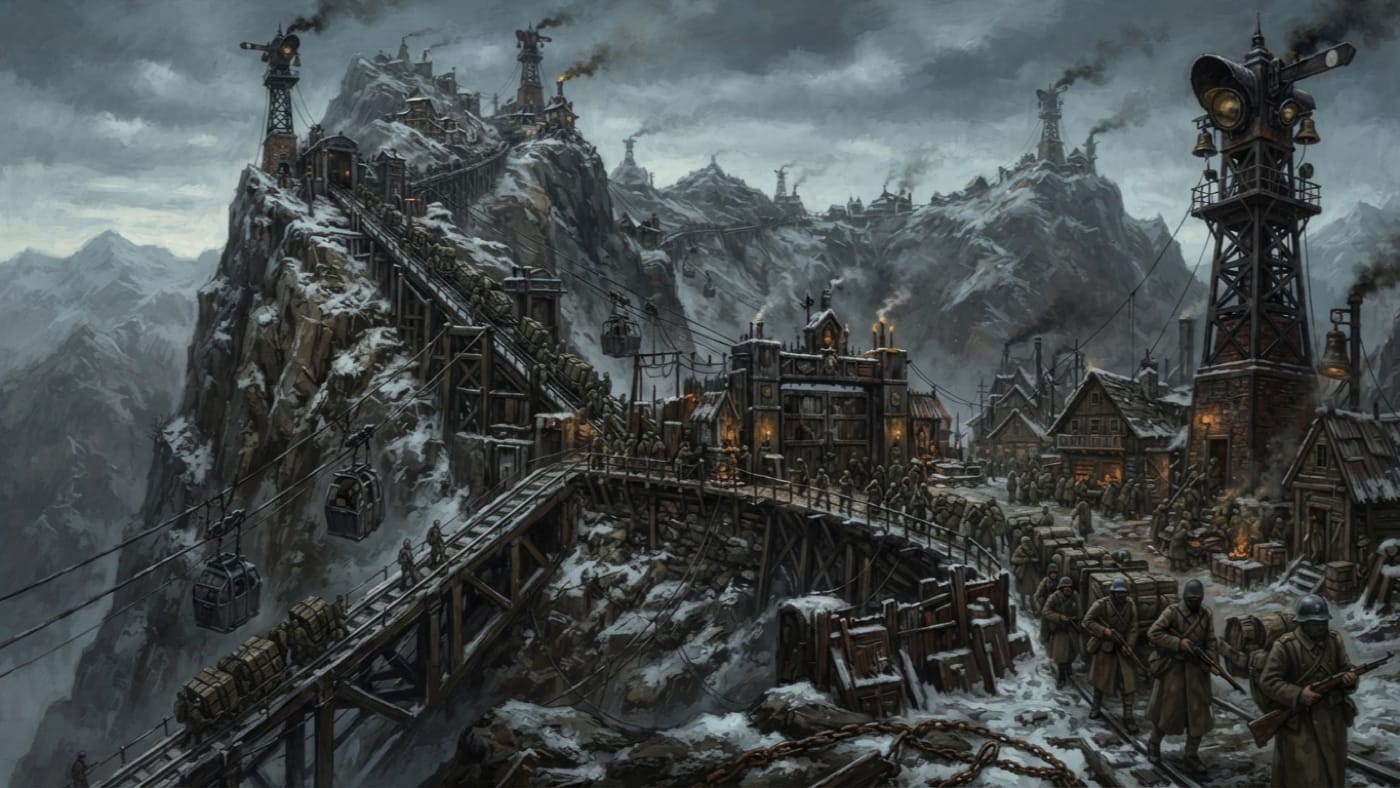
The Carpathian Passes registry now describes the approach roads as a licensed holy road under Bureau of Pilgrimage custody. They are policed by Peregrine Wardens, Route-Stampers, local bell-keepers and armed escorts. The Carpathian Corridor feeds the two mountain bastions by rail where rail can be laid, by road where it cannot, and by mule where the road gives up. Every transfer point is a place where freight stops. Every place where freight stops is a place where somebody charges for it to start again.
The Reliquary Switchbacks are the worked example. In the winter of A.S. 72 a convoy was lost in the passes. Two years later, in A.S. 74, the wartime logistics offices whose papers are now shelved under the Bureau of War carried out the Sixth Carpathian Route Audit. It chose a shepherd's track on a knife-ridge between 47° and 48° North and had it widened, because that track let relics climb toward the highland bastions without crossing the gold-corrupted basin routes below. The track rises two thousand feet in about four miles. Those are the corridor's figures. They do not measure the Highlands, and any clerk who multiplies them to estimate the range will be posted to a range.
In A.S. 76 an avalanche killed forty-seven porters and fourteen mules on what was then the Third Turn, and the first femur was driven into the shale. By A.S. 82 all eight principal turns had names and tolls. Formal Registry licensing came in A.S. 92, two years after the Concordat of Strasbourg gave the licensing offices a constitution to stand on.
None of this traffic moves blind. Above the roads stand the signal posts of the Beaconchain. A convoy on the ridges moves when the lights and bells allow it and waits in the snow when they do not.
#On the Inhabitants and Their Passage
The people of the Highlands are paid to keep other people moving: porters, mulewrights, rope-lift operators, shrine clerks, innkeepers, wax-workers, signal tenders, lantern mechanics and couriers. The old herding survives in the lower folds. The mountain grows almost nothing else they need. Food, lamp oil, rope, paper, iron fittings, wool and working mules come up from the basins. Whatever comes up is paid for twice, once in coin at the bottom and once in breath on the way.
Warmth is the real currency. On the Switchbacks the inns auction bunks by body heat, and a corner near the stove costs more than absolution. At Third Light, by its own account, rent is a shift rotation and heat is rationed oil. Cold stone, wet wool, pine tar and tallow smoke smell the same at every altitude. Nobody up there has been dry since the last thaw.
Authority is plural, which is how the Church prefers any place it cannot fully reach. On the Switchbacks, three offices divide one corridor:
- Registrar-Mother Elske Vane issues the Turn Licenses and Relic Handling Certificates.
- Warden-Captain Bronn of the Shrine-Court of Seven Nails enforces the court's dispensation. He also holds the keys to the locks on the Hanging Mile, a catwalk of iron bolted to a cliff, which can be sealed section by section at his discretion.
- Porter-Master Jaro "Knot" Ilwyn owns the labour. No porter works without a knot-mark card, and no card is issued without a winter debt pledge.
The corridor has roughly eleven thousand registered souls. That figure belongs to the Switchbacks alone. The rest of the Highlands has never been counted as one, and the Bureau of Records would like it known that this is a matter of discretion.
Third Light keeps its own law. Its Signal Office and Beaconmaster govern the relic-lanterns and the bell-signets, which are struck into the logs as sound-seals. They also govern the route permissions without which no caravan passes the Switchback Gate. That gate is the outpost's checkpoint and has nothing to do with the Summit Gate Reliquary of the corridor, however often pilgrims confuse the two in their prayers. By local testimony, late entries, corrected timestamps and lost pages are all for sale, and so are clearances. Error debt is paid off in night shifts and cliff work. Elsewhere on the Carpathian edge, the frontier town of Black-Snow Lor lives under a weather of its own, and its customs should not be carried uphill.
Survival on the heights depends on the porter who knows which step glazes first. Lawful passage depends on a clerk who has never seen the step. The Church finds the arrangement durable.
#On the Wind and the Opposing Heights
The mountains kill without help. Shale slides. Snow shelves let go. Steps glaze in the night, and the first porter of the morning finds out with his spine. Whiteouts arrive in minutes and stay for days. On the basalt ridges at Third Light, lightning walks the towerwork, and the outpost keeps a field of grounding chains to send it somewhere else. Every pilgrim road repeats the line that lightning takes only the impure. Third Light's own people call it a lie, and they have the burns to cite.
Then there are the reports. On the Switchbacks, the local name-wind is said to carry syllables. In A.S. 199 the Name-Drift was classified, or at least acknowledged. Since then the Registry has entered names after storms that its martyr list did not contain before. Witnesses describe whispering gusts, femur markers that vibrate and slate ink that bleeds into letters. The Bureau of Alchemical Standards puts the voices down to air passing through spires and hollow bone. The Blank Saints claim the Registry invents the names to create new tolls. Neither account has been proved, and the Registry's ledgers have been certified as in order.
At Third Light the fog is said to answer signals with altered timing: a bell returned half a beat late, a lantern glow that leans. In Carpathian redoubts, soldiers have reported mirror choirs that sing their own voices back to them, reversed. These are separate reports from separate posts. The Codex declines to marry them.
The enemy keeps its distance and its altitude. Opposite Przemyśl, Atheron's Pride presses the eastern heights, where standing is measured in elevation, spires and rank, and a man is tempted by the chance to look down. Opposite Sibiu, Velmora's Greed works the Transylvanian veins with gold, counterfeit relics and credit. A Registry that sells martyr-credits and a Guild that binds porters by debt need no help from her, and the Codex makes no such accusation. It notes only that she would approve. Fog from the Shipka theatre, where Syrion holds, sometimes climbs north into the passes. Some of the fog is only weather, which the Church finds almost as inconvenient.
#On the Present Condition
Traffic climbs. The Switchbacks stand at Amber, which means the relics move and the deaths stay under a threshold that is raised every year. The Passes registry reports counterfeit tokens, snow and strain on the convoys. By its own logs, Third Light is short of oil, lenses and people in roughly equal and worsening measure. When the oil runs out the ridge goes blind, and a blind ridge moves nothing.
Closures breed debt. When a summit gate seals, the inns fill, warmth goes up in price and winter pledges turn into service. Porters on the Switchbacks say the seals come earlier every year. The Registry records that they come when the weather requires. Both statements are on file.
The heights remain inhabited, licensed, tolled and only partly held. They belong to the Synod in the strict sense that the Synod issues their paperwork. In every other sense they belong to the mountain.