
#On the Square and the Hall
"A smile is a receipt." — Wexel proverb
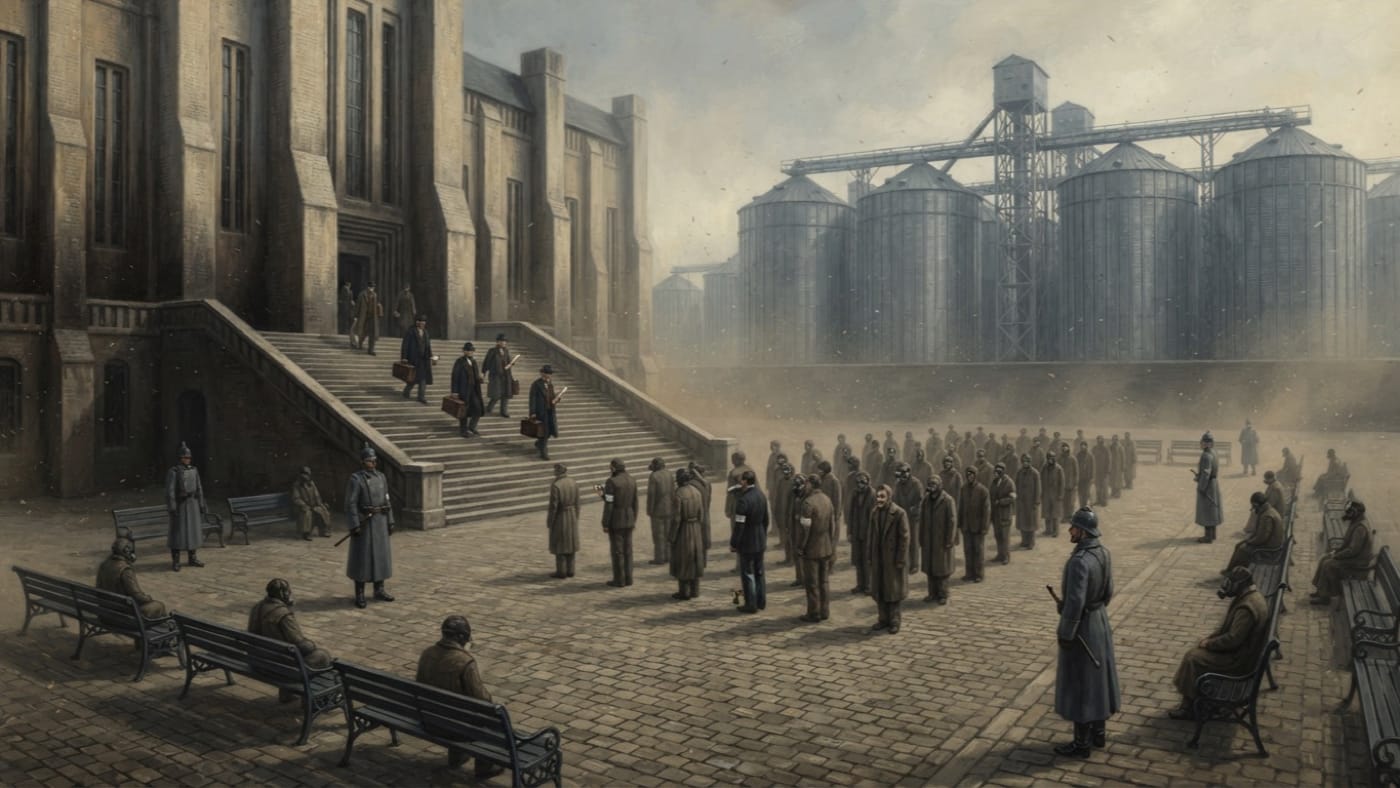
Parliament Square is the centre of the Grain-Gray Ration Parliament of Wexel, and the town arranges itself around it the way a tribunal arranges itself around the accused. The fourteen steel silos of the Silo Crown stand far out at the perimeter, joined by catwalks and gantries. From the square they are a ring of grey shoulders over the rooftops, close enough to hear and too far to lean on. Inside that ring, apart from the weighing at the Scale Gate and the trading at the Chit Market, lies the district where Wexel's numbers become official.
It smells of chalk, ink and boiled grain. The pale brick is dusted white to the height of a clerk's elbow. Clerks are the square's principal traffic. They carry quotas from the Parliament Hall of Measures to the offices around it and back again, at a pace meant to look diligent without ever looking hurried, since hurry is a mood. Runners carry slips sealed under tallow-wax. Provosts stand where the paths converge. Audit escorts cross with a citizen between them and nobody watches, which is the local manner of watching.
The Hall and the square are separate things, and I shall keep them separate, having once failed to. The Hall is the building: the quota-voting chamber, the master chalkboards, the confession booths, the dais, and beneath the dais the name drawer. The square is the open ground before it, where everything the Hall decides is carried out in public view. Around the Hall the Parliament keeps silent zones, where clerks may read figures aloud and nobody else may speak.
In my earlier dispatch on Wexel I wrote that the Ration Parliament meets daily "in Parliament Square — a chamber of pale brick and chalkboard walls."
Incorrect. The chamber of pale brick and chalkboard walls is inside the Parliament Hall of Measures. Parliament Square is the open district outside it. The same dispatch says so correctly three sections later. The Hieromnemon has weighed himself against himself and found in his own favour.
#On the Business of Noon
"Hunger hears everything." — Wexel proverb
The Parliament sits every day. The quota vote falls at midday. The bell sounds, bell-cards admit the members, and the square takes on the posture of a congregation awaiting a verdict it already suspects. On paper the Parliament is elected. In practice the Bureau of Records approves its candidates and the Bureau of Doctrine vetoes them. Whoever survives both is offered to the voters with the assurance that any ballot is acceptable, provided it is correct.
Inside, Speaker Huld Bex presides from the dais above his drawer. A name placed in the drawer is a name marked for audit, and the drawer opens when Bex decides it opens. The square sees only the result: a clerk coming down the Hall steps with a sheet, an escort stepping away from the wall, and a door somewhere in Wexel that will have a visitor before evening.
The figures come out next. Clerks chalk the new quotas onto the boards and carry the household schedules across the square toward the Ration Prefecture. There Prefect Marwen Kile decides how much grain each family receives, and whether the books will call it provision or clemency. Provision is owed to the family. Clemency is owed by it. That difference crosses Parliament Square in a clerk's satchel twice a day, and the clerk does not know which he is carrying.
The third current comes from Mirth Office Row, where Sister-Lector Neme Varr directs the Mirth Office and its inspectors. Her citations reach the square as paper and leave it as consequence. A mirth mark entered against a face becomes a fine. The fine is charged against the household's chits, against its coin if it has coin, and against its labour-hours if it has none. An unpaid fine becomes debt. Debt becomes a foreclosure writ, or a name payment offered to clear it, or an ash bill under flame seal for the Ash-Fine Marshals to collect in the Ash Fines District. None of the burning happens in the square. The square only does the arithmetic.
#On the Demonstration of Civic Joy
In A.S. 197, during my pastoral tour, the Ration Parliament honoured me with a demonstration of civic joy. Two hundred citizens were drawn up in rows in Parliament Square. At a signal they smiled. A clerk then went down the rows with a brass gauge, a small curved instrument hinged at one end, and set it against each mouth in turn to measure its curve.
I report what I saw. The rows held, and so did the smiles. The clerk worked steadily and without haste. Once the gauge had passed a mouth, I did not see that mouth move. Chaff blew across the front rank and settled on cheeks, and the cheeks did not twitch to shed it. I have reviewed processions in Strasbourg with less discipline in the ranks. I recall wishing the Strasbourg choir could be measured the same way.
The gauge belongs to the Mirth Office. The system it serves is Sister-Lector Varr's: the training, the citation schedules, the forty-three inspectors on the Row. She did not hold the instrument that day. A clerk held it. This distinction will matter to no one in the rows. I record it because it matters to the Ledger, which likes its hands identified.
The rules are simple. A smile that is too wide is cited as unearned joy, and one that is too narrow as ingratitude. Between the two lies the permitted band. I was told it is approximately three millimetres.
I measured. It is two.
I was shown no victims that day, and I was shown nothing I was not meant to see. I note only what the arithmetic implies. In front of a visiting Hieromnemon, any mouth outside two millimetres meant a citation. The citation meant a fine, and the fine could cost a household its grain for the week. The citizens knew this. When one Wexeler asks another how his mouth is today, the answer is a number, and the number is "Two." They had measured before I did.
The charter followed the Dust Fire, which killed three hundred and forty people in the wooden silos. The measure was declared temporary. Eighty-nine years later it is still temporary, under the same heading, and in A.S. 197 its joy discipline was performed in the town's most public place for an honoured guest.
#On Speech Returned by the Wind
"If the wind laughs first, don't answer with yours." — Wexel superstition
The square has one fault the Parliament cannot vote away. Its words do not stay in it.
The Chaff-Winds blow through Wexel all year, carrying grain dust and chaff and the knock of silo skins flexing in the gusts. They also carry speech. They take half-syllables from Parliament Square and return them from the Silo Crown. A clerk reading figures on the Hall steps may hear the end of his own sentence come back off the steel a moment later, from the wrong direction. Quotas spoken in the Hall repeat in its corridors with the clauses rearranged, sometimes as a question. The winds have got into the Hall's vents. The Hall is said to breathe dust through its floorboards when quotas change, and that chalk dust now gathers in its corners.
Sound travels inward too. Genuine laughter from Canalback, such as a cellar joke told under a floor on the canal's southern bank, can reach Parliament Square on a gust. It crosses the silent zones and the watched benches and arrives in front of the provosts with no mouth attached to cite.
The Bureau of Rites holds the disturbance at Category One, Localized Atmospheric-Acoustic. The classification commits the Bureau to nothing about how the wind works or who speaks through it, if anyone does. The square has no classification of its own. It is simply where the anomaly finds its largest audience.
#On the Square's Continuing Use
The reports sealed in A.S. 201 describe a square in ordinary use. Clerks still cross it with quotas, and the noon vote still falls. The benches still face the Hall, and the people on them still sit the way people sit in a queue for confession. The wind still takes the syllables. On the Row, the Mirth Office's citation ledgers still dry their ink into loops like smiles. The Office has gone back to paper because paper, at least, can be blamed.
The revenue holds. By the Bureau of Records' own accounting, mirth-compliance fees make up eleven percent of Wexel's municipal revenue. That figure is gathered from every ward of the town, and I credit none of it to the square in particular. The Bureau of Tithes collects and the Bureau of Purity files. The square is where the town is shown the bill.
Parliament Square is assessed as fit for purpose. Its purpose is to be crossed under observation, and in a long acquaintance with public ground I have found none better suited to it. The benches want repainting. The request has been filed as received.