
#On the Bill that Burns
"A joke can burn a house." — Wexel proverb, cited by the Mirth Office as evidence of public awareness
The Ash-Fine Marshals of the Grain-Gray Ration Parliament of Wexel describe themselves, on every form they issue, as a debt-collection service. This is accurate in the way a pyre is accurately described as a heating arrangement.
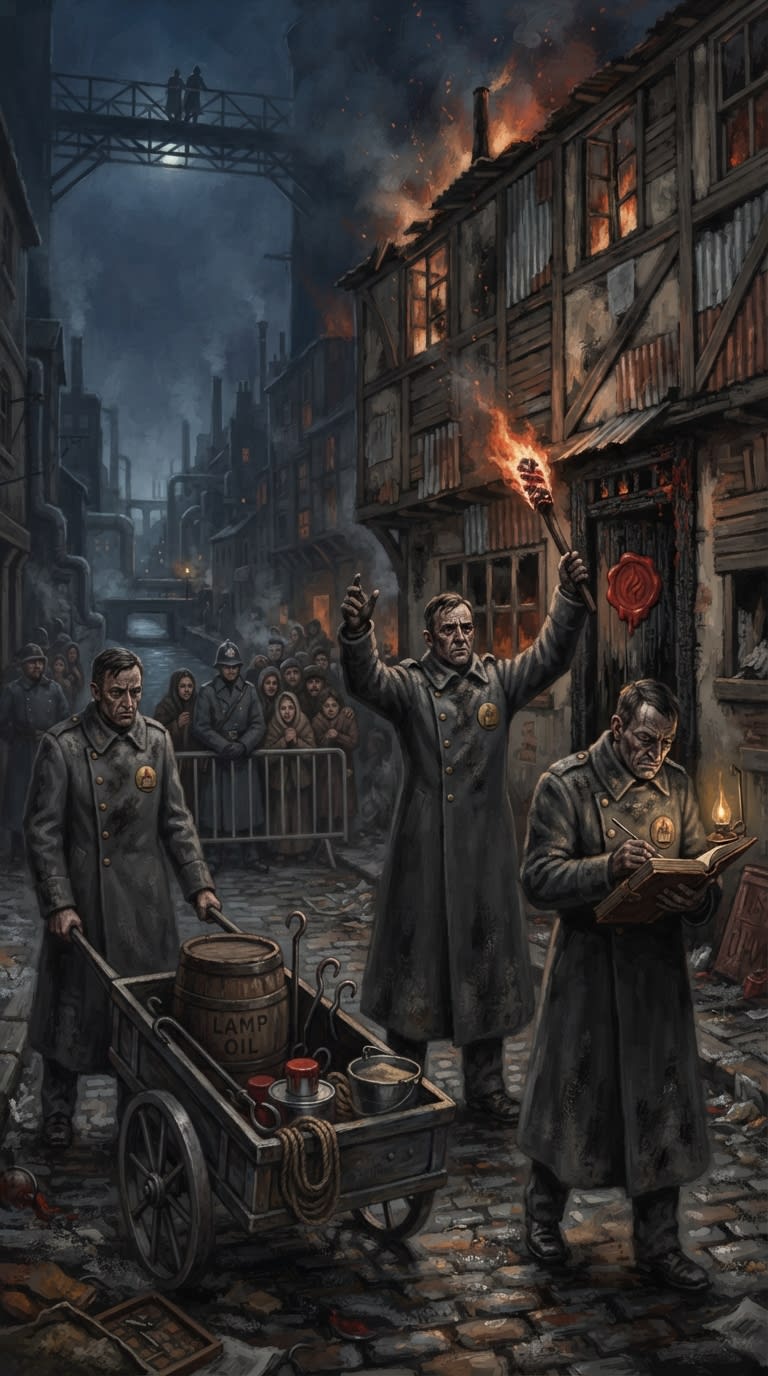
Their instrument is the ash bill: a foreclosure writ on grey ration paper, stamped at the foot with a flame seal in red wax. It names a household, a sum and a date. The sum is the household's fines added together: mirth citations, gratitude deficiencies, a child's laugh during ration issuance, three breaths of audible amusement at a funeral, all rolled forward, compounded and certified. The date is three days away. The household may pay in stamped pounds, in labour-hours, in chits, in lamp oil, or in names.
On the fourth day the Marshals arrive with torches and a cart, and the house is purified.
That is the entire procedure. I have read the regulation that governs it. It runs to nineteen pages, and eighteen of them concern the correct placement of the seal.
The Bureau of Records enters the event as "property purification." The Bureau of Tithes collects the land assessment on the cleared lot. That assessment is higher than the one on the occupied house, because an empty lot has been improved by the removal of its debtors. The family goes south to the Canalback Shacks, or into the Ash Fines District, or somewhere the Ledger does not trouble to record.
#On the Marshals and Their Implements
"Burn by invoice, sleep by bell." — Marshal barracks saying, chalked above the oil store
Do not picture soldiers. The Marshals are clerks who were issued fire. They wear long grey-black greatcoats that hold soot the way a cassock holds incense. On the left breast each wears the ash stamp, a brass disc showing a flame over an open ledger. It is the only insignia in the Heartlands I have seen townspeople cross a canal to avoid.
Their kit is short. Each man carries a tarred and wrapped torch. The handcart holds a cask of lamp oil, iron hooks, a writ-board, a tin of red wax, and a bucket of wet sand for the neighbours' roofs, since liability is a Tithes concern. A seizure clerk walks behind with the inventory book and prices the furniture before it goes into the cart. The value of a family's table is credited against the family's debt at the exact moment it stops being the family's table.
They patrol at night because the quiet-hour ordinances keep the streets empty, and an empty street reports nothing. The Silo Catwalk Choir reports everything. When smoke rises from a purification lot, its lookouts sing a designated verse so the town knows the fire is lawful and can go back to sleep.
I have been permitted to read nothing on the Marshals' origin. They appear in Wexel's papers after the Dust Fire of A.S. 112, once the Ration Prefecture had learned that fire could serve the town if it were properly filed. No charter has been produced for my inspection, and no founding year is claimed. The Marshals call their existence "continuous," which in Wexel is the word for anything nobody wishes to admit beginning. The Bureau of Purity holds no command over them and has never needed one. It supplied the vocabulary, and vocabulary is cheaper than a garrison.
Ration Prefecture circular, reissued annually: "The Ash-Fine Marshals conduct debt collection without punitive intent."
Corrected to read "without punitive accounting." No Wexel ledger has a column for intent, so the original claim could never be proved false. The Bureau of Records has asked that it stay in circulation on exactly those grounds.
#On the House as Collateral
"The ledger eats last." — Canalback proverb
The mechanism is patient. Sister-Lector Neme Varr's Mirth Office issues the citation: unearned joy, ingratitude, suspicious hesitation, atmospheric unease. The citation carries a fine. Prefect Marwen Kile has spent fifteen years reclassifying household provision as clemency, and clemency accrues. His Ration Prefecture adds the unpaid fine to a debt the family did not know it owed. Once the debt passes the Prefecture's schedule, it is transferred to the property. A house that cannot pay is turned into ash. Ash is assessed as land, and land is revenue.
Every step is lawful. Every step was voted.
Near the Chit Market I spoke with a Marshal, a narrow man with ink in the creases of his knuckles and soot in the creases of his neck. He called his work "closing the column" and appeared to hold no opinion of it. He had been a grain counter at the Scale Gate and transferred for the better ration. He showed me an ash bill already stamped for a house on Ash Fines Row. I asked whether the family had been told. He said the delivery clerk worked Tuesdays.
The payment in names deserves a paragraph of its own and will get one sentence here. A household may clear its bill by surrendering another household, whose name then goes into the drawer to wait.
#On Canalback and the Ash Fines District
The Ash Fines District is where the Marshals' work piles up: burned lots, foreclosed frames, doorways with the flame seal still nailed to what is left of the jamb. Canal runoff keeps the cinders wet, so the district smells of old smoke in every season, and a boot pressed into the ground comes up grey to the ankle. Its people are called the ash-fined. They have no house left for a citation to land on, so the next one lands on them.
The rest go to Canalback, on the canal's southern bank. It has algae, fever, cheap stew, and the joke sheets of the Cellar Circles, who call themselves the Quiet Mirth. They have learned something the Marshals have not: a purified house is an unwatched house. On Ash Fines Row, reclaimed lots host contraband feasts under half a roof, with honey, a stolen loaf, and an oil lamp shaded by a ration sack. No inspector audits a building the Ledger has already declared gone.
Resistance is rare, and when it comes it is public, which is what the Marshals fear most. Their standing trigger is a debtor who refuses out loud. One widow sat on her own doorstep through the fourth day with her ash bill folded into a paper hat. The Marshals purified the house around her. The Mirth Office fined the hat.
#On the Name Drawer
"Names are currency. Pay in people." — Canalback saying
Speaker Huld Bex keeps the name drawer and its key beneath the dais of the Parliament Hall of Measures. Names come in from Varr's citations, from Kile's clemency rolls, from the informants of the Chit Market and from frightened households paying in names. Some leave with clearance stamps and some with foreclosure writs. The rest go to the Marshals with no writ at all, only an address.
Canalback calls those fires ledger cleanses. The house burns, and so does whatever was inside it that should not have been there: a storeroom of sacks the Scale Gate never weighed, a grain counter's private tally, a cellar holding more than its allotment, a witness. Records enters each one as "property purification," in the same hand as all the others.
FOURTH-DAY RETURN, ASH-FINE SCHEDULE (recovered, scorched at margin): Parcel ██. Household ████. Writ: none. Instruction: "purify contents with structure." Contents: ██ sacks, unmarked, reconciled against ████████ surplus ledger. Ledger pages removed before purification by ████████. Receiving authority: ████████████. Route: ██████ corridor. Remainder: ash.
I have recorded before that Wexel grows more grain than it eats. I record now that the Marshals are sometimes sent to burn the places where the difference is written down. I have been instructed to leave the question of where the difference goes in the drawer. I have left it there, unlocked.
#On the Present Shortfall
The Bureau of Tithes' compliance note for A.S. 199 put arson-fine revenue at 4,200 stamped pounds, adjusted. That was three percent below projection, owing to "insufficient flammable housing stock in the Canalback sector." I have read a great many sentences in the Synod's service. Few were so honest by accident.
The shortage is built into the system. The Marshals burn faster than Wexel builds, and Canalback's shacks, patched with tin and wet reed, only smoulder when a torch touches them. The projections have not been lowered. In Wexel, projections only go up.
By A.S. 201 the Chaff-Winds have made the work humiliating. A purification is meant to be quiet. The wind lifts the writ clauses and returns them rearranged from the Silo Crown, so that "the household is purified" comes back as "the household purifies." It carries smoke into Parliament Square in the shape of the hour's laughter. Some of the ash-fined laugh at their own fires, because a burned house pays no rent and fears no further bill. The wind carries that sound farther than fear allows and sets it down in the Mirth Office Schoolhouse during recitation drill. The Marshals' seizure books have started drying with smiling loops down the inventory column. One return for a house on Ash Fines Row came back from the Records clerk with a loop beside every item, the house included.
Canalback's rumour is that Speaker Bex intends a purge by fire: one night, a great many bills, the drawer emptied at once. I have no document that confirms it. I do have the Marshals' oil requisition for the coming quarter, drawn on stores shipped in from the Palatine Switchyard of Lorn. It is four times the last one.