
"How's your mouth today?" — Wexel greeting; the correct answer is a number
#On the Row and Its Business
Mirth Office Row is the district of the Grain-Gray Ration Parliament of Wexel where amusement is received, weighed, written down and invoiced. The Mirth Office keeps its laughter inspectors and doctrine clerks here, along with its citation rooms. Whatever the town has done with its face during the week arrives here sooner or later as paper. Parliament Square votes the quotas. The Silo Crown holds the grain. The Row decides which households have enjoyed themselves beyond their means.
Wexel has eight districts. Seven of them smell of some kind of work: chalk, hot metal, onions, wet ash, algae, straw. The Row smells of incense and sour tea, which is to say it smells of people sitting down.
#On Incense, Tea and Glass
The Row lies on the flat floor of the basin, where the wind never stops counting and every halo of chaff drifts toward the silo ring. It is built from what Wexel builds with: pale brick, salvaged glass and tallow-wax at the seals. The older civic walls use the bone-lime mortar that the town prefers not to discuss at meals. The Bureau has never surveyed the street, and I decline to invent a survey for the reader. Its length is whatever distance an inspector can walk between two citations. Its boundaries lie where the incense gives out.
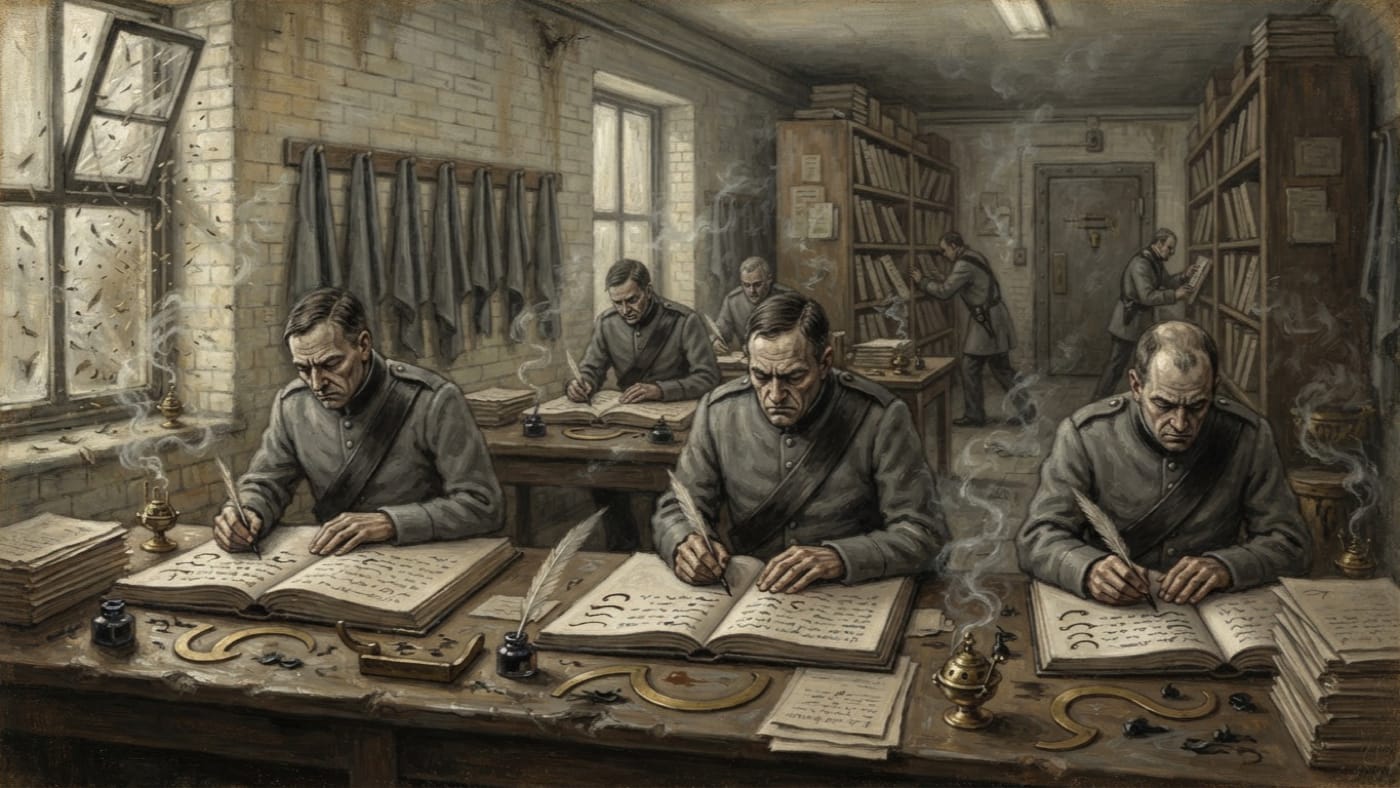
The citation rooms are furnished modestly and adequately. Grey sashes hang on pegs. Brass smile-gauges sit in trays beside the ink. These are the small curved rulers that the town calls joy gauges. Citation ledgers lie open, ready for entries. Household papers come in from the Chit Market, the Scale Gate and the canal steps, and they wait in stacks until an inspector finishes his tea. The incense never goes out. The clerks say it is for devotion. Grain dust has a smell too, and the incense covers it. A room that smells of the field reminds a clerk that somebody grew the bread.
The Office trains its inspectors at the Mirth Office Schoolhouse, which has the same incense and the same sour tea. A confession archive is said to be kept inside its walls. The Office has never given Records the Schoolhouse's address, and I will not supply one for it.
The glass rattles. It always rattles. In Wexel this counts as weather until it laughs.
#On the Citation and Its Household
The people an inspector watches call him count-cold, after how it feels to be looked at by him. He studies a face and judges its curve against the gauge. An experienced inspector can also judge it against his memory of the gauge. He brings the observation back to the Row, and a clerk writes it up as a joy citation.
The citation becomes a mirth mark, and the mark goes into the household ledger. From that point the consequences belong to other offices. Prefect Marwen Kile reduces the household allotment. Labor-hours are assigned. Debt builds up. Once the debt is due, the file passes to Speaker Huld Bex's audit name lists and to the Ash-Fine Marshals, who make their collections among the foreclosed homes and burned lots of the Ash Fines District. The clerks of the Row will tell you they have never set fire to anything. The Row only writes.
Mood confessions are attached to the same ledgers, and so are name payments. A citizen can clear a record by offering someone else for scrutiny. The Row accepts names as readily as labor-hours, and the second household gets an inspector where the first got a reprieve. Accounting, properly done, is conservation.
This is the Row's real accomplishment. Every week, at Mirth Rollcall, each household must report its gratitudes aloud. Gratitude that goes unheard counts as ingratitude, and ingratitude can be cited. But a mouth that gives thanks too warmly risks a mark for unlicensed mirth, because laughter permits are issued only for named events and an ordinary Tuesday is not one. So the citizen of Wexel must show the Office enough joy to prove obedience and too little to suggest pleasure. The face that manages this is called measure-face. People practice it in mirrors the way others practice their prayers.
The Cellar Circles, which Canalback calls the Quiet Mirth, keep jokes and coded proverbs alive in the undercellars and pass bread to households the Row has marked. They are hunted. Their best material reaches the Row only as citations, and a citation records the joke without its punchline.
#On the Emergency That Furnished the Rooms
Wexel was founded in A.S. 98 / 1808 CE, after a Hessian famine killed eleven thousand people and Records blamed their deaths on insufficient grain accounting. That date belongs to the town. I can certify no founding date for the Row, and I will not borrow one from a catastrophe simply because the catastrophe has a date.
The Dust Fire of A.S. 112 / 1822 CE killed three hundred and forty people and destroyed the wooden silos. Its aftermath produced the steel crown, the Ration Prefecture and the joy discipline, which was brought in to stop reckless behavior near grain dust. The discipline was a temporary measure, as emergency measures always are, and it has now been temporary for eighty-nine years.
The first preserved citation is Case 112-MO-44, filed six weeks after the fire. A mill hand named Orven Tesch was cited for laughing during the Silence Minute. He denied it, and twelve witnesses said they had heard nothing. He paid in labor-hours, and his household allotment was reduced for two weeks. It is the oldest case in the archive. The archive does not claim it was the first laugh the wind ever carried.
A Ration Prefecture bulletin of A.S. 113 / 1823 CE states that citations for wind-borne laughter began only after formal Mirth Office authorization.
Incorrect. The citations came four months before the authorization. The bulletin reversed the order so the fines would seem to obey the law that later permitted them. The Row's ledgers were not consulted at the time. They have been consulted since.
#On the Air in the Citation Rooms
The Chaff-Winds of Wexel are classed as a Category One atmospheric-acoustic disturbance. That classification applies to the wind. The Row has no hazard grade of its own, though its clerks would gladly accept one if it came with a stipend.
The wind comes into the citation rooms carrying chaff. It brings laughter in from the market and the canal, repeats it, rearranges what people said, and leaves it among the ledgers where an inspector has to hear it. The inspector cannot tell whose throat it came from. The Office cites a household anyway. Within a year of the Tesch case, the Row had begun recording airborne mirth. In time it was citing citizens for reactions they were judged likely to have had if the wind's provocation had gone on. The Row does not need a culprit. It needs an account number.
The ledgers answer back. Ink in the citation books dries into curved loops shaped like smiles: beside the charge, under the amount, in the margin where a clerk rests his thumb. The loops erase nothing, and they do not rewrite text the way Hungry Ink does. They only bend. I examined three such ledgers in A.S. 199. Every page had loops on it, and no two loops matched. One ran through the amount column of a widow's citation and bent a nine toward zero. A clerk corrected the figure, and the loop was back by evening.
The Office has protected its rooms with every measure the town could spare. Salt lines run across the thresholds. Wax plugs fill the keyholes. Inspectors wore joy masks during audits, so that the face issuing a citation could not itself be cited. None of it worked. Salt does not bind sound, wax does not stop weather, and the Row cannot afford to be seen with a masked inspector whose shoulders are shaking.
For a while the Office gave up paper altogether. The Ration Prefecture moved citations onto chalkboards, and the chalk dust settled into crescents. It tried slate, and the scratches curved. It tried reading citations aloud under the bell, and the wind sent each charge back with a laugh stuck in the middle. That ruined the solemnity of the sentence and made the accused look up.
#On the Present Condition
By A.S. 201 the Row has gone back to paper, because paper at least permits blame. Doctrine has stamped its approval and Records has filed the stamp, and the citation rooms are back to their usual work.
The inspectors leave each morning with their sashes and gauges and come back with faces. The tea is still brewed sour and the incense still burns. In Canalback, at the Chit Market and along the weighline, households keep reporting their gratitudes at Rollcall, aloud and in measure. The clerks of the Row keep entering them, sitting very straight, in fresh ink on good paper. Beside each entry the ink dries however it likes.