
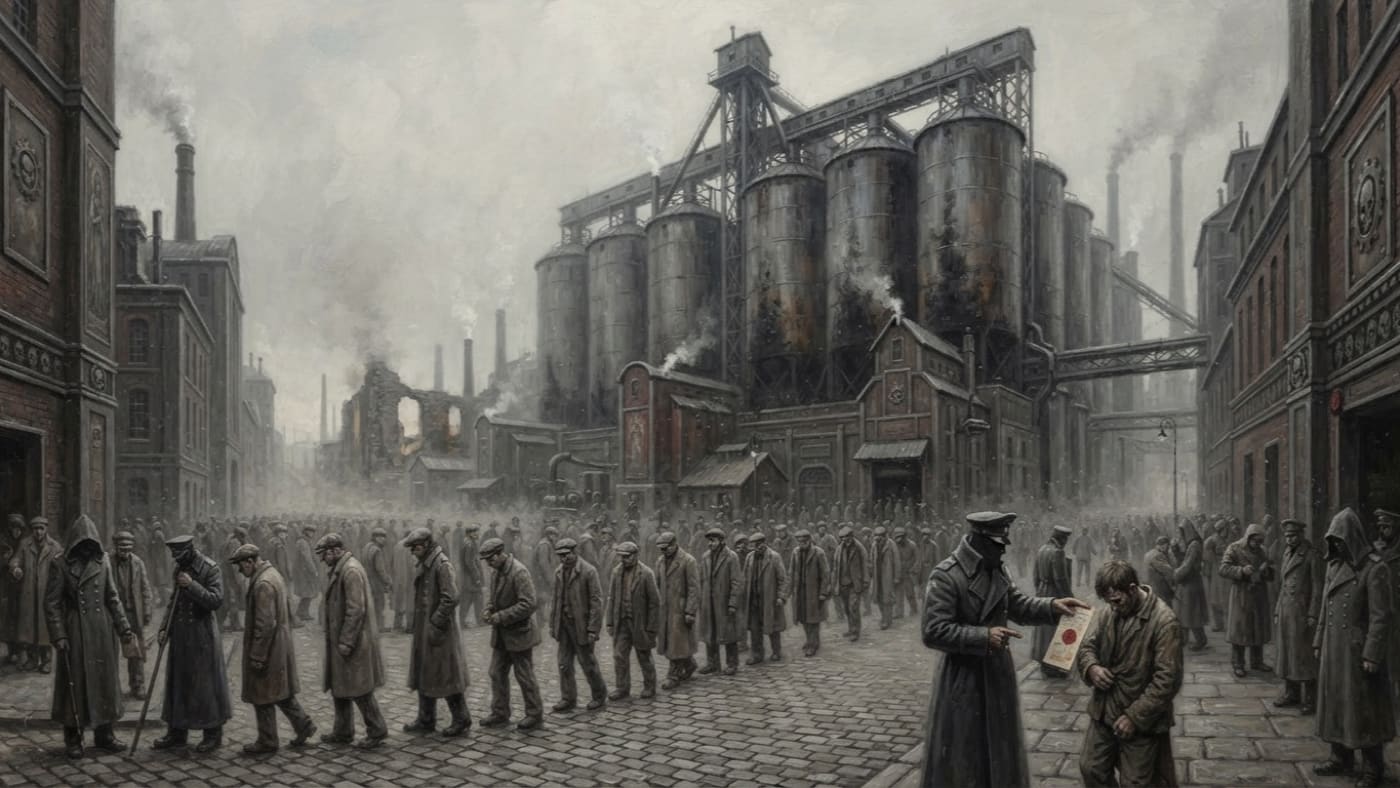
#On the Town Before the Fire
"Count the grain and the grain will keep." — Wexel saying, older than the steel
Wexel began as an answer to a corpse count. In A.S. 98, eight years after the Concordat of Strasbourg, a Hessian famine killed eleven thousand across three provinces. The Bureau of Records found the cause in insufficient grain accounting. Its remedy was a consolidation depot at a canal junction in the flat grain basin of the Heartlands. It came with one clerk, one stamp, and a mandate to count everything edible between the canal and the horizon.
Clerks breed. The depot acquired assistants, the assistants formed a committee, and the committee became a parliament. Well before anything caught fire, that parliament developed an appetite for taxing the emotions of the people it fed. The sources disagree by a year or two about when this appetite first found a schedule of fees. They agree that it came before the Dust Fire. I insist on the point because Wexel's later officers prefer a cleaner genealogy, in which joy was free until the silos burned and regulation arrived only as a grieving necessity.
In A.S. 110 the first silos rose on the site of a demolished pre-Synod harvest shrine. They were built of timber: plank walls, wooden chutes and floors soaked through with flour, the whole works breathing dust into the basin wind. A town built to prevent famine now kept its surplus in a box of kindling. No objection survives in the depot files. The forms for objection had not yet been printed.
#On the Dust Fire
The Dust Fire occurred in A.S. 112, when Wexel was fourteen years old. No record I have been permitted to read fixes the day, the month, the season or the hour, and I decline to invent one for the convenience of a calendar.
The record does fix the body count. A grain-dust explosion in the original wooden silos killed three hundred and forty people. The published account describes a column of flame visible from Lorn, which today lies a single day's rail transit away at the Palatine Switchyard. The report tells you something about the height of the flame and something about Lorn's signalmen, who apparently looked up from their manifests long enough to notice a town burning.
Grain dust is a patient fuel. Hung in the air of an enclosed timber structure, it needs only a spark. A working granary produces sparks the way a chapel produces coughing.
The Ledger's omissions are just as exact. It establishes no ignition source and names no culprit. No roll of the dead by name has reached any file I have examined. There was no rescue commander, and no engineering inquiry survives, if one was ever held. Three hundred and forty is a number with no faces attached, and Wexel has kept it that way with a care other towns reserve for relics.
The scorched foundations of the wooden silos survive. The Ledger acknowledges no memorial over them. The town keeps no feast and appoints no anniversary. Grey dust settles on blackened stone, and whoever is assigned to sweep it sweeps it off.
#On the Interpretation of the Dead
Records logged the dead. That is what Records does, and it did the work well: three hundred and forty entries were struck from the ration rolls, and their allotments were presumably reassigned with dispatch.
The Bureau of Doctrine then interpreted them. Doctrine announced that the explosion had been caused by reckless behaviour, and it said what it meant: singing, running, and the improper management of flour near open flames. Only one of these three is a fire hazard. The other two describe a choir and a child. Doctrine filed them together because they share a quality the Bureau finds more combustible than flour: nobody had authorized them.
No record I have seen shows that anyone sang, ran or mishandled flour at the moment of ignition. Doctrine did not need such a record. An interpretation is under no obligation to call witnesses.
The Bureau of Purity then took up the interpretation and widened it, as Purity widens anything left unattended on its desk. Singing became exuberance. Exuberance became vitality. Vitality became any unregulated expression of the human creature near a public good. The grain hazard was a matter of ventilation. The vitality hazard was a matter of discipline, and discipline, unlike ventilation, can be billed.
The Ration Prefecture was constituted within the month. It introduced joy discipline, the formal regulation of emotional display enforced through ration access and fines, as a temporary public safety measure. The parliament had taxed feelings before the fire. Afterward the taxation had a body count to stand behind, a Prefecture to run it, and a vocabulary borrowed from the fire marshal. A man who laughed too loudly was no longer merely impolite or underassessed. He was a spark.
Article IX is the most honest lie in the Heartlands. By denying the thing, it concedes it.
#On the Steel Replacement
Steel replaced the wooden silos. The Bureau of Engineering supplied the specifications, the Bureau of Tithes paid, and the Bureau of Rites consecrated the result with a hymn composed for the occasion. The hymn was so joyless that the choir wept. Rites entered the weeping into the record as evidence of appropriate devotion.
I cannot tell you how long construction took, when the last plate was fixed, which foundries supplied the metal, or what the engineers changed beyond swapping one material for a less flammable one. The files are silent. Older inventories put the whole replacement inside A.S. 112, but they rest on nothing I would sign. The steel came in the aftermath, and that is as far as the evidence goes.
Fourteen towers now ring Wexel. No document I have examined records how many wooden silos came before them, or how many burned. The temptation to say fourteen and fourteen is strong, tidy and unsupported.
The physical remedy was finished. The steel went up, the hymn was sung, and the choir dried its eyes. By every engineering standard the Synod recognizes, the hazard that killed three hundred and forty people had been addressed. The administrative remedy was never finished, because it was never designed to finish. A silo can be completed. A temporary measure cannot.
#On the First Preserved Citation
Six weeks after the fire, still in A.S. 112, the new machinery produced the earliest citation that survives: Case 112-MO-44. Orven Tesch, a mill hand, was fined for laughing during the Silence Minute before the noon ration. Tesch denied laughing. Twelve witnesses denied hearing him laugh. He paid in labour-hours, and his household allotment was reduced for two weeks.
Six weeks earlier the town had lost three hundred and forty people. Its first preserved act of emotional enforcement took bread from a household on the strength of a laugh that thirteen people swore never happened. The file does not say whether Tesch's household was large or small, or whether he had ever worked the silos that burned. The Prefecture had no need to know. It needed the fine.
Beside the entry, in the same ledger, sits a loop of dried ink curved like a mouth. The next seventeen entries smile too. What the loops are belongs to the Chaff-Winds of Wexel and the Category One file that governs them. I will not rule here on whether they began on that page, before it, or in some unrecorded gust years earlier. The first preserved instance is only the first preserved instance. It is not a birth certificate.
The Mirth Office followed within the year. Citations had begun four months before its formal authorization, and the authorization was then backdated. Enforcement came first, permission second, and a date covered the gap.
Later, the Ration Parliament amended its fines schedule to class wind-borne laughter as a civic hazard equal to open flame near grain dust. Records accepted the fee structure, and Doctrine endorsed it. With that amendment, the language of the Dust Fire finished its migration. It moved from the silo floor into the charter, then into every citizen's throat, and finally into the air itself.
An A.S. 113 Ration Prefecture bulletin states that mirth citations began only after formal Mirth Office authorization.
Incorrect. Citations began four months before authorization, and the authorization was then backdated to come before them. The bulletin was right about the paperwork and wrong about the world. Wexel has never found that distinction troubling.
#On the Measure Still in Force
Eighty-nine years have passed. Joy discipline remains in force and, on every instrument that names it, remains temporary. The Prefecture still administers allotments, and the Mirth Office still writes citations. During my A.S. 199 examination, the Bureau of Records' own accounting put mirth compliance fees at eleven percent of the town's municipal revenue. The figure belongs to this century and says nothing about the fire year. It does explain why no one in Wexel has drafted the rescission.
The steel crown does not burn. The basin wind still moves through it, carrying dust, chaff and, on certain days, laughter that nobody admits to making. The Chaff-Winds remain Category One. Return to the Grain-Gray Ration Parliament of Wexel and you will find the scorched foundations still unmarked, the Silence Minute still observed, and Case 112-MO-44 still upheld.